6th Grade Percent Problems Explained: The 3 Types Every Student Must Master
Struggling with 6th grade percent problems? Learn the three types every student must master, simple solving strategies, and how interactive lessons make percentages click.
Why Percentages Matter More Than Ever for 6th Graders
Your 6th grader is stepping into mathematical territory that will follow them for life. From calculating restaurant tips to understanding sale prices, from analyzing sports statistics to managing future finances, percentages are everywhere.
Yet many parents feel a wave of uncertainty when their child brings home percent word problems. Maybe you learned percentages differently decades ago, or perhaps the problems seem more complex than you remember. The good news? Once you understand that every percent problem falls into one of just three categories, the entire topic becomes manageable.
In this guide, we'll break down 6th grade percent problems explained in a way that makes sense. You'll learn the simple question your child should ask before every problem, discover real-world examples that make percentages click, and see how interactive lessons can transform confusion into confidence.
Whether your child is preparing for upcoming tests or struggling with homework tonight, this guide gives you the tools to support them without needing to be a math teacher yourself.
What Are the Three Types of Percent Problems?
Here's a secret that transforms percent problems from overwhelming to organized: every single percent problem asks your child to find one of just three things.
Type 1: Finding the Part
These problems give your child the whole amount and the percent, asking them to find the part.
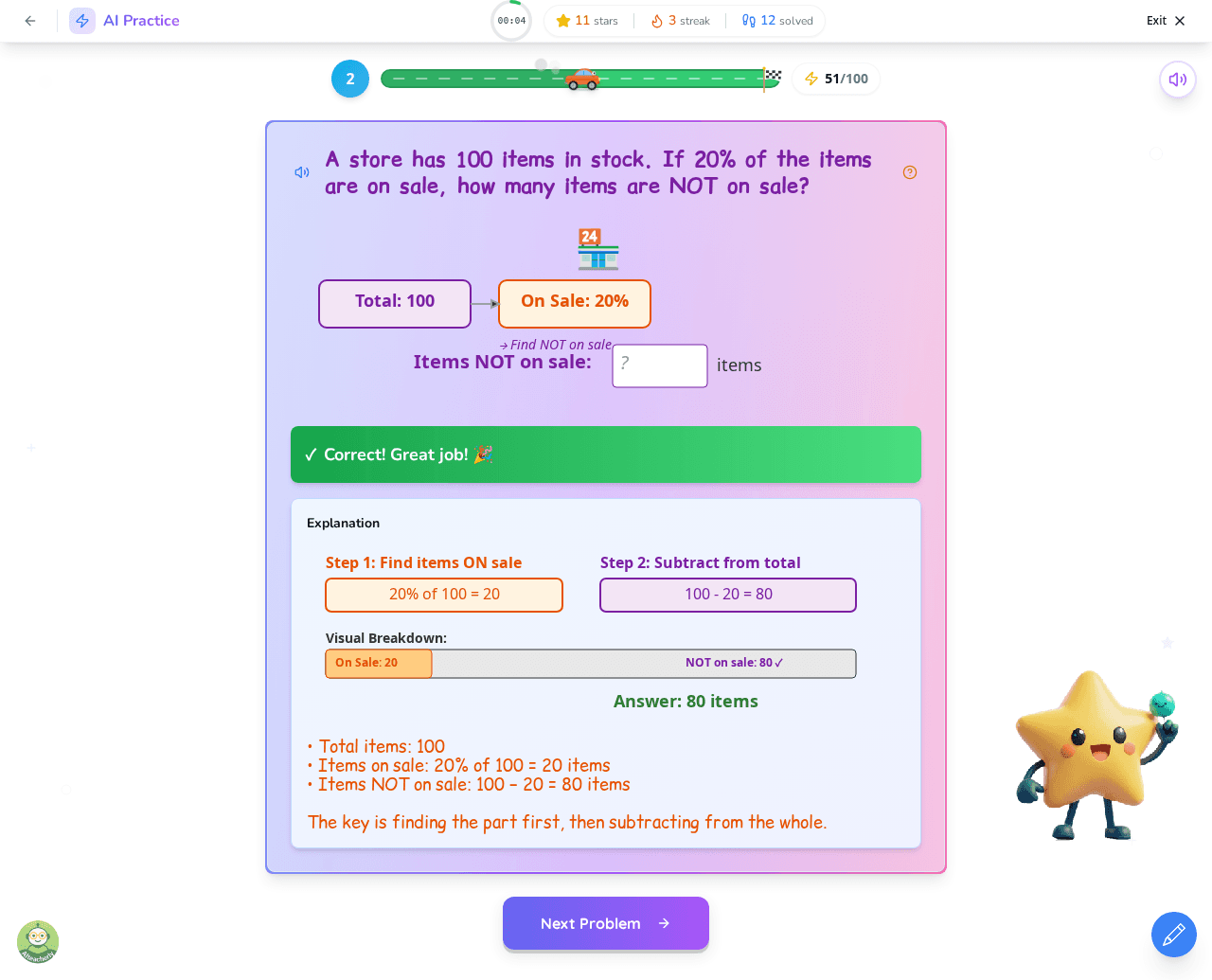
Example: "A store has 200 items. If 35% are on sale, how many items are on sale?"
The formula: Whole × Percent (as decimal) = Part
Type 2: Finding the Percent
These problems give your child the part and the whole, asking what percent one represents of the other.
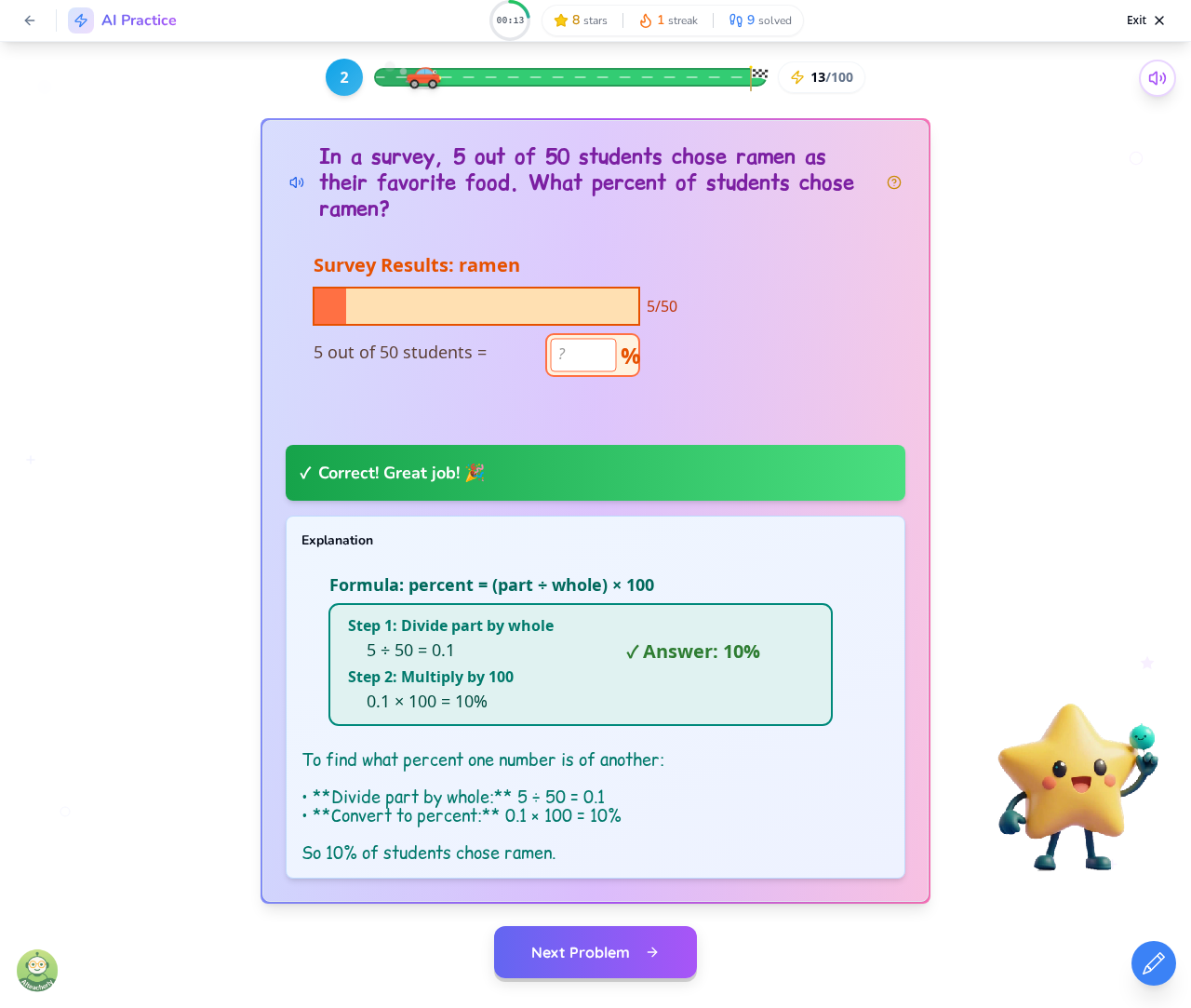
Example: "In a survey, 18 out of 60 students chose pizza as their favorite food. What percent chose pizza?"
The formula: Part ÷ Whole = Percent (as decimal)
Type 3: Finding the Whole
These problems give your child a part and a percent, asking them to find the original whole amount.
Example: "Marcus saved $45, which is 30% of his goal. What is his total savings goal?"
The formula: Part ÷ Percent (as decimal) = Whole
The key strategy? Before solving any problem, teach your child to ask: "What am I solving for: the part, the percent, or the whole?" This single question eliminates most confusion and points directly to the right approach.
How Do You Find What Percent One Number Is of Another?
Finding what percent one number is of another is one of the most common percent problems in 6th grade math. The approach is straightforward once your child understands the relationship between parts and wholes.
The Formula: Percent = Part ÷ Whole × 100
Step-by-Step Process:
- Identify the part (the smaller amount being compared)
- Identify the whole (the total amount)
- Divide the part by the whole to get a decimal
- Multiply by 100 (or move the decimal point two places right) to convert to a percent
Real Example: In a class survey, 24 students out of 80 chose science as their favorite subject. What percent chose science?
- Part = 24 (students who chose science)
- Whole = 80 (total students surveyed)
- 24 ÷ 80 = 0.30
- 0.30 × 100 = 30%
The interactive problem below shows exactly how students work through this type of calculation step by step.
Pro Tip for Parents: Remind your child that the whole is always the "total" or "original" amount. If the problem mentions "out of" something, the number after "out of" is typically the whole.
How Do You Find the Whole When You Know the Part and Percent?
This is often the trickiest percent problem type for 6th graders because it requires working backwards. Instead of multiplying, your child needs to divide.
The Formula: Whole = Part ÷ Percent (as decimal)
Step-by-Step Process:
- Convert the percent to a decimal (divide by 100 or move decimal two places left)
- Divide the part by that decimal to find the whole
Real Example: Emma saved $63, which is 45% of her goal for a new bicycle. What is her total savings goal?
- Part = $63 (amount saved)
- Percent = 45% = 0.45 (as a decimal)
- $63 ÷ 0.45 = $140
Emma's total savings goal is $140.
Why This Trips Up Students: Many 6th graders instinctively want to multiply when they see percentages. The key insight is understanding that the whole is always larger than the part. If your child's answer is smaller than the part they started with, they likely multiplied when they should have divided.
Quick Check Strategy: Teach your child to verify their answer: Does 45% of $140 equal $63? (0.45 × $140 = $63 ✓)
This backward-checking method builds mathematical confidence and catches errors before they're submitted.
Real-World Percent Problems Your Child Will Actually Use
One of the best ways to make percentages meaningful is connecting them to situations your child encounters in real life. These aren't just test problems; they're life skills.
Shopping and Discounts
"Those sneakers are 25% off the original $80 price. How much will you save?"
This is a "finding the part" problem: $80 × 0.25 = $20 savings
Restaurant Tips
"The bill is $45. How much is a 20% tip?"
Another "finding the part" problem: $45 × 0.20 = $9 tip
Savings Goals
"You've saved $75, which is 60% of your goal for that video game. What's the total price?"
This is a "finding the whole" problem: $75 ÷ 0.60 = $125 total
Sports Statistics
"A basketball player made 18 free throws out of 25 attempts. What's their free throw percentage?"
This is a "finding the percent" problem: 18 ÷ 25 = 0.72 = 72%
Survey Data
"In a poll, 156 out of 400 people preferred Brand A. What percent preferred Brand A?"
Another "finding the percent" problem: 156 ÷ 400 = 0.39 = 39%
Parent Tip: Look for percent opportunities during everyday activities. Grocery shopping, restaurant visits, and sports events all offer natural practice moments that don't feel like homework.
See How Interactive Percent Lessons Work
Traditional worksheets present percent problems as static text, but interactive lessons transform the learning experience. When students can manipulate visual elements, receive immediate feedback, and work through guided steps, concepts stick better.
On platforms like AI Teacherly, the Finding Percent Relationships lesson for 6th grade breaks down each problem type with:
Visual Problem Breakdowns Students see problems with clear visual cues highlighting which number is the part and which is the whole. This visual scaffolding helps students identify problem types before they even begin solving.
Step-by-Step Guidance Rather than jumping straight to answers, interactive lessons walk students through each step: identifying the problem type, setting up the equation, and checking the answer.
Real-World Contexts Problems use scenarios students care about: surveys about favorite foods, savings goals for things they want, store inventory situations they can relate to.
Immediate Feedback Students know instantly whether they're on the right track, allowing them to catch mistakes and understand where their thinking went wrong.
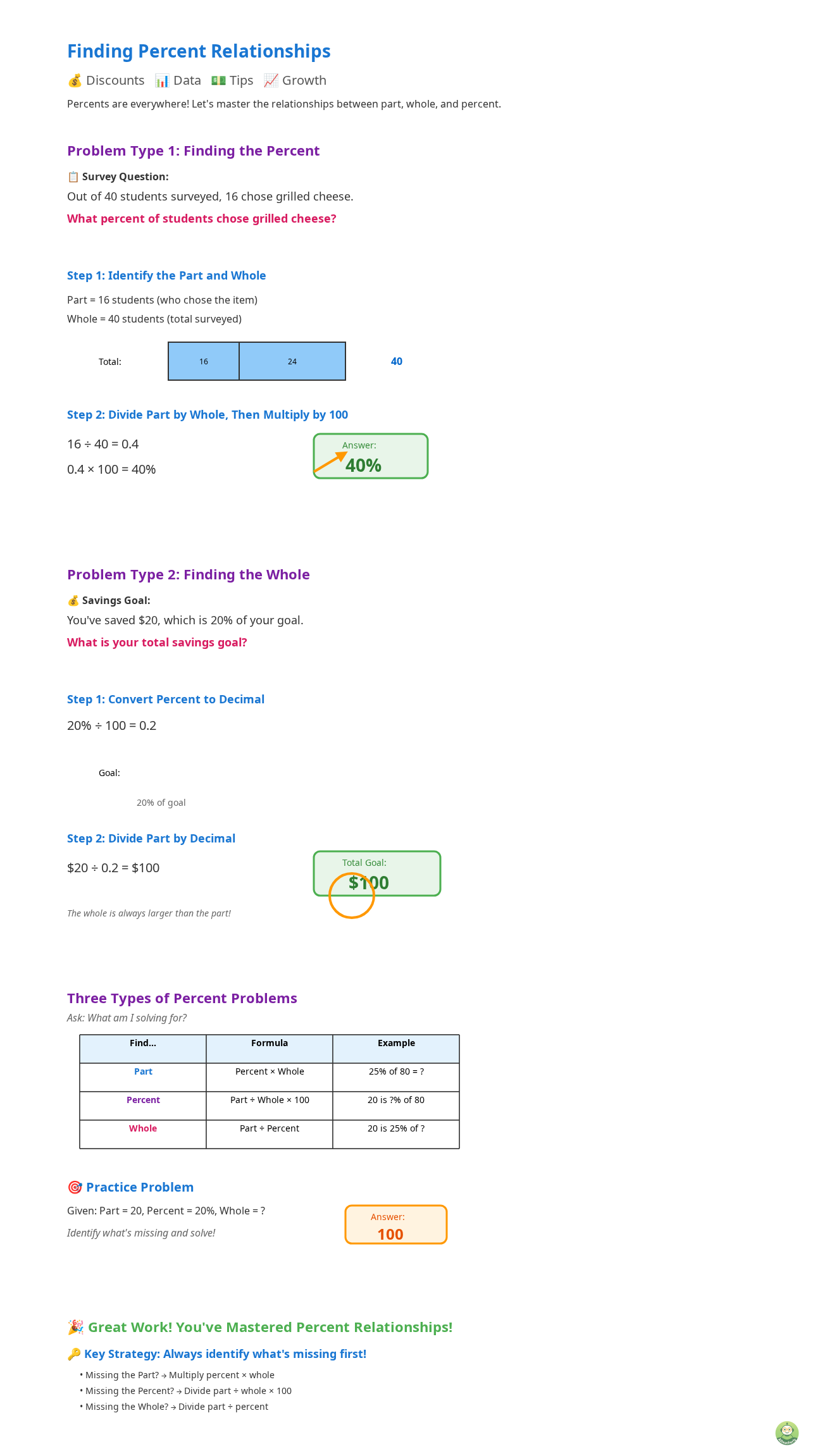
Here's what the full interactive lesson looks like on AI Teacherly:
The combination of visual learning, guided practice, and real-world contexts makes abstract percent relationships tangible and memorable.
Common Mistakes in Percent Problems (And How to Fix Them)
Understanding where 6th graders commonly stumble helps you provide targeted support. Here are the most frequent errors and how to address them:
Mistake 1: Forgetting to Convert Percents to Decimals
The Error: Writing 25% as 25 in calculations instead of 0.25
The Fix: Practice the conversion separately. "Move the decimal two places left" or "divide by 100." Quiz your child: "What's 45% as a decimal?" until it's automatic.
Mistake 2: Multiplying When They Should Divide
The Error: When finding the whole, students multiply instead of divide, getting an answer smaller than the part.
The Fix: Use the "whole is larger" check. If searching for a whole and the answer is smaller than the part, something went wrong.
Mistake 3: Mixing Up Part and Whole
The Error: Dividing whole by part instead of part by whole when finding a percent.
The Fix: Circle or highlight which number is the part (being compared) and which is the whole (total amount) before calculating.
Mistake 4: Not Checking Answers
The Error: Submitting answers without verification, missing obvious errors.
The Fix: Teach the reverse-check habit. If they found that 30% of something is $45, multiply to verify: Does the whole × 0.30 = $45?
Mistake 5: Misreading Word Problems
The Error: Jumping to calculations before understanding what the problem asks.
The Fix: Always start with the question: "What am I solving for?" This forces careful reading before calculating.
Key Takeaways
- Every percent problem asks for one of three things: the part, the percent, or the whole. Teach your child to identify which type before solving.
- The key question strategy works: 'What am I solving for?' eliminates most confusion instantly.
- Finding a percent means dividing the part by the whole, then multiplying by 100.
- Finding the whole requires dividing the part by the percent (as a decimal). Remember: the whole is always larger than the part.
- Real-world connections make percentages meaningful. Look for practice opportunities in shopping, tipping, and sports.
- Interactive lessons with visual scaffolding and immediate feedback help concepts stick better than static worksheets.
- Common mistakes include forgetting decimal conversion and multiplying when they should divide. Teach the reverse-check habit to catch errors.
Frequently Asked Questions
What are the three types of percent problems in 6th grade math?
The three types are: finding the part (given whole and percent), finding the percent (given part and whole), and finding the whole (given part and percent). Every percent word problem falls into one of these categories.
How do you find what percent one number is of another?
Divide the part by the whole, then multiply by 100. For example, to find what percent 24 is of 80: 24 ÷ 80 = 0.30 × 100 = 30%.
How do you find the whole when given a part and percent?
Convert the percent to a decimal, then divide the part by that decimal. For example, if $45 is 30% of the total: $45 ÷ 0.30 = $150 total.
Why does my child struggle with percent word problems?
Most students struggle because they jump to calculations before identifying the problem type. Teaching them to first ask 'What am I solving for?' significantly reduces confusion and errors.
What is the formula for calculating percent?
The basic formula is: Percent = (Part ÷ Whole) × 100. Rearranged to find the part: Part = Whole × Percent. To find the whole: Whole = Part ÷ Percent.
When do kids learn percentages in school?
Students typically begin learning basic percentages in 5th grade and master percent relationships, including all three problem types and real-world applications, in 6th grade as part of proportional reasoning.
How can I help with percent homework without giving away answers?
Ask guiding questions: 'What type of problem is this?' 'Which number is the part?' 'Should you multiply or divide?' These prompts build thinking skills without doing the work for them.
What real-world examples help kids understand percentages?
Discounts while shopping, calculating tips at restaurants, sports statistics, savings goals, and survey results all provide relatable contexts that make percent problems meaningful and memorable.
Ready to see percent problems click for your 6th grader? Try the interactive Finding Percent Relationships lesson free on AI Teacherly and watch confusion turn into confidence!