Division Remainders Made Easy: 3 Strategies Every 4th Grader Needs to Master
Discover the 3 simple strategies that transform division remainder confusion into confident problem-solving. A practical parent's guide with real-world examples for 4th grade math success.
When Getting the Math Right Still Gets the Answer Wrong
Picture this: your 4th grader works through a division problem carefully, shows all their work, and gets 47 ÷ 5 = 9 R2. The math is perfect. But when they write "9 buses" as their answer to how many buses are needed for a field trip, the teacher marks it wrong.
Sound familiar? You're not alone. Division remainders in 4th grade word problems are one of the most misunderstood concepts in elementary math. The frustrating part? It's not a calculation problem; it's a thinking problem.
Here's the secret that many parents don't realize: there are actually three different ways to handle remainders, and the right choice depends entirely on what the word problem is asking. Once your child understands this framework, those confusing "leftover" problems suddenly make sense.
In this guide, you'll discover the three remainder strategies that transform confusion into confidence, learn how to help your child identify which strategy to use, and see real examples from interactive lessons that make these concepts click.
What Are Division Remainders and Why Do They Confuse Kids?
Before we dive into strategies, let's understand what we're dealing with. A remainder is simply what's "left over" when a number doesn't divide evenly. When your child solves 47 ÷ 5, they get 9 groups of 5 (which equals 45) with 2 left over.
In basic division practice, kids just write "R2" and move on. But division word problems in grade 4 require something more: they need to figure out what that remainder means in real life.
Consider these three problems:
- 47 students need buses that hold 5 each. How many buses? (Answer: 10 buses)
- 47 stickers shared among 5 friends equally. How many each? (Answer: 9 stickers each)
- 47 students form teams of 5. How many students won't have a team? (Answer: 2 students)
All three problems use 47 ÷ 5 = 9 R2, but each has a different correct answer! This is where kids get stuck. They've been trained to find "the answer," but now the same math gives three different answers depending on context.
Why does this confuse 4th graders?
- They're used to math having one right answer
- Word problems require reading comprehension AND math skills
- Remainders feel "unfinished" or "wrong" to kids who like neat solutions
- Many haven't learned to ask "what makes sense in real life?"
The good news? Once kids learn the three remainder strategies, they have a reliable framework for any word problem thrown their way.
The 3 Remainder Strategies Every 4th Grader Must Know
Here's the framework that transforms remainder confusion into confident problem-solving. Teach your child these three strategies, and they'll have a tool for any interpreting remainders question they encounter.
Strategy 1: Round Up (No One Left Behind!)
When to use it: When nothing can be left out or left behind.
Example: 47 students need buses that hold 5 each. How many buses are needed?
- Calculation: 47 ÷ 5 = 9 R2
- Thinking: "We can't leave 2 students behind! We need one more bus."
- Answer: 10 buses
This strategy applies to situations involving transportation, seating, containers for fragile items, or anything where everyone/everything MUST be included.
Strategy 2: Drop It (Only Complete Groups Count)
When to use it: When only complete, full groups matter.
Example: A baker has 47 cookies and puts 5 in each gift bag. How many complete gift bags can she make?
- Calculation: 47 ÷ 5 = 9 R2
- Thinking: "She can only sell complete bags. The 2 leftover cookies don't make a full bag."
- Answer: 9 gift bags
Use this strategy for packaging, team formation, recipes that need exact amounts, or any situation where partial groups don't count.
Strategy 3: Use It (The Remainder IS the Answer!)
When to use it: When the question specifically asks about what's left over.
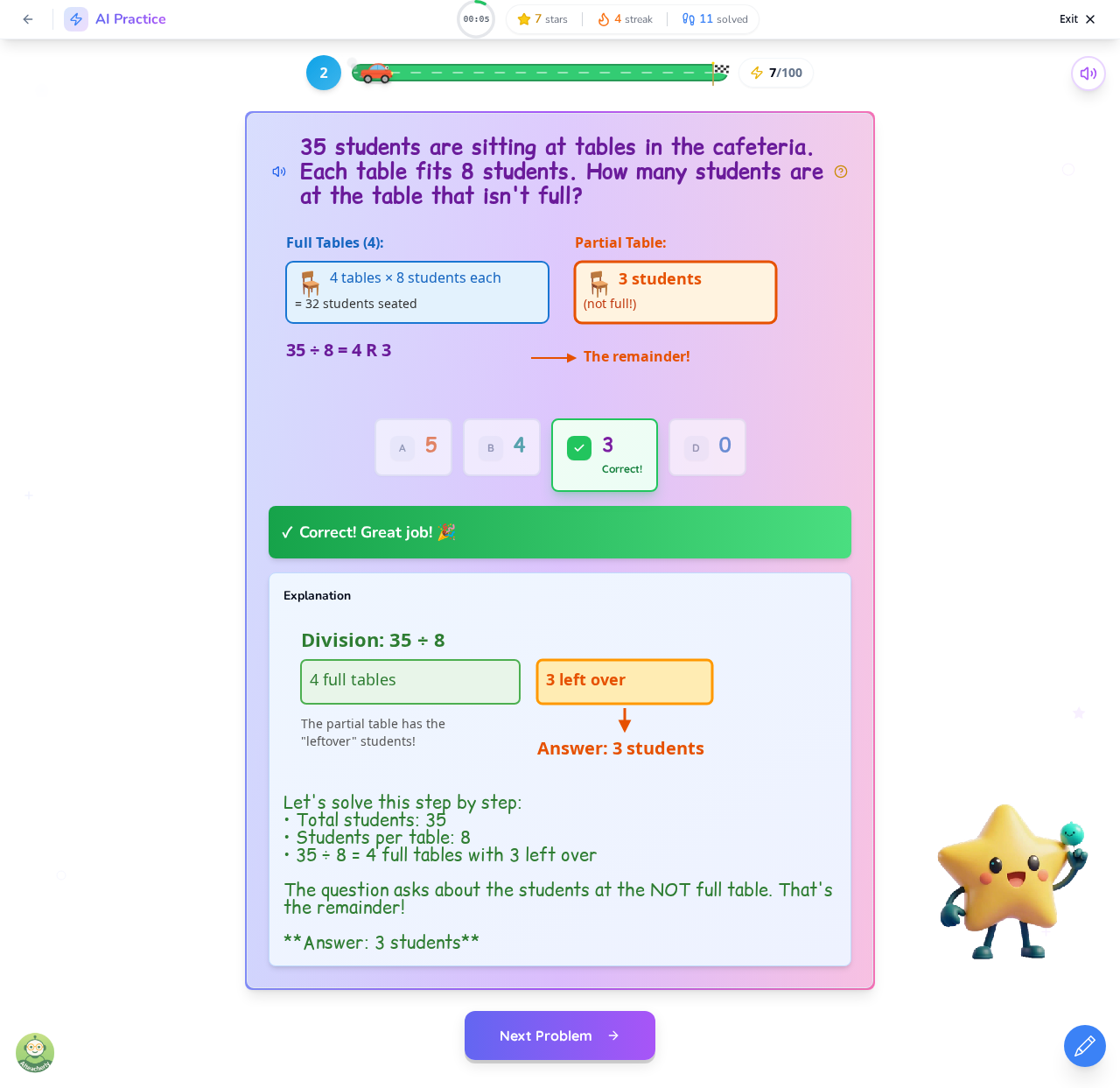
Example: 47 students form teams of 5. How many students will be left without a team?
- Calculation: 47 ÷ 5 = 9 R2
- Thinking: "The question asks how many are LEFT. That's the remainder!"
- Answer: 2 students
The interactive problem below shows exactly how this "use the remainder" strategy works in practice with a relatable cafeteria scenario.
How Do I Help My Child Choose the Right Strategy?
The secret to teaching remainders to 4th graders is helping them become word problem detectives. Here's a simple decision guide you can practice together:
Step 1: Solve the division first Get the quotient and remainder. Don't worry about interpretation yet.
Step 2: Re-read the question carefully Circle or underline exactly what's being asked. This is where most mistakes happen; kids solve correctly but answer the wrong question.
Step 3: Ask the magic question: "What makes sense in real life?"
Use these detective questions with your child:
| If the question involves... | Ask your child... | Strategy |
|---|---|---|
| Transportation, seating, containers | "Can we leave anyone/anything behind?" | Round Up |
| Complete groups, packaging, equal sharing | "Do incomplete groups count?" | Drop It |
| "How many left?" or "How many remaining?" | "Is the leftover the actual answer?" | Use It |
Practice script for parents:
"Let's be word problem detectives! First, what's the math asking us to divide? Good. Now let's re-read and circle what the question wants. Okay, now the big question: in real life, what makes sense here? Would we leave someone behind? Or are they asking about what's left over?"
With consistent practice, your child will internalize these questions and start asking them automatically.
See Division Remainders in Action on AI Teacherly
Learning remainder strategies for kids becomes much easier when children can interact with real-world scenarios rather than just reading about them. On AI Teacherly, the Division Word Problems: Interpreting Remainders lesson brings these concepts to life.
Here's what makes interactive practice different from worksheets:
Visual storytelling: Instead of abstract numbers, kids encounter relatable situations. They're helping plan field trips, organizing cafeteria seating, and figuring out gift bags for parties. The scenarios make abstract math feel relevant and engaging.
Immediate feedback: When your child chooses "9 buses" instead of "10 buses," they don't just see a red X. They understand why that answer doesn't work in context. This builds the critical thinking that worksheets can't replicate.
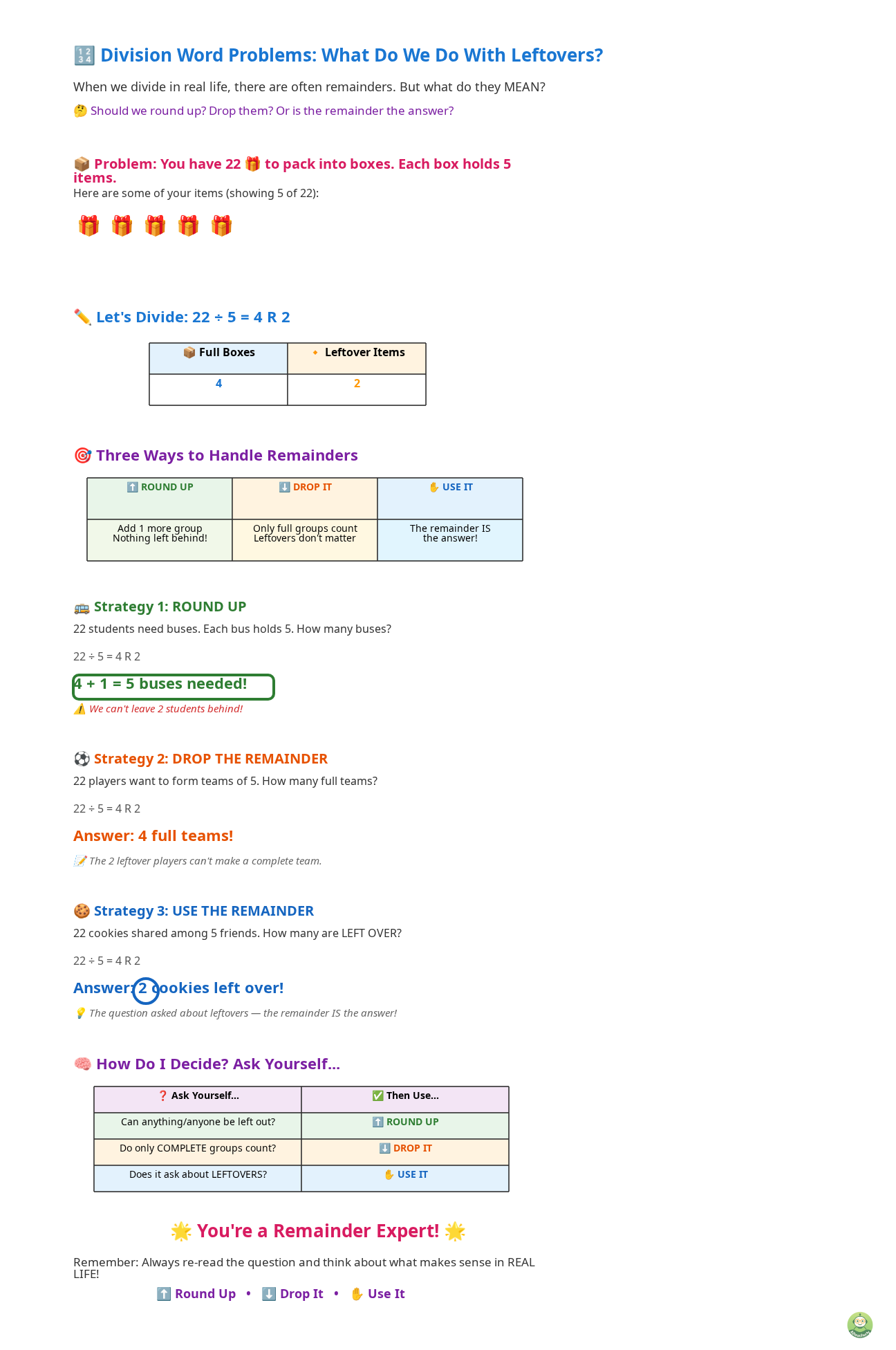
Guided discovery: The lesson walks students through each of the three strategies with narrated explanations. As one lesson script puts it: "When we divide in real life, there are often leftovers. But here's the tricky part: what do we do with them?"
Here's what the full interactive lesson looks like on AI Teacherly:
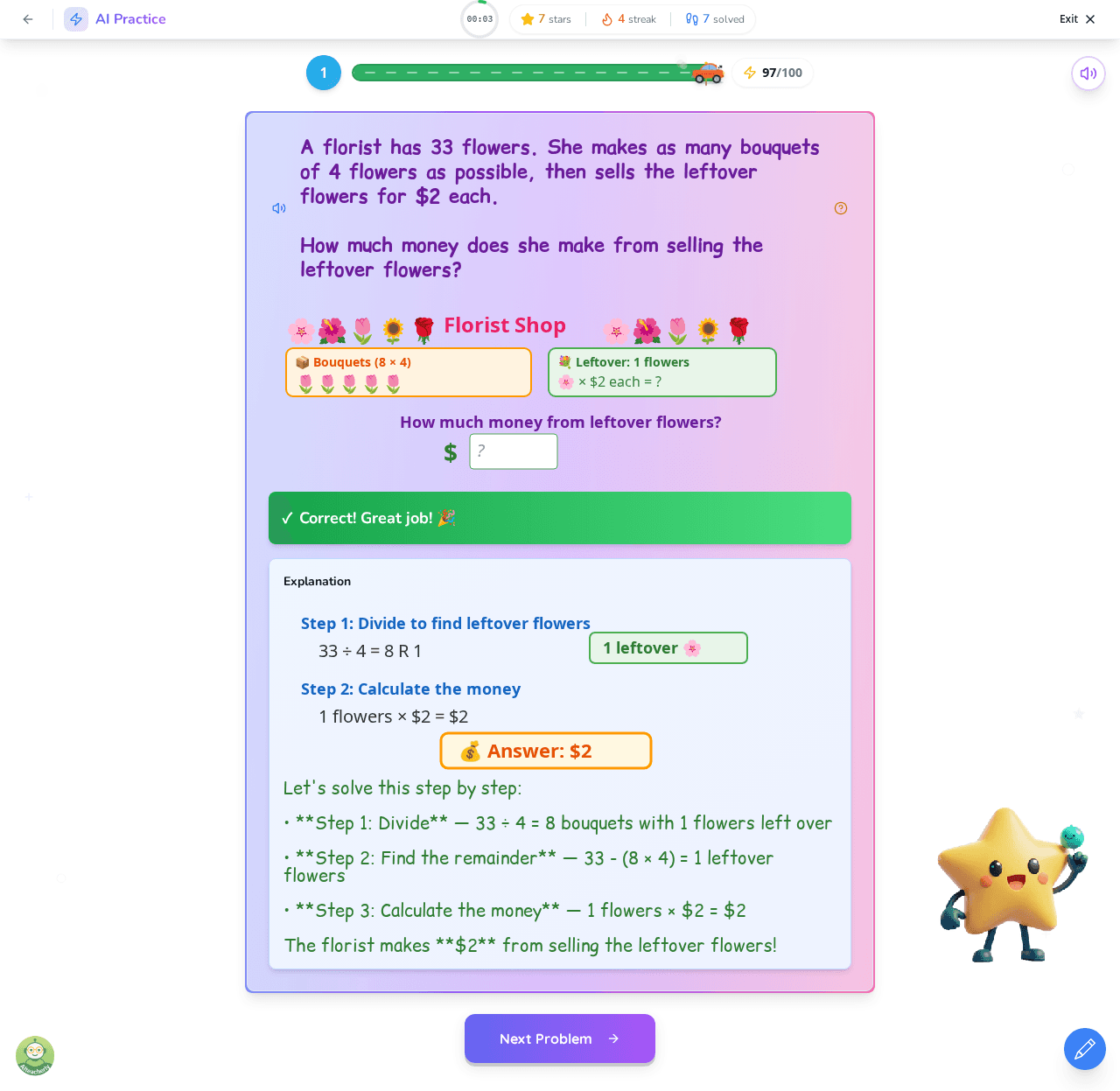
Progressive difficulty: Problems start simple and build complexity. By the end, students tackle multi-step challenges like calculating how a florist handles leftover flowers, applying multiple strategies in one problem.
The lesson takes about 30 minutes and includes instant feedback, visual models, and plenty of practice across all three remainder strategies.
Common Mistakes Kids Make With Remainders (And Quick Fixes)
Even after learning the three strategies, kids often stumble on a few predictable mistakes. Here's what to watch for and how to help:
Mistake #1: Writing "R2" as the final answer
What's happening: Your child is treating word problems like basic division practice.
Quick fix: Ask, "What does R2 mean in this story? Can you tell me in words what happens to those 2 leftover items?"
Mistake #2: Always rounding up (or always dropping)
What's happening: They've latched onto one strategy and use it for everything.
Quick fix: Before solving, have them predict: "Is this a 'no one left behind' problem, a 'complete groups only' problem, or a 'leftovers are the answer' problem?"
Mistake #3: Not re-reading the question
What's happening: They solve the math correctly but answer something different than what was asked.
Quick fix: Make circling/underlining the question a required step. Ask: "What exactly is this question asking you to find?"
Mistake #4: Forgetting that remainders can be zero
What's happening: When division is even, kids sometimes think they did something wrong.
Quick fix: Celebrate even division! "Great news; everyone fits perfectly with no leftovers!"
Mistake #5: Adding instead of analyzing
What's happening: For "round up" problems, kids sometimes add the remainder to the quotient (9 + 2 = 11 buses).
Quick fix: Use concrete examples. "If 9 buses fit 45 kids and we have 47, do we need 2 more buses or just 1 more?"
Remember, making mistakes is part of learning. Each error is an opportunity to strengthen understanding.
Key Takeaways for Parents
Mastering division remainders in 4th grade word problems doesn't require advanced math skills from parents. It requires helping your child think like a problem-solving detective. Here's what to remember:
Remainders aren't just leftovers. They require real-world reasoning that goes beyond calculation. Your child needs to interpret what the remainder means in context.
Three strategies cover every situation. Round Up when nothing can be left behind. Drop It when only complete groups count. Use It when the leftover is the answer.
Context clues are everything. Teach your child to re-read the question and ask "what makes sense in real life?" before choosing a strategy.
Practice with real scenarios. Buses, cookies, teams, and gift bags are more effective than abstract numbers. Interactive lessons provide these relatable contexts.
Mistakes are learning opportunities. Most errors come from not re-reading the question or applying the wrong strategy, not from calculation mistakes.
You don't need to be a math expert. Asking good questions ("Can we leave anyone behind?" "Is it asking about what's left?") is more powerful than showing them how to solve.
Interactive practice accelerates understanding. The immediate feedback and visual scenarios in digital lessons help concepts stick faster than worksheets alone.
With the three-strategy framework in hand, your 4th grader is equipped to tackle any remainder word problem with confidence.
Key Takeaways
- Division remainders require real-world reasoning, not just calculation skills; your child must interpret what the leftover means in context
- Three strategies cover every remainder situation: Round Up (nothing left behind), Drop It (complete groups only), Use It (the remainder IS the answer)
- Teach your child to re-read the question and ask 'what makes sense in real life?' before choosing a strategy
- Most remainder mistakes come from not re-reading the question or applying the wrong strategy, not from calculation errors
- Practice with relatable scenarios (buses, cookies, gift bags) makes abstract math concepts concrete and memorable
- Interactive lessons with immediate feedback help kids understand WHY an answer is wrong, building critical thinking
- You don't need to be a math expert; asking guiding questions is more powerful than showing solutions
Frequently Asked Questions
What are the three ways to interpret remainders in division?
The three strategies are: Round Up (when nothing can be left behind, like buses for a field trip), Drop It (when only complete groups count, like gift bags), and Use It (when the remainder IS the answer, like how many students are left without a team).
How do I explain remainders to my 4th grader in simple terms?
A remainder is what's 'left over' when a number doesn't divide evenly. The key is helping them understand that leftovers mean different things in different situations, like leftover students needing another bus vs. leftover cookies that can't fill a bag.
When should my child round up a remainder vs. drop it?
Round up when nothing can be left out (transportation, seating). Drop the remainder when only complete groups count (packaging, equal sharing). Ask: 'Can we leave anyone behind?' If no, round up. If only full groups matter, drop it.
Why do kids struggle with division word problems more than regular division?
Regular division only requires calculation, but word problems require interpretation. Kids must read carefully, understand context, and decide what the remainder means in real life. It combines reading comprehension with mathematical reasoning.
What are good real-life examples to practice remainder problems?
Use relatable scenarios: buses for field trips (round up), cookies in gift bags (drop it), students forming teams (use remainder), pizza slices shared among friends, eggs packed in cartons, or seats at tables for a party.
Is it normal for 4th graders to find remainders confusing?
Absolutely! Interpreting remainders is a significant cognitive leap. Kids are used to math having one right answer, but the same division can have different correct answers depending on context. This confusion is developmentally normal and improves with practice.
How can I help my child with division remainders at home?
Use the detective approach: solve the division first, re-read the question to find what's being asked, then ask 'what makes sense in real life?' Practice with household scenarios like dividing snacks or planning car seats for friends.
What common mistakes do kids make with division remainders?
Top mistakes include: writing 'R2' without interpreting it, always using the same strategy, not re-reading the question, and adding the remainder to the quotient when rounding up. Most errors are interpretation mistakes, not calculation errors.
Ready to help your 4th grader conquer division remainders? Try the interactive Division Word Problems: Interpreting Remainders lesson free on AI Teacherly and watch confusion transform into confidence!