Division Word Problems with Remainders: 3 Simple Rules Every 4th Grader Needs to Know
Confused about what to do with remainders in 4th grade math? Discover the 3 simple rules that make division word problems easy for your child to master.
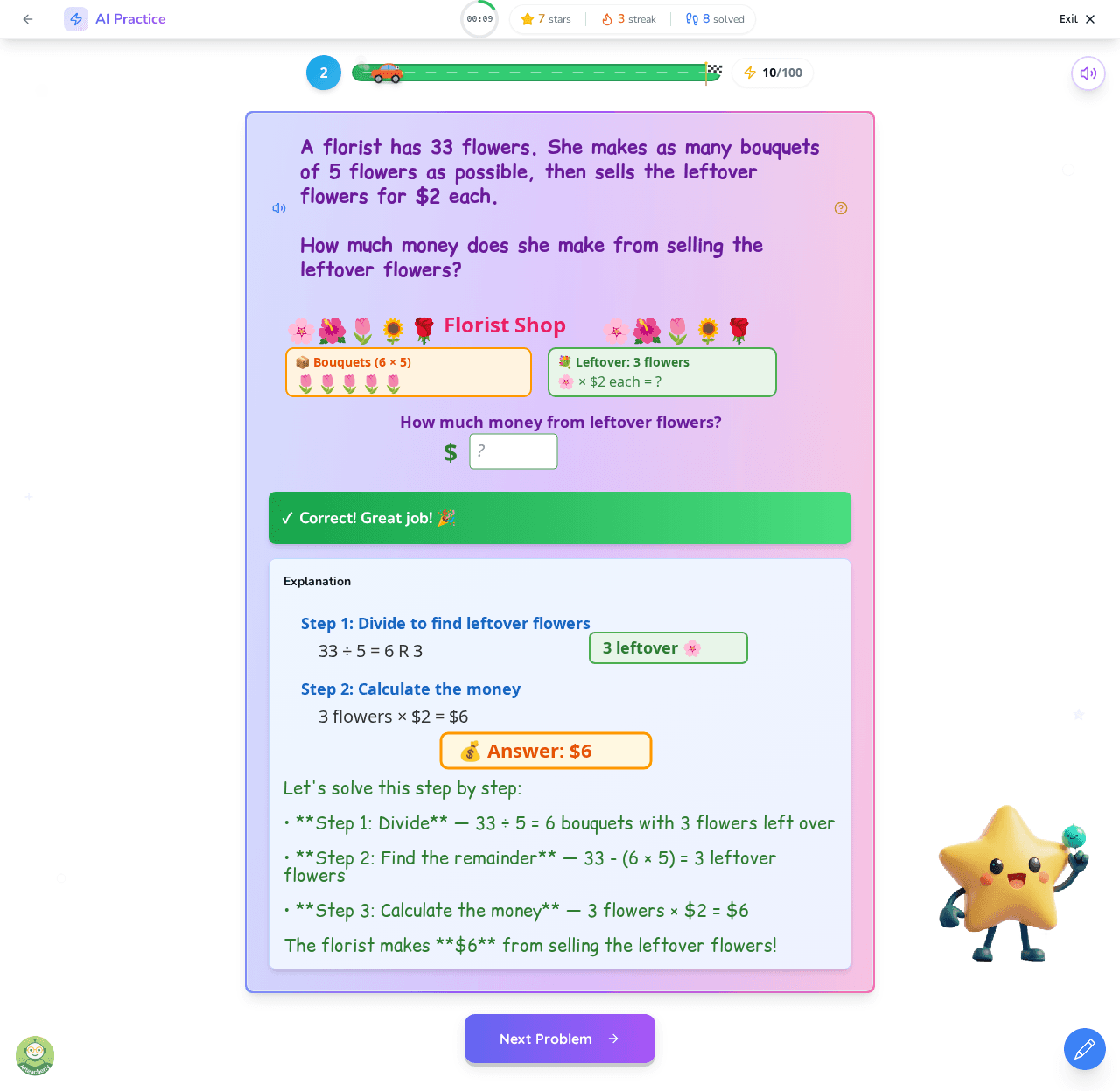
Why Remainder Word Problems Trip Up 4th Graders
Picture this: your 4th grader confidently calculates 23 ÷ 5 = 4 remainder 3, then stares at the word problem completely stumped. "But what do I DO with the 3?" they ask. You glance at the problem, and honestly, you're not sure either.
You're not alone. Division word problems with remainders are one of the trickiest concepts in 4th grade math because the same calculation can have three different correct answers depending on the context. That's right: 23 ÷ 5 = 4 R3 could mean you need 5 buses, 4 complete teams, OR that 3 leftover cookies are the answer.
The good news? There's a simple framework that makes this click. Once your child learns the three rules for interpreting remainders, they'll approach these problems with confidence instead of confusion. And the best part is you don't need to be a math expert to teach it.
In this guide, you'll learn:
- The three strategies for handling remainders (and when to use each)
- Real-world examples that make each strategy memorable
- Simple questions to ask that help your child figure it out themselves
- How interactive practice can reinforce these concepts
Let's turn remainder confusion into remainder confidence.
What Are the Three Ways to Handle Remainders in Division?
When we divide in real life, there are often leftovers. But here's the tricky part that stumps most 4th graders: what we do with those leftovers depends entirely on the situation.
Think of it this way: the math stays the same, but the answer changes based on what the question is really asking.
Here are the three remainder strategies your child needs to master:
1. Round Up the Remainder
Use this when nothing can be left behind or left out. If the problem asks how many containers, buses, boxes, or trips are needed to hold or transport EVERYTHING, you round up.
Example: 23 students need buses that hold 5 each. 23 ÷ 5 = 4 R3. You can't leave 3 students behind! Answer: 5 buses.
2. Drop the Remainder
Use this when only complete groups count. If the problem asks how many complete sets, full teams, or finished items you can make, you ignore the leftover.
Example: 23 students form teams of 5. 23 ÷ 5 = 4 R3. The 3 extra students can't make a complete team. Answer: 4 teams.
3. Use the Remainder as the Answer
Use this when the leftover itself is what the question asks about. Sometimes we want to know what's left over, not how many groups.
Example: 23 cookies shared equally among 5 kids. How many are left? 23 ÷ 5 = 4 R3. Answer: 3 cookies.
The secret is teaching your child to re-read the question and ask: "What makes sense in real life?"
When Should Your Child Round Up the Remainder?
The "round up" strategy is often the most confusing for kids because it feels counterintuitive. The math says 4, but the answer is 5? That doesn't seem right!
Here's how to explain it: When nothing can be left behind, you need extra space for the leftovers.
Teach your child to look for these clue words and scenarios:
Round Up When You See:
- "How many ___ are needed to hold/carry/fit everything?"
- Buses, vans, or vehicles for people
- Boxes, bags, or containers for items
- Trips needed to move something
- Tables or rows needed to seat everyone
The Real-World Test: Ask your child: "Can we leave anyone or anything behind?" If the answer is no, they need to round up.
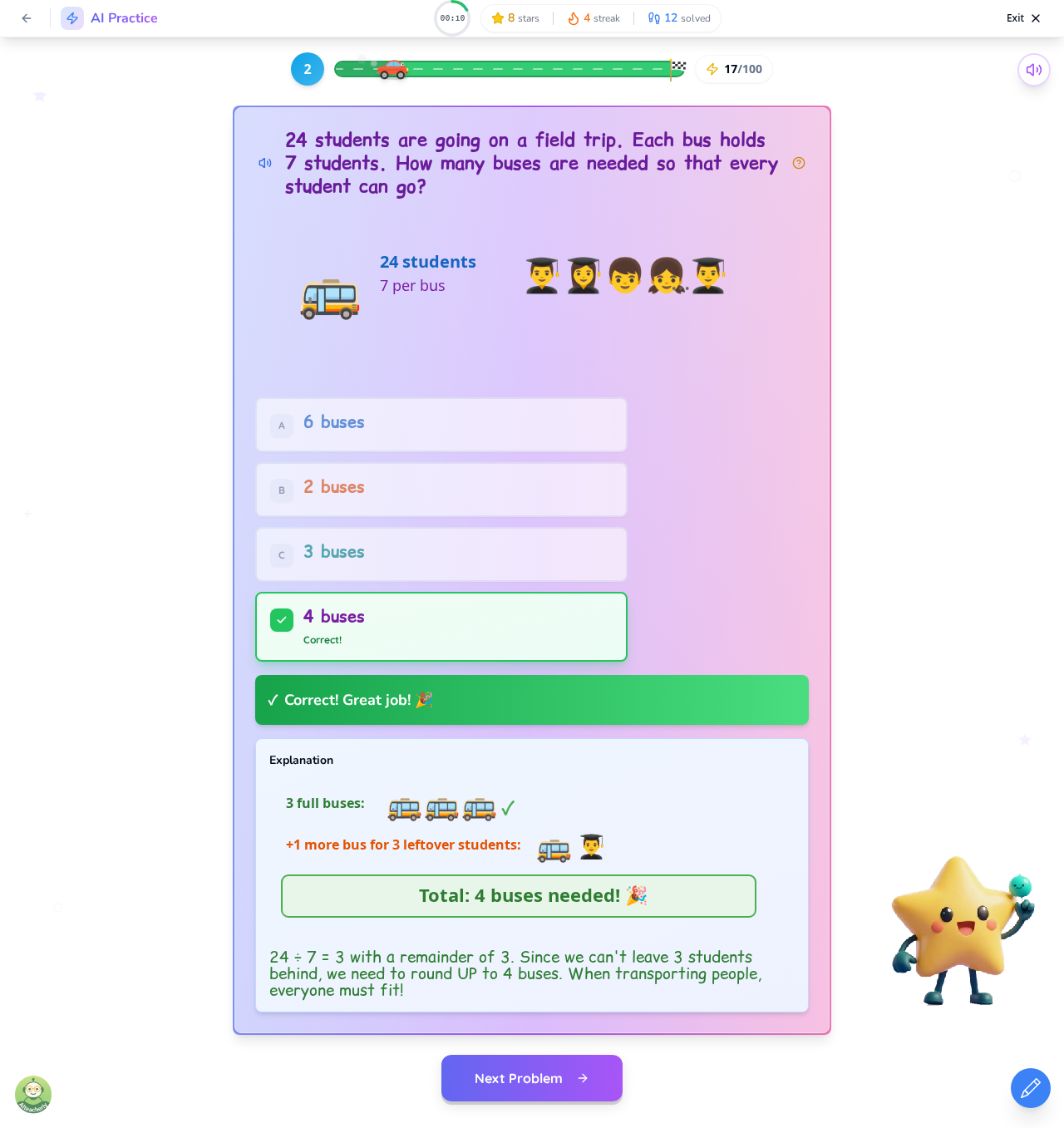
Consider this scenario: A school has 53 students going on a field trip. Each bus holds 10 students. How many buses are needed?
53 ÷ 10 = 5 R3
If your child answers "5 buses," ask them: "What happens to the 3 students who don't fit?" They'll quickly realize those students can't be left at school! You need that 6th bus, even if it's mostly empty.
The interactive problem below shows exactly how this works in practice.
Pro Tip: Practice with real scenarios at home. "We have 17 cupcakes and boxes that hold 6. How many boxes do we need to bring ALL of them to the party?"
When Should Your Child Drop the Remainder?
The "drop the remainder" strategy is the most straightforward once your child understands one key concept: sometimes only complete groups matter.
Think about making friendship bracelets. If you have 23 beads and each bracelet needs 5 beads, you can only make 4 complete bracelets. Those 3 extra beads? They don't count toward the answer because you can't give someone three-fifths of a bracelet!
Drop the Remainder When You See:
- "How many complete or full ___?"
- Teams, groups, or sets that need specific numbers
- Items that must be whole (bracelets, sandwiches, gift bags)
- Fair shares where everyone gets the same amount
Clue Words to Watch For:
- Complete
- Full
- Whole
- Equal groups
- How many can be made?
A Helpful Scenario: A teacher has 29 stickers and wants to put 4 stickers on each student's paper. How many students can get stickers?
29 ÷ 4 = 7 R1
The teacher can give stickers to 7 students, with 1 sticker left over. But the question asks about students, not leftover stickers, so the answer is simply 7 students.
Practice at Home: "We're making gift bags with 3 toys each. We have 20 toys. How many complete gift bags can we make?" (Answer: 6, because 20 ÷ 3 = 6 R2, and we drop the remainder)
Help your child see that the "leftover" isn't wasted; it's just not part of the answer to THIS question.
When Is the Remainder the Answer?
Here's where things get interesting! Sometimes the remainder isn't something to round up or ignore. Sometimes the remainder IS exactly what the question asks for.
This happens when the problem specifically wants to know about the leftovers.
Use the Remainder as Your Answer When:
- "How many are left over?"
- "How many extra?"
- "How many remain?"
- "What is the remainder?"
- "How many couldn't fit?"
A Clear Example: You have 25 photos and can fit 6 photos on each album page. After filling as many pages as possible, how many photos are left?
25 ÷ 6 = 4 R1
The answer isn't 4 (pages) or 5 (if you rounded up). The answer is 1 photo, because that's what "left over" means.
Why This Confuses Kids: Children are conditioned to think the "big number" is the answer. When the answer is just the small remainder, it feels wrong. Reassure them that math problems come in all shapes, and sometimes we're specifically interested in what doesn't fit!
Kitchen Math Practice: Next time you're cooking or baking, create these moments: "We have 14 eggs and the recipe needs 3 eggs per batch. After making as many batches as possible, how many eggs will be left in the carton?"
The Memory Trick: Teach your child this phrase: "If the question asks about leftovers, the leftover IS the answer!"
How to Practice Remainder Problems at Home
The best way to cement these concepts is through real-world practice. And you don't need worksheets; everyday situations provide perfect opportunities!
Dinner Table Division:
- "We have 17 chicken nuggets for 4 people. How many does each person get? How many are left over?"
- "There are 22 grapes. If everyone gets 5, how many full servings can we make?"
Car Ride Challenges:
- "Our car holds 5 people. There are 23 people at the party who need rides. How many trips will we need to get everyone home?"
- "A parking lot has 47 cars and each row fits 8. How many complete rows are full?"
Shopping Scenarios:
- "Apples come in bags of 6. We need 20 apples for the class. How many bags should we buy?"
- "Stickers are 4 for a dollar. With $7, how many full sets of 4 can you buy? How much money is left?"
Game Night Math:
- "We have 30 game pieces and 4 players. How many pieces does each player get to start?"
- "If each team needs exactly 5 players and we have 18 friends, how many complete teams can play?"
The Question That Unlocks Everything: Whenever your child gets stuck, ask: "What is the question really asking about: the groups, or the leftovers? And can anything be left behind?"
This simple prompt helps them identify which of the three strategies to use. With practice, it becomes automatic!
See How Interactive Learning Makes Remainders Click
While practice at home is valuable, interactive digital lessons can take remainder understanding to the next level. Visual manipulatives and immediate feedback help concepts stick in ways that worksheets simply can't match.
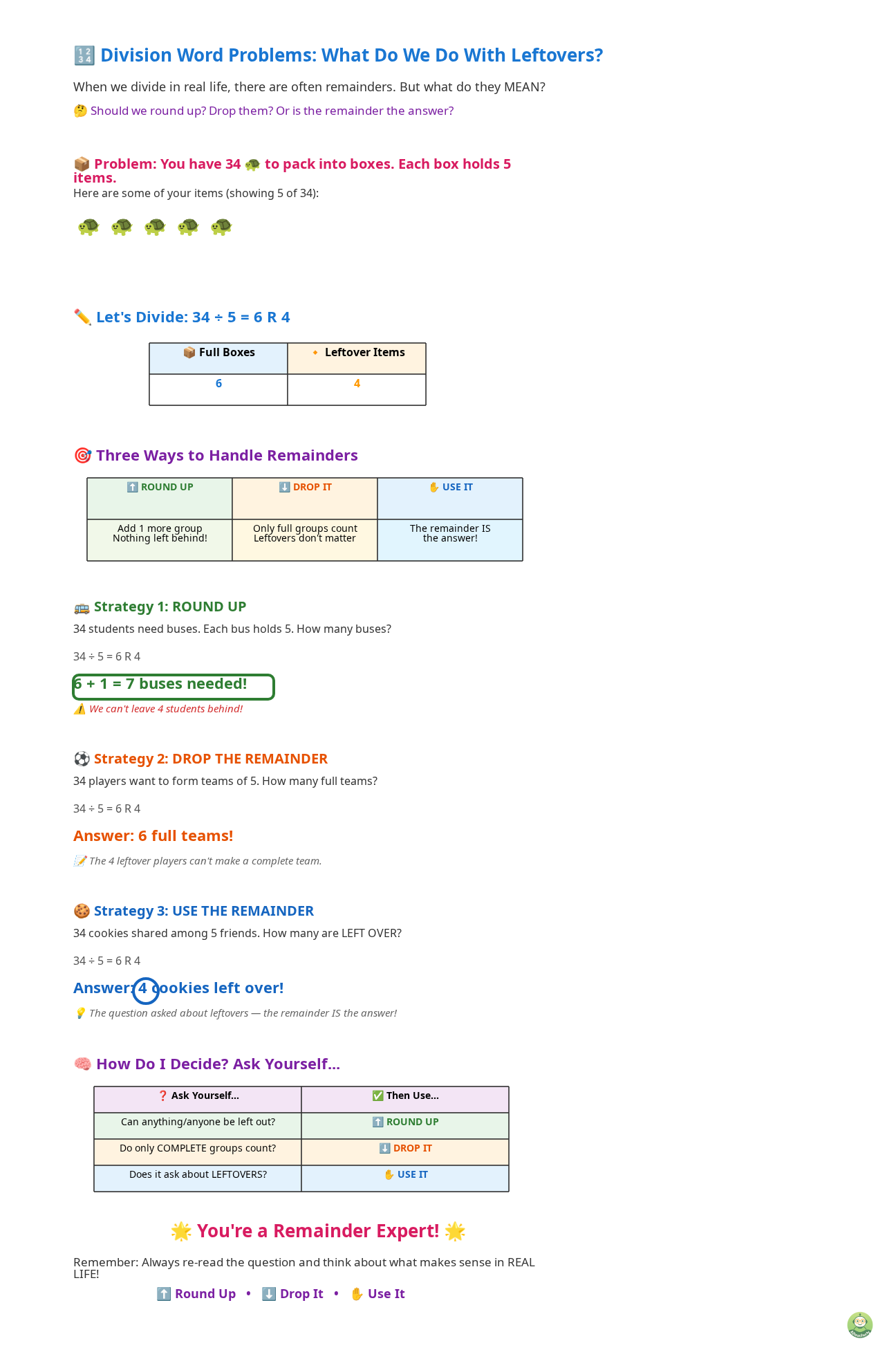
Here's what the full interactive lesson looks like on AI Teacherly:
On AI Teacherly, the Division Word Problems: Interpreting Remainders lesson for Grade 4 uses engaging scenarios that students actually care about: field trip buses, classroom seating, party planning, and more.
What Makes Interactive Practice Different:
Visual Context Clues Students see pictures of buses filling up, tables being arranged, and items being grouped. This visual component helps them connect the math to real situations, making the "which strategy do I use?" decision more intuitive.
Immediate Feedback When a student picks the wrong interpretation, they get instant guidance explaining WHY that answer doesn't make sense in context. This corrective feedback is incredibly powerful for building understanding.
Progressive Difficulty The lesson starts with straightforward scenarios and builds to more complex word problems that require multi-step thinking. Students develop confidence gradually.
Multiple Problem Types From multiple choice to fill-in-the-blank, students practice identifying the correct approach across various formats, just like they'll see on tests.
Why Parents Love It: You don't have to be the math teacher! The lesson does the heavy lifting of explaining concepts, giving you more time to encourage and celebrate progress rather than trying to remember 4th grade division rules yourself.
Key Takeaways
- There are three ways to handle remainders: round up (when nothing can be left behind), drop it (when only complete groups count), and use it (when the leftover is the answer)
- The same division calculation can have different correct answers depending on what the word problem asks
- Teach your child to re-read the question and ask: 'What makes sense in real life?'
- Look for clue words like 'needed,' 'complete,' 'full,' 'left over,' and 'extra' to identify the right strategy
- Practice with real-world scenarios at home during meals, car rides, and shopping trips
- Interactive lessons with visual context and immediate feedback help cement remainder concepts faster than worksheets
- 4th grade mastery of remainders builds the foundation for fractions and more complex problem-solving in 5th grade
Frequently Asked Questions
What are the three ways to interpret remainders in division word problems?
Round up when nothing can be left behind (like buses for a field trip), drop it when only complete groups count (like forming teams), and use the remainder when the question asks about leftovers.
How do I know when to round up a remainder in division?
Round up when the problem asks how many containers, vehicles, or trips are NEEDED to hold everything. If leaving anything behind isn't an option, you need that extra group.
When should my child drop the remainder in a word problem?
Drop the remainder when the problem asks about complete or full groups, teams, or sets. If partial groups don't count (like incomplete teams), only the whole number matters.
Why does my 4th grader struggle with remainder word problems?
Remainder problems require interpreting context, not just calculating. The same math can have different answers based on the question, which requires reading comprehension alongside math skills.
How can I practice division remainders with my child at home?
Use everyday scenarios: sharing snacks, planning car trips, packing items into boxes. Ask questions like 'How many bags do we need?' versus 'How many will be left over?'
What does 'use the remainder as the answer' mean?
Sometimes the question specifically asks about leftovers, like 'How many cookies remain?' In these cases, the small remainder number IS your answer, not the quotient.
Is it normal for kids to find division remainders confusing?
Absolutely! This is one of the trickiest 4th grade math concepts because it combines calculation with real-world reasoning. Most students need explicit teaching of all three strategies.
What clue words help identify which remainder strategy to use?
Look for 'needed' or 'required' (round up), 'complete' or 'full' (drop it), and 'left over,' 'extra,' or 'remain' (use the remainder). These signal what the question really wants.
Ready to help your 4th grader master division word problems? Try the free interactive Division Word Problems: Interpreting Remainders lesson on AI Teacherly and watch remainder confusion turn into confidence!