Division Word Problems With Remainders: The 3 Rules Every 4th Grader Needs to Know
Your 4th grader got the division right but the answer wrong? Learn the 3 simple rules for interpreting remainders that turn confusing word problems into confident problem-solving.
Why Remainder Word Problems Trip Up 4th Graders
Picture this: your 4th grader sits down with their math homework, confidently divides 47 by 5, and gets 9 with a remainder of 2. Perfect! But then they write "9 R2" as their final answer to a word problem about buses needed for a field trip, and their teacher marks it wrong.
Sound familiar? You're not alone. Division word problems with remainders are one of the most challenging concepts in 4th grade mathematics, and here's why: the math itself isn't the hard part. The tricky part is figuring out what to do with that leftover number.
Unlike basic division facts where there's one right answer, remainder word problems require something more: critical thinking about real-world context. The same division problem (47 ÷ 5 = 9 R2) can have three completely different correct answers depending on what the question is actually asking.
This is where many students (and parents trying to help!) get stuck. The computation is correct, but the interpretation is where the real learning happens. The good news? There's a simple 3-rule framework that makes interpreting remainders straightforward and even intuitive. Let's break it down.
What Does Interpreting Remainders Actually Mean?
Before we tackle the strategies, let's clarify what we mean by "interpreting remainders." When we divide in real life, there are often leftovers. But here's the crucial question: what do we do with them?
Consider this example: You have 47 students going on a field trip, and each bus holds 5 students. How many buses do you need?
The computation: 47 ÷ 5 = 9 remainder 2
But wait! If you only send 9 buses, 2 students get left behind. That's not okay! So the answer isn't "9 R2" or even "9." The answer is 10 buses, because you need to round up to make sure everyone has a seat.
Now imagine a different scenario: You have 47 students forming basketball teams of 5 players each. How many complete teams can you make?
Same computation: 47 ÷ 5 = 9 remainder 2
But this time, those 2 extra students can't form a complete team. You can only have 9 teams, and the remainder gets "dropped" because the question asks for complete teams only.
See the difference? The math is identical, but the answers are different because the real-world context determines what makes sense. This is interpreting remainders, and it's a skill that builds mathematical reasoning far beyond just computation.
The 3 Remainder Rules Every Parent Should Know
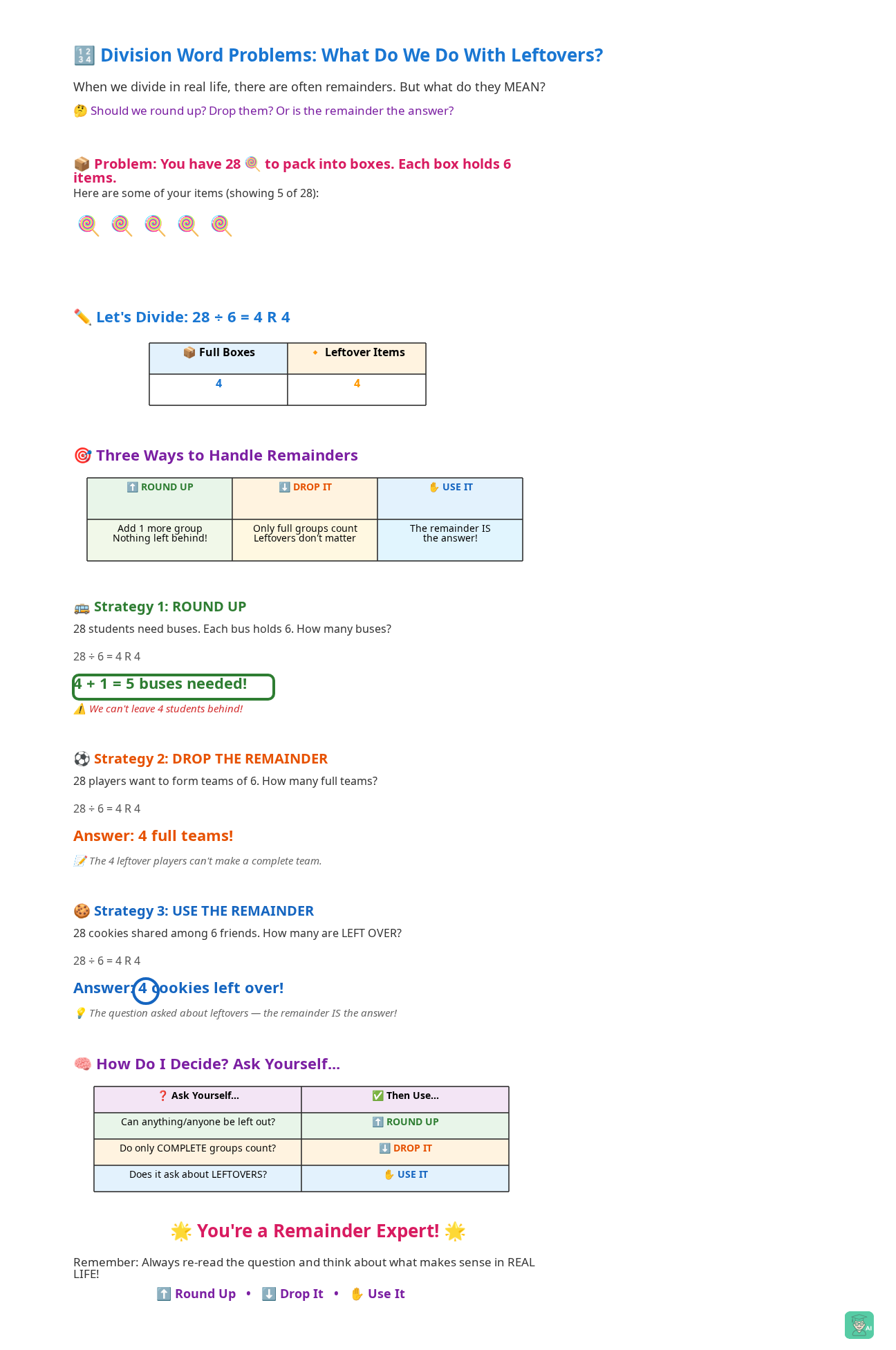
Here's the framework that transforms remainder confusion into confident problem-solving. Teach your child these 3 rules, and they'll have a reliable system for any division word problem:
Rule 1: Round Up (When Nothing Can Be Left Out)
Use this when everyone or everything must be included, and leaving anything behind isn't an option.
Examples:
- Buses for a field trip (can't leave students behind)
- Tables for guests at a party (everyone needs a seat)
- Containers to pack ALL the items
Signal words: "at least," "needed for all," "to fit everyone"
Rule 2: Drop It (When Only Complete Groups Count)
Use this when only whole, complete groups matter, and the leftovers simply can't be used.
Examples:
- Teams with exactly 5 players (2 extra can't play)
- Bags of 10 apples (7 loose apples don't make a bag)
- Rows of chairs that must be full
Signal words: "complete," "full," "how many groups"
Rule 3: Use It (When the Leftover IS the Answer)
Use this when the question specifically asks about what's left over.
Examples:
- "How many will be left?" after sharing equally
- "How many extras?" after filling boxes
- "What remains?" after dividing into groups
Signal words: "left over," "remaining," "extra"
The secret is in the question! Teach your child to re-read the problem and ask: "What makes sense in real life?"
How Do You Know Which Strategy to Use?
Now that you know the 3 rules, how do you help your child figure out which one applies? Here's a simple decision-making framework they can use every time:
Step 1: Solve the Division First
Always start by computing the division and finding the quotient and remainder. Get the math done first before worrying about interpretation.
Step 2: Re-Read the Question Carefully
The answer to "which strategy?" is almost always hidden in the question itself. Look for key phrases:
| If the question asks... | Then... |
|---|---|
| "How many needed for ALL?" | Round Up |
| "How many COMPLETE groups?" | Drop It |
| "How many LEFT OVER?" | Use It |
Step 3: Apply the "Real Life" Test
Ask your child: "If this were really happening, what would make sense?"
- Would it make sense to leave 2 students without a bus? No, round up.
- Would it make sense to have a basketball team with only 2 players? No, drop it.
- Does the question literally ask about leftovers? Yes, use the remainder.
Practice Question to Try Together
A baker made 52 cookies and puts 8 cookies in each box. How many full boxes can the baker fill?
Work through it:
- 52 ÷ 8 = 6 remainder 4
- Question asks for "full boxes" (complete groups)
- Real life: 4 cookies aren't a full box
- Answer: 6 boxes (drop the remainder)
Now ask: "How many cookies are left over?" Same math, different answer: 4 cookies (use the remainder).
Real-World Practice: Try These Examples With Your Child
The best way to master remainder interpretation is through practice with relatable scenarios. Here are some examples to work through together, organized by strategy:
Round Up Examples
1. Field Trip Vans: 34 students need rides to the museum. Each van holds 6 students. How many vans are needed?
- 34 ÷ 6 = 5 R4
- Can't leave 4 students behind!
- Answer: 6 vans
2. Egg Cartons: You have 75 eggs to put in cartons that hold 12 eggs each. How many cartons do you need to store ALL the eggs?
- 75 ÷ 12 = 6 R3
- Those 3 eggs need a carton too!
- Answer: 7 cartons
Drop It Examples
3. Soccer Teams: 29 kids want to play soccer. Each team needs exactly 4 players. How many complete teams can be formed?
- 29 ÷ 4 = 7 R1
- 1 player can't make a complete team
- Answer: 7 teams
Use It Examples
4. Sharing Stickers: Mia has 50 stickers to share equally among 8 friends. How many stickers will be left over?
- 50 ÷ 8 = 6 R2
- The question asks about leftovers!
- Answer: 2 stickers
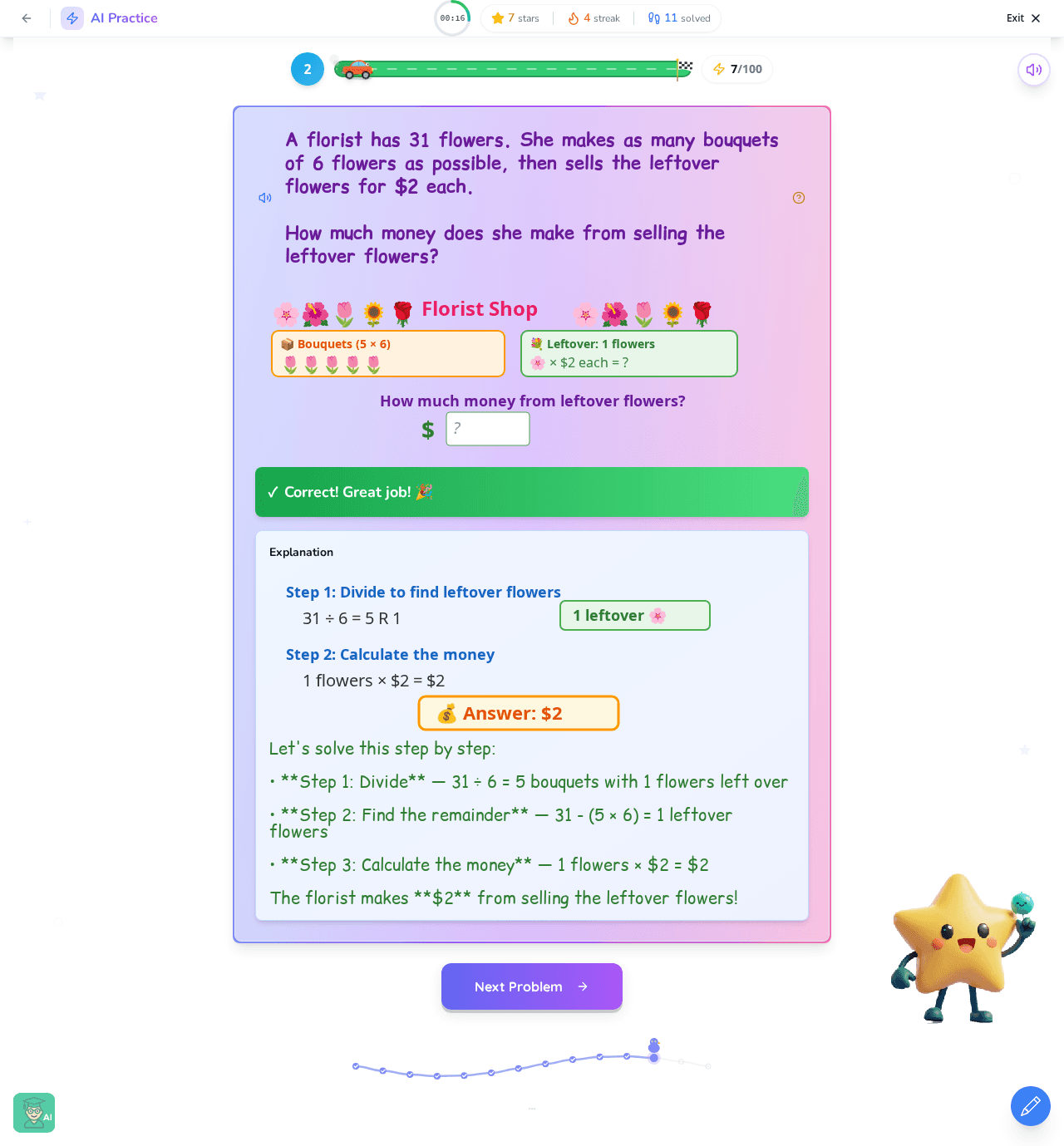
The interactive problem below demonstrates exactly how these remainder concepts work in practice.
Pro tip: Use everyday situations at home! "We have 23 cookies and 4 people. How many does each person get, and how many are left for tomorrow?"
See How AI Teacherly Makes Remainder Problems Click
Understanding remainder strategies is one thing, but building fluency requires practice with immediate feedback. That's where interactive learning makes all the difference.
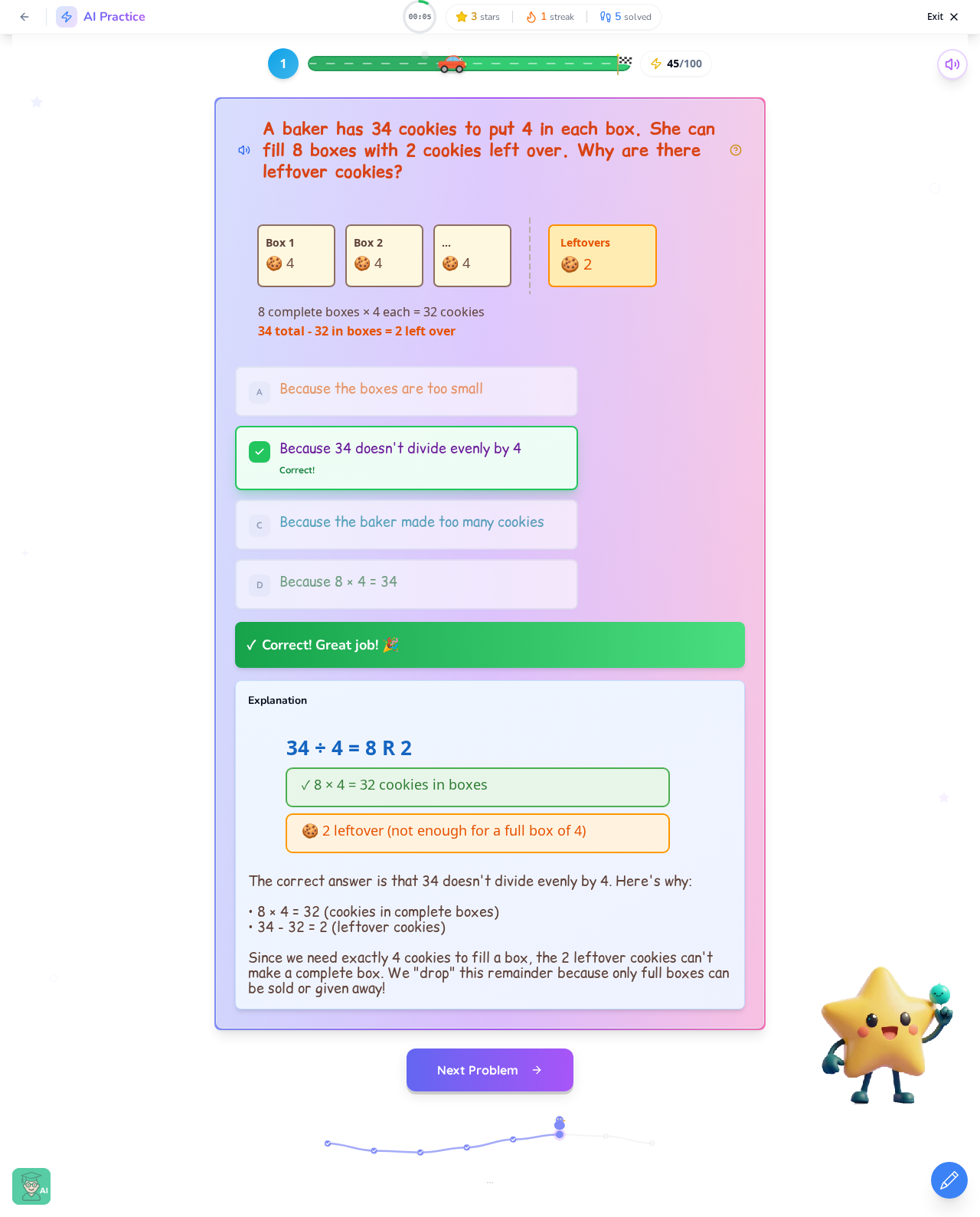
The Division Word Problems: Interpreting Remainders lesson on AI Teacherly takes students through progressively challenging scenarios, helping them recognize patterns and build confidence. Here's what the full interactive lesson looks like on AI Teacherly:
What makes this lesson effective:
- Visual word problems with engaging scenarios students can relate to (buses, cookies, teams, and more)
- Instant feedback that explains not just whether an answer is right, but why a particular strategy applies
- Multiple problem types covering all three remainder rules so students see the full picture
- Real-world contexts that make abstract division concepts concrete and meaningful
The lesson builds from foundational understanding ("What IS a remainder?") to application ("Which strategy should I use?") to mastery ("I can solve any remainder word problem!").
Unlike worksheets where students might practice the same strategy repeatedly, interactive lessons adapt to ensure students experience all three remainder interpretations. This variety is crucial because students need to decide which rule applies, not just apply a single method.
For parents: You can sit alongside your child as they work through the lesson, or let them practice independently while the platform provides guidance. Either way, you'll see their progress and know exactly where they might need extra support.
Key Takeaways
- Remainder word problems require critical thinking about context, not just computation. The same division can have three different correct answers depending on what the question asks.
- The 3 Remainder Rules: Round Up when nothing can be left out, Drop It when only complete groups count, Use It when the question asks about leftovers.
- Teach your child to re-read the question and look for signal words like 'at least,' 'complete,' 'full,' 'left over,' or 'remaining.'
- The 'Real Life Test' helps: Ask 'What would make sense if this were actually happening?' to determine the right strategy.
- Practice with everyday scenarios at home (sharing snacks, car rides, packing items) makes abstract division concepts concrete.
- Interactive lessons with immediate feedback help students build fluency in recognizing which remainder strategy to apply.
Frequently Asked Questions
What are the 3 ways to interpret remainders in division word problems?
The 3 ways are: Round Up (when nothing can be left out, like buses for students), Drop It (when only complete groups count, like full teams), and Use It (when the question asks about leftovers directly).
How do I know when to round up a remainder vs. drop it?
Round up when everyone or everything must be included (like seats for all guests). Drop the remainder when only complete groups matter (like forming teams of exactly 5 players).
Why do 4th graders struggle with division remainder problems?
The computation is usually not the issue. Students struggle because interpreting remainders requires critical thinking about real-world context, and the same math problem can have different correct answers depending on what's being asked.
What real-life examples can I use to teach remainders at home?
Try sharing cookies equally (who gets the extras?), planning car rides (how many cars for everyone?), or packing items in boxes (how many full boxes?). These everyday scenarios make remainder interpretation concrete and relatable.
What keywords in word problems tell you what to do with the remainder?
Look for 'at least' or 'needed for all' (round up), 'complete' or 'full groups' (drop it), and 'left over' or 'remaining' (use the remainder). These signal words usually reveal which strategy to apply.
Is it normal for my child to find remainder word problems confusing?
Absolutely! Remainder interpretation is one of the most challenging 4th grade math concepts because it requires reasoning beyond computation. With practice using the 3-rule framework, most students gain confidence quickly.
How can I help my child check if their remainder answer makes sense?
Use the 'Real Life Test.' Ask your child: 'If this were really happening, would this answer work?' If they say 9 buses for 47 students (5 per bus), ask 'What happens to the 2 leftover students?' This builds self-checking habits.
At what age should kids understand division with remainders?
Division with remainders is typically introduced in 3rd grade and mastered in 4th grade. Interpreting remainders in word problems is a key 4th grade skill that prepares students for more complex math reasoning in 5th grade and beyond.
Ready to make division word problems click for your 4th grader? Try the interactive Interpreting Remainders lesson free on AI Teacherly and watch their confidence grow!