Help Your Child With Division Using Area Models: A Parent's Guide to 4th Grade Math
Feeling lost when your 4th grader shows you division homework with rectangles and "partial quotients"? This parent-friendly guide explains area models, remainders, and simple ways to practice at home.
Why Division Homework Looks Different Now
When your child brings home their 4th grade division homework covered in rectangles, arrows, and terms like "partial quotients," your first instinct might be panic. You learned division with long division symbols and a series of memorized steps. Now it looks like your child is learning an entirely different subject.
Here's the reassuring truth: the math itself hasn't changed. What has changed is how we help children understand what division actually means. Modern math education focuses on building number sense, which means children learn to visualize and reason through problems rather than simply memorizing procedures they don't understand.
The good news? Once you understand how area models work, you might find this approach is actually more intuitive than what you learned. And the best part is that you'll be able to help your child with division area models without feeling lost or worried about confusing them.
This guide will walk you through everything you need to know about 4th grade division help for parents, including the area model method, partial quotients, remainders, and practical ways to practice at home. By the end, you'll feel confident tackling homework time together.
What Is the Area Model for Division?
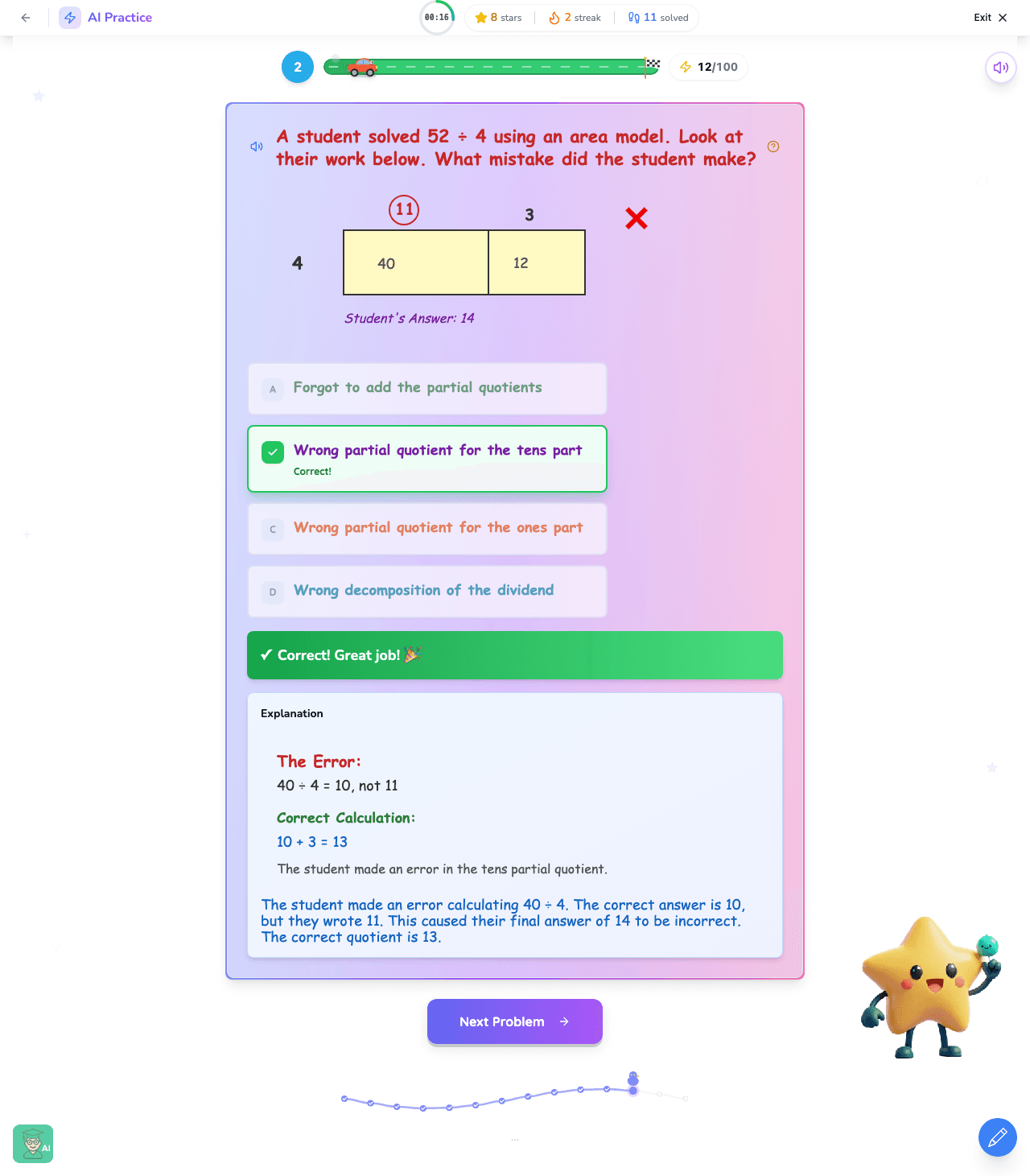
The area model is a visual method that represents division as finding the missing side of a rectangle. Think about it this way: if you know the area of a rectangle and the length of one side, you can figure out the other side. That's essentially what division does.
Let's say your child needs to divide 84 by 4. In the area model approach, we imagine a rectangle with an area of 84 square units (the dividend). One side of the rectangle is 4 units long (the divisor). The question becomes: what is the length of the other side?
Here's where the "friendly parts" concept comes in. Instead of tackling 84 all at once, we break it into numbers that are easier to work with:
- 80 ÷ 4 = 20 (this becomes the yellow section of our rectangle)
- 4 ÷ 4 = 1 (this becomes the green section)
- 20 + 1 = 21 (our final answer!)
The beauty of this approach is that children can see the math happening. They're not blindly following steps; they understand that 84 is made up of 80 + 4, and dividing each part separately gives them partial quotients that add up to the complete answer.
The interactive problem below shows exactly how the area model works in practice:
This visual representation helps children (and parents!) grasp that division is about equal sharing or grouping, concepts that connect to real-world experiences like splitting pizza slices or organizing items into equal groups.
How Does the Partial Quotients Method Work?
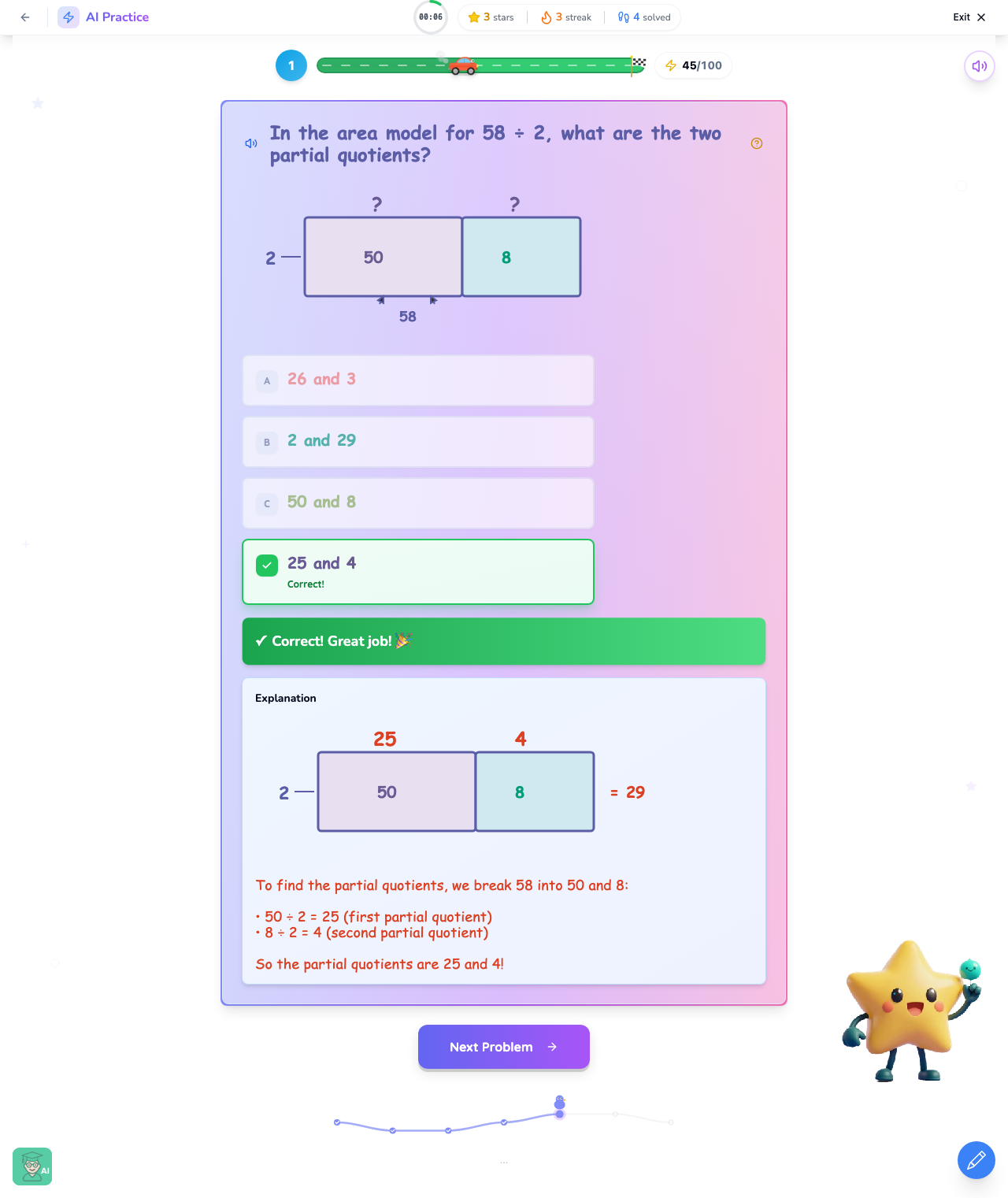
Partial quotients is closely related to the area model, and understanding both will help you support your child's division learning. The core idea is the same: break a big division problem into smaller, friendlier chunks.
Here's how partial quotients works step by step, using 96 ÷ 6 as an example:
Start with an easy chunk: How many 6s can you easily find in 96? Well, 6 × 10 = 60. So we know at least 10 groups of 6 fit into 96. Write down 10 as our first partial quotient.
Subtract and repeat: 96 - 60 = 36. Now ask: how many 6s fit into 36? That's 6 × 6 = 36 exactly. Write down 6 as our second partial quotient.
Add the partial quotients: 10 + 6 = 16. That's our answer!
What makes this method powerful is its flexibility. There's no single "right" way to break up the problem. Some children might think of 6 × 5 = 30 first, then work from there. Others might recognize 6 × 15 = 90 right away. Both approaches lead to the correct answer.
This flexibility reduces math anxiety because children aren't penalized for not immediately knowing multiplication facts. They can work with numbers they're comfortable with and still arrive at the correct solution. Over time, they naturally become more efficient as their number sense develops.
For parents who learned the traditional long division algorithm, this might feel strange at first. But think about how you do mental math: you probably break numbers apart too! This method simply makes that natural thinking process explicit and visual.
How Can I Help My Child Understand Remainders?
Remainders are where many 4th graders hit a stumbling block, and it's a common area where parents wonder how to help. The good news is that remainders connect beautifully to real-life situations your child already understands.
Imagine you have 25 candies to share equally among 4 friends. Each friend gets 6 candies (that's 24 total), but there's 1 candy left over. That leftover candy is the remainder. Your child experiences this concept whenever they can't divide something perfectly evenly.
Here's a critical rule that helps children check their work: the remainder must always be less than the divisor. If your child divides by 4 and gets a remainder of 5, something went wrong. Why? Because if there were 5 left over, they could give one more to each of the 4 friends!
This self-checking rule is powerful. Teach your child to ask: "Is my remainder smaller than the number I'm dividing by?" If not, they need to revisit their calculation.
Ways to practice remainders at home:
- Snack sharing: Divide crackers, grapes, or carrot sticks among family members. "We have 17 strawberries for 3 people. How many does each person get? How many are left over?"
- Toy organization: "You have 23 action figures to put on 5 shelves equally. How many on each shelf? How many don't fit?"
- Game pieces: Use dice, cards, or board game pieces. "If we deal 52 cards to 7 players, how many does each get? How many remain in the pile?"
These hands-on activities make remainders tangible and meaningful, rather than an abstract math concept.
See How Interactive Division Practice Works
Reading about division strategies is helpful, but seeing them in action makes all the difference. Interactive practice allows children to manipulate visual models, receive immediate feedback, and build confidence through repetition that feels more like play than homework.
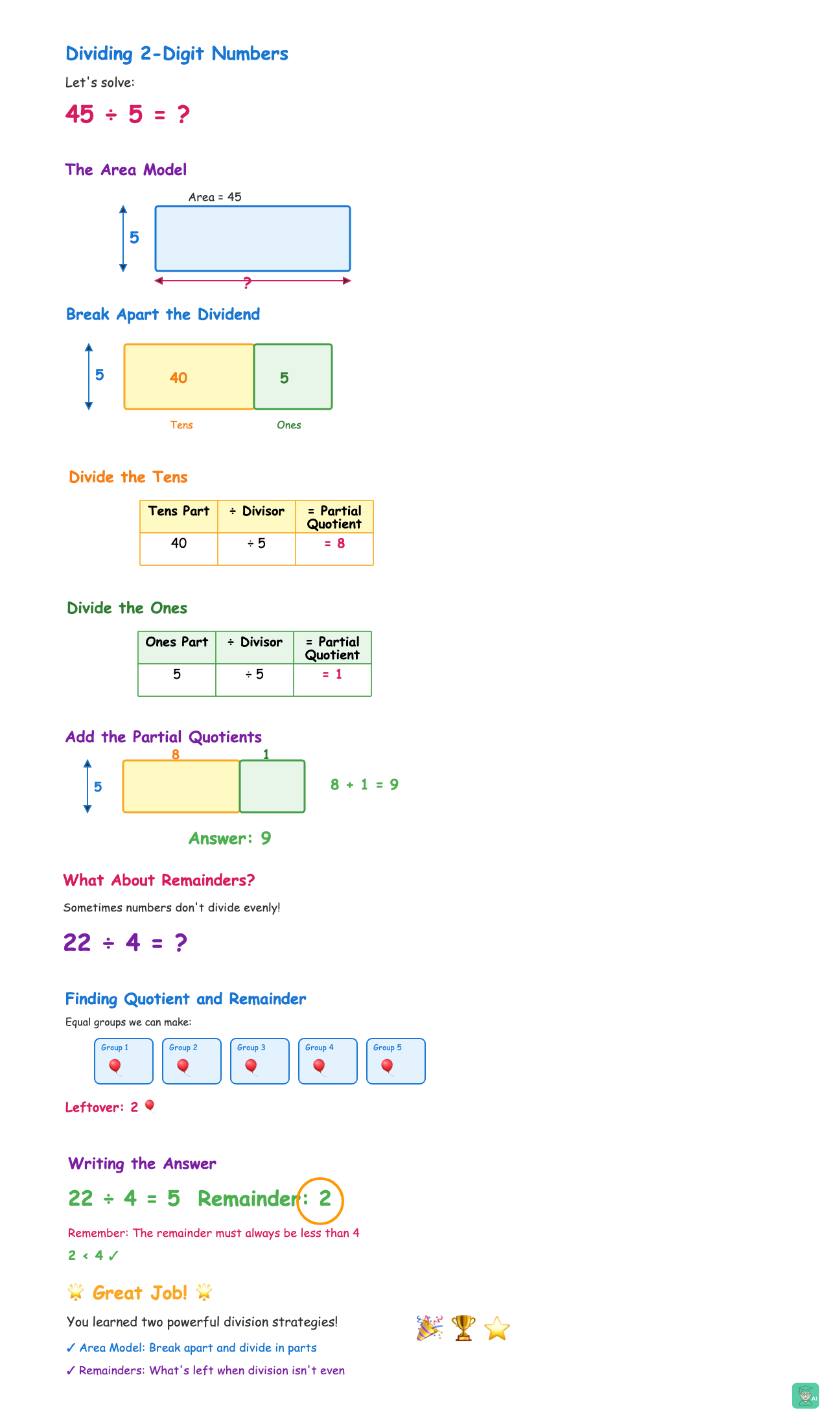
Here's what the full interactive lesson looks like on AI Teacherly:
The Divide 2-Digit Numbers by 1-Digit Numbers lesson on AI Teacherly guides students through progressively challenging problems. It starts with basic concepts and builds toward division with remainders, ensuring children develop solid foundations before tackling harder material.
What makes interactive practice particularly effective for division:
- Visual manipulatives: Children can see area models being built, which reinforces the connection between the visual representation and the numerical calculation
- Immediate feedback: Instead of completing an entire worksheet only to discover mistakes later, children know right away if their thinking is on track
- Multiple problem types: From multiple choice to ordering steps to error analysis, varied question formats keep practice engaging and address different aspects of understanding
- Self-paced learning: Children can take time on concepts they find challenging and move quickly through material they've mastered
For parents, platforms like AI Teacherly offer a window into exactly what your child is learning. You can work through problems together, see the same visual models your child sees at school, and speak the same mathematical language when helping with homework.
This bridges the gap between the "old math" you learned and the methods being taught today, making homework help sessions more productive and less stressful for everyone.
3 Simple Ways to Practice Division at Home
You don't need special materials or a teaching degree to help your child practice division. Here are three simple approaches that make practice feel natural and even fun:
1. Make It Real With Everyday Situations
The best division practice happens when children don't realize they're doing math. Look for natural opportunities throughout your day:
- Planning a birthday party: "We have 48 party favors for 8 goodie bags. How many in each bag?"
- Cooking together: "This recipe serves 4, but we need to feed 8 people. How do we adjust?"
- Road trips: "We have 150 miles to go and we're traveling about 50 miles per hour. How many hours?"
- Allowance and saving: "If you save $36 over 4 weeks, how much should you set aside each week?"
2. Play Division Games
Turn practice into play with simple games that require no preparation:
- Division War: Use a deck of cards. Each player flips two cards; the larger number is divided by the smaller. Highest quotient wins the round.
- Target Division: Pick a target number (like 12). Take turns finding division problems that equal that target (24÷2, 36÷3, 48÷4, etc.).
- Remainder Race: Roll two dice. The larger number is divided by the smaller. Score points equal to the remainder. First to 20 wins!
3. Use Visual Tools You Already Have
Create area models with materials around your home:
- Graph paper makes perfect grids for visualizing division
- Building blocks or LEGO pieces can be grouped and divided
- Draw rectangles on a whiteboard or paper and practice breaking them into friendly parts
Consistency matters more than duration. Ten minutes of engaged practice daily builds stronger skills than an hour of frustrated worksheet grinding once a week.
Key Takeaways
- The area model visualizes division as finding a missing side of a rectangle, making abstract math concrete and understandable for children and parents alike
- Partial quotients let children break big division problems into smaller, friendlier chunks, reducing anxiety and building number sense
- The remainder must always be less than the divisor; this rule helps children self-check their work
- Real-world practice (sharing snacks, planning parties, cooking) is more effective than worksheets for building lasting understanding
- Interactive digital lessons bridge the gap between how you learned math and how it's taught today, making homework help easier
- Consistency beats intensity: 10 minutes of daily practice outperforms weekly hour-long cramming sessions
- Modern division methods build the number sense and mental math skills your child will need for algebra and beyond
Frequently Asked Questions
What is the area model method for division?
The area model represents division as finding the missing side of a rectangle. If you know the area (dividend) and one side length (divisor), you can find the other side (quotient). It makes division visual and concrete.
Why do schools teach division differently now with area models?
Modern methods focus on building number sense so children understand what division means, not just how to calculate. This conceptual foundation helps students succeed in higher-level math like algebra and problem-solving.
How do I explain remainders to my 4th grader?
Use real examples like sharing snacks: '25 candies for 4 friends means 6 each with 1 left over.' The leftover is the remainder. Remind them the remainder must always be smaller than the number they divided by.
What does partial quotients mean in division?
Partial quotients means breaking a division problem into smaller, easier chunks. For 96÷6, you might find 10 sixes (60), then 6 more sixes (36), then add 10+6=16. It's flexible and builds mental math skills.
Is it normal for my child to struggle with two-digit division?
Absolutely! Two-digit division is a significant jump in complexity. Most 4th graders need plenty of practice. Consistent short practice sessions and visual models help build confidence over time.
How can I help with division homework if I learned it differently?
Focus on understanding the area model concept rather than your old method. Interactive platforms like AI Teacherly show exactly how these methods work, so you can learn alongside your child.
What's the rule about remainders being less than the divisor?
If the remainder is greater than or equal to the divisor, the division isn't complete. For example, when dividing by 4, a remainder of 5 means you can still make another group. It's a built-in error-checker.
How long should my 4th grader practice division each day?
10-15 minutes of focused daily practice is ideal. Short, consistent sessions are more effective than long, infrequent ones. Mix interactive lessons with real-world practice for the best results.
Ready to make division practice engaging and stress-free? Try the interactive Divide 2-Digit Numbers by 1-Digit Numbers lesson on AI Teacherly. Your child will build confidence with visual area models while you finally understand the method behind the math!