Mixed Operations with Decimals: The PEMDAS Secret Every 5th Grader Needs to Know
When your 5th grader freezes at expressions like "(3.5 + 2.8) × 4.2," PEMDAS is the answer. Learn the step-by-step framework that transforms decimal confusion into confidence.
Why Mixed Decimal Operations Trip Up 5th Graders
If your 5th grader has ever stared blankly at a math problem like (3.5 + 2.8) × 4.2 + 1.6 and said, "I don't even know where to start," you're not alone. Mixed operations with decimals represent one of the biggest leaps in 5th grade mathematics, and it's where many students hit a wall.
The challenge isn't that decimals are hard on their own, or that addition and multiplication are confusing individually. The struggle comes when students must combine multiple operations in the correct order while also keeping track of decimal points. It's cognitive overload, and without a clear system, even bright students get lost.
Here's the good news: there's a simple framework that transforms these overwhelming expressions into manageable, step-by-step puzzles. It's called PEMDAS, and once your child understands how it works with decimals, those intimidating problems become almost fun to solve.
In this guide, you'll learn exactly how PEMDAS works, how to apply it to decimal expressions, and how to use real-world shopping problems to make practice engaging. By the end, you'll have the tools to guide your child through homework confidently, even if math wasn't your favorite subject in school.
What Is PEMDAS and How Does It Work with Decimals?
PEMDAS is the order of operations that tells mathematicians (and 5th graders!) which calculations to perform first when an expression has multiple operations. Think of it as a universal rulebook that ensures everyone gets the same answer to the same problem.
Here's what each letter stands for:
- P = Parentheses (solve what's inside first)
- E = Exponents (powers like 2² or 3³)
- M/D = Multiplication and Division (left to right)
- A/S = Addition and Subtraction (left to right)
The key insight that many students miss: multiplication and division are equals, so you solve them left to right as they appear. The same goes for addition and subtraction. It's not strictly M then D, or A then S.
Why does PEMDAS matter for decimals?
When students work with whole numbers, PEMDAS mistakes sometimes go unnoticed because the numbers are simpler. But with decimals, every misplaced operation creates obviously wrong answers. A problem that should equal 15.7 might come out as 23.4 if steps are done out of order.
The good news? PEMDAS works exactly the same way with decimals as it does with whole numbers. The decimal point doesn't change the rules; it just means students need to be more careful with their calculations at each step.
A helpful mantra: "Parentheses first, then multiply or divide, and last, add or subtract. Follow this order, and you'll always get the right answer."
How to Solve Multi-Step Decimal Expressions Step by Step
Let's walk through exactly how your child should approach a mixed decimal operations problem. We'll use this example:
(4.2 + 1.8) × 2.5 - 3.0
Step 1: Find the parentheses and solve them first
Look for any numbers grouped in parentheses. Here, we have (4.2 + 1.8). Solve that addition first: 4.2 + 1.8 = 6.0
Now the expression becomes: 6.0 × 2.5 - 3.0
Step 2: Look for multiplication and division
Next, scan left to right for any multiplication or division. We have 6.0 × 2.5: 6.0 × 2.5 = 15.0
Now the expression becomes: 15.0 - 3.0
Step 3: Handle addition and subtraction last
Finally, solve the remaining addition or subtraction: 15.0 - 3.0 = 12.0
The answer is 12.0
Pro tip for parents: When helping with homework, encourage your child to rewrite the expression after each step. This "show your work" approach does two things: it catches mistakes early, and it builds the habit of organized mathematical thinking that pays off in middle school algebra.
Common pitfall to avoid: Many students want to work left to right regardless of operation type. In our example, that would mean adding 4.2 + 1.8, but then subtracting 3.0 before multiplying. Wrong! PEMDAS always trumps left-to-right ordering for different operation types.
Real-World Practice: Shopping Problems Your Child Can Relate To
Abstract math expressions can feel meaningless to 5th graders. But turn that same math into a shopping trip? Suddenly they're engaged.
Here's why real-world word problems are so powerful for teaching mixed decimal operations: they give kids a reason to care about getting the right answer. Nobody wants to overpay at the store or miscalculate their change!
Example shopping problem:
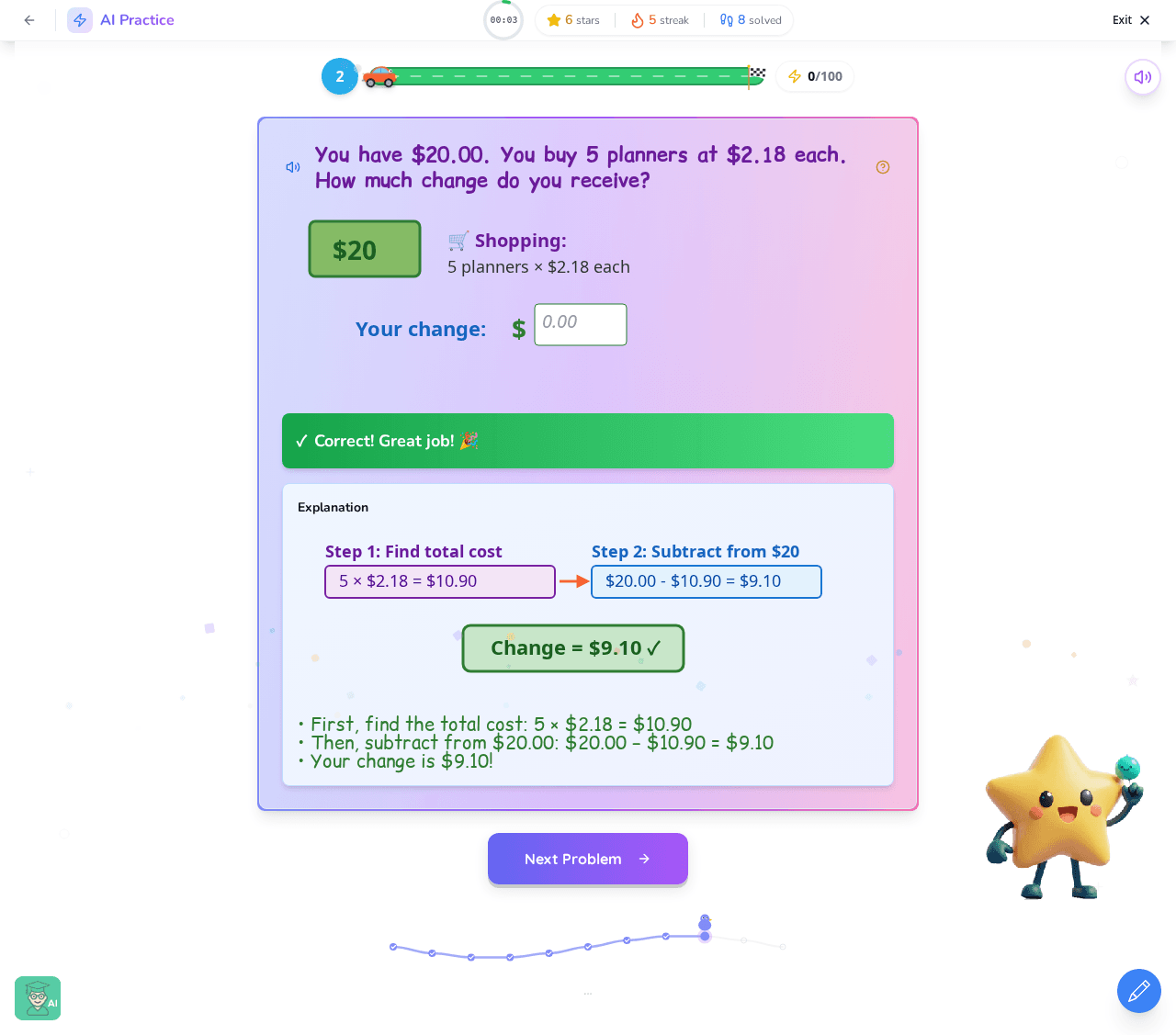
You're buying 3 notebooks at $2.50 each and 2 pens at $1.75 each. How much do you spend in total?
This problem requires setting up and solving: (3 × 2.50) + (2 × 1.75)
Using PEMDAS:
- First, solve the parentheses: 3 × 2.50 = 7.50 and 2 × 1.75 = 3.50
- Then add: 7.50 + 3.50 = $11.00
Why this approach works:
Shopping problems connect decimal operations to something tangible. Your child can visualize the notebooks and pens. They understand why you multiply price by quantity, and why you add the totals together. This conceptual understanding is far more durable than memorizing procedures.
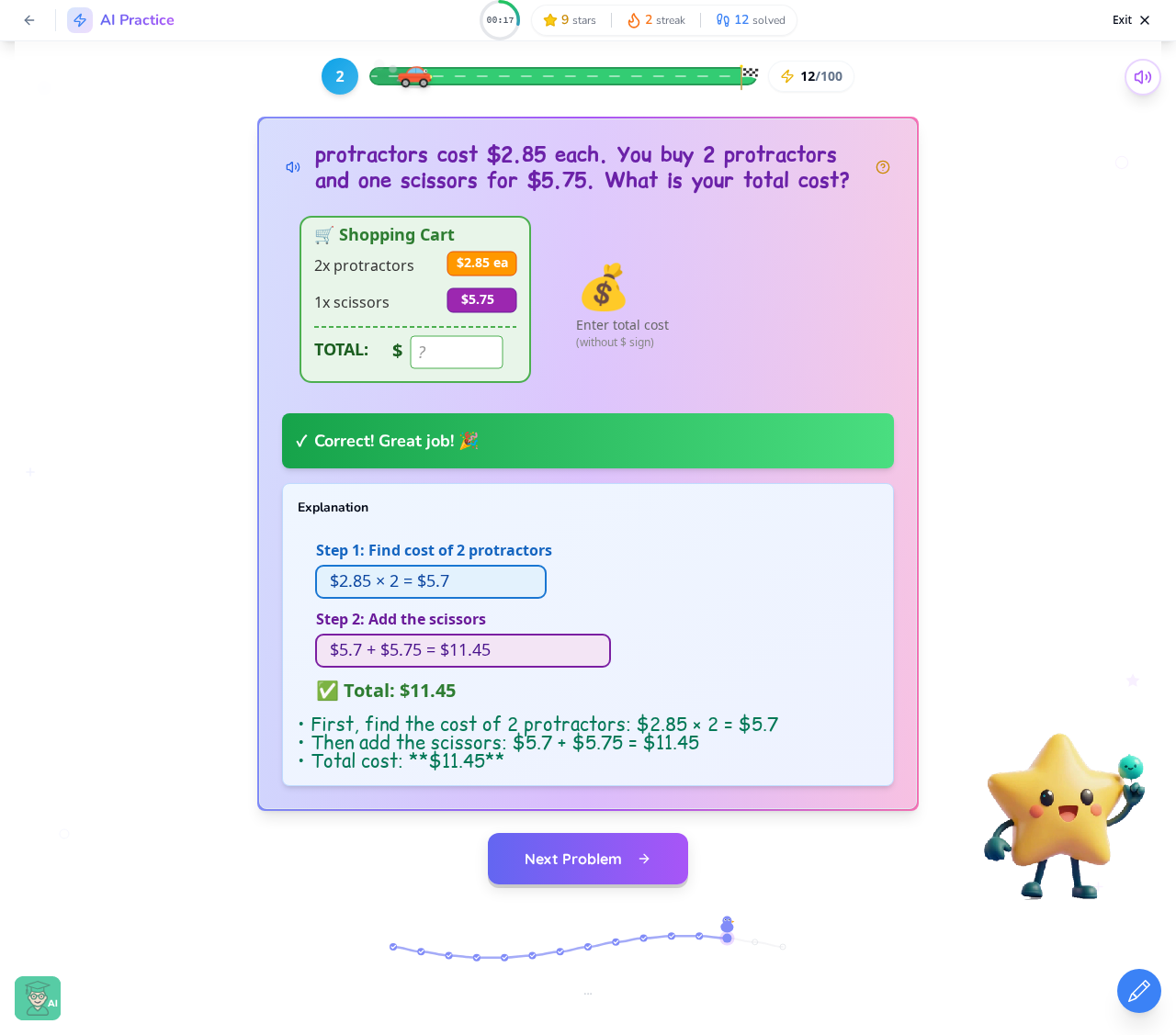
The interactive problem below shows exactly how AI Teacherly presents these real-world scenarios, making practice feel like problem-solving rather than drilling.
At-home practice idea: Next time you're at the grocery store or shopping online, ask your child to calculate the total before checkout. Start simple (two or three items), then gradually increase complexity. Real stakes make real mathematicians!
How to Check Answers: The True/False Equation Method
One of the most valuable skills your 5th grader can develop is self-verification: the ability to check their own work and catch mistakes before turning in assignments.
The true/false equation method teaches exactly this skill. Here's how it works:
Given an equation like: 2.4 × 3.0 = 4.2 + 3.0
To determine if this is true or false, your child should:
- Evaluate the left side independently: 2.4 × 3.0 = 7.2
- Evaluate the right side independently: 4.2 + 3.0 = 7.2
- Compare the results: 7.2 = 7.2 ✓ TRUE
Try another one: 5.5 - 2.3 = 1.5 × 2.0
- Left side: 5.5 - 2.3 = 3.2
- Right side: 1.5 × 2.0 = 3.0
- Compare: 3.2 ≠ 3.0 FALSE
Why this matters for homework success:
When students can evaluate both sides of an equation independently, they develop the critical thinking skill of checking their own reasoning. This transfers directly to catching mistakes in their own solutions.
Teach your child to become a "math detective" by always asking: "Can I verify this answer another way?" The lesson on AI Teacherly explicitly frames this as detective work, which makes the verification process feel like a fun challenge rather than extra work.
Parent coaching tip: When your child finishes a problem, instead of immediately telling them if it's right or wrong, ask: "How could you check that answer?" This builds independence and problem-solving confidence.
See How Interactive Decimal Lessons Work on AI Teacherly
Reading about PEMDAS is one thing. Seeing it in action is another.
On AI Teacherly, the Mixed Operations with Decimals lesson transforms these concepts into an engaging, interactive experience. Students work through problems step by step with immediate feedback, visual representations, and encouraging narration that keeps them motivated.
Here's what makes the interactive approach different from worksheets:
Visual scaffolding: Problems include colorful visual elements that help students organize their thinking. Instead of staring at a wall of numbers, they see the structure of the problem clearly.
Immediate feedback: Students know right away if their approach is working. No more waiting until the next day to find out they've been practicing incorrectly.
Real-world contexts: The lesson uses shopping scenarios, making change, and calculating costs; problems that feel relevant to a 5th grader's life.
Confidence-building progression: The lesson starts with simpler expressions and gradually increases complexity, ensuring students build confidence before tackling the hardest problems.
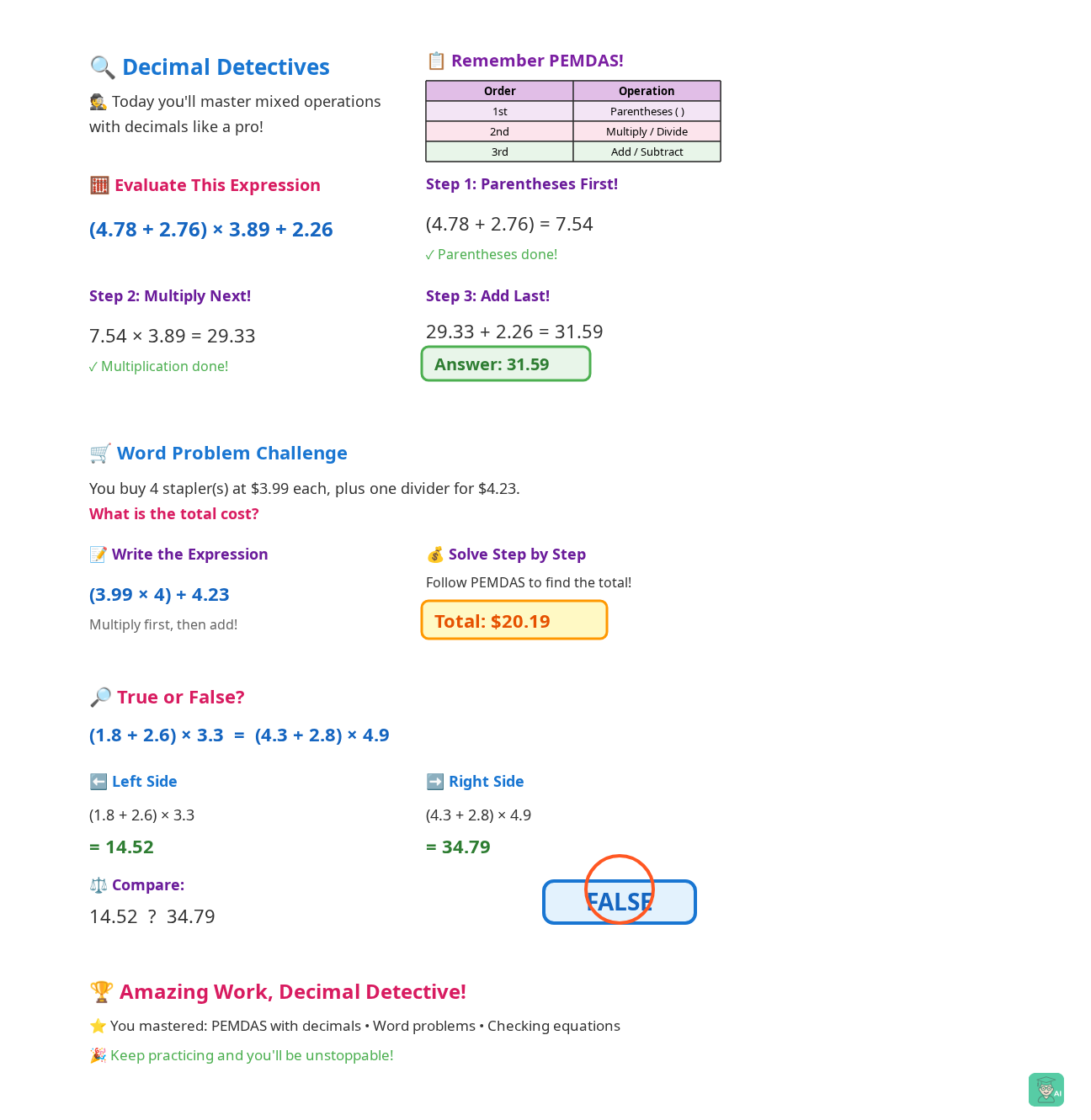
Here's what the full interactive lesson looks like on AI Teacherly:
The "Decimal Detectives" theme runs throughout the lesson, framing students as investigators solving mathematical cases. This gamified approach keeps engagement high while teaching rigorous mathematical thinking.
What parents tell us: "My daughter went from dreading decimal homework to actually asking to do more practice. The interactive format made all the difference."
Common Mistakes to Watch For (And How to Fix Them)
Even after learning PEMDAS, students make predictable mistakes. Knowing what to watch for helps you guide your child more effectively.
Mistake #1: Working strictly left to right
In 3.0 + 4.0 × 2.0, students often add 3.0 + 4.0 first (getting 7.0) then multiply by 2.0 (getting 14.0). Wrong! PEMDAS says multiply first: 4.0 × 2.0 = 8.0, then add: 3.0 + 8.0 = 11.0.
The fix: Before solving, have your child circle or highlight all multiplication and division operations. These get solved before any addition or subtraction.
Mistake #2: Forgetting that M/D and A/S are equal pairs
In 8.0 ÷ 2.0 × 4.0, some students think multiplication comes before division. Actually, you work left to right: 8.0 ÷ 2.0 = 4.0, then 4.0 × 4.0 = 16.0.
The fix: Emphasize that M and D are "tied" (work left to right), and A and S are "tied" (work left to right).
Mistake #3: Decimal point misalignment in multi-step problems
When students rush through multiple operations, decimal points can drift. 2.5 × 4 becomes "100" instead of "10.0."
The fix: Encourage writing each step on a new line with decimal points vertically aligned. This simple habit catches errors before they cascade.
Mistake #4: Not showing work (then not finding errors)
Students who try to do everything mentally often get wrong answers and can't identify where they went wrong.
The fix: Make "show your work" non-negotiable for multi-step problems. It's not about proving they didn't cheat; it's about building habits that support accuracy and learning.
Key Takeaways
- PEMDAS (Parentheses, Exponents, Multiplication/Division, Addition/Subtraction) is the universal order of operations that works the same with decimals as with whole numbers
- Multiplication and division are equal (work left to right), and addition and subtraction are equal (work left to right) — it's not strictly M then D or A then S
- Real-world shopping problems make decimal practice meaningful by giving kids a reason to care about correct answers
- Breaking complex expressions into steps (rewriting after each operation) prevents overwhelm and catches mistakes early
- The true/false equation method teaches self-verification — a critical skill for catching homework errors independently
- Common mistakes include working strictly left to right, forgetting M/D and A/S are pairs, and not showing work
- Interactive lessons with immediate feedback and visual scaffolding help students build confidence faster than worksheets alone
Frequently Asked Questions
What is PEMDAS and why is it important for decimals?
PEMDAS stands for Parentheses, Exponents, Multiplication/Division, Addition/Subtraction. It's the order of operations that ensures everyone solves math expressions the same way. It's crucial for decimals because mistakes in order create obviously wrong answers.
How do you solve expressions with multiple decimal operations?
First solve anything in parentheses, then handle exponents, next do multiplication and division from left to right, and finally complete addition and subtraction from left to right. Rewrite the expression after each step to stay organized.
Why does my 5th grader struggle with decimal word problems?
Multi-step decimal problems combine several cognitive challenges: identifying operations, remembering correct order, and tracking decimal points. Without a clear system like PEMDAS, it's easy to feel overwhelmed. The solution is breaking problems into single steps.
What order do you solve decimal expressions?
Always follow PEMDAS: Parentheses first, then Exponents, then Multiplication and Division (left to right), and finally Addition and Subtraction (left to right). The decimal point doesn't change these rules.
How can I help my child practice decimal operations at home?
Use real shopping scenarios! Ask your child to calculate totals before checkout, figure out change, or compare unit prices. Real stakes make practice meaningful. Interactive platforms like AI Teacherly also provide engaging, feedback-rich practice.
What are common mistakes kids make with PEMDAS and decimals?
The top mistakes are: working strictly left to right (ignoring operation priority), thinking multiplication always comes before division, misaligning decimal points in multi-step problems, and not showing work (making errors hard to find).
Is it normal for 5th graders to struggle with order of operations?
Absolutely normal. Mixed operations with decimals represent one of the biggest leaps in 5th grade math. The combination of multiple operations and decimal tracking is genuinely challenging. With consistent practice using PEMDAS, most students improve significantly.
How do you check if a decimal equation is true or false?
Evaluate each side of the equation independently, then compare the results. If both sides equal the same value, the equation is true. If they differ, it's false. This method teaches valuable self-verification skills.
Ready to turn decimal confusion into confidence? Try the free Mixed Operations with Decimals lesson on AI Teacherly and watch your 5th grader become a true decimal detective!