Multiplication with Equal Groups and Arrays: A Parent's Guide to 3rd Grade Math
Confused by equal groups and arrays on your 3rd grader's math homework? Discover how today's visual approach to multiplication builds deeper understanding and how you can support learning at home.
Why Multiplication Looks Different in Your Child's Classroom
If you've ever looked at your 3rd grader's math homework and thought, "This isn't how I learned multiplication," you're not alone. Today's classrooms have shifted away from memorizing times tables first. Instead, teachers focus on building conceptual understanding through visual methods like equal groups and arrays.
This approach might seem slower at first, but research shows that children who understand why multiplication works retain their knowledge longer and apply it more flexibly. The pictures and diagrams on your child's worksheet aren't just busy work. They're building the foundation for mathematical thinking that will serve them through algebra and beyond.
As a parent, understanding this visual approach means you can support your child's learning without creating confusion. You won't accidentally teach them a shortcut that contradicts what they're learning in class. Instead, you'll reinforce the same concepts using the same language their teacher uses.
The good news? Once you understand equal groups and arrays, you'll see multiplication opportunities everywhere, from snack time to toy organization. Let's break down exactly what these terms mean and how they transform multiplication from memorization into understanding.
What Are Equal Groups in Multiplication?
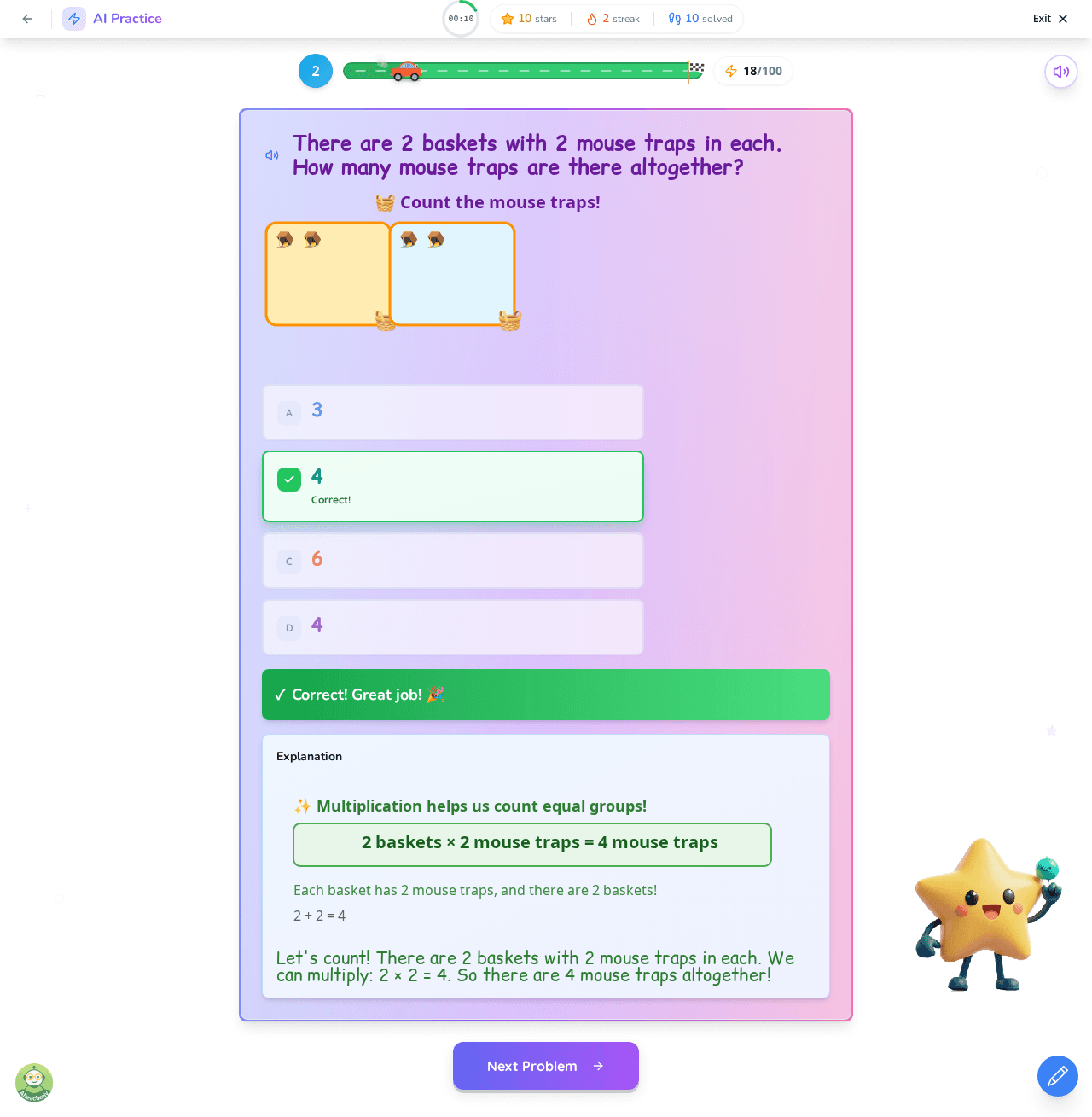
Equal groups are the foundation of multiplication. The concept is simple: when you have several groups that each contain the same number of items, you have equal groups. Multiplication tells you how many items you have in total without counting each one individually.
Think of it this way: if you have 4 bags and each bag contains 3 apples, you have 4 equal groups of 3. Instead of counting 3 + 3 + 3 + 3, multiplication gives you the shortcut: 4 × 3 = 12.
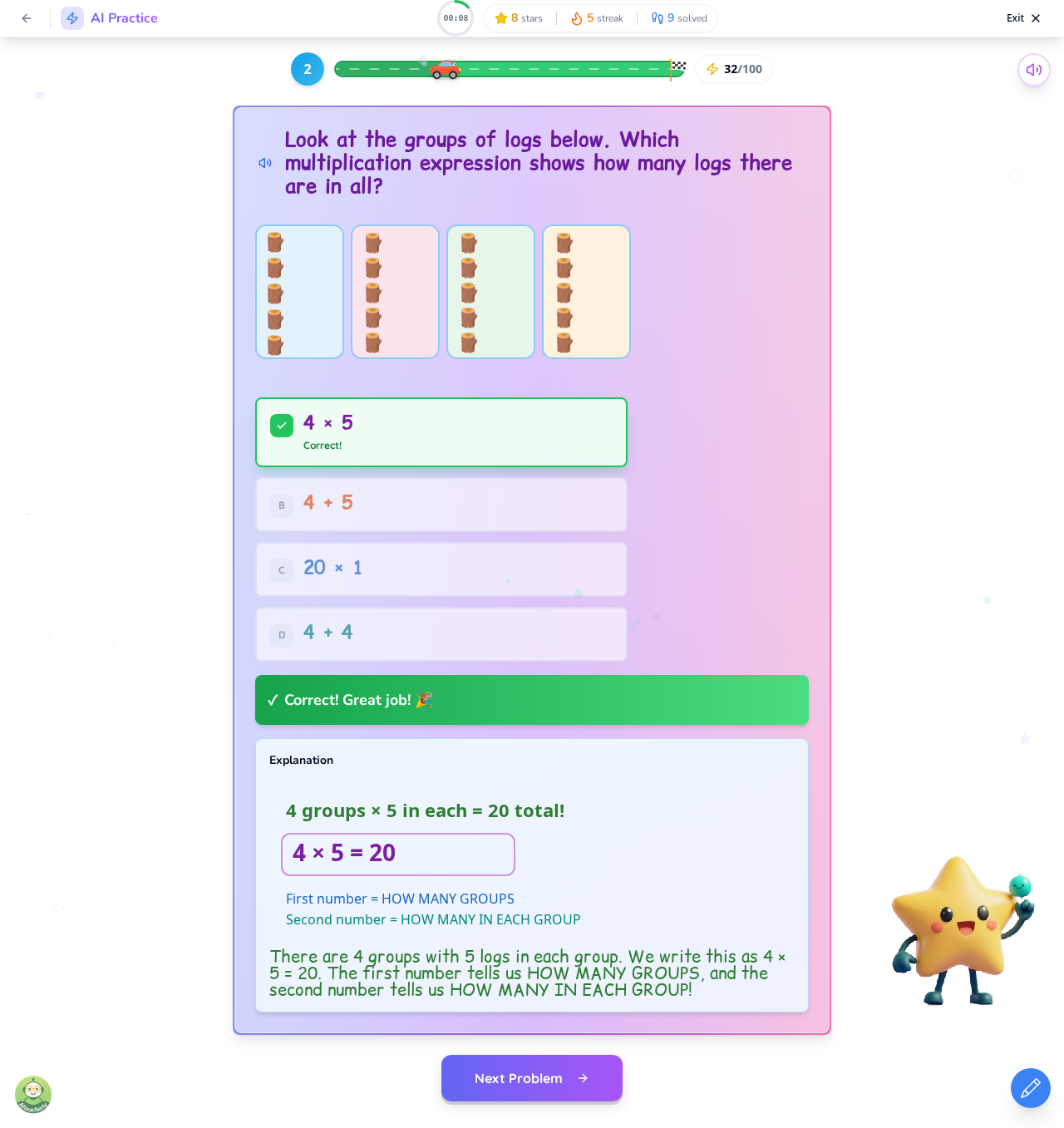
The first number in a multiplication problem tells you how many groups you have. The second number tells you how many items are in each group. This is why your child's teacher might ask them to draw circles (representing groups) with dots inside (representing items).
Why this matters: When children understand equal groups visually, they grasp that multiplication isn't a scary new operation. It's simply a faster way to count things that are already organized. This understanding makes learning multiplication facts much easier because the numbers have meaning attached to them.
The interactive problem below shows exactly how equal groups work in practice, displaying grouped items that students count and then express as multiplication.
How Do Arrays Help Kids Understand Multiplication?
Arrays take equal groups one step further by organizing them into rows and columns. Think of an egg carton, a muffin tin, or a checkerboard. These are all arrays: items arranged in neat rows going across and columns going down.
Here's where arrays become powerful: they help children discover the commutative property of multiplication naturally. When looking at an array of 3 rows with 4 items in each row (3 × 4), children can also see 4 columns with 3 items in each column (4 × 3). Both equal 12! This visual proof shows children why order doesn't matter in multiplication, a concept that's hard to grasp through memorization alone.
Arrays also connect multiplication to real-world scenarios your child encounters daily:
- Rows of desks in their classroom
- Tiles on the bathroom floor
- Windows on a building
- Keys on a keyboard
The language of arrays: Teachers often say "rows are your groups" and "columns are items in each group." When your child sees an array, encourage them to count the rows first (that becomes the first number), then count how many are in each row (that becomes the second number).
This visual organization prepares children for more advanced concepts like area and multiplication with larger numbers. When they eventually multiply 23 × 15, the array model scales up beautifully to show why the standard algorithm works.
The Secret Connection: Multiplication as Repeated Addition
Here's the bridge that connects what your child already knows to this new operation: multiplication is a shortcut for repeated addition. When children see that 4 × 3 is just a faster way to write 3 + 3 + 3 + 3, multiplication stops being mysterious.
This connection is crucial for several reasons:
It builds on prior knowledge. Your child already knows how to add. Multiplication isn't replacing addition; it's building on it.
It explains why multiplication makes numbers bigger. When you add the same number multiple times, of course the result grows!
It helps with fact memorization later. If your child forgets 7 × 3, they can figure it out: 3 + 3 + 3 + 3 + 3 + 3 + 3 = 21.
Teachers often have children write out the repeated addition equation before writing the multiplication sentence. This isn't busywork. It's cementing the connection between operations.
Practice at home: When you're setting the table, say "We need 4 plates. Each plate gets 3 pieces of silverware. That's 3 + 3 + 3 + 3... or we could just say 4 times 3!" These everyday moments reinforce that multiplication is practical, not abstract.
The lesson scripts capture this perfectly: "Multiplication is just a shortcut for adding the same number over and over." When children internalize this, multiplication transforms from intimidating to intuitive.
Why Zero and One Follow Special Rules
Two multiplication facts often confuse children: anything times zero equals zero, and anything times one equals itself. Memorizing these rules is easy, but understanding them prevents confusion later.
Multiplying by zero: Using the equal groups model, if you have zero groups, you have zero items. It doesn't matter what's supposedly "in" each group because there are no groups! Similarly, if you have 5 groups with zero items in each group, you still have nothing.
Visualize it: Imagine 5 empty baskets. How many apples do you have total? Zero, because each basket has zero apples. This visual makes "anything times zero equals zero" obvious rather than magical.
Multiplying by one: If you have one group of 7, you just have 7. The items aren't duplicated or changed. Having one group is the same as having that group's contents.
Visualize it: One bag with 7 marbles gives you 7 marbles. One row with 7 chairs gives you 7 chairs. There's no multiplication "happening" in the traditional sense; you're just counting what's in your single group.
Why this matters for parents: When your child encounters 847 × 0 or 1 × 999 on a test, they won't need to calculate. The visual understanding they built with small numbers applies to any number instantly. This is the power of conceptual learning: rules that seem arbitrary become self-evident.
5 Easy Ways to Practice Multiplication at Home
You don't need worksheets or flashcards to reinforce multiplication concepts. The best practice happens naturally, using objects your child already interacts with daily.
1. Snack Time Math Arrange crackers, grapes, or carrot sticks into equal groups or arrays before eating. "Let's make 3 rows with 4 crackers each. How many crackers do we have?" Then let them eat their math!
2. Toy Organization When cleaning up, sort toys into equal groups. "Put your cars into groups of 4. How many groups did you make? How many cars total?" This turns cleanup into a learning moment.
3. Egg Carton Counting An egg carton is a perfect 2 × 6 or 6 × 2 array. Use small objects (buttons, beans, coins) to fill different portions and calculate totals. "We filled 3 rows of 4 spaces. How many buttons?"
4. Window and Tile Hunts When you're out and about, look for arrays. Building windows, floor tiles, and ceiling panels all work. "That window has 3 rows of 4 panes. What multiplication fact is that?"
5. Story Problems with Favorite Things Create word problems using your child's interests. "You have 5 Pokémon cards, and each card has 3 special moves. How many moves total?" Personal relevance increases engagement dramatically.
The key: Use the language of equal groups and arrays. Say "groups" and "rows" rather than jumping to "times." This reinforces school learning rather than creating shortcuts that might confuse.
See How Interactive Learning Makes Multiplication Click
While hands-on practice with physical objects is invaluable, interactive digital lessons offer something unique: immediate feedback and visual scaffolding that adapts to your child's responses.
On platforms like AI Teacherly, the Introduction to Multiplication: Equal Groups and Arrays lesson guides 3rd graders through the same conceptual progression we've discussed:
- First, they encounter scattered equal groups and count total items
- Then, the same items are arranged into organized arrays
- Next, they write the repeated addition equation
- Finally, they express it as a multiplication sentence
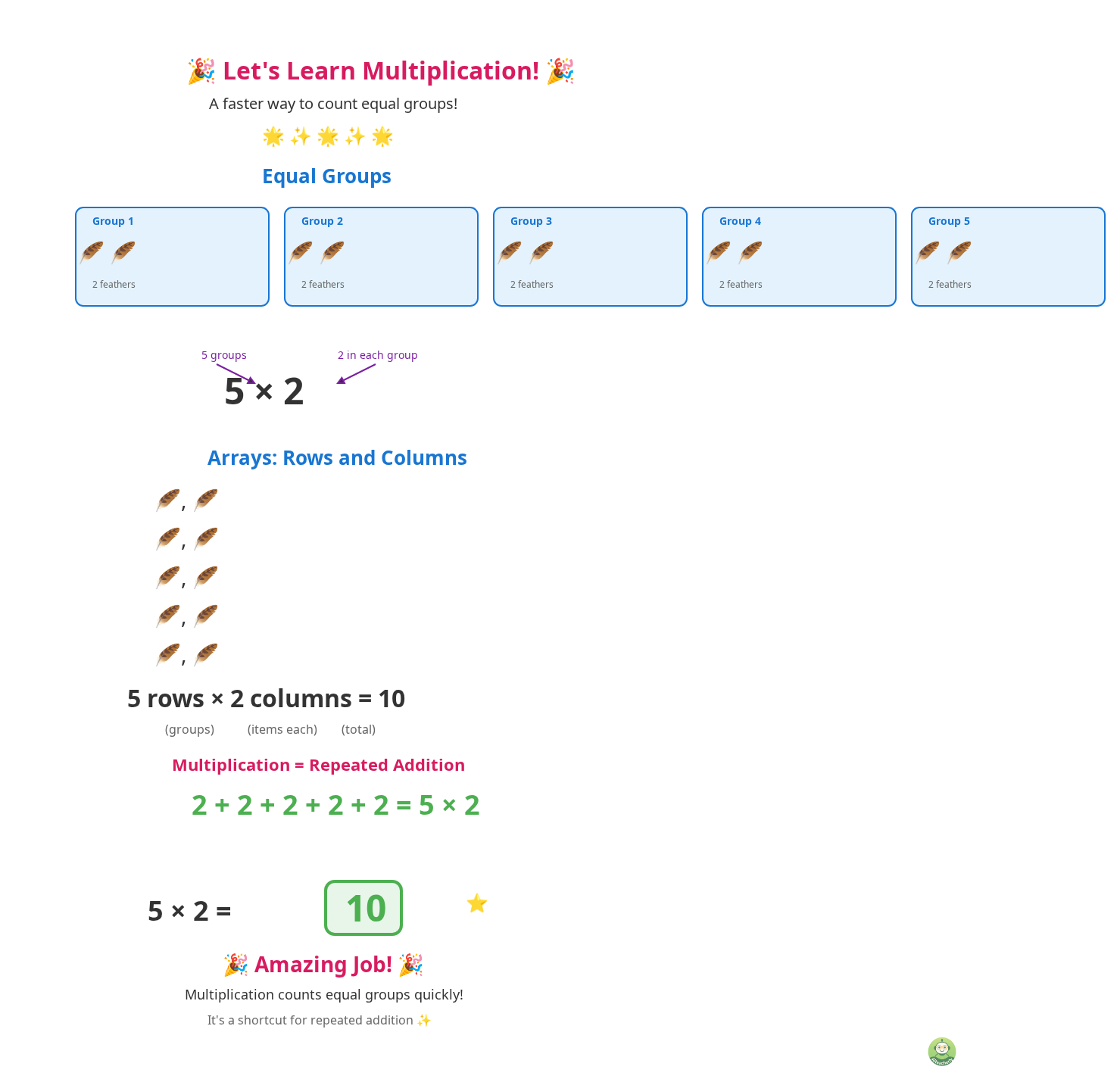
Seeing the same problem represented four different ways builds flexible thinking. Children understand that 3 × 4, 4 + 4 + 4, and an array of 3 rows by 4 columns are all the same thing.
The narrated instruction uses child-friendly language: "Multiplication is a super fast way to count things when they're in equal groups." This matches how their teacher explains it, creating consistency between school, home, and digital practice.
Here's what the full interactive lesson looks like on AI Teacherly, showing how visual manipulatives, narration, and engaging activities come together:
Why interactive practice works: Unlike static worksheets, interactive lessons can show animations of groups forming, arrays rotating, and repeated addition transforming into multiplication. This dynamic visualization helps visual learners especially, and the instant feedback prevents children from practicing mistakes.
Key Takeaways
- Equal groups are the foundation: Multiplication counts groups with the same number of items, making it a visual concept before it becomes memorization
- Arrays organize equal groups into rows and columns, helping children discover that 3×4 and 4×3 give the same answer
- Multiplication is repeated addition in disguise: 4×3 is just 3+3+3+3, connecting new learning to what children already know
- Zero and one rules make sense visually: Zero groups means zero items, and one group means just that group's contents
- Practice anywhere without worksheets: Snacks, toys, egg cartons, and window panes become multiplication opportunities
- Consistent language matters: Use 'groups,' 'rows,' and 'arrays' to reinforce what children learn at school
- Interactive lessons provide immediate feedback and visual scaffolding that static worksheets cannot match
Frequently Asked Questions
What are equal groups in multiplication?
Equal groups means having several groups that each contain the same number of items. For example, 4 bags with 3 apples each is 4 equal groups of 3. Multiplication (4×3=12) counts the total without adding each group separately.
How do arrays help children understand multiplication?
Arrays organize items into rows and columns, helping children see that 3 rows of 4 equals 4 columns of 3. This visual proof shows why order doesn't matter in multiplication and connects to real objects like egg cartons and window panes.
Why do schools teach multiplication with pictures instead of times tables?
Research shows children who understand WHY multiplication works retain knowledge longer and apply it more flexibly. Visual methods build conceptual understanding before memorization, creating a stronger foundation for advanced math.
What is the difference between equal groups and arrays?
Equal groups can be scattered anywhere, while arrays organize those groups into neat rows and columns. Arrays are essentially equal groups arranged in a structured grid pattern, making it easier to see multiplication relationships.
How does repeated addition connect to multiplication?
Multiplication is a shortcut for repeated addition. Instead of writing 3+3+3+3, you write 4×3. This connection helps children understand multiplication isn't a new scary operation but builds on addition they already know.
When should my child start memorizing multiplication facts?
After they understand the concepts visually, typically mid-to-late 3rd grade. Memorization is faster and sticks better when children already understand what the facts mean. Rushing memorization before understanding can create math anxiety.
How can I practice multiplication at home without worksheets?
Use everyday objects: arrange snacks in arrays, sort toys into equal groups, count window panes or floor tiles, or create story problems with your child's favorite things. Real-world practice reinforces concepts naturally.
Why does anything multiplied by zero equal zero?
Using equal groups: if you have zero groups, you have zero items regardless of what would be in each group. Similarly, groups containing zero items still total zero. The visual model makes this rule obvious rather than requiring memorization.
Ready to make multiplication click for your child? Try the free interactive lesson on equal groups and arrays at AI Teacherly, where visual learning meets instant feedback!