Multiplying Mixed Numbers Made Easy: The Simple 3-Step Method Every 5th Grader Needs
Struggling with mixed number multiplication homework? Discover the simple 3-step method (convert, multiply, simplify) that makes 5th grade fraction math click for your child and you.
Why Mixed Number Multiplication Feels So Confusing
That moment when your 5th grader asks for homework help and you realize you haven't multiplied mixed numbers in decades? You're not alone, and the good news is there's one simple conversion trick that makes it all manageable.
Multiplying mixed numbers for 5th grade is one of the most challenging concepts in elementary math. Unlike simple fraction multiplication, mixed numbers (like 2¾ or 3½) combine whole numbers and fractions, which creates confusion about where to even begin. Should you multiply the whole numbers first? What about the fractions? Do they get multiplied separately?
The answer is simpler than you might think. The secret that makes mixed number multiplication manageable is this: convert everything to improper fractions first. Once you do that, the actual multiplication becomes straightforward. No juggling whole numbers and fractions separately. No complicated multi-step mental math.
In this guide, we'll walk through the exact 3-step process your child is learning, show you common pitfalls to avoid, and demonstrate how interactive practice can build lasting confidence. By the end, you'll feel equipped to support your 5th grader through any mixed number problem that comes home.
What Are Mixed Numbers and Why Does Conversion Matter?
Before diving into multiplication, let's clarify what we're working with. A mixed number combines a whole number with a fraction, like 2¾ (two and three-fourths). An improper fraction is where the numerator (top number) is larger than the denominator (bottom number), like 11/4.
Here's the key insight: 2¾ and 11/4 are the exact same value, just written differently. The improper fraction form is much easier to multiply because it's a single number rather than two parts you need to track.
Why do you convert mixed numbers to improper fractions before multiplying?
Trying to multiply mixed numbers directly creates chaos. Imagine multiplying 2¾ × 1½ without converting first. Would you multiply 2 × 1, then ¾ × ½, then somehow combine them? That approach gets messy fast and often leads to wrong answers.
By converting first, you transform the problem into simple fraction multiplication:
- 2¾ becomes 11/4
- 1½ becomes 3/2
- Now you just multiply: 11/4 × 3/2 = 33/8
This is the foundational concept your child needs to master. Once they understand that conversion simplifies everything, mixed number multiplication becomes much more approachable.
How Do You Multiply Mixed Numbers Step by Step?
Here's the complete process broken down into three manageable steps. This is the exact method your 5th grader is learning, and it works for any mixed number multiplication problem.
Step 1: Convert Mixed Numbers to Improper Fractions
Use this simple formula: multiply the whole number by the denominator, add the numerator, and put that total over the original denominator.
For example, to convert 3¼:
- Multiply: 3 × 4 = 12
- Add the numerator: 12 + 1 = 13
- Keep the same denominator: 13/4
Step 2: Multiply Straight Across
Once both numbers are improper fractions, multiplication is easy:
- Multiply the numerators (top numbers) together
- Multiply the denominators (bottom numbers) together
Example: 13/4 × 7/2 = (13 × 7)/(4 × 2) = 91/8
Step 3: Simplify and Convert Back
Your answer is likely an improper fraction, so convert it back to a mixed number:
- Divide the numerator by the denominator: 91 ÷ 8 = 11 remainder 3
- The quotient becomes the whole number, the remainder becomes the new numerator: 11⅜
The complete workflow: Convert → Multiply → Simplify. That's it. Three steps, and your child can solve any mixed number multiplication problem.
See Interactive Mixed Number Practice in Action
Understanding the steps conceptually is important, but practice with immediate feedback is what truly builds mastery. This is where interactive learning platforms make a real difference.
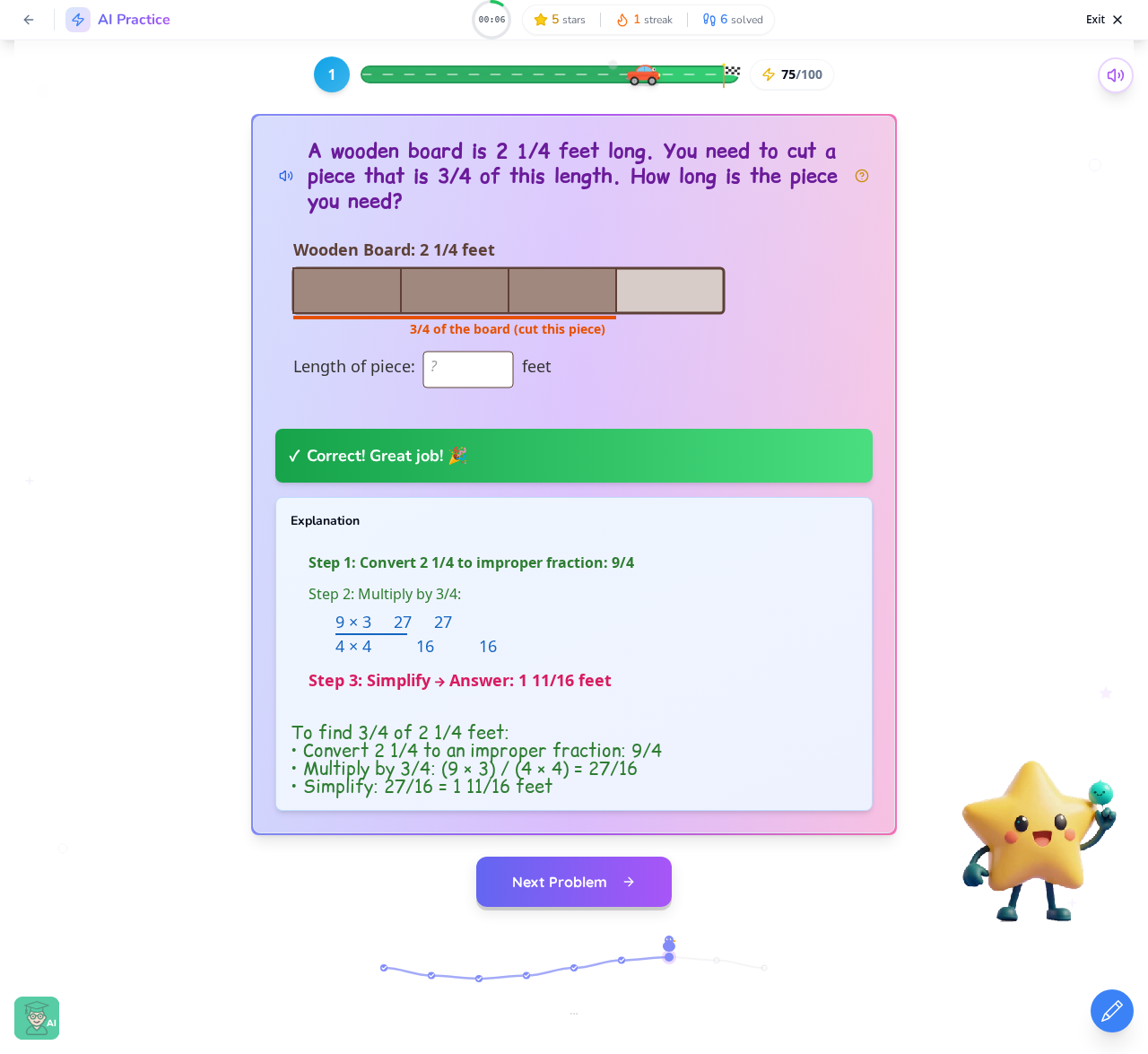
The interactive problem below demonstrates how mixed number multiplication works with a practical, real-world scenario. Notice how the problem uses measurement (cutting wood), which helps students connect abstract math to situations they might actually encounter.
What makes interactive practice effective is the instant feedback loop. When your child enters an answer, they immediately know if they're on track. If they make an error, they can identify exactly where their calculation went wrong rather than completing an entire worksheet incorrectly.
For parents, this type of practice is valuable because:
- It reduces homework frustration: Your child can work through problems independently
- Mistakes become learning moments: Immediate feedback prevents practicing errors
- Progress is visible: You can see which concepts are clicking and which need more work
- Real-world context: Problems like recipes and measurements make math feel relevant
Research consistently shows that interactive, visual math practice improves both understanding and retention compared to traditional worksheet-only approaches. The key is combining conceptual explanation (like the steps above) with hands-on practice.
Common Mistakes Kids Make When Multiplying Mixed Numbers
Knowing where students typically stumble helps you spot and correct errors before they become habits. Here are the most frequent mistakes 5th graders make with mixed number multiplication:
Mistake #1: Forgetting to Convert First
Some students try to multiply the whole numbers and fractions separately, then add them together. For example, with 2½ × 1⅓, they might calculate 2 × 1 = 2 and ½ × ⅓ = ⅙, then write 2⅙. This gives the wrong answer (the correct answer is 3⅓).
How to fix it: Remind your child that the first step is ALWAYS conversion. The multiplication only happens after both numbers are improper fractions.
Mistake #2: Conversion Calculation Errors
The formula (whole × denominator + numerator) has multiple steps where students can make arithmetic mistakes. A child might forget to add the numerator or multiply incorrectly.
How to fix it: Have your child write out each step: "3 × 4 = 12, 12 + 1 = 13, so 13/4." Showing work catches errors.
Mistake #3: Forgetting to Simplify or Convert Back
Students often stop at the improper fraction answer (like 33/8) without converting back to a mixed number (4⅛) or simplifying when possible.
How to fix it: Create a checklist: "Did I convert back? Can this fraction be simplified?" Having a routine prevents skipped steps.
Mistake #4: Treating Whole Numbers Incorrectly
When multiplying a mixed number by a whole number, students sometimes forget that whole numbers can be written as fractions. The number 4 can be written as 4/1, which makes multiplication straightforward.
How to fix it: Practice writing whole numbers as fractions over 1 before multiplying.
Real-World Examples: When Will My Child Use This?
One of the best ways to motivate math learning is connecting it to real life. Mixed number multiplication appears in many everyday situations:
Cooking and Recipes
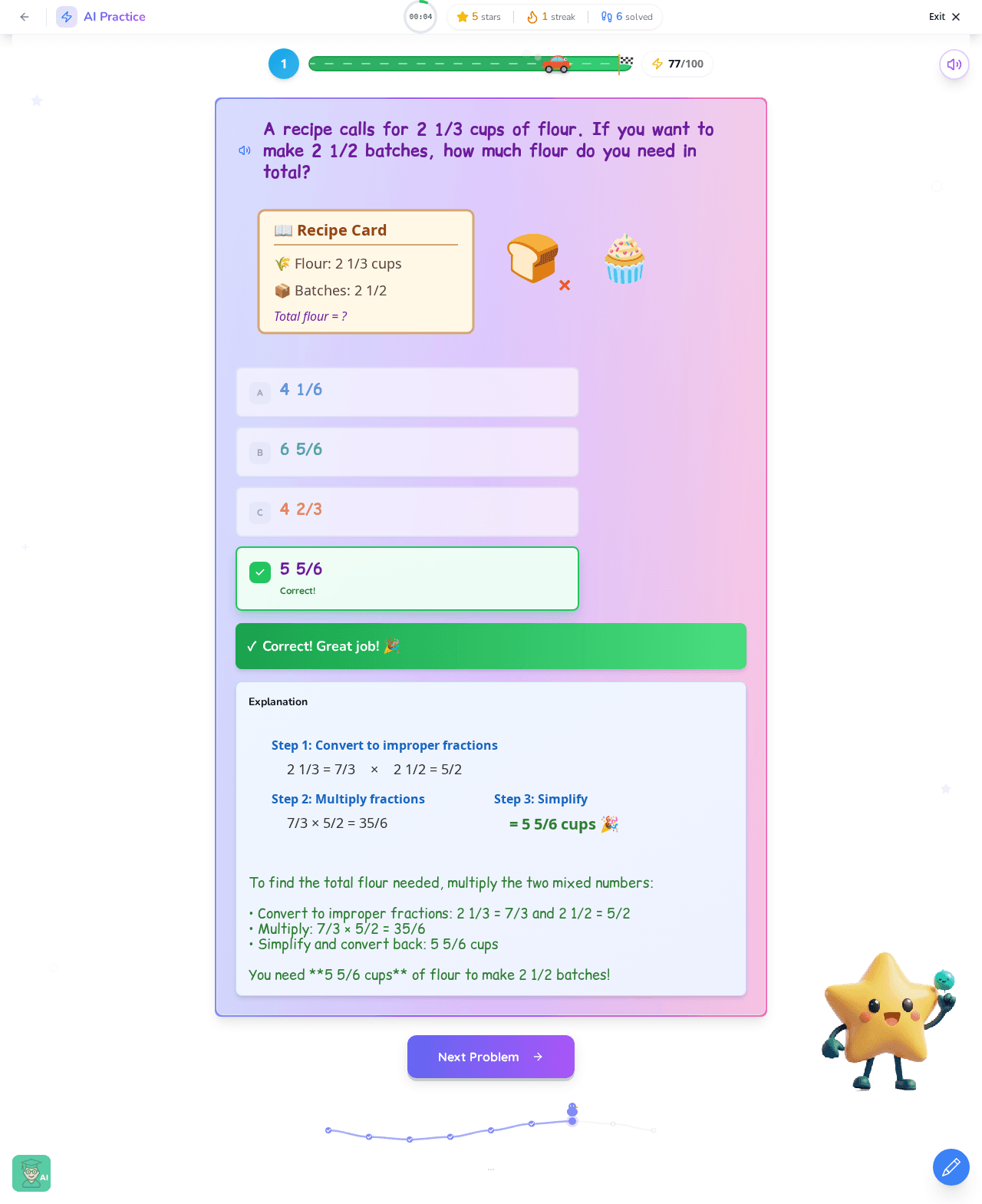
Doubling or tripling a recipe is classic mixed number multiplication. If a recipe calls for 1½ cups of flour and you're making 2½ batches, you need to calculate 1½ × 2½ = 3¾ cups. This is practical math your child can actually use in the kitchen.
Building and Measurement
Cutting materials for projects often involves mixed numbers. If a board needs to be 3¼ inches wide and you're making 4 pieces, you need 3¼ × 4 = 13 inches of material total. Home improvement projects, crafts, and woodworking all use these calculations.
Sharing and Dividing
Dividing things fairly sometimes requires multiplying mixed numbers. If each person gets 2⅓ pieces of pizza and there are 1½ pizzas to share, how many people can eat? These scenarios help students see fractions as real quantities.
Sports and Statistics
Calculating distances, times, and averages in sports often involves mixed numbers. A runner who completes 2½ laps in a certain time might wonder how far they'd go in 1½ times that duration.
When your child asks "when will I ever use this?", these examples provide concrete answers. Math class isn't just about passing tests; it's building skills for real situations they'll encounter throughout life.
Try AI Teacherly's Mixed Number Lesson
Understanding the theory is one thing, but putting it into practice is what truly builds confidence. AI Teacherly's Multiplying Mixed Numbers lesson for Grade 5 provides exactly the kind of structured, interactive practice that helps concepts stick.
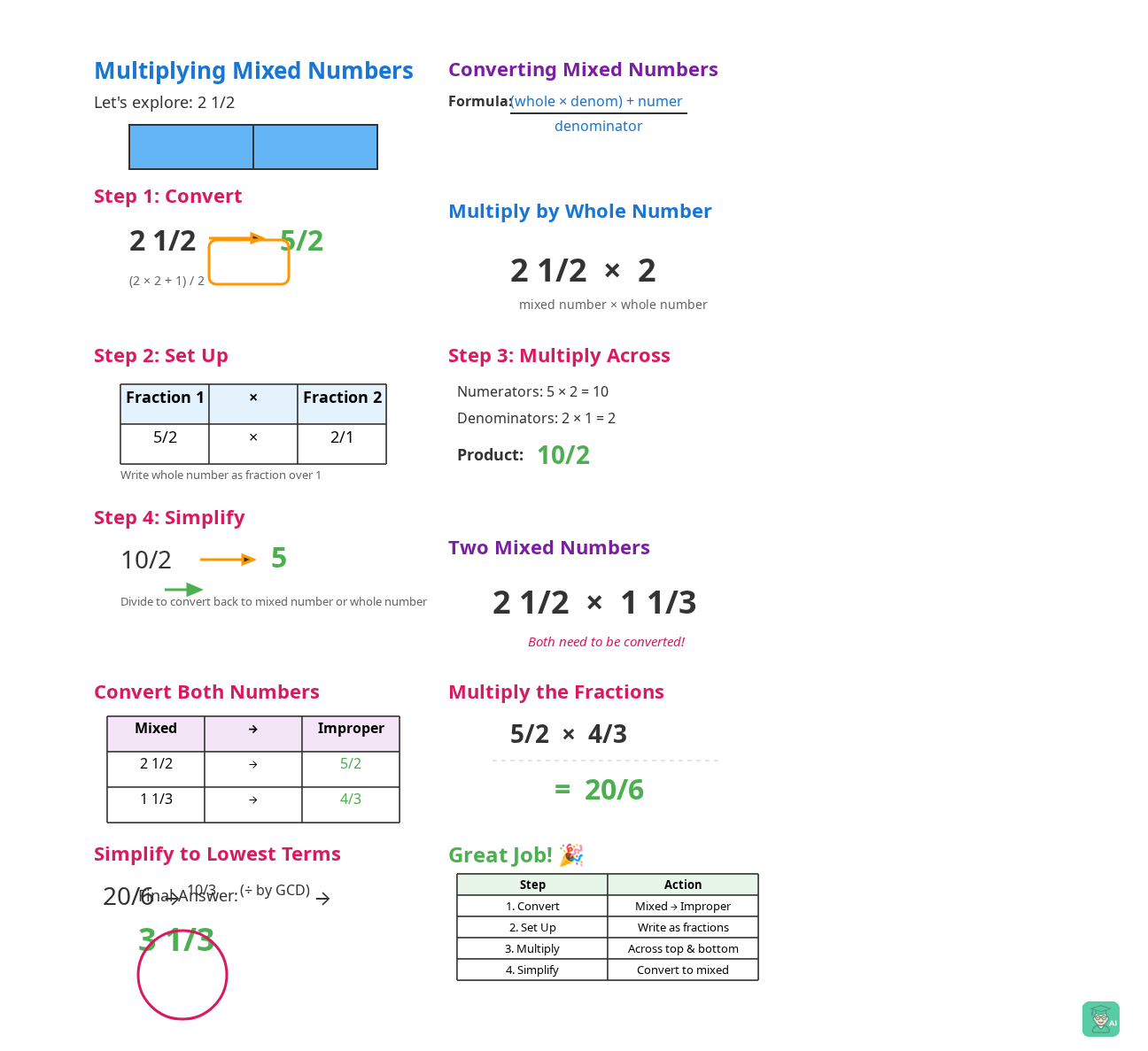
Here's what the full interactive lesson looks like on AI Teacherly:
The lesson breaks down mixed number multiplication into digestible sections, starting with the conversion concept and building up to complex multi-step problems. Each problem provides immediate feedback, so your child knows right away whether they're applying the steps correctly.
What makes this lesson effective for parents:
- Self-paced learning: Your child can work through problems at their own speed
- Visual explanations: Fraction concepts are shown, not just described
- Progressive difficulty: Problems start simple and gradually increase in complexity
- Real-world contexts: Recipe problems, measurement scenarios, and practical applications
- Immediate feedback: No waiting for a teacher to grade; learn from mistakes instantly
For parents who feel uncertain about their own fraction skills (which is completely normal after years away from elementary math!), watching your child work through these interactive problems can be a refresher for you too. Many parents tell us they learn alongside their kids.
The lesson covers all the essential skills: converting mixed numbers to improper fractions, multiplying fractions straight across, simplifying answers, and converting back to mixed numbers when appropriate.
Key Takeaways
- The key to multiplying mixed numbers is converting to improper fractions FIRST — this eliminates confusion from trying to multiply parts separately
- Use the conversion formula: whole number × denominator + numerator, then keep the same denominator
- Once converted, multiply straight across: numerator × numerator over denominator × denominator
- Always check the final answer: convert back to a mixed number and simplify if possible
- Common mistakes include skipping conversion, calculation errors during conversion, and forgetting to simplify
- Real-world practice with recipes, measurements, and building projects makes the math meaningful
- Interactive practice with immediate feedback builds lasting mastery faster than worksheets alone
Frequently Asked Questions
What is the easiest way to multiply mixed numbers?
Convert both mixed numbers to improper fractions first, then multiply numerators together and denominators together. Finally, simplify and convert back to a mixed number. This 3-step method eliminates confusion.
Why do you convert mixed numbers to improper fractions before multiplying?
Multiplying whole numbers and fractions separately creates errors. Converting first gives you a single fraction to work with, making multiplication straightforward: just multiply across.
How do you convert a mixed number to an improper fraction?
Multiply the whole number by the denominator, add the numerator, and put that total over the original denominator. Example: 2¾ = (2×4+3)/4 = 11/4.
Can you multiply mixed numbers without converting them first?
Technically yes, but it's much more complicated and error-prone. The conversion method is faster and more reliable, which is why it's the standard approach taught in schools.
What mistakes do kids make when multiplying mixed numbers?
Common errors include: forgetting to convert first, making arithmetic mistakes during conversion, forgetting to simplify the answer, and not converting improper fraction answers back to mixed numbers.
How can I help my child with multiplying mixed numbers at home?
Focus on the 3-step process: convert, multiply, simplify. Use real-world examples like recipes. Interactive practice platforms provide immediate feedback that builds confidence faster than worksheets.
Is multiplying mixed numbers on the 5th grade math test?
Yes, multiplying mixed numbers is a core 5th grade math standard. Students need to demonstrate they can convert, multiply, and simplify mixed number products on standardized assessments.
What comes after learning to multiply mixed numbers?
Students typically move on to dividing fractions and mixed numbers, then apply these skills to more complex word problems and eventually algebra concepts in middle school.
Ready to make mixed number multiplication click? Try AI Teacherly's interactive Multiplying Mixed Numbers lesson free and watch your 5th grader's confidence grow!