One-Step Equations Made Simple: A Parent's Complete Guide to 6th Grade Algebra
Discover how inverse operations unlock one-step equations for 6th graders. This parent-friendly guide breaks down the step-by-step process to support your child's algebra journey with confidence.
Why One-Step Equations Are a Game-Changer in 6th Grade Math
Your child just brought home homework covered in x's and equals signs, and suddenly you're transported back to your own middle school math class. If you're feeling a wave of anxiety, you're not alone. One-step equations for 6th graders represent one of the most significant transitions in your child's mathematical journey: the leap from arithmetic to algebra.
But here's the reassuring truth: one-step equations are far simpler than they look. Despite the intimidating variables and symbols, these problems follow a straightforward, repeatable process that any parent can understand and explain.
In this guide, you'll discover exactly what one-step equations are, learn the "secret weapon" that makes solving them easy (hint: it's called inverse operations), and gain practical strategies to support your 6th grader without needing to be a math expert yourself. By the end, you'll feel confident helping with algebra homework, and you might even find yourself enjoying the puzzle-solving aspect of equations.
The skills your child learns now with one-step equations form the foundation for all future algebra. Getting these fundamentals right makes everything that follows, from two-step equations to solving systems in high school, feel like a natural progression rather than an overwhelming challenge.
What Is a One-Step Equation and Why Do Kids Find It Tricky?
A one-step equation is an equation where you can find the value of the unknown variable (usually x) in just one step. Think of it like a mystery where you need to find the hidden number that makes the equation true.
Here are some classic one-step equation examples:
- x + 7 = 12 (What number plus 7 equals 12?)
- x - 4 = 9 (What number minus 4 equals 9?)
- 3x = 15 (Three times what number equals 15?)
- x ÷ 2 = 6 (What number divided by 2 equals 6?)
Why do 6th graders struggle with these?
The challenge isn't usually the math itself. It's the conceptual shift from finding answers to finding unknowns. In elementary school, your child saw problems like "5 + 7 = ?" where they calculated the result. Now, with equations like "x + 7 = 12," the unknown is in a different position, and they must work backwards.
Another common stumbling block is understanding what the variable represents. Some kids think x is just a letter to memorize rather than a placeholder for a real number. When your child grasps that x represents "the number we're trying to discover," equations suddenly make much more sense.
Many 6th graders also feel pressure because algebra feels "official." Reassure your child that everyone learns this at their own pace, and making mistakes is a normal part of mastering something new.
What Are Inverse Operations? The Secret Weapon for Solving Equations
If there's one concept that unlocks all equation-solving, it's inverse operations. These are your child's secret weapon, and understanding them makes one-step equations feel almost automatic.
Inverse operations are pairs of operations that undo each other. Think of them like an "undo button" for math:
- Addition and Subtraction are inverses (if you add 5, subtracting 5 undoes it)
- Multiplication and Division are inverses (if you multiply by 3, dividing by 3 undoes it)
Why does this matter for solving equations?
When we solve an equation, our goal is to get the variable (x) alone on one side. We do this by "undoing" whatever operation is attached to it. Here's the magic: whatever we do to one side of the equation, we must do to the other side to keep it balanced.
Imagine a balance scale with equal weights on both sides. If you remove weight from one side, you must remove the same amount from the other to keep it balanced. Equations work the same way.
Example in action:
Solve: x + 7 = 12
- The x has 7 added to it
- To undo addition, we use subtraction (the inverse)
- Subtract 7 from BOTH sides: x + 7 - 7 = 12 - 7
- This gives us: x = 5
Once your child internalizes that inverse operations "undo" other operations, they have the key to solving any one-step equation, and later, any multi-step equation too.
How to Solve One-Step Equations: A Step-by-Step Breakdown
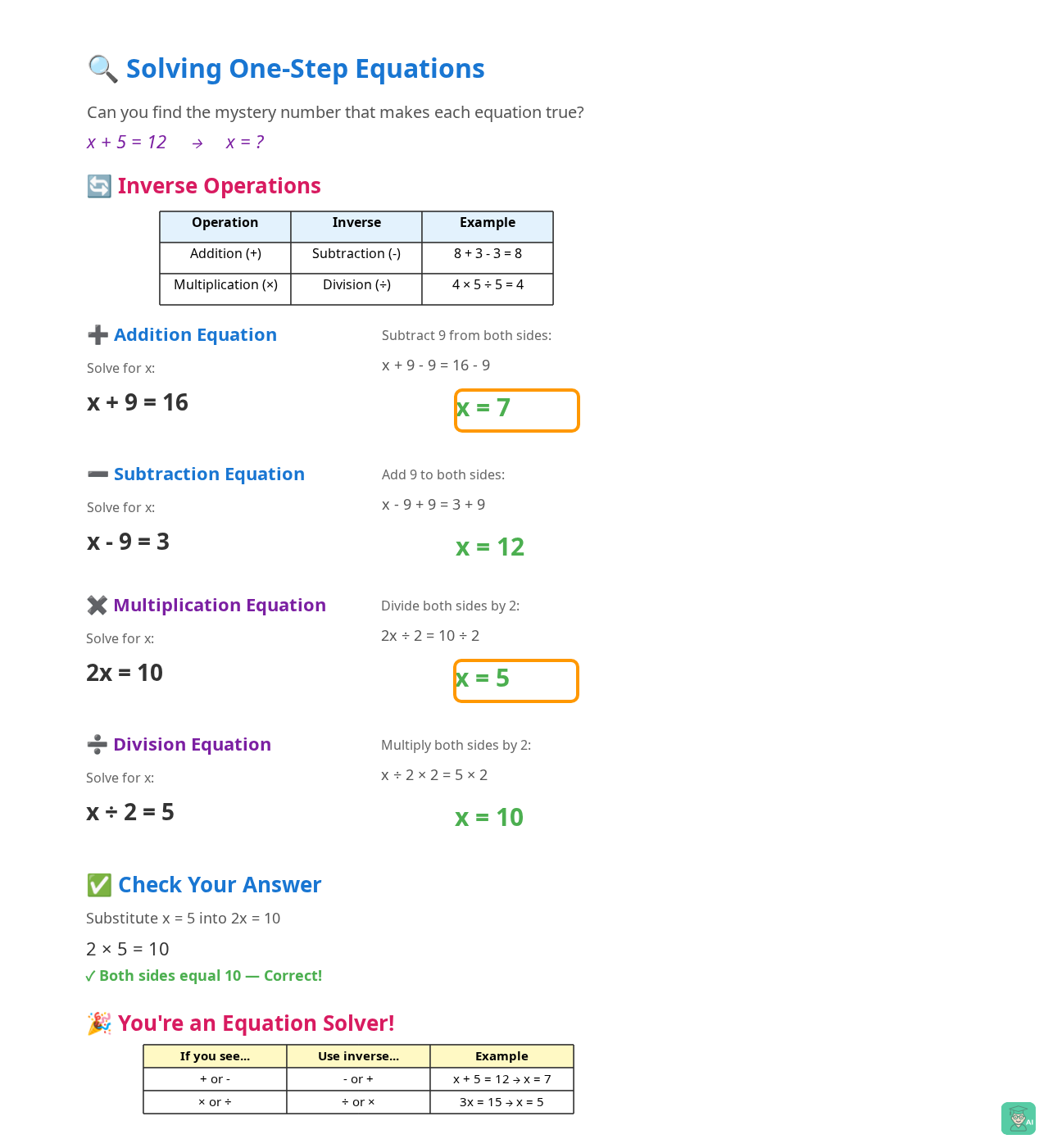
Every one-step equation, regardless of which operation it involves, follows the same three-step process. Teach your child this framework, and they'll have a reliable method that works every time.
The 3-Step Process:
- Identify the operation attached to the variable
- Apply the inverse operation to both sides of the equation
- Check your answer by substituting it back into the original equation
Let's walk through examples for each type:
Addition Equation: x + 9 = 14
- Operation: Addition (+9)
- Inverse: Subtract 9 from both sides
- x + 9 - 9 = 14 - 9 → x = 5
- Check: 5 + 9 = 14 ✓
Subtraction Equation: x - 6 = 8
- Operation: Subtraction (-6)
- Inverse: Add 6 to both sides
- x - 6 + 6 = 8 + 6 → x = 14
- Check: 14 - 6 = 8 ✓
Multiplication Equation: 4x = 20
- Operation: Multiplication (×4)
- Inverse: Divide both sides by 4
- 4x ÷ 4 = 20 ÷ 4 → x = 5
- Check: 4 × 5 = 20 ✓
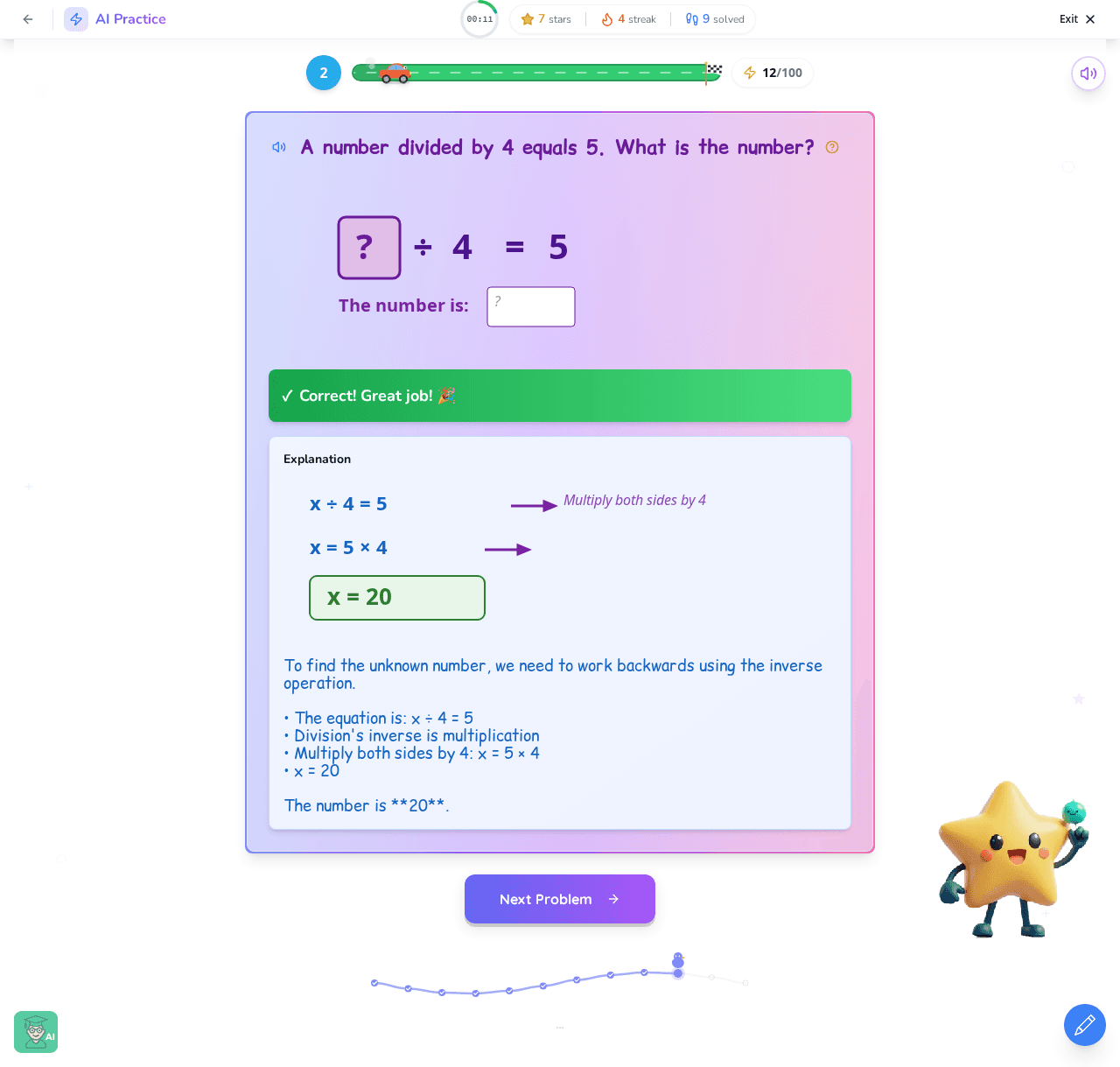
Division Equation: x ÷ 3 = 7
- Operation: Division (÷3)
- Inverse: Multiply both sides by 3
- (x ÷ 3) × 3 = 7 × 3 → x = 21
- Check: 21 ÷ 3 = 7 ✓
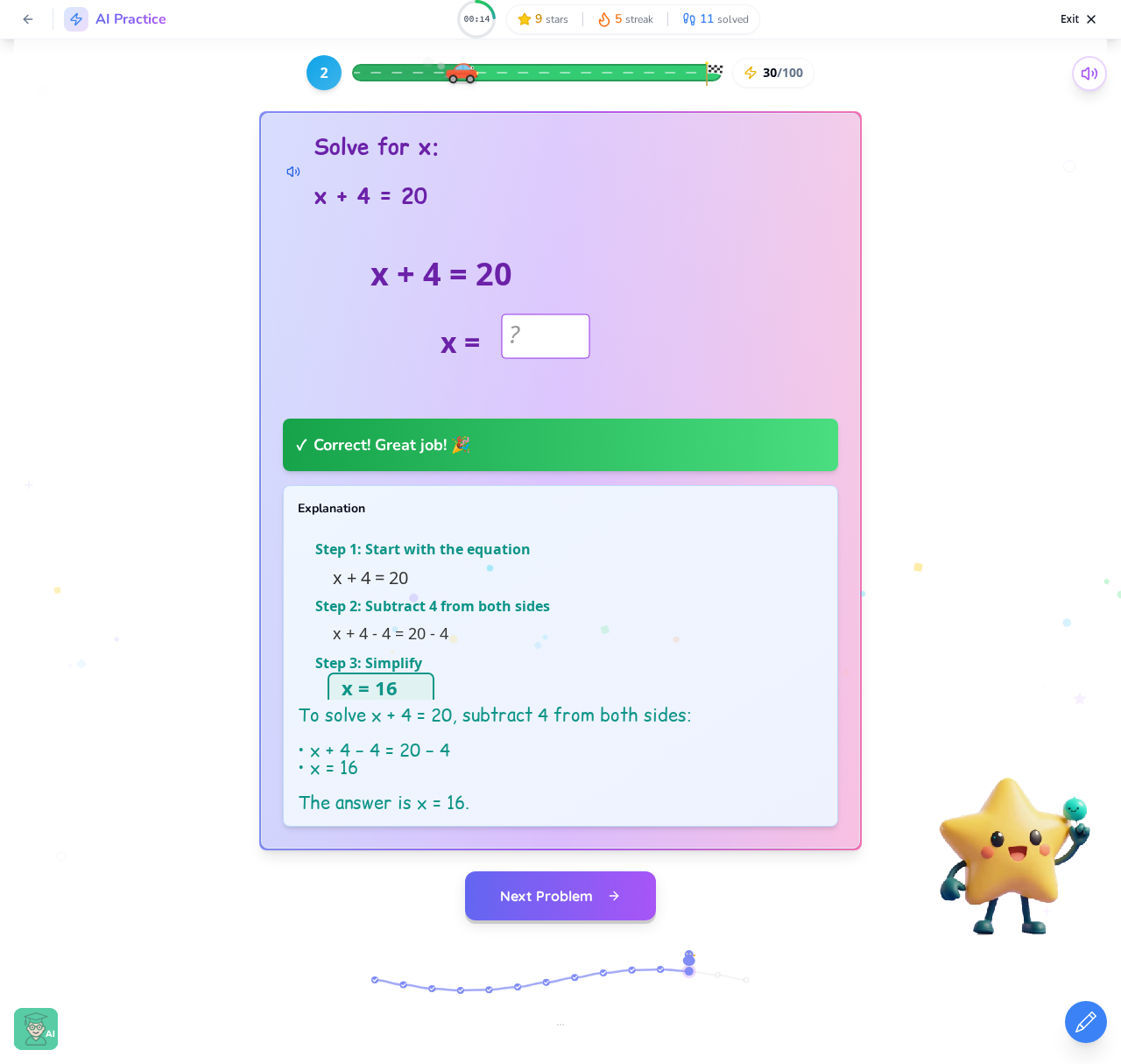
The interactive problem below shows exactly how this step-by-step process works in practice.
Pro tip for parents: Encourage your child to write out all steps, including the check. It may feel tedious now, but this habit prevents careless errors and builds confidence.
See How Interactive Practice Makes Equations Click
Reading about inverse operations is one thing; actually practicing them is where real understanding develops. This is why interactive, hands-on practice is so valuable for mastering one-step equations.
On AI Teacherly's Solving One-Step Equations lesson for Grade 6, students don't just watch explanations; they actively solve problems with immediate feedback. The lesson frames equation-solving as cracking a mystery: finding the unknown number that makes each equation true.
Here's what the full interactive lesson looks like on AI Teacherly:
What makes interactive practice effective:
- Immediate feedback tells students right away if their approach is working
- Visual elements help concrete thinkers see the balance principle in action
- Progressing difficulty builds confidence before introducing harder problems
- Real-world word problems connect abstract math to everyday situations
The lesson guides students through all four equation types (addition, subtraction, multiplication, and division) using a consistent strategy. By the end, your child will have internalized the process: identify the operation, apply the inverse, and always check your answer.
For parents, having a resource like this means you don't need to create practice problems or worry about explaining concepts the "right way." The guided instruction handles the teaching, while you can focus on encouragement and support.
Interactive practice also removes the stigma of making mistakes. When a student gets immediate feedback in a low-pressure digital environment, they're more willing to try, fail, and learn, which is exactly how mathematical understanding develops.
Common Mistakes 6th Graders Make (And How to Help Them Self-Correct)
Even bright students make predictable errors when learning one-step equations. Knowing what to look for helps you guide your child without simply giving them the answer.
Mistake #1: Forgetting to apply the operation to BOTH sides
This is the most common error. A student might write: x + 5 = 12 x = 12 - 5 (only subtracting from the right side)
How to help: Ask, "What did you do to each side?" Remind them of the balance scale: both sides must receive the same treatment.
Mistake #2: Using the wrong inverse operation
Some students add when they should subtract, or multiply when they should divide.
How to help: Before solving, ask, "What operation do you see with the x? What's the opposite of that operation?" Creating an inverse operations reference card can be helpful.
Mistake #3: Skipping the verification step
Many kids consider the problem "done" once they isolate x, but checking catches errors.
How to help: Make checking non-negotiable. Say, "Your answer is x = 4. Can you prove it works?" When substitution confirms their answer, it builds real confidence.
Mistake #4: Confusing word problems
Translating "Sarah has 8 more stickers than Jason" into an equation trips up many students.
How to help: Encourage your child to identify the unknown ("What are we trying to find?") and translate phrases one piece at a time. "8 more than" means + 8.
Mistake #5: Negative number errors
When equations involve negative numbers, sign errors multiply. For now, most 6th grade one-step equations use positive numbers, but be aware this becomes more complex later.
Your role as a parent: Ask guiding questions rather than providing answers. "Walk me through your thinking" is more powerful than "You made a mistake here."
Tips for Supporting Your 6th Grader with Algebra at Home
You don't need to be a math expert to effectively support your child's algebra journey. Here are practical strategies that work:
1. Embrace the "I don't know, let's figure it out together" approach
If you're rusty on algebra, that's okay! Learning alongside your child models that math is something everyone can understand with effort. Your willingness to engage matters more than having instant answers.
2. Focus on the process, not just the answer
Praise your child for showing their steps and checking their work, even if the final answer is wrong. Process-focused encouragement builds resilient learners who aren't afraid of challenging problems.
3. Connect equations to real life
Make algebra tangible with everyday scenarios:
- "You have $15 and want to buy something that costs $23. How much more do you need?" (x + 15 = 23)
- "If we split this pizza equally among 4 people and each person gets 3 slices, how many slices total?" (x ÷ 4 = 3)
4. Create a distraction-free homework environment
Algebra requires focused thinking. A quiet space, even just 20 minutes of concentrated practice, is more effective than an hour of distracted work.
5. Celebrate small wins
Mastering one type of equation before moving to the next builds momentum. If your child aces addition equations, acknowledge that success before tackling multiplication equations.
6. Know when to step back
Productive struggle is valuable. If your child is frustrated but making progress, resist the urge to rescue them. The satisfaction of solving a problem independently is far more powerful than being handed the answer.
7. Use quality resources
Interactive platforms like AI Teacherly provide structured practice with immediate feedback, taking pressure off parents to be the primary teacher. You become the supportive coach instead.
Key Takeaways
- One-step equations can be solved using a simple 3-step process: identify the operation, apply the inverse, and check your answer
- Inverse operations are the key concept: addition undoes subtraction, multiplication undoes division
- Always perform the same operation on both sides of the equation to maintain balance
- Checking answers by substitution builds confidence and catches mistakes before they become habits
- Common errors include forgetting to apply operations to both sides and skipping the verification step
- Interactive practice with immediate feedback helps concepts stick better than passive learning
- Parents don't need to be math experts; asking guiding questions like 'walk me through your thinking' is more effective than providing answers
Frequently Asked Questions
What is a one-step equation and how do you solve it?
A one-step equation is an equation where you find the unknown variable (x) in just one step. Solve it by identifying the operation attached to x, applying the inverse operation to both sides, and checking your answer by substitution.
What are inverse operations in math?
Inverse operations are pairs of operations that undo each other. Addition and subtraction are inverses, and multiplication and division are inverses. They're the key tool for isolating variables when solving equations.
How can I help my child with algebra if I'm not good at math?
Focus on asking guiding questions like 'What operation do you see?' and 'Walk me through your thinking.' You don't need to know the answer; helping your child articulate their process is what builds understanding.
What is the difference between one-step and two-step equations?
One-step equations require only one operation to isolate the variable (like x + 5 = 12). Two-step equations require two operations (like 2x + 3 = 11). One-step equations are taught first as the foundation for more complex equations.
Why do we use inverse operations to solve equations?
Inverse operations 'undo' other operations, allowing us to isolate the variable. To get x alone, we must remove whatever is attached to it using its opposite operation while keeping both sides of the equation balanced.
Is it normal for 6th graders to struggle with equations?
Yes, absolutely. The shift from arithmetic (finding answers) to algebra (finding unknowns) is a significant conceptual leap. Most students need time and practice to internalize the new way of thinking about math problems.
What are common mistakes kids make with one-step equations?
The most common mistakes are forgetting to apply operations to both sides of the equation, using the wrong inverse operation, and skipping the verification step. Regular practice and always checking answers helps prevent these errors.
How long should my child practice one-step equations each day?
For 6th graders, 15-20 minutes of focused practice is ideal. Short, consistent sessions are more effective than long, infrequent study periods. Interactive practice with immediate feedback maximizes learning in minimal time.
Ready to make algebra click for your 6th grader? Try the interactive Solving One-Step Equations lesson free on AI Teacherly and watch your child master inverse operations with confidence!