PEMDAS with Decimals Made Easy: A Parent's Step-by-Step Guide to 5th Grade Math Success
Master PEMDAS with decimals for your 5th grader using the Decimal Detective approach. Step-by-step strategies, real-world examples, and common mistake fixes that make math homework stress-free.
Why 5th Grade Decimal Operations Feel So Overwhelming
You know that feeling when your 5th grader slides their homework across the table and you see something like (3.5 + 2.7) × 4.2 + 1.8? Your brain might freeze for a moment, and that's completely normal. You're not alone in this experience.
Fifth grade marks a major turning point in math education. The problems suddenly involve multiple operations, decimals, and those dreaded parentheses. It's the year when straightforward arithmetic transforms into something that looks more like algebra. Many parents find themselves Googling "PEMDAS with decimals" at 8 PM on a school night, desperate for answers.
Here's the good news: once you understand the simple rules behind mixed operations with decimals, you can walk through any problem confidently with your child. This guide will give you exactly what you need to become your 5th grader's math hero, not just for tonight's homework but for the entire school year.
What Is PEMDAS and Why Does Order Matter with Decimals?
PEMDAS is the secret code that tells mathematicians (and your 5th grader) exactly which operations to perform first. The acronym stands for:
- Parentheses (solve these first)
- Exponents (powers and roots)
- Multiplication and Division (left to right)
- Addition and Subtraction (left to right)
But here's what many parents don't realize: the order absolutely matters, especially with decimals. Let's see why with a quick example.
Consider the expression: 3.5 + 2.7 × 4
If you work left to right (adding first, then multiplying), you'd get: 6.2 × 4 = 24.8
But following PEMDAS (multiplying first, then adding), you get: 3.5 + 10.8 = 14.3
Those are completely different answers! The second one is correct because PEMDAS requires multiplication before addition. When decimals are involved, even small ordering mistakes lead to significantly wrong answers. This is why mastering PEMDAS with decimals is so critical in 5th grade; it's the foundation for all future math success.
Think of PEMDAS as a recipe. You wouldn't frost a cake before baking it, right? Math operations have a specific order too, and when you follow it, the answer comes out perfectly every time.
How to Solve Mixed Operations with Decimals Step-by-Step
Let's break down exactly how to tackle a mixed operations problem with decimals. We'll use the "Decimal Detective" approach that makes this process feel like cracking a case rather than doing tedious homework.
Example Problem: Solve (3.5 + 2.7) × 4.2 + 1.8
Step 1: Spot the Parentheses Look for anything inside parentheses first. Here we see (3.5 + 2.7). Solve it: 3.5 + 2.7 = 6.2
Now our expression becomes: 6.2 × 4.2 + 1.8
Step 2: Multiplication Before Addition Next, we multiply before we add. Calculate: 6.2 × 4.2 = 26.04
Now we have: 26.04 + 1.8
Step 3: Finish with Addition Finally, add the remaining numbers: 26.04 + 1.8 = 27.84
The Detective's Checklist:
- Circle all parentheses and solve those first
- Underline any multiplication or division signs and work those next (left to right)
- Finally, handle addition and subtraction (left to right)
- Double-check by estimating: 6 × 4 = 24, plus about 2 = 26. Our answer of 27.84 makes sense!
This methodical approach transforms intimidating expressions into manageable steps. Encourage your child to write out each step; it prevents careless errors and builds good mathematical habits.
Real-World Decimal Problems: Shopping, Budgeting, and Making Change
Here's a secret that makes 5th grade decimal operations click: connect them to real life. Your child already uses PEMDAS without realizing it whenever they think about money.
Imagine this scenario: Your child wants to buy 3 notebooks that cost $2.75 each and a single pen that costs $1.50. How much will they spend?
The math expression is: 3 × 2.75 + 1.50
Following PEMDAS:
- First, multiply: 3 × 2.75 = $8.25 (cost of notebooks)
- Then add: $8.25 + $1.50 = $9.75 (total cost)
If someone incorrectly added first (2.75 + 1.50 = 4.25, then × 3 = $12.75), they'd think they need to bring almost three extra dollars!
Practice at the Grocery Store: Next time you're shopping, challenge your child with problems like:
- "We're buying 4 apples at $0.89 each and a gallon of milk for $3.99. What's the total?"
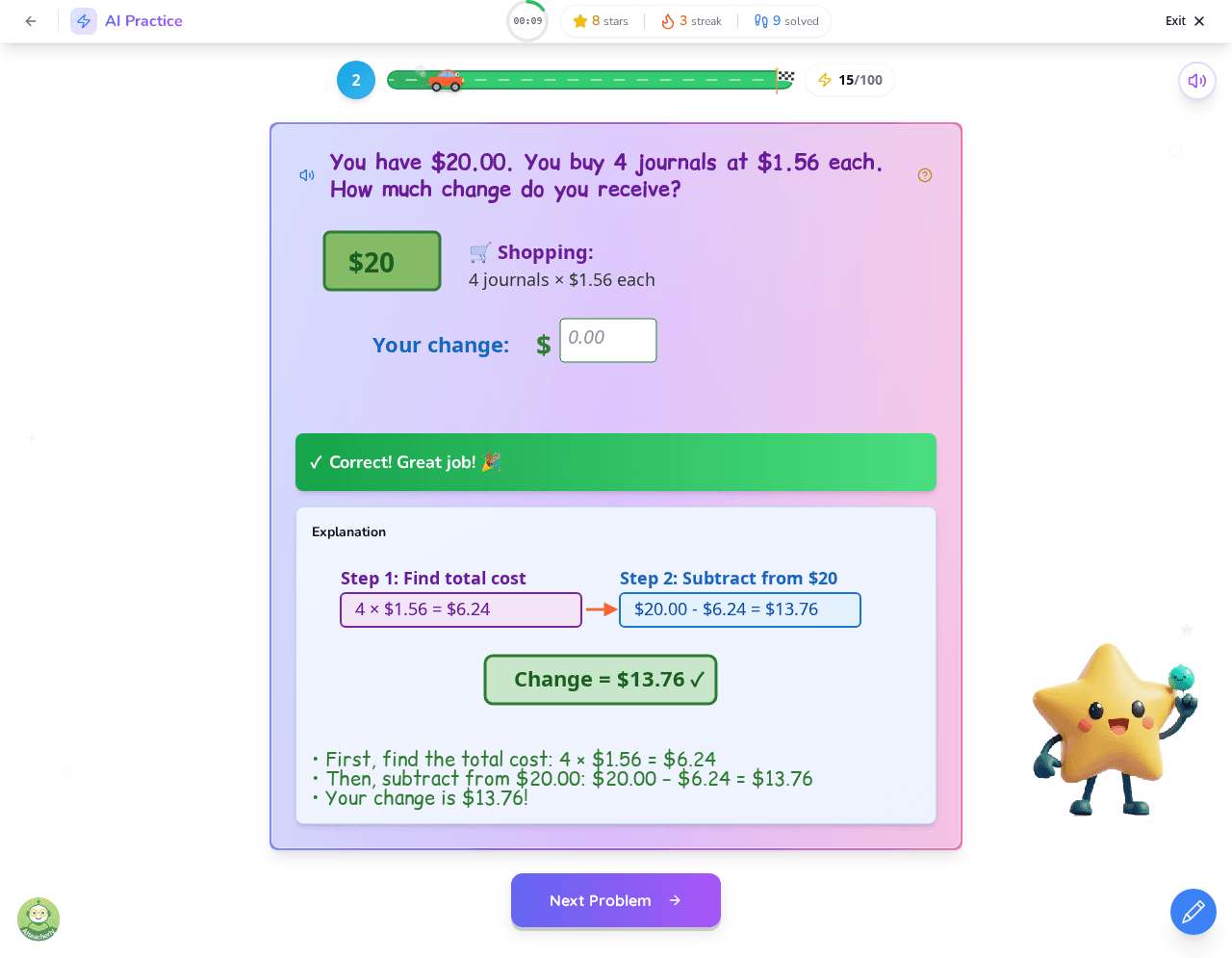
- "I gave the cashier $20.00. We spent $14.35. How much change do we get?"
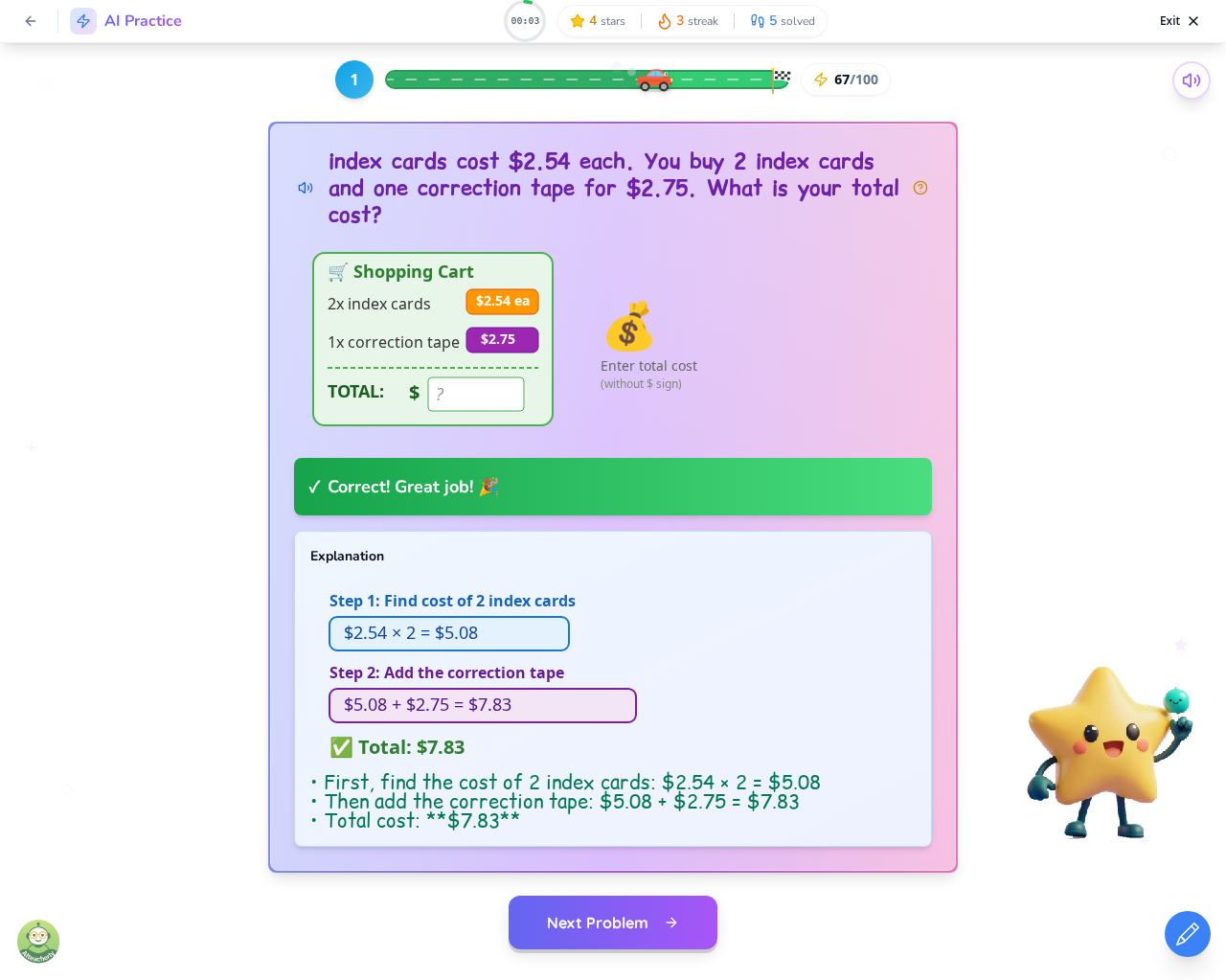
The interactive problem below shows exactly how these real-world shopping scenarios translate into PEMDAS practice.
These everyday connections help your child see that math isn't just textbook exercises; it's a life skill they'll use forever.
See How Interactive Decimal Lessons Work on AI Teacherly
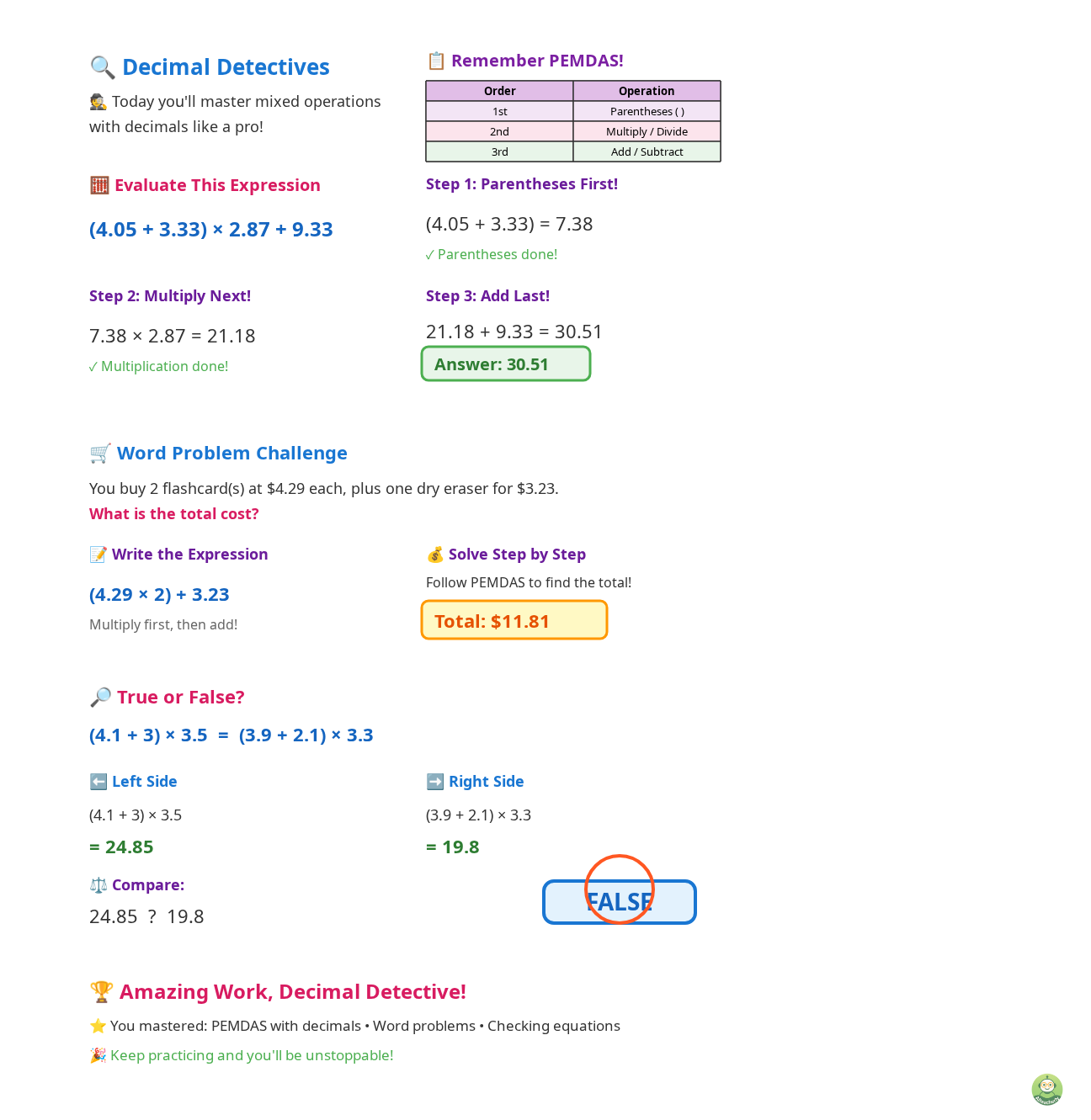
Traditional worksheets can make decimal operations feel like a chore. That's where interactive learning changes everything. On AI Teacherly, the Mixed Operations with Decimals lesson transforms your 5th grader into a "Decimal Detective," solving mathematical mysteries step by step.
Here's what the full interactive lesson looks like on AI Teacherly:
What Makes Interactive Practice Different:
- Immediate Feedback: Your child knows instantly if they're on the right track, not after waiting days for graded homework
- Visual Scaffolding: Problems break down into visual steps, showing exactly where parentheses and operations fit
- Real-World Context: Problems feature relatable scenarios like shopping, making change, and budgeting
- Confidence Building: Starting with easier problems and progressing to challenges keeps frustration low and motivation high
The lesson guides students through PEMDAS fundamentals, then builds to multi-step word problems and equation verification. By the end, students can confidently determine whether equations like "24.5 = (3.2 + 2.8) × 4" are true or false by evaluating both sides independently.
As the lesson celebrates: "You mastered PEMDAS with decimals, turned word problems into equations, and checked your answers like a pro. You're a true decimal detective!"
Common PEMDAS Mistakes and How to Help Your Child Avoid Them
Even the brightest 5th graders stumble on these common PEMDAS errors. Knowing what to watch for helps you catch mistakes before they become habits.
Mistake #1: Adding Before Multiplying This is the most frequent error. When kids see 5 + 3 × 2, many naturally work left to right and get 16 instead of the correct answer, 11.
Fix: Have your child circle or highlight multiplication and division signs in a different color. This visual cue reminds them to handle those operations first.
Mistake #2: Forgetting Parentheses Change Everything Students often overlook parentheses or don't understand their power. (5 + 3) × 2 = 16, but 5 + 3 × 2 = 11.
Fix: Teach the "box method." Draw a box around parentheses and solve that box first, like unwrapping a present before playing with what's inside.
Mistake #3: Decimal Point Mishaps When multiplying decimals, kids sometimes misplace the decimal point in their answer.
Fix: Always estimate first. If calculating 3.2 × 4.1, think "3 × 4 = 12," so the answer should be close to 12 (it's 13.12). If your child gets 131.2, the estimate reveals the decimal point error immediately.
Mistake #4: Working Right to Left with Multiplication/Division PEMDAS doesn't mean "all multiplication, then all division." When you have both, work left to right.
Fix: Practice with expressions like 12 ÷ 3 × 2. Left to right gives 8 (correct), while right to left gives 2 (wrong).
Your Role as Math Coach: When your child makes an error, resist the urge to give the answer. Instead, ask: "Which operation does PEMDAS say to do first?" This builds independent problem-solving skills.
Key Takeaways
- PEMDAS (Parentheses, Exponents, Multiplication/Division, Addition/Subtraction) is the order of operations that ensures consistent, correct answers in math
- Always solve parentheses first, then multiplication and division (left to right), and finally addition and subtraction (left to right)
- Connect decimal operations to real life through shopping scenarios, budgeting, and making change to help concepts stick
- The most common mistake is adding before multiplying; teach your child to highlight multiplication signs as a visual reminder
- Estimating answers before calculating helps catch decimal point errors and builds number sense
- Interactive practice with immediate feedback builds confidence faster than traditional worksheets
- Ask guiding questions rather than giving answers to develop your child's independent problem-solving skills
Frequently Asked Questions
What does PEMDAS stand for and why is it important?
PEMDAS stands for Parentheses, Exponents, Multiplication, Division, Addition, and Subtraction. It tells you the exact order to solve math operations so everyone gets the same correct answer. Without it, the same expression could give different results.
How do you solve expressions with decimals using order of operations?
First solve anything in parentheses, then handle multiplication and division from left to right, and finally do addition and subtraction from left to right. Keep decimal points aligned when calculating to avoid errors.
What's the difference between solving (3.5 + 2.7) × 4 and 3.5 + 2.7 × 4?
With parentheses: (3.5 + 2.7) × 4 = 6.2 × 4 = 24.8. Without parentheses: 3.5 + 2.7 × 4 = 3.5 + 10.8 = 14.3. Parentheses force you to add first, completely changing the answer.
How can I help my child remember the order of operations?
Use the phrase 'Please Excuse My Dear Aunt Sally' for PEMDAS. Also try color-coding: circle parentheses in red, underline multiplication/division in blue. Visual cues help reinforce the sequence.
Why does my child keep getting decimal problems wrong?
Common causes include adding before multiplying, misplacing decimal points, or rushing through parentheses. Have your child estimate first and write out each step to catch errors before they happen.
Are there real-life examples of PEMDAS with decimals?
Yes! Shopping math uses PEMDAS constantly. Buying 3 items at $4.50 each plus $2.99 shipping requires multiplying first (3 × 4.50 = 13.50), then adding (13.50 + 2.99 = $16.49).
When should my child use parentheses in math expressions?
Use parentheses to group operations that must be done first. If you want to add before multiplying, put the addition in parentheses. They override the normal PEMDAS order and are essential for word problems.
How do I check if a decimal equation is true or false?
Evaluate each side of the equation separately using PEMDAS. If both sides equal the same number, the equation is true. For example, to verify 14.3 = 3.5 + 2.7 × 4, calculate the right side: 3.5 + 10.8 = 14.3. Both sides match, so it's true.
Ready to turn your 5th grader into a Decimal Detective? Try the interactive Mixed Operations with Decimals lesson free on AI Teacherly and watch math confidence soar!