Teaching Fractions to 3rd Graders: A Parent's Visual Guide to Making Math Click
Discover practical, visual strategies to teach fractions to your 3rd grader. From pizza slice math to the simple secret of fraction addition, this parent guide makes numerators and denominators finally click.
Why Fractions Matter (And Why They Don't Have to Be Scary)
Teaching fractions to 3rd graders is one of those parenting moments that can feel surprisingly daunting. Maybe you remember your own confusion with fractions as a kid, or perhaps the mere sight of a fraction on your child's homework triggers a wave of uncertainty. Here's the good news: today's visual learning methods have transformed how children understand fractions, and you don't need a math degree to guide them through it.
Fractions are absolutely everywhere in daily life, from slicing a birthday cake into equal pieces to figuring out how much of the movie is left. When children understand fractions, they're not just learning math; they're developing the ability to think about parts and wholes, fairness in sharing, and proportional reasoning that serves them throughout life.
The key insight that makes fractions accessible? Visual models. When your 3rd grader can see a pizza divided into 8 slices and understand that eating 3 slices means they've had 3/8 of the pizza, the abstract numbers suddenly have concrete meaning. This visual foundation is exactly what builds confident math learners.
In this guide, you'll discover simple strategies to explain fractions clearly, master the "secret" to adding fractions that teachers use, and find practical ways to practice fractions during everyday moments with your child.
What Are Fractions and Why Do 3rd Graders Struggle With Them?
A fraction represents a part of a whole. It's the mathematical way of expressing "some but not all" of something. While this concept seems straightforward to adults, 3rd graders encounter fractions at a critical developmental stage where abstract thinking is still emerging.
Why the struggle is so common:
- Whole numbers feel familiar; fractions feel foreign. Children have spent years counting 1, 2, 3, and suddenly they're asked to understand that numbers can exist between those whole numbers.
- The notation is confusing. A fraction like 3/4 looks like two separate numbers, and understanding that they work together as one value takes time.
- Counterintuitive rules. In whole numbers, bigger numbers mean more. But with fractions, 1/8 is actually smaller than 1/4, even though 8 is bigger than 4. This flips their existing number sense upside down.
- Abstract without visuals. When fractions are taught purely through numbers and rules, children miss the concrete foundation they need.
The research is clear: children who learn fractions through visual models develop deeper understanding than those who learn through procedures alone. That's why the most effective 3rd grade fraction instruction uses pictures, manipulatives, and real-world examples before ever introducing the rules.
How to Explain Numerator and Denominator to Your Child
The two parts of a fraction have specific jobs, and explaining them simply makes all the difference. Here's the clearest way to help your 3rd grader understand:
The denominator (bottom number) tells us how many equal parts the whole is divided into. Think of it as answering: "How many total pieces are there?"
The numerator (top number) tells us how many of those parts we're talking about. It answers: "How many pieces do we have or are we counting?"
A helpful script to use with your child:
"Look at this pizza cut into 4 equal slices. The 4 goes on the bottom because that's how many total pieces there are. Now, if you eat 1 slice, the 1 goes on top because that's how many pieces you took. So you ate 1/4 of the pizza!"
Memory tricks that work:
- The denominator is down (bottom)
- The numerator is the number of pieces you have
- "The denominator names the size of the pieces, the numerator counts them"
Real-life practice opportunities:
- Cutting sandwiches: "I'm cutting your sandwich into 2 pieces. If you eat 1, what fraction did you eat?"
- Sharing snacks: "There are 6 crackers. If you take 2, you have 2/6 of the crackers!"
- Telling time: "A quarter hour is 1/4 because the hour is divided into 4 parts of 15 minutes each."
The magic happens when children realize that fractions aren't random symbols; they're a precise way to describe the parts they encounter every day.
The Simple Secret to Adding Fractions With the Same Denominator
Here's the "aha" moment that transforms fraction addition from confusing to completely logical: when the pieces are the same size, you just count them.
This is the secret teachers use, and it works beautifully once children understand it:
When adding fractions like 2/5 + 1/5, your child isn't doing complicated math. They're simply counting pieces:
- You have 2 pieces (that are each 1/5 of the whole)
- You add 1 more piece (also 1/5 of the whole)
- Now you have 3 pieces total
- Answer: 3/5
The key rule: When adding fractions with the same denominator, add the numerators and keep the denominator the same.
Why does the denominator stay the same? Because the size of the pieces hasn't changed! You're still counting fifths; you just have more of them.
Try this visual explanation:
Imagine a chocolate bar divided into 8 equal pieces.
- Your child eats 3/8 (3 pieces)
- Then eats 2/8 more (2 more pieces)
- Total: 5/8 (5 pieces of the same size)
Notice we didn't add 8 + 8 on the bottom to get 16. The bar was always divided into 8 pieces. We're just counting how many pieces were eaten total.
Common mistake to watch for: Many 3rd graders initially want to add both the top AND bottom numbers (3/8 + 2/8 = 5/16). Gently redirect them with: "Did we cut more pieces? No! The pieces are still the same size. We just have more of them."
5 Easy Ways to Practice Fractions at Home
The best fraction practice doesn't feel like practice at all. Here are five simple strategies to reinforce fraction concepts during everyday moments:
1. Kitchen Math Cooking and baking are fraction goldmines. "The recipe needs 3/4 cup of flour. Can you show me where 3/4 is on the measuring cup?" Let your child pour ingredients and explain what fraction of the total they've added.
2. Pizza Night Fractions The classic for a reason! Before eating, ask: "If we cut this pizza into 8 slices and you eat 2, what fraction did you eat?" Follow up with: "What fraction is left?"
3. The Sharing Game Any time you're dividing treats equally, make it a fraction moment. "I have 10 strawberries for the 2 of us. If we share fairly, what fraction does each person get?" (5/10 or 1/2 each)
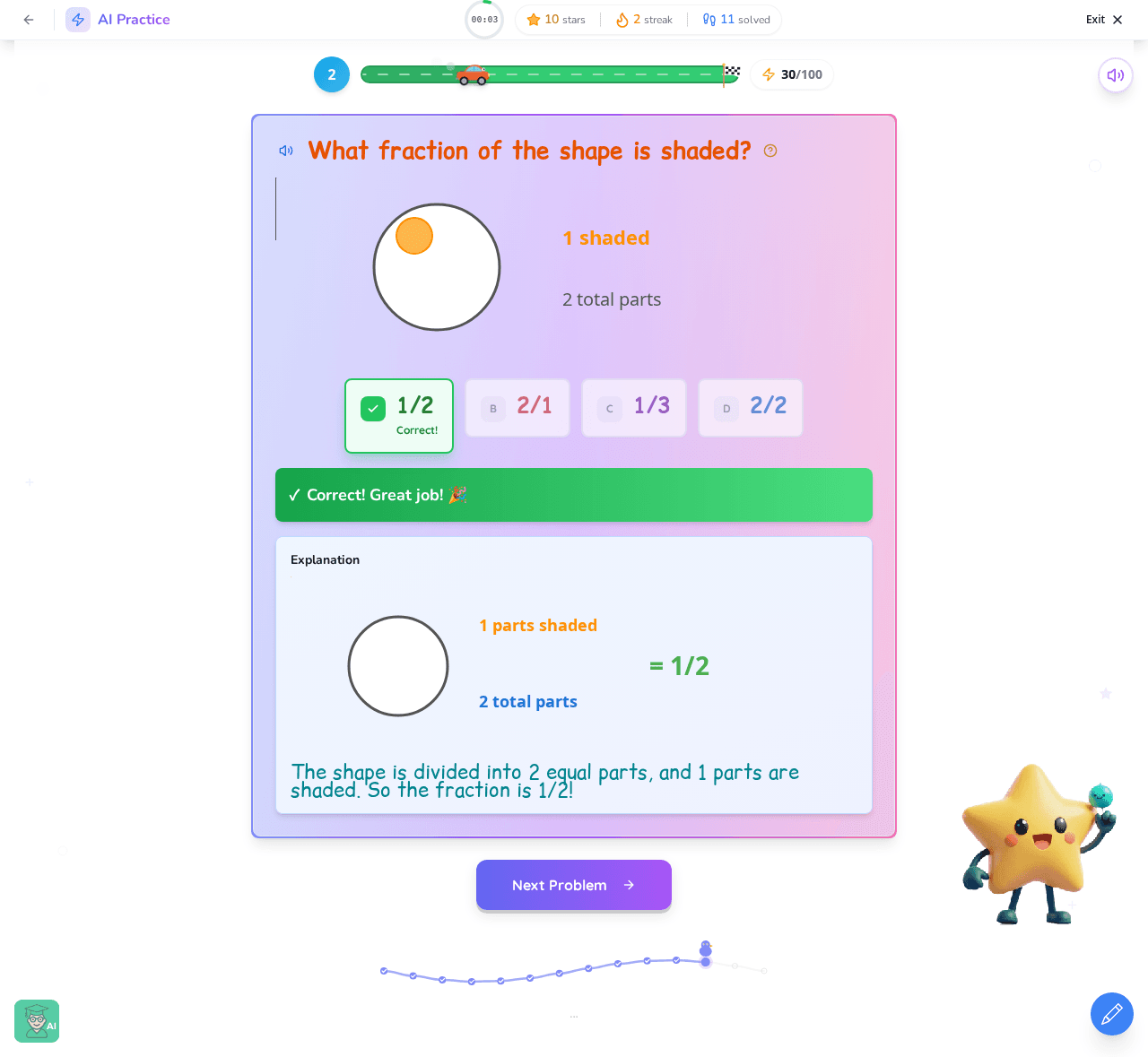
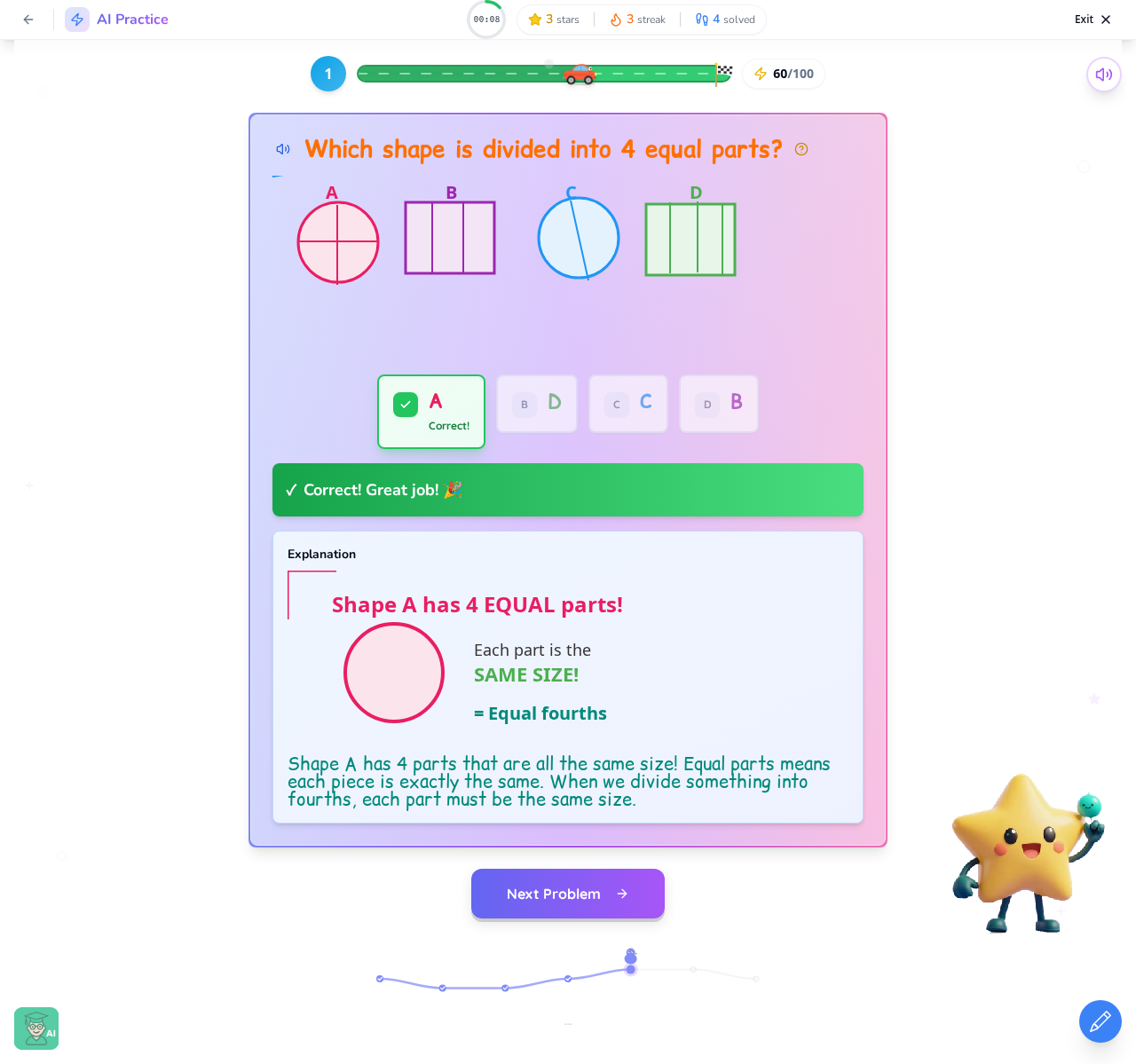
4. Interactive Online Practice Digital platforms like AI Teacherly offer visual, interactive fraction lessons that make practice engaging. The interactive problem below shows exactly how visual fraction practice works, with shapes that help children identify fractions through colorful, clickable activities.
5. Fraction Art Have your child color fractions of shapes. Draw a rectangle, divide it into 6 equal parts, and say: "Color 4/6 of this shape." This reinforces both the concept and gives a visual record of their understanding.
Pro tip: Keep practice sessions short (10-15 minutes) and positive. Celebrating small wins builds the confidence that makes children want to keep learning.
See How Visual Fraction Learning Works
Visual learning transforms abstract fraction concepts into something children can see, touch, and manipulate. When a child watches a shape being divided into equal parts, then sees specific sections light up to represent the numerator, the connection between the visual and the numbers becomes unmistakable.
Here's what the full interactive lesson experience looks like on AI Teacherly:
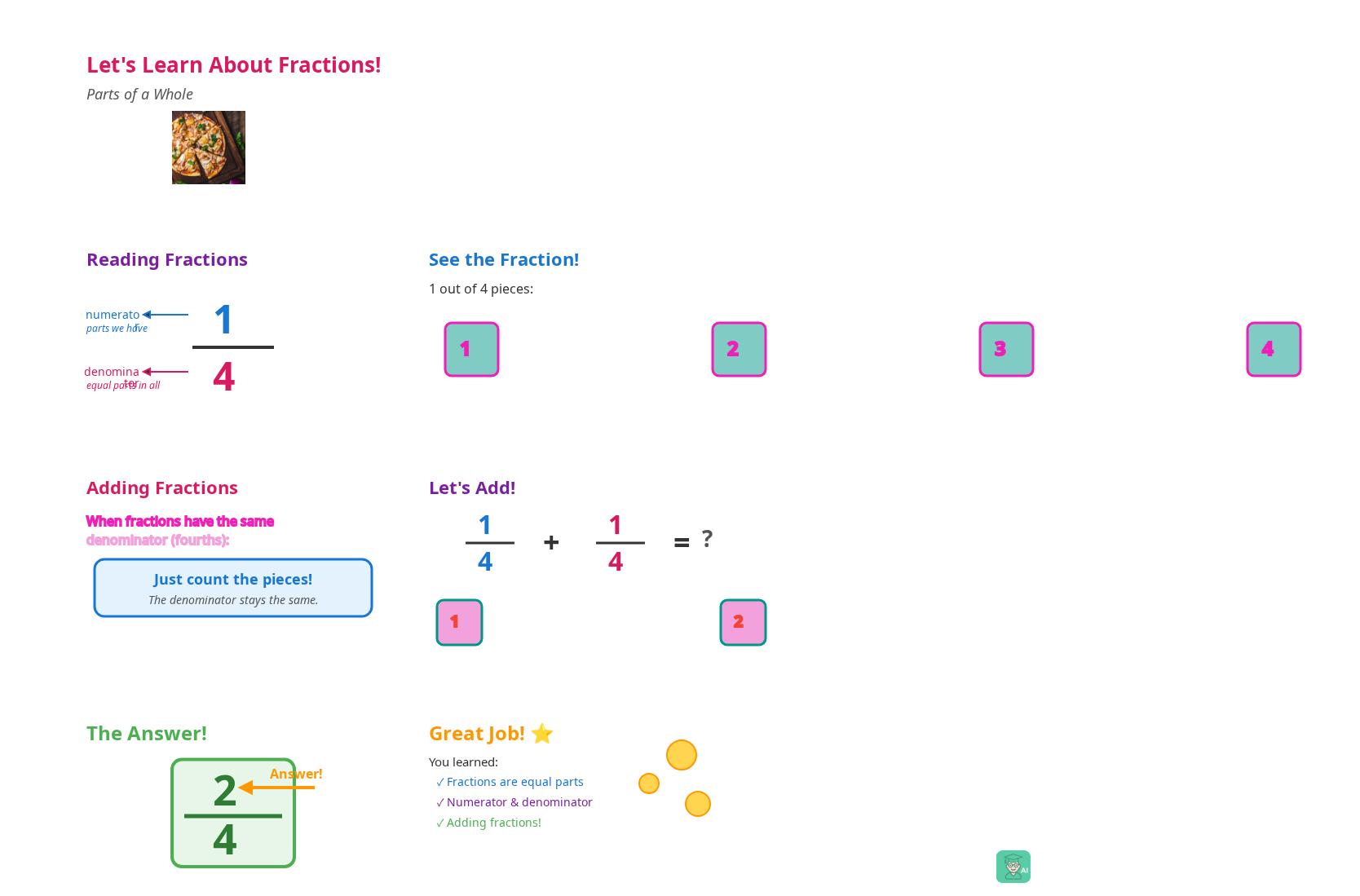
The Introduction to Fractions and Simple Fraction Addition lesson on AI Teacherly demonstrates this approach perfectly. The lesson opens with a relatable scenario: "Fractions help us share things fairly, like this pizza!" This immediately grounds the abstract concept in something every child understands.
As the lesson progresses, children see:
- Shapes divided into equal parts with clear visual cues
- The numerator highlighted as "how many parts we have"
- The denominator explained as "how many equal parts in all"
- Interactive practice where they identify fractions by clicking on visual representations
The fraction addition sections reveal the "secret" in a memorable way: "Here's the secret to adding fractions! When the pieces are the same size, we just count them." Children then practice this with guided problems that show the visual alongside the numbers.
What makes visual platforms particularly effective:
- Immediate feedback tells children if they're on track
- Multiple representations (circles, rectangles, number lines) build flexible thinking
- Self-paced learning allows struggling concepts to be revisited
- Engaging format keeps children motivated longer than worksheets
The combination of parent support at home and structured visual practice creates the strongest foundation for fraction mastery.
Key Takeaways
- Visual models (pizza slices, pie pieces, shaded shapes) make abstract fraction concepts concrete and memorable for 3rd graders
- The denominator tells how many equal parts total; the numerator tells how many parts we're counting; use this simple script when explaining
- Adding fractions with the same denominator is just counting pieces: add the numerators, keep the denominator the same
- Everyday moments (cooking, sharing snacks, pizza night) are perfect opportunities for natural fraction practice
- Short, positive practice sessions (10-15 minutes) build confidence better than lengthy drilling
- Interactive visual platforms provide immediate feedback and multiple representations that deepen understanding
- Watch for the common mistake of adding both numerator and denominator; remind children the piece size doesn't change
Frequently Asked Questions
What is the easiest way to explain fractions to a 3rd grader?
Use pizza or pie slices! Show a pizza cut into 8 pieces. If they eat 3 slices, they ate 3/8. The bottom number (8) shows total pieces, the top number (3) shows pieces taken. Visual examples make fractions concrete and relatable.
How do you add fractions with the same denominator?
Add the top numbers (numerators) and keep the bottom number (denominator) the same. For 2/5 + 1/5, add 2+1=3, keep the 5, answer is 3/5. The piece size stays the same; you're just counting more pieces!
Why do so many kids struggle with fractions?
Fractions flip familiar number rules. With whole numbers, bigger means more. But 1/8 is smaller than 1/4 even though 8 is bigger. Also, the stacked notation looks like two separate numbers. Visual models help bridge this confusion.
What does numerator and denominator mean in simple terms?
The denominator (bottom) tells how many equal pieces the whole is cut into. The numerator (top) tells how many of those pieces you have. Memory trick: Denominator is Down, Numerator is the Number you have.
How can I practice fractions with my child at home?
Use everyday moments! Cut sandwiches into parts and name the fractions. Share snacks equally and count what fraction each person gets. Bake together using measuring cups. These natural moments reinforce fractions without feeling like homework.
Are visual fraction models better than worksheets?
Research shows visual models build deeper understanding than procedures alone. Children who see fractions as shaded shapes, divided pizzas, or number lines develop flexible thinking. Worksheets work best after visual understanding is established.
When should my 3rd grader understand basic fractions?
By end of 3rd grade, children should identify fractions, understand numerator/denominator, compare fractions with same denominators, and add simple fractions. Don't worry if it takes time; fractions are genuinely challenging.
What common fraction mistakes should I watch for?
The biggest one: adding both numerator AND denominator (like 2/8 + 3/8 = 5/16). Remind them the piece size doesn't change! Also watch for confusing which number goes on top vs. bottom, and thinking bigger denominators mean bigger fractions.
Ready to make fractions click for your 3rd grader? Try the interactive Introduction to Fractions lesson free on AI Teacherly and watch visual learning transform math frustration into confidence!