Teach 2nd Grade Multiplication with Number Lines: A Visual Method That Actually Works
Discover how number lines turn confusing multiplication into a visual jumping game. Learn the method 2nd grade teachers use and how to practice it at home in just 10 minutes.
Why Number Lines Make Multiplication Click for 2nd Graders
If your 2nd grader freezes up when they see a multiplication problem, you're not alone. Multiplication can feel like a giant leap from the addition and subtraction they've been practicing. But here's the good news: number lines transform this abstract concept into something kids can actually see and touch.
Think about it this way. When your child learned to add, they could count on their fingers or use objects. Multiplication feels different because suddenly they're dealing with "times" and groups, which seems invisible. The number line method changes everything by making multiplication a physical journey: hop, hop, hop, and you land on the answer.
The beauty of this approach is that it connects what your child already knows (adding the same number repeatedly) to what they're learning (multiplication as a shortcut). Research shows that students who understand multiplication visually develop stronger number sense and experience less math anxiety as they progress through school.
You don't need to be a math expert to teach this method. All you need is a piece of paper, a pencil, and about 10 minutes. By the end of this guide, you'll have practical strategies to make multiplication click for your child, whether they're doing homework or practicing over the summer.
What Is the Number Line Method for Multiplication?
The number line method for multiplication is a visual strategy where students represent multiplication as equal jumps along a number line. Instead of memorizing that 3 × 4 = 12, your child literally sees three jumps of four spaces each, landing on 12.
Here's how it works in practice:
- Draw a number line starting at zero and extending past your expected answer
- Identify the jump size (the number being multiplied)
- Make equal jumps (the number of times you're multiplying)
- Find where you land (that's your answer!)
For example, to solve 3 × 4:
- Start at 0
- Make 3 jumps
- Each jump is 4 spaces
- You land on 12
The key phrase teachers use is "groups of." When your child sees 3 × 4, they should think "3 groups of 4" or "3 jumps of 4." This language is crucial because it builds conceptual understanding rather than just rote memorization.
Why does this method work so well? Because children are naturally drawn to movement and patterns. The jumping action engages their spatial reasoning while the visual representation helps them verify their answers. They can literally count the landing spots to check their work, building confidence with every problem.
How Does Multiplication Connect to Repeated Addition?
Before your child can truly understand multiplication, they need to see that multiplication is just a shortcut for repeated addition. This is where the number line becomes incredibly powerful.
Let's say your child needs to solve 4 × 3. Using repeated addition, they would write:
3 + 3 + 3 + 3 = 12
That's adding 3 four times. Now, on a number line, this looks exactly the same: four jumps of 3, landing on 12. The multiplication symbol (×) is simply a faster way to write what they already know how to do.
As one math educator puts it: "Multiplication is just a quicker way to add the same number over and over again." When children see this connection on a number line, the "aha moment" is almost guaranteed.
Here's a simple activity to reinforce this at home:
- Write a repeated addition problem: 5 + 5 + 5 = ?
- Have your child draw the jumps on a number line
- Ask: "How many jumps did you make?" (3)
- Ask: "How big was each jump?" (5)
- Introduce the shortcut: "Instead of writing 5 + 5 + 5, we can write 3 × 5!"
This progression, from concrete (number line) to abstract (multiplication equation), is exactly how schools teach multiplication today. By practicing at home, you're reinforcing what your child learns in class while building their confidence.
How to Practice Number Line Multiplication at Home
You don't need fancy materials or a teaching degree to practice number line multiplication at home. Here are practical, parent-tested strategies that work:
The Paper Number Line Method
Grab lined paper and draw a number line from 0 to 30. Start with small problems like 2 × 3 or 3 × 4. Have your child draw arcs (the "jumps") while counting aloud: "Jump 1, jump 2, jump 3... I landed on 12!"
The Floor Tile Game
If you have tile or wood flooring, turn it into a giant number line! Label tiles with sticky notes (0, 1, 2, 3...) and have your child physically hop while solving problems. Kinesthetic learners especially love this approach.
The Snack Groups Method
Use crackers, grapes, or cereal pieces. For 4 × 2, make 4 groups with 2 items in each. Then line them up and count how many total. This bridges the "groups of" concept with the number line visual.
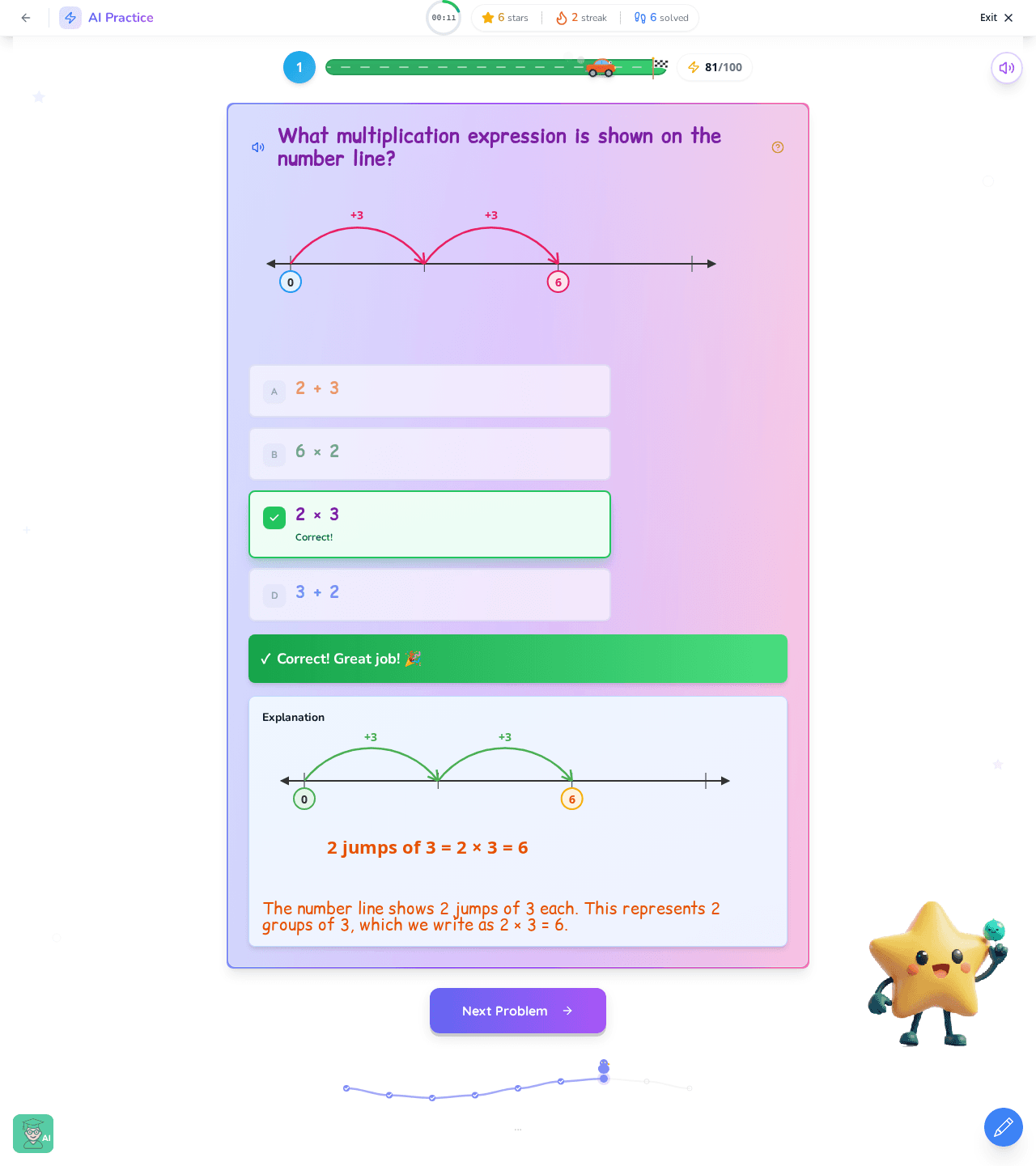
The interactive problem below shows exactly how number line multiplication works in practice.
Daily Practice Tips:
- Keep sessions short (10 to 15 minutes maximum)
- Celebrate the process, not just correct answers
- Start with multiplication facts using 2s, 5s, and 10s (they follow easy patterns)
- Let your child create their own problems to solve
Consistency beats intensity. A few minutes of practice each day builds stronger skills than occasional hour-long sessions.
See How Interactive Number Line Lessons Work
While paper number lines are great for practice, interactive digital lessons take the learning experience to another level. On AI Teacherly, the Multiplication on the Number Line lesson for Grade 2 brings this concept to life with animated jumps and instant feedback.
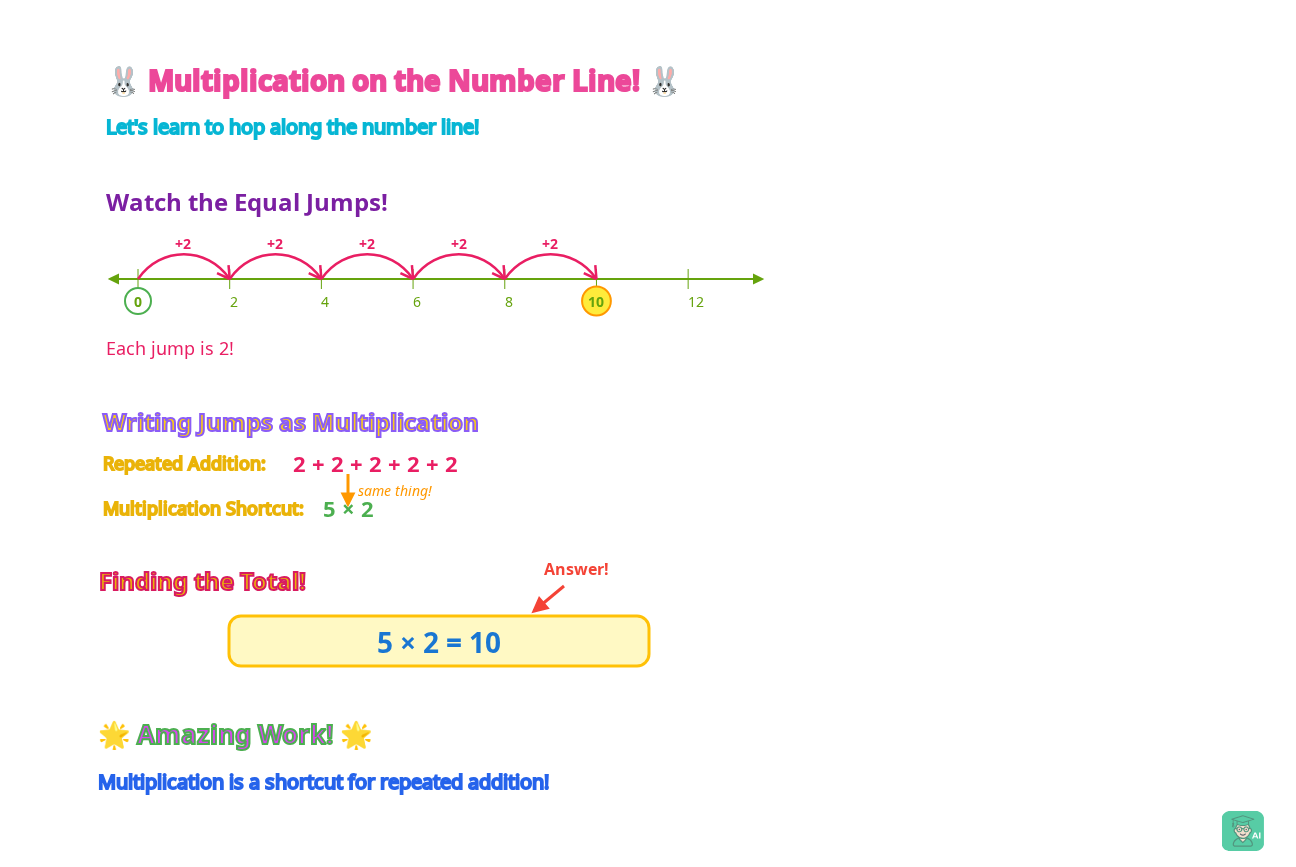
Here's what the full interactive lesson looks like on AI Teacherly:
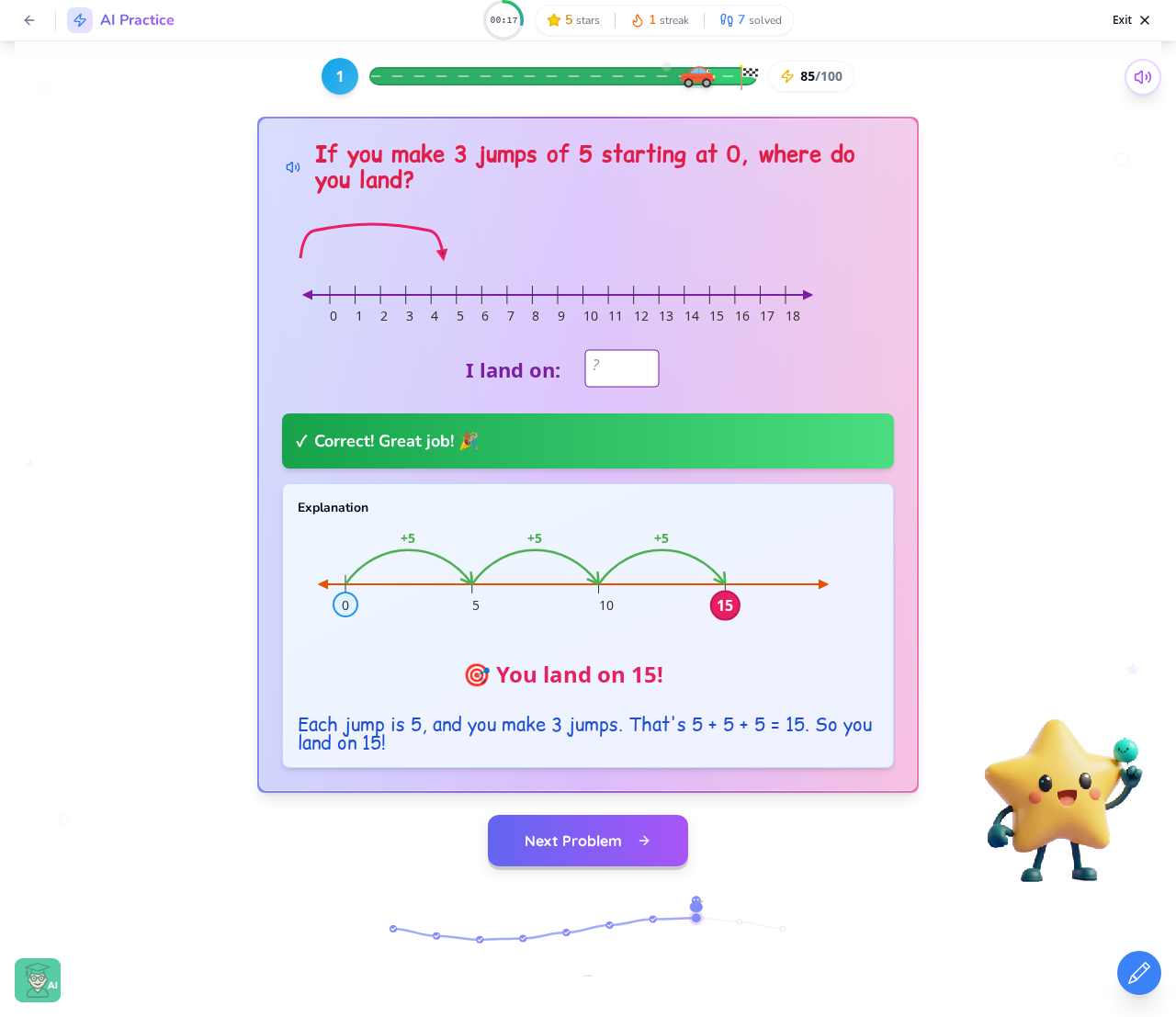
In the lesson, students see number lines with colorful arcs showing each jump. They might be asked to:
- Identify the multiplication expression that matches a series of jumps
- Find where they land after making a certain number of equal jumps
- Complete the jumps to solve a multiplication problem
What makes interactive practice different from worksheets?
- Immediate feedback: Kids know right away if they're on track
- Visual animations: Jumps appear one at a time, reinforcing the counting
- Guided instruction: Built-in explanations help when kids get stuck
- Engagement: Colorful visuals and interactive elements keep attention
The lesson guides students through the key insight: "Each jump is the same every time! That's the pattern: equal jumps." This equal groups concept is fundamental to multiplication mastery.
For parents, the benefit is clear: your child gets structured, curriculum-aligned practice without you needing to prepare materials or check answers. The platform handles the teaching while you provide encouragement.
Common Mistakes Kids Make (And How to Fix Them)
Even with the number line method, 2nd graders can stumble. Knowing what to watch for helps you guide them back on track:
Mistake #1: Confusing the Jump Size with the Number of Jumps
For 3 × 4, some kids make 4 jumps of 3 instead of 3 jumps of 4. While both equal 12 (commutative property!), it's important they understand which number means what.
Fix: Use the phrase "3 times 4 means 3 jumps of 4." The first number tells how many jumps; the second tells how big each jump is.
Mistake #2: Making Unequal Jumps
Kids might accidentally make jumps of different sizes (jumping 4, then 3, then 5).
Fix: Before jumping, ask "How big is each jump going to be?" Then have them say the jump size aloud with each hop: "4... 4... 4!"
Mistake #3: Starting at 1 Instead of 0
Some children begin their jumps at 1, throwing off the final answer.
Fix: Always emphasize "We start at zero, where our journey begins." Mark 0 with a star or smiley face as the starting point.
Mistake #4: Counting Tick Marks Instead of Jumps
Children might count the lines on the number line rather than the spaces between them.
Fix: Draw arcs clearly above the number line and have them tap each arc while counting.
Remember, mistakes are learning opportunities. When your child makes an error, resist the urge to immediately correct them. Instead, ask guiding questions: "Let's count your jumps together. How big was each one?"
Key Takeaways
- Number lines transform abstract multiplication into visible, countable jumps that 2nd graders can understand
- The key phrase is "groups of": 3 × 4 means "3 groups of 4" or "3 jumps of 4 spaces"
- Multiplication is simply a shortcut for repeated addition, and number lines prove this visually
- Practice at home requires only paper and pencil; keep sessions short (10 to 15 minutes) for best results
- Start with 2s, 5s, and 10s because they have easy-to-recognize patterns
- Watch for common mistakes like starting at 1 instead of 0, or making unequal jumps
- Interactive lessons provide immediate feedback and animated visuals that reinforce the jumping concept
Frequently Asked Questions
What is the number line method for teaching multiplication?
The number line method shows multiplication as equal jumps. For 3 × 4, students make 3 jumps of 4 spaces starting at zero, landing on 12. This visual approach helps kids see multiplication as repeated addition.
How do I explain multiplication to my 2nd grader?
Tell them multiplication is a shortcut for adding the same number multiple times. Show that 4 × 3 is the same as 3 + 3 + 3 + 3. Use number lines, objects, or drawings to make it visual and concrete.
Why is multiplication taught as groups of?
The "groups of" language builds conceptual understanding. When kids think "3 groups of 4" instead of just "3 times 4," they understand what the numbers actually mean, making problem-solving easier.
Is it normal for 2nd graders to struggle with multiplication?
Absolutely. Multiplication is typically introduced in 2nd grade and mastered through 3rd grade. Struggling is part of learning. Focus on understanding through visuals rather than rushing to memorization.
How many multiplication facts should a 2nd grader know?
By the end of 2nd grade, most students should understand the concept and know basic facts for 2s, 5s, and 10s. Full multiplication table memorization usually happens in 3rd grade.
What comes first, repeated addition or multiplication?
Repeated addition comes first. Children need to see that 5 + 5 + 5 equals 15 before learning that 3 × 5 is a faster way to write the same thing. Number lines bridge these two concepts beautifully.
How can I practice multiplication at home without worksheets?
Use floor tiles as a giant number line for jumping games, group snacks into equal sets, or draw number lines on paper. Interactive apps like AI Teacherly also provide engaging, visual practice.
What is the difference between skip counting and multiplication?
Skip counting is counting by a number (2, 4, 6, 8...). Multiplication uses skip counting but asks "where do you land after a certain number of skips?" Skip counting is the foundation; multiplication applies it to solve problems.
Ready to make multiplication click for your 2nd grader? Try the free interactive Multiplication on the Number Line lesson on AI Teacherly and watch those jumps turn into confidence!