4th Grade Division Remainders: 3 Simple Strategies to Master Word Problems
Your 4th grader gets the division math right but the word problem wrong. Sound familiar? Learn the 3 simple strategies that make remainder problems click.
Why Division Remainders Trip Up 4th Graders
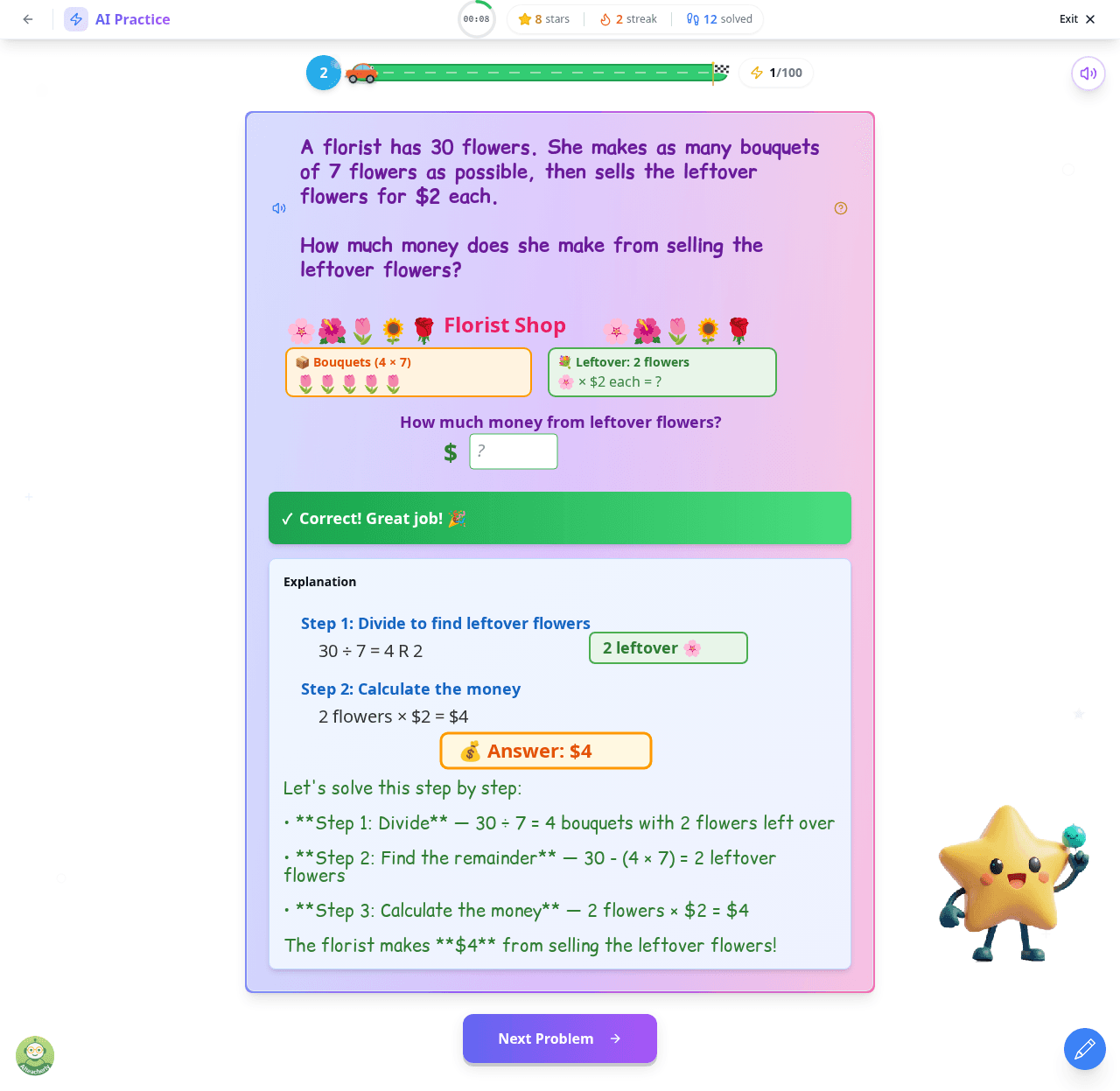
Your child solves 25 ÷ 4 = 6 R1 perfectly. Then they write "6 remainder 1" as their final answer to a word problem, and it's marked wrong. Frustrating, right?
Here's the thing: the math was correct, but the interpretation wasn't. This is exactly where 4th grade division remainders word problems become tricky. It's not about calculating the remainder; it's about knowing what to do with it.
When we divide in real life, there are often leftovers. But here's the tricky part: what do we do with them? A remainder of 3 could mean "we need one more group," "ignore it," or "that's our actual answer." The same leftover number requires completely different handling depending on the situation.
This is why so many students (and parents!) feel stuck. The division is easy. The decision-making? That's where critical thinking comes in. The good news is that there's a simple framework that makes this click for every child.
What Does It Mean to Interpret a Remainder?
Interpreting remainders in division means deciding what the leftover number represents in a real-world context and adjusting your answer accordingly.
Think of it this way: when you divide 23 cookies among 4 friends, each person gets 5 cookies with 3 left over. But what happens to those 3 cookies depends on your goal:
- If you're asking "how many cookies does each person get?" the answer is 5 (you drop the remainder)
- If you're asking "how many cookies are left for later?" the answer is 3 (you use the remainder)
- If you're packaging cookies in boxes of 4 for sale, you might need 6 boxes to sell all 23 (you round up)
The mathematical division is always the same: 23 ÷ 4 = 5 R3. But the interpreted answer changes based on the question being asked.
This is why interpreting remainders is considered a critical thinking skill in 4th grade math. Your child must read carefully, understand the context, and make a logical decision. It's math meeting real life, and it's one of the most practical skills they'll learn.
The 3 Strategies: Round Up, Drop It, or Use It
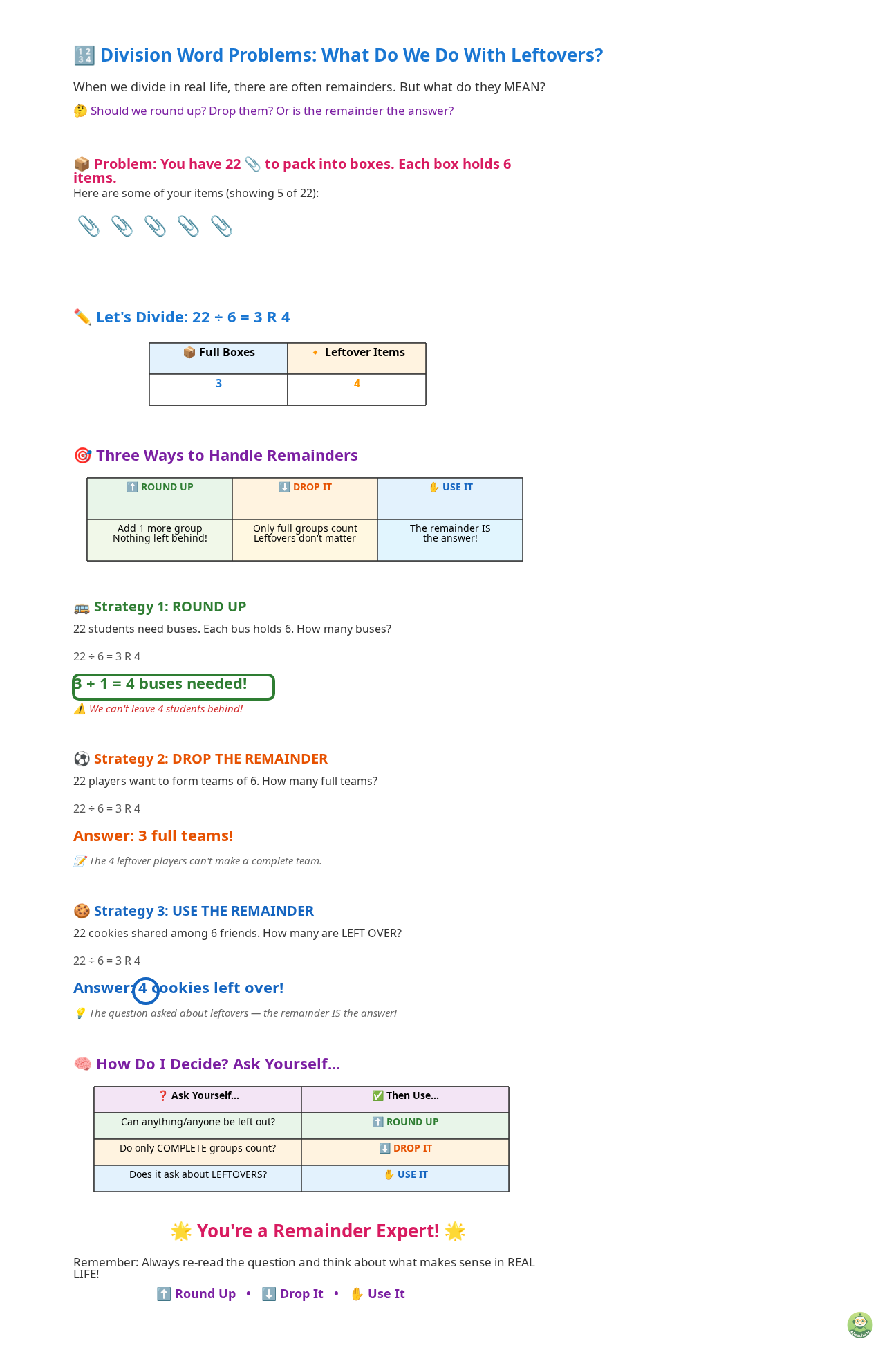
Here's the framework that transforms remainder confusion into confident problem-solving. Every division remainder word problem falls into one of three categories:
Strategy 1: Round Up the Answer
When nothing can be left behind, you need to round up to the next whole number. Classic examples include:
- Buses for a field trip: If 47 students need rides and each bus holds 10, you can't leave 7 students behind! You need 5 buses (47 ÷ 10 = 4 R7, round up to 5).
- Tables at a party: Everyone needs a seat, so you round up.
- Containers for moving: You can't leave items on the floor.
Strategy 2: Drop the Remainder
When only complete groups count, you ignore the remainder entirely. Examples include:
- Soccer teams: If you have 23 players and need teams of 5, you can make 4 complete teams. The 3 extra players can't form their own team.
- Gift bags: You can only give away complete bags.
- Pages in a photo album: Only full pages count.
Strategy 3: Use the Remainder as Your Answer
Sometimes the leftover itself is what the problem asks about:
- Leftover cookies: "How many are left over?" The remainder IS the answer.
- Remaining money: After buying as many items as possible, how much is left?
- Extra students: How many don't fit in a group?
Teach your child to ask: "What is the question actually asking about: the groups, or the leftovers?"
How to Know Which Strategy to Use (With Examples)
The secret is in the question! Here's a simple decision guide your child can use:
Ask these three questions:
- Can anything be left behind? If NO → Round Up
- Does only complete groups matter? If YES → Drop It
- Is the problem asking about the leftover? If YES → Use It
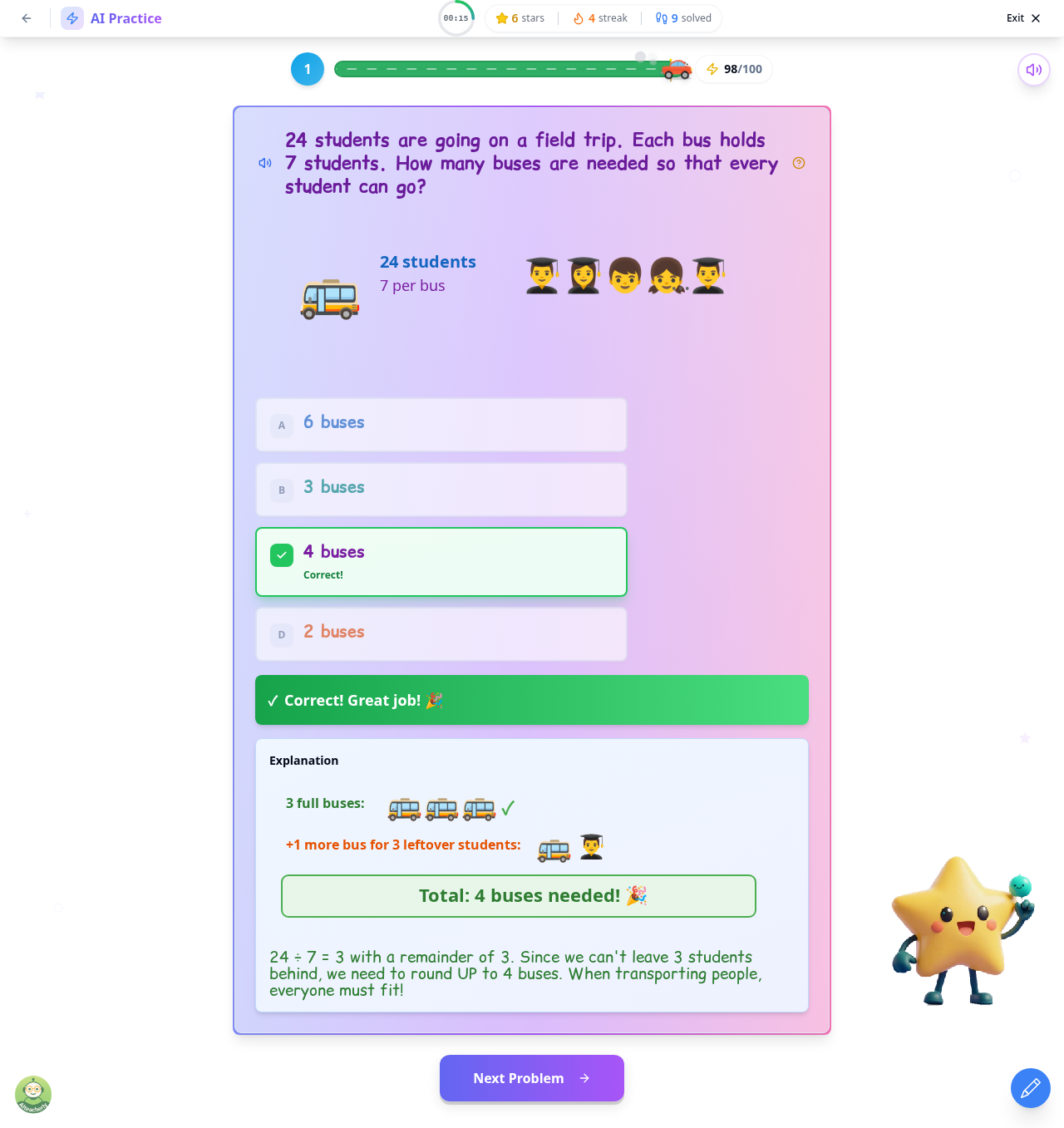
Let's see this in action with a real problem. Imagine a field trip where 47 students need transportation, and each bus holds 10 students. The division gives us 47 ÷ 10 = 4 R7. But can we leave 7 students behind at school? Absolutely not! So we round up to 5 buses.
The interactive problem below shows exactly how this round-up strategy works in practice.
This kind of contextual reasoning is what separates students who merely calculate from those who truly understand mathematics. When your child re-reads the question and thinks about what makes sense in real life, they develop problem-solving skills that extend far beyond the math worksheet.
Pro tip for parents: When practicing at home, have your child explain why they chose their strategy before giving the numerical answer. This verbalization reinforces the decision-making process and helps identify any confusion early.
Practice Makes Perfect: Interactive Division Remainder Problems
Understanding the three strategies is one thing; applying them fluently is another. The best way to build this skill is through varied practice with immediate feedback.
Here's what the full interactive lesson looks like on AI Teacherly:
The Division Word Problems: Interpreting Remainders lesson on AI Teacherly guides students through all three remainder strategies using relatable scenarios:
- Bus and transportation problems (round up practice)
- Gift bag and team formation (drop remainder practice)
- Cafeteria seating and leftover counting (use remainder practice)
What makes interactive practice different from worksheets? Your child gets:
- Instant feedback on whether their interpretation was correct
- Visual models showing the division with concrete objects
- Varied contexts so they learn to transfer the skill, not memorize answers
- Scaffolded hints when they're stuck, rather than just seeing a red X
The lesson takes approximately 30 minutes and includes problems at varying difficulty levels. Students start with straightforward scenarios and progress to more challenging multi-step problems where they must both calculate and interpret.
Recommended practice schedule: 2-3 sessions per week until your child can identify the correct strategy before solving. When they start saying "Oh, this is a round-up problem!" you'll know the framework has clicked.
Common Mistakes Kids Make With Remainders (And How to Fix Them)
Even after learning the three strategies, students often fall into predictable traps. Here's what to watch for:
Mistake 1: Always Writing "R" as the Answer
Some students write "6 R2" for every word problem because that's what the calculation shows. Fix: Remind them that word problems need real-world answers. Ask, "Would you say you need 6 R2 buses? What does that even mean?"
Mistake 2: Forgetting to Re-read the Question
Students rush to calculate and forget to check what the question actually asks. Fix: Create a habit of circling the question before solving. What exactly does the problem want to know?
Mistake 3: Confusing Round Up with Adding the Remainder
When rounding up from 4 R7, some students write 11 (adding 4+7) instead of 5. Fix: Explain that rounding up means "one more group," not "answer plus remainder." Use visuals to show why you need just ONE more bus, not 7 more.
Mistake 4: Not Checking if the Answer Makes Sense
A student might answer "0.5 buses" or "4.7 teams" because they used decimal division. Fix: Ask, "Does half a bus exist? Can you have part of a team?" Real-world contexts demand whole number answers.
Mistake 5: Applying the Same Strategy to Every Problem
Once a student learns "round up," they might round up everything. Fix: Mix problem types during practice. Present two problems with the same numbers but different questions to highlight how context changes the answer.
Key Takeaways
- Division remainders require interpretation, not just calculation; the math is often right even when the answer is wrong
- Use the 3-strategy framework: Round Up (nothing left behind), Drop It (only complete groups count), Use It (the leftover is the answer)
- Teach your child to re-read the question and ask 'What makes sense in real life?' before finalizing their answer
- Practice with varied problem types builds the critical thinking skills that transfer beyond just division
- Interactive lessons with immediate feedback help students recognize patterns faster than traditional worksheets
- Watch for common mistakes like always writing 'R' answers or adding remainder to quotient when rounding up
- When your child identifies the strategy before calculating, the framework has truly clicked
Frequently Asked Questions
What does it mean to interpret a remainder in division?
Interpreting a remainder means deciding what the leftover number represents in real life and adjusting your final answer accordingly, rather than just writing the mathematical result.
What are the three ways to handle remainders in word problems?
Round Up (when nothing can be left behind), Drop It (when only complete groups count), and Use It (when the leftover itself is what the question asks about).
When should my child round up the remainder?
Round up when nothing can be left behind, like needing buses for all students on a field trip. Even if 7 students are 'left over,' they still need transportation, so you need one more bus.
Why does my child get division remainders right but word problems wrong?
The calculation is often correct, but interpreting what to do with the remainder requires understanding the real-world context. This is a critical thinking skill that needs separate practice.
How do I know when the remainder is the actual answer?
The remainder is the answer when the question specifically asks about the leftover, such as 'How many cookies are left over?' or 'How much money remains after buying?'
Is interpreting remainders important for standardized tests?
Yes, interpreting remainders is a key 4th grade Common Core standard and frequently appears on state assessments, making it essential for test readiness.
What's the best way to practice remainder word problems at home?
Use interactive lessons with varied problem types and immediate feedback. Have your child explain which strategy they're using and why before solving.
At what age do kids learn to interpret remainders?
Interpreting remainders is typically introduced in 4th grade (ages 9-10) as students move from basic division facts to applying division in real-world contexts.
Ready to help your 4th grader master division remainders? Try the interactive Division Word Problems: Interpreting Remainders lesson free on AI Teacherly and watch the "what do I do with the leftover?" confusion disappear!