Why Dividing Fractions Gets Bigger: Visual Models That Finally Make 5th Grade Math Click
Fraction division breaks every rule your 5th grader learned about math. Discover why dividing by fractions gives bigger answers and how visual models finally make it click.

The Fraction Division Surprise Your 5th Grader Didn't See Coming
Your 5th grader has spent years learning one fundamental truth about division: when you divide, numbers get smaller. 12 divided by 4 equals 3. 100 divided by 10 equals 10. It makes perfect sense.
Then fraction division arrives, and everything they thought they knew falls apart.
Suddenly, dividing by 1/2 makes numbers bigger. 4 ÷ 1/2 = 8. Wait, what? This isn't just confusing for your child; it feels like math itself broke the rules. No wonder so many 5th graders hit a wall when fraction division enters the curriculum.
Here's the good news: your child isn't bad at math. Fraction division is genuinely counterintuitive, and the confusion is completely normal. The key to breaking through isn't more memorization or drill practice. It's helping your child see why fraction division works the way it does through visual models.
In this guide, you'll discover why dividing by fractions gives bigger answers, how visual models transform confusion into clarity, and practical ways to support your 5th grader at home. By the end, fraction division won't feel like broken math anymore.
Why Does Dividing by a Fraction Give a Bigger Answer?
When you divide by a fraction less than one, you're essentially asking: how many of these smaller pieces fit inside the larger number? The answer is always more than what you started with.
Think about it this way: if you have 4 pizzas and you want to know how many half-pizza servings you can make, you're not making the pizzas smaller. You're counting how many half-sized portions fit inside 4 whole pizzas. The answer is 8, because each whole pizza contains 2 half-servings.
This is where the "division makes smaller" rule finally reveals its secret. Division doesn't always make things smaller; it asks "how many groups of this size fit inside that number?" When the group size is less than one, you always get more groups than you started with.
The mathematical principle your child is discovering is profound: dividing by less than one always gives us more. This insight is the foundation for understanding ratios, proportions, and algebra concepts they'll encounter in middle school.
Most 5th graders struggle because they're trying to apply whole number logic to fractions. Visual models bridge this gap by showing, not just telling, why the math works.
Two Types of Fraction Division Problems (And Why Both Confuse Kids)
Fraction division actually comes in two distinct flavors, and each one trips up students in different ways. Understanding both types helps you know exactly where your child might be struggling.
Type 1: Fraction ÷ Whole Number
This is when you're splitting a fraction into smaller equal parts. For example: 1/2 ÷ 3 means splitting half a pizza among 3 people. The result is smaller pieces (1/6 each). This type follows the "division makes smaller" intuition, so it's usually easier for kids to grasp.
Type 2: Whole Number ÷ Fraction
This is the brain-bender. When you divide 4 ÷ 1/2, you're asking how many half-sized pieces fit inside 4 wholes. The answer (8) is bigger than where you started. This type violates everything kids think they know about division.
Here's why it matters: many 5th graders can solve Type 1 problems correctly but freeze on Type 2. If your child gets some fraction division problems right but others wrong, they likely understand one type but not the other.
The solution isn't more formula memorization. It's using visual models that show the physical reality of what's happening with each problem type. When kids can see the pieces splitting or multiplying, the abstract symbols start making sense.
How Visual Models Make Fraction Division Click
Visual models transform fraction division from abstract symbol manipulation into something kids can actually see and touch. Two models work especially well for 5th graders: area models and number lines.
Area Models: Seeing the Pieces Split
Area models use shapes (usually rectangles) to represent fractions. When your child divides 1/2 by 3, they can watch the half-section get divided into 3 equal pieces. Each piece is visually smaller, and counting the pieces relative to the whole shows why the answer is 1/6.
The power of area models is in the visual feedback. Kids don't have to trust the formula; they can see how each piece splits into smaller parts and verify the answer by counting.
Number Lines: Counting the Jumps
Number lines work beautifully for Type 2 problems (whole number ÷ fraction). To solve 4 ÷ 1/2, students hop in half-sized jumps along the number line and count: how many jumps does it take to reach 4? The answer (8 jumps) becomes obvious when they can see and count each hop.
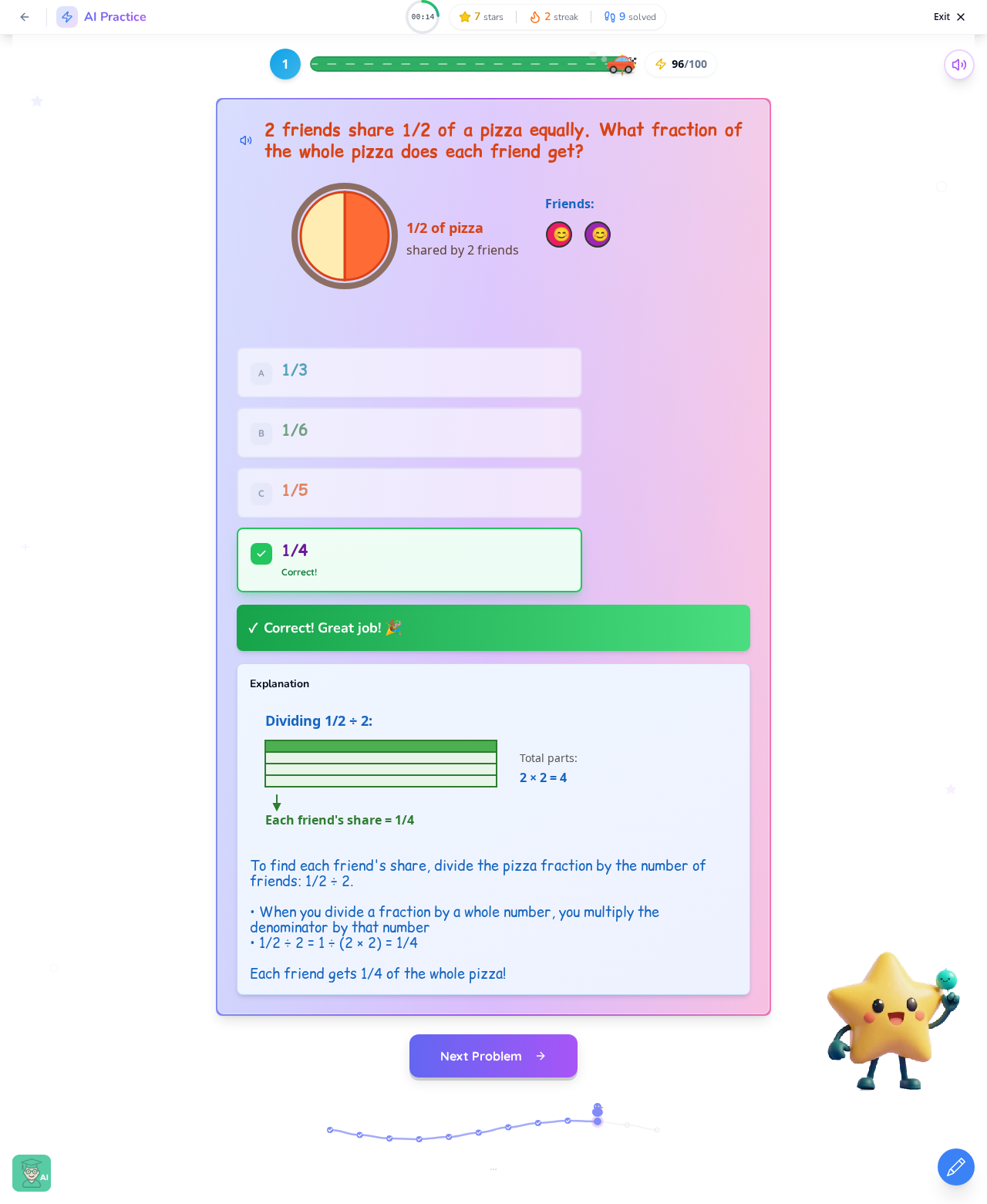
The interactive problem below shows exactly how visual models help students see fraction division in action.
These visual approaches give kids a mental model they can carry with them. When they encounter fraction division on a test, they can visualize the area model or number line even without drawing it.
See Fraction Division in Action with AI Teacherly
Understanding fraction division concepts is one thing. Giving your child hands-on practice that reinforces those concepts is another. That's where interactive learning makes all the difference.
On AI Teacherly, the Understanding Fraction Division with Visual Models lesson takes 5th graders through a carefully designed learning journey. Students don't just watch explanations; they interact with area models by dragging pieces, hop along number lines by clicking, and build intuition through guided discovery.
Here's what the full interactive lesson looks like on AI Teacherly:
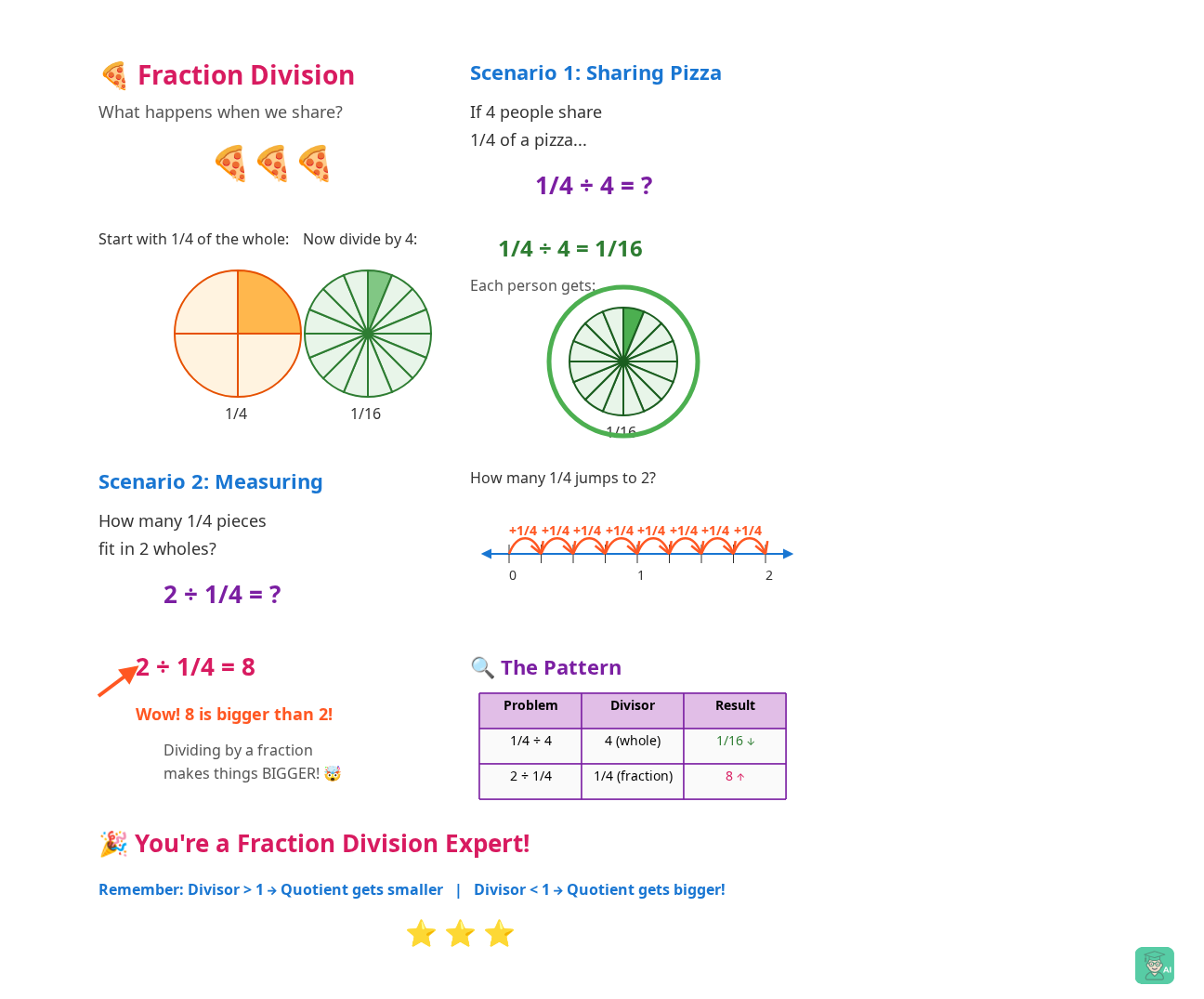
The lesson starts with familiar scenarios like sharing pizza, then builds to the counterintuitive discovery that dividing by fractions gives bigger answers. Each concept is reinforced with immediate visual feedback, so students can self-correct and build confidence.
What makes this approach effective is the progression. Students begin with concrete examples (pizza, recipes), move to visual models (area diagrams, number lines), and finally connect these to the abstract mathematical notation. This concrete-to-abstract pathway is exactly how math education experts recommend teaching fraction division.
The interactive elements also keep kids engaged longer than worksheet practice. Instead of getting frustrated and giving up, students can experiment, make mistakes, and see immediate results.
Real-World Examples That Make Fraction Division Stick
Abstract math concepts stick better when kids can connect them to real life. Here are fraction division scenarios you can discuss with your 5th grader:
The Pizza Problem
You have half a pizza left over. Three kids want to share it equally. How much does each kid get? This is 1/2 ÷ 3 = 1/6. Each child gets one-sixth of the original pizza. Your child can visualize (or actually draw) the half pizza being split into three pieces.
The Recipe Challenge
A recipe calls for 1/4 cup of sugar, but you want to make 3 batches. How many quarter-cups do you need? This is a multiplication problem (1/4 × 3), but you can flip it: if you have 3/4 cup total, how many 1/4-cup servings is that? Answer: 3/4 ÷ 1/4 = 3.
The Ribbon Cutting
You have 6 feet of ribbon and need pieces that are 1/3 foot long. How many pieces can you cut? This is 6 ÷ 1/3 = 18 pieces. Kids can visualize (or physically measure) cutting the ribbon into many small pieces.
The Walking Distance
You walked 2 miles. Each lap around the track is 1/4 mile. How many laps did you complete? This is 2 ÷ 1/4 = 8 laps.
The key is connecting fraction division to questions your child might actually wonder about. When math answers real questions, it stops feeling like arbitrary symbol shuffling.
Key Takeaways
- Fraction division feels counterintuitive because it breaks the 'division makes smaller' rule kids learned with whole numbers
- Dividing by a fraction less than one asks 'how many smaller pieces fit inside?' which always gives a bigger answer
- Two problem types exist: fraction ÷ whole number (pieces get smaller) and whole number ÷ fraction (answer gets bigger)
- Visual models like area diagrams and number lines let kids SEE why fraction division works instead of just memorizing formulas
- Real-world contexts (pizza sharing, recipe scaling, ribbon cutting) make abstract concepts memorable and meaningful
- Interactive practice with immediate visual feedback builds confidence faster than worksheet drilling
- Confusion about fraction division is completely normal and doesn't mean your child is 'bad at math'
Frequently Asked Questions
Why does dividing by a fraction give a bigger answer?
When you divide by a fraction less than one, you're asking how many smaller pieces fit inside the larger number. Since the pieces are smaller than one whole, more of them fit, giving you a bigger answer.
How do I explain fraction division to my 5th grader?
Use visual models and real-world examples. Ask 'how many half-pizzas fit in 4 whole pizzas?' and let them count. Seeing the pieces makes the concept click better than memorizing formulas.
What visual models help with fraction division?
Area models (rectangles showing pieces splitting) and number lines (hopping in fraction-sized jumps) work best for 5th graders. Both let kids see and count the results instead of trusting abstract rules.
Why is fraction division so hard for kids?
Fraction division contradicts years of learning that 'division makes smaller.' When dividing by fractions gives bigger answers, it feels like math broke its own rules. Visual models help bridge this cognitive gap.
Is it normal for my child to find fraction division confusing?
Absolutely. Fraction division is one of the most challenging 5th grade math concepts because it's genuinely counterintuitive. Confusion indicates your child is thinking deeply, not that they're bad at math.
What's the difference between dividing a fraction by a whole number and a whole number by a fraction?
Fraction ÷ whole number makes pieces smaller (1/2 ÷ 3 = 1/6). Whole number ÷ fraction counts how many small pieces fit, giving a bigger answer (4 ÷ 1/2 = 8). Each type needs different mental models.
How can I practice fraction division at home with my child?
Use real objects: cut paper strips, share food portions, or measure ingredients. Online platforms like AI Teacherly offer interactive visual lessons with immediate feedback that reinforce concepts through practice.
When should my child have mastered fraction division?
Fraction division is a core 5th grade Common Core standard (5.NF.B.7). Most students encounter it in spring semester. Mastery typically develops over several months of practice, not overnight.
Ready to turn fraction frustration into confidence? Try the interactive Understanding Fraction Division with Visual Models lesson free on AI Teacherly. Your 5th grader will see exactly why dividing by fractions works the way it does!