5th Grade Multi-Step Word Problems Made Easy: The PEMDAS Strategy Parents Need to Know
Tackle 5th grade multi-step word problems with confidence using the PEMDAS strategy and keyword code system. Practical tips every parent needs for homework success.
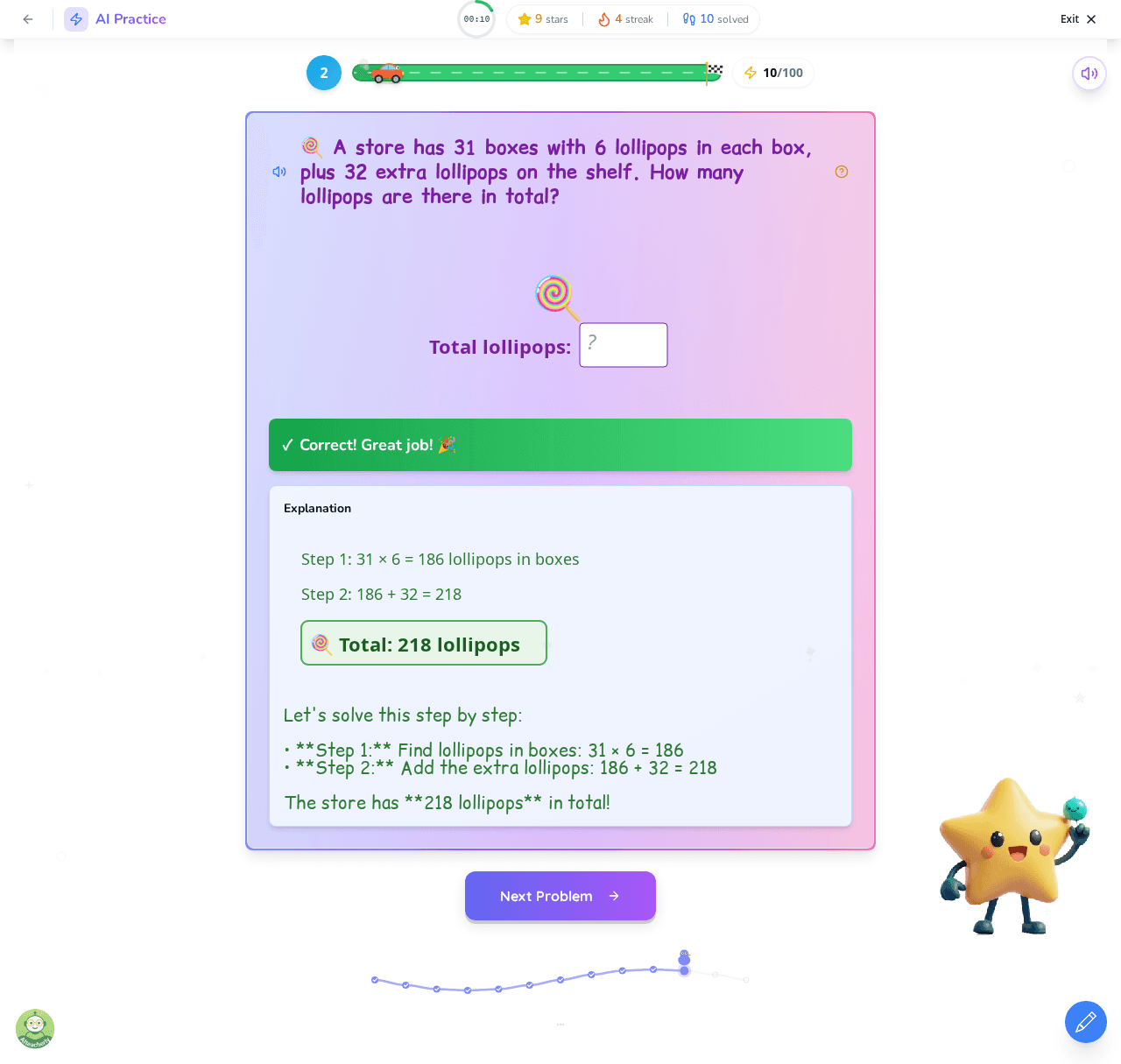
When Word Problems Leave Your Family Stumped
That moment when your 5th grader slides their homework across the table and you see a word problem with multiple operations? You're not alone if your heart sinks a little. Multi-step word problems are one of the most challenging aspects of 5th grade mathematics, and many parents feel unprepared to help.
The good news is that there's a systematic approach that makes these problems manageable for both you and your child. In this guide, you'll discover the keyword code strategy that reveals which operations to use, understand how PEMDAS (order of operations) works, and learn a simple 4-step framework your child can apply to any complex problem.
By the end of this article, homework time will feel less like a guessing game and more like cracking a code together. Let's transform those overwhelming word problems into confidence-building opportunities.
What Makes Multi-Step Word Problems Challenging for 5th Graders?
5th grade multi-step word problems require students to do much more than simple calculation. They must read carefully, identify relevant information, choose the correct operations, perform calculations in the right order, and verify their answer makes sense. That's a lot of cognitive load for a 10 or 11-year-old.
Here's why these problems trip up so many students:
Multiple operations in one problem: Unlike earlier grades where problems typically use one operation, 5th grade problems often combine addition, subtraction, multiplication, and division in a single question.
Hidden information: The necessary numbers aren't always stated directly. Students might need to infer quantities from context clues.
Order matters: Solving operations in the wrong sequence leads to incorrect answers, even when individual calculations are correct.
Real-world context: Problems are embedded in scenarios (shopping, sharing, measuring) that require students to translate words into mathematical operations.
Understanding these challenges helps you pinpoint where your child might be getting stuck. Is it identifying operations? Calculation errors? Or solving steps out of order? Each issue has a specific solution.
The Keyword Code: How to Identify Which Operations to Use
One of the most effective strategies for tackling mixed operations word problems is teaching your child to spot keyword clues. Certain words and phrases in problems act as signals that point directly to which mathematical operation is needed.
Addition Keywords:
- Total, altogether, combined, sum, in all, both, plus, increased by
Subtraction Keywords:
- Difference, left, remaining, fewer, less than, decreased by, how many more
Multiplication Keywords:
- Each, every, times, product, groups of, double, triple, per
Division Keywords:
- Share, split, divide, separate, distribute, each person gets, per group
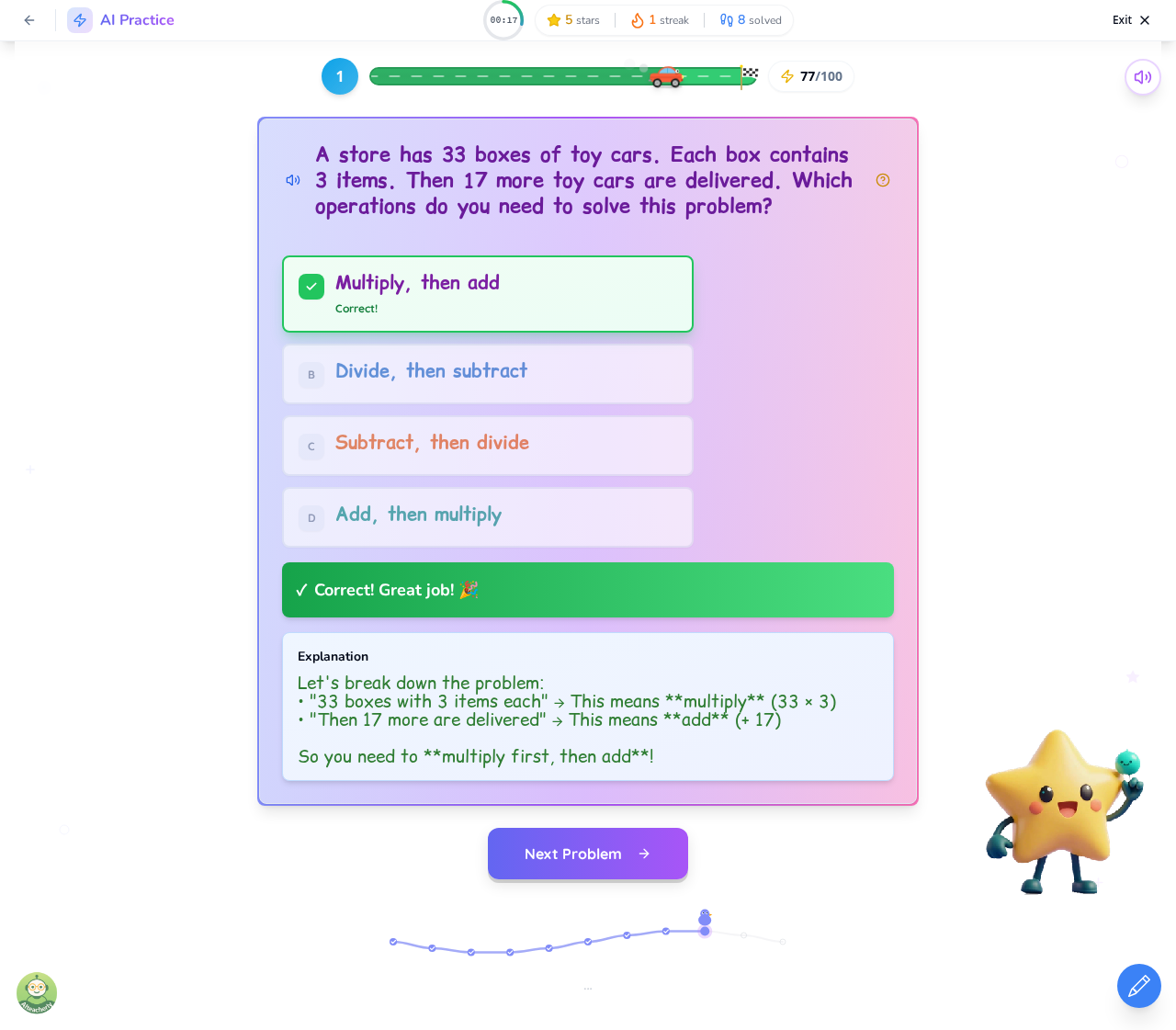
Here's how to practice: Read the problem aloud with your child and have them circle or highlight these keyword clues. Before doing any math, ask, "What operation does this word tell us to use?"
The interactive problem below demonstrates exactly how this keyword identification works in practice.
Pro tip: Create a keyword reference card together that your child can keep in their homework folder. When they encounter a tricky problem, they can scan for these signal words to unlock the solution path.
PEMDAS Explained: The Order of Operations Made Simple
Once your child identifies which operations to use, they need to know what order to solve them in. This is where PEMDAS comes in, and it's one of the most important math concepts for 5th graders to master.
PEMDAS stands for:
- P - Parentheses (solve what's inside first)
- E - Exponents (powers and roots)
- M/D - Multiplication and Division (left to right, whichever comes first)
- A/S - Addition and Subtraction (left to right, whichever comes first)
A common misconception: Many students think multiplication always comes before division, or addition before subtraction. In reality, multiplication and division are equal partners (solved left to right), as are addition and subtraction.
Example walkthrough: Problem: 8 + 4 × 3 - 2
- No parentheses or exponents
- Multiplication first: 4 × 3 = 12
- Now solve left to right: 8 + 12 - 2 = 18
Memory trick: Many kids remember "Please Excuse My Dear Aunt Sally." Help your child create their own silly sentence using P-E-M-D-A-S to make it stick.
When a problem has more than one operation, PEMDAS is the reliable roadmap that leads to the correct answer every time. Without it, even perfect calculations will yield wrong results.
The Estimation Trick: How to Check If Answers Make Sense
Here's a strategy that separates confident math students from those who second-guess themselves: estimation checking. After solving a multi-step problem, students should verify their answer is reasonable before moving on.
The 3-step estimation check:
- Round the numbers: Simplify each number to something easy to work with mentally (nearest 10 or 100)
- Do quick mental math: Perform the operations with rounded numbers
- Compare: Is your actual answer close to your estimate? If yes, you're likely correct. If the numbers are wildly different, recheck your work.
Example: A problem asks: "Maya bought 3 books at $12.95 each and paid with a $50 bill. How much change did she receive?"
- Estimate: 3 × $13 = $39, and $50 - $39 = about $11 in change
- Actual calculation: 3 × $12.95 = $38.85, and $50 - $38.85 = $11.15
- Check: $11.15 is very close to our $11 estimate. ✓
This skill builds mathematical intuition. When students notice their answer of "$111.15" doesn't match an estimate of "about $11," they know immediately to look for errors rather than submitting an unreasonable answer.
Encourage your child to make estimation a habit, not just a sometimes strategy. It takes seconds and catches most calculation mistakes.
See Multi-Step Problem Solving in Action
Understanding strategies is one thing; seeing them applied is another. Interactive learning platforms like AI Teacherly bring these concepts to life through visual, engaging practice.
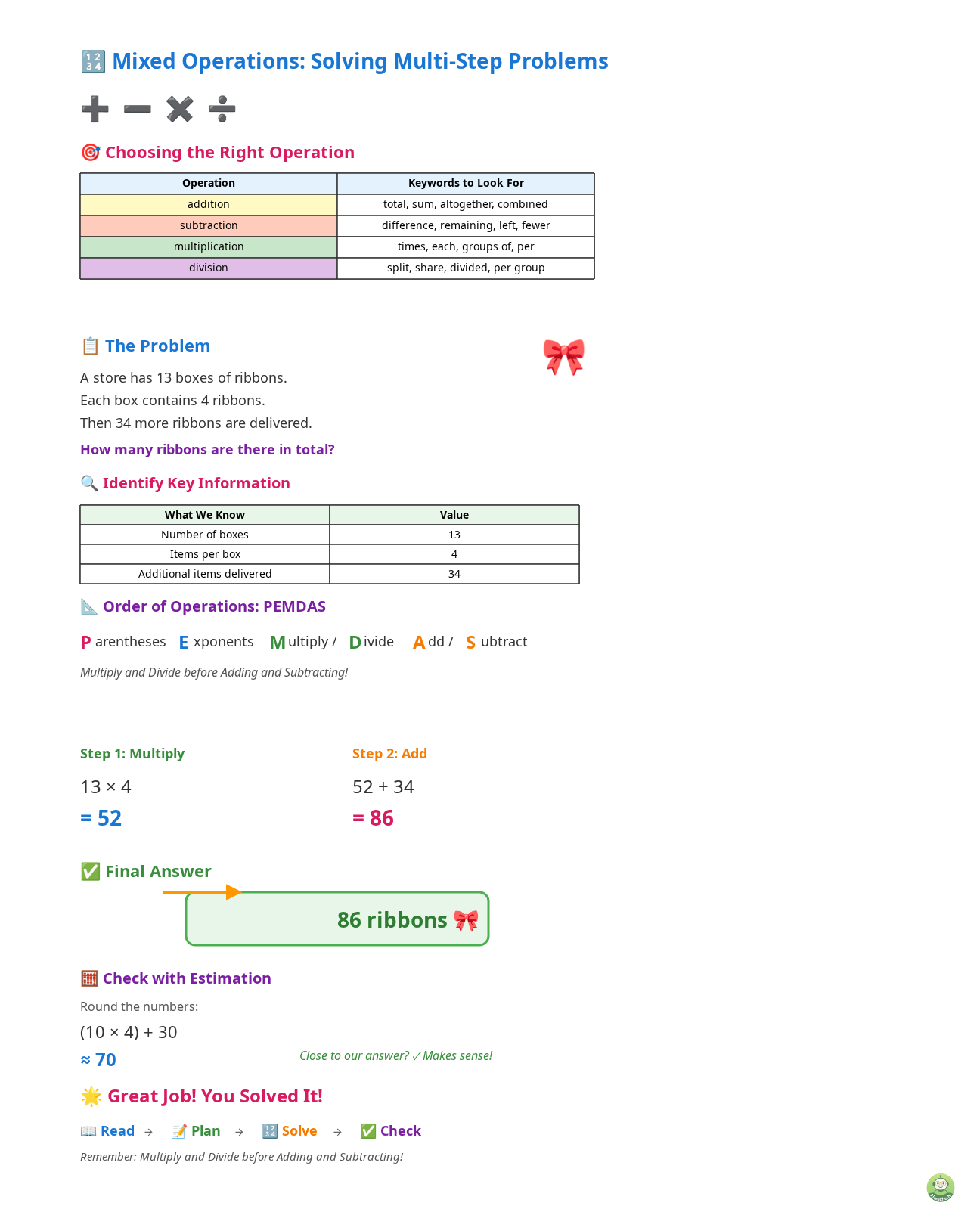
Here's what the full interactive lesson looks like on AI Teacherly:
In the Mixed Operations with Whole Numbers lesson for Grade 5, students work through progressively challenging problems that build confidence step by step. The lesson uses:
- Visual word problems with relatable scenarios (shopping, sharing, measuring)
- Guided practice that walks through the Read-Plan-Solve-Check framework
- Immediate feedback so students know if they're on track
- Multiple problem formats including input problems, multiple choice, and ordering activities
The beauty of interactive practice is that it removes the pressure of homework time. Your child can make mistakes, learn from them, and build mastery at their own pace.
The Read-Plan-Solve-Check Framework:
- Read: Understand what the problem is asking
- Plan: Identify operations and the order to use them
- Solve: Calculate step by step, following PEMDAS
- Check: Use estimation to verify the answer makes sense
This 4-step approach gives students a repeatable system they can apply to any multi-step problem, whether on homework, tests, or standardized assessments.
Key Takeaways
- Teach your child to spot keyword clues (total, each, share, left) that reveal which operations to use in word problems
- PEMDAS is non-negotiable: Parentheses, Exponents, Multiplication/Division (left to right), Addition/Subtraction (left to right)
- Estimation checking catches most mistakes: round numbers, calculate mentally, then compare to actual answer
- Use the Read-Plan-Solve-Check framework for any multi-step problem
- 5th grade is a pivotal year for math reasoning; mastering these skills now prevents algebra struggles later
- Interactive practice (like AI Teacherly) builds confidence through immediate feedback and visual learning
Frequently Asked Questions
What is PEMDAS and why is it important for 5th graders?
PEMDAS stands for Parentheses, Exponents, Multiplication, Division, Addition, Subtraction. It's the order of operations rule that tells students which calculations to do first in multi-step problems. Without PEMDAS, students get wrong answers even when their individual calculations are correct.
How do I know which operation to use in a word problem?
Look for keyword clues: words like 'total' and 'altogether' signal addition; 'each' and 'times' mean multiplication; 'share' and 'split' indicate division; 'left' and 'remaining' point to subtraction. These keywords act as a code to unlock the correct operation.
Why does my 5th grader struggle with multi-step word problems?
Multi-step problems require reading comprehension, operation identification, correct sequencing, and calculation accuracy all at once. This cognitive load is challenging. Breaking problems into the Read-Plan-Solve-Check framework reduces overwhelm and builds systematic problem-solving habits.
What order do you solve math problems with multiple operations?
Follow PEMDAS: solve Parentheses first, then Exponents, then Multiplication and Division from left to right, finally Addition and Subtraction from left to right. Remember that M/D and A/S are equal partners solved in order of appearance.
How can I check if my child's math answer is correct?
Use estimation: round the numbers, do quick mental math, then compare to the actual answer. If the estimate and answer are close, the calculation is likely correct. If they're wildly different, rework the problem to find the error.
Is online math practice effective for learning word problems?
Yes, interactive platforms like AI Teacherly provide immediate feedback, visual models, and step-by-step guidance that traditional worksheets lack. Studies show interactive practice improves math outcomes by 15-25% when combined with conceptual teaching.
How much time should my 5th grader spend on math homework?
For 5th grade, 20-30 minutes of focused math practice is ideal. Short, consistent sessions are more effective than hour-long cramming. Quality matters more than quantity; use this time to work through problems using the PEMDAS and keyword strategies.
What are common mistakes kids make with order of operations?
The biggest mistake is solving left to right without considering operation priority. Students often add before multiplying, or think multiplication always comes before division. Teaching PEMDAS as a roadmap, not just a memorized phrase, prevents these errors.
Ready to make multi-step word problems click for your 5th grader? Try the Mixed Operations with Whole Numbers lesson free on AI Teacherly and watch their confidence grow!