Master Adding and Subtracting Integers: The 3 Rules Every 6th Grader Needs
Struggling with 6th grade integer math? Discover the 3 simple rules that make adding and subtracting positive and negative numbers easy for your child.
Why 6th Grade Integer Math Feels So Different
That moment when your 6th grader's math homework suddenly has negative numbers everywhere, and they're completely lost? You're not alone. Integer operations represent one of the biggest mathematical shifts your child will encounter in middle school.
For years, your child worked with counting numbers: 1, 2, 3, and so on. Math made intuitive sense. But 6th grade introduces a whole new world where numbers can be less than zero, and the rules they've relied on suddenly seem to break.
Here's the good news: adding and subtracting integers in 6th grade follows just three simple rules that make everything click. Once your child understands these rules, the confusion disappears, and they build the foundation for algebra success.
In this guide, you'll learn:
- What integers are and why they trip up so many students
- The 3 foolproof rules for integer operations
- How number lines turn confusion into clarity
- Real-world examples that make negative numbers meaningful
- Interactive practice that builds lasting confidence
Let's demystify integer math together.
What Are Integers and Why Do They Confuse Kids?
Integers are whole numbers that can be positive, negative, or zero. This includes numbers like -5, -2, 0, 3, and 10. Unlike the counting numbers your child mastered in elementary school, integers extend infinitely in both directions from zero.
So why do integers confuse so many 6th graders? The answer lies in how their brains have been trained.
For five years, your child learned math rules that work perfectly for positive numbers:
- Adding makes numbers bigger
- Subtracting makes numbers smaller
- You can't take a bigger number from a smaller one
Integers break all of these "rules."
When you add -5 to a number, it gets smaller. When you subtract a negative, the number grows. And suddenly, 3 minus 8 has an answer: -5.
This isn't just confusing; it's conceptually revolutionary. Your child must rebuild their mathematical intuition from the ground up. That's why struggling with integers is completely normal and expected.
The students who master integers quickly aren't necessarily "better at math." They simply learn the new rules and trust them. And those rules are surprisingly simple.
The 3 Simple Rules for Adding and Subtracting Integers
Here's the secret that transforms integer confusion into confidence: all integer addition and subtraction follows just three rules. Memorize these, practice them, and integer operations become automatic.
Rule 1: Same Signs? Add and Keep the Sign
When adding two numbers with the same sign (both positive or both negative), add their absolute values and keep the sign.
- 5 + 3 = 8 (both positive, answer is positive)
- (-4) + (-6) = -10 (both negative, answer is negative)
Think of it like this: if you're walking in the same direction, you just go farther that way.
Rule 2: Different Signs? Subtract and Keep the Larger Number's Sign
When adding two numbers with different signs, subtract the smaller absolute value from the larger one. The answer takes the sign of the number with the larger absolute value.
- 7 + (-3) = 4 (7 is larger, answer is positive)
- (-8) + 5 = -3 (8 is larger, answer is negative)
Rule 3: Subtraction Becomes Adding the Opposite
Here's the game-changer: subtracting any number is the same as adding its opposite.
- 9 - 4 becomes 9 + (-4) = 5
- 3 - 7 becomes 3 + (-7) = -4
- (-2) - (-5) becomes (-2) + 5 = 3
That last example reveals the famous "minus a negative equals plus" rule. The two negatives turn into addition!
These three rules work every single time. Once your child internalizes them, integer operations become as automatic as basic addition.
How Number Lines Make Integers Click
Abstract rules are helpful, but visual learners need something they can see. That's where the number line becomes your child's secret weapon for understanding integers.
Picture a number line with zero in the middle. Positive numbers stretch to the right; negative numbers extend to the left. Here's the key insight: 5 and -5 are the same distance from zero, just in opposite directions.
This mirror concept helps students visualize why integer rules work:
Adding Positive Numbers: Move Right
Starting at 3 and adding 4? Move 4 spaces right to land on 7.
Adding Negative Numbers: Move Left
Starting at 3 and adding -4? Move 4 spaces left to land on -1.
Subtracting = Adding the Opposite
Subtracting 4 means moving 4 spaces in the opposite direction of positive 4. That's left. So 3 - 4 moves left from 3, landing on -1.
Subtracting -4? Move opposite of negative (which is right!). So 3 - (-4) moves right, landing on 7.
When your child can visualize these movements, the rules stop being arbitrary and start making logical sense. Many students have their "aha moment" when they see integers on a number line for the first time.
Pro tip for parents: Draw a number line on paper when helping with homework. Have your child physically trace the movements with their finger. This kinesthetic connection reinforces the visual learning.
Real-World Integer Problems Your Child Will Actually Care About
Nothing makes math click like seeing it in action. Integers aren't just abstract symbols; they describe real situations your child encounters every day. Here are the examples that make students say, "Oh, that's why this matters!"
Temperature Changes
If the temperature is 5°F and drops 12 degrees overnight, what's the new temperature? That's 5 + (-12) = -7°F. Cold weather makes negative numbers tangible.
Bank Accounts and Money
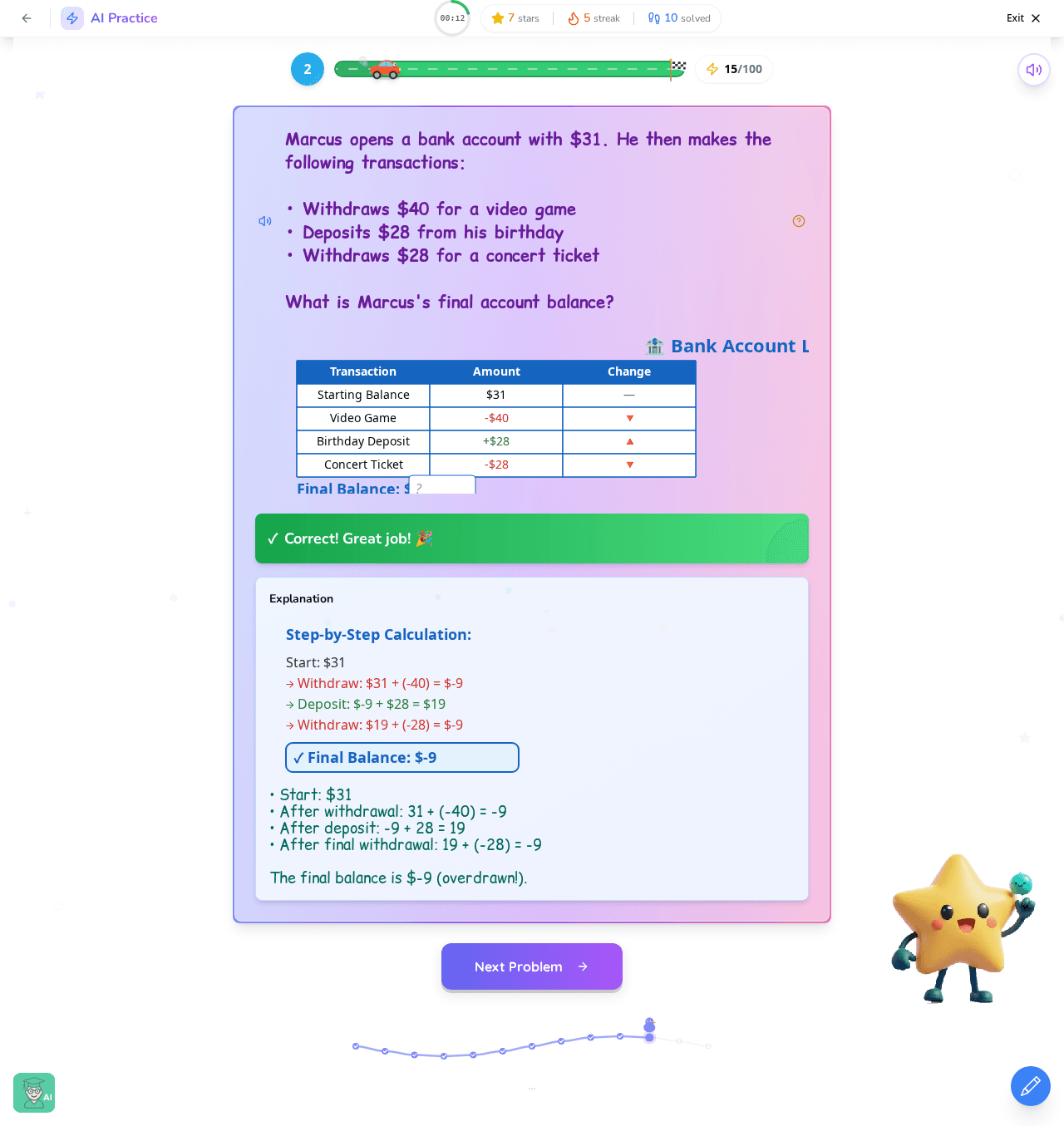
Your account has $50. You spend $75 using a debit card. Your balance: 50 + (-75) = -$25. That negative balance (overdraft) suddenly makes integers very real.
Elevation and Depth
A submarine at -200 feet rises 50 feet. New depth: -200 + 50 = -150 feet. Below sea level is negative; above is positive.
Football Yards
Your team gains 8 yards, then loses 15 yards on a penalty. Net yardage: 8 + (-15) = -7 yards. Losses are negative gains.
The interactive problem below shows exactly how real-world integer problems work in practice.
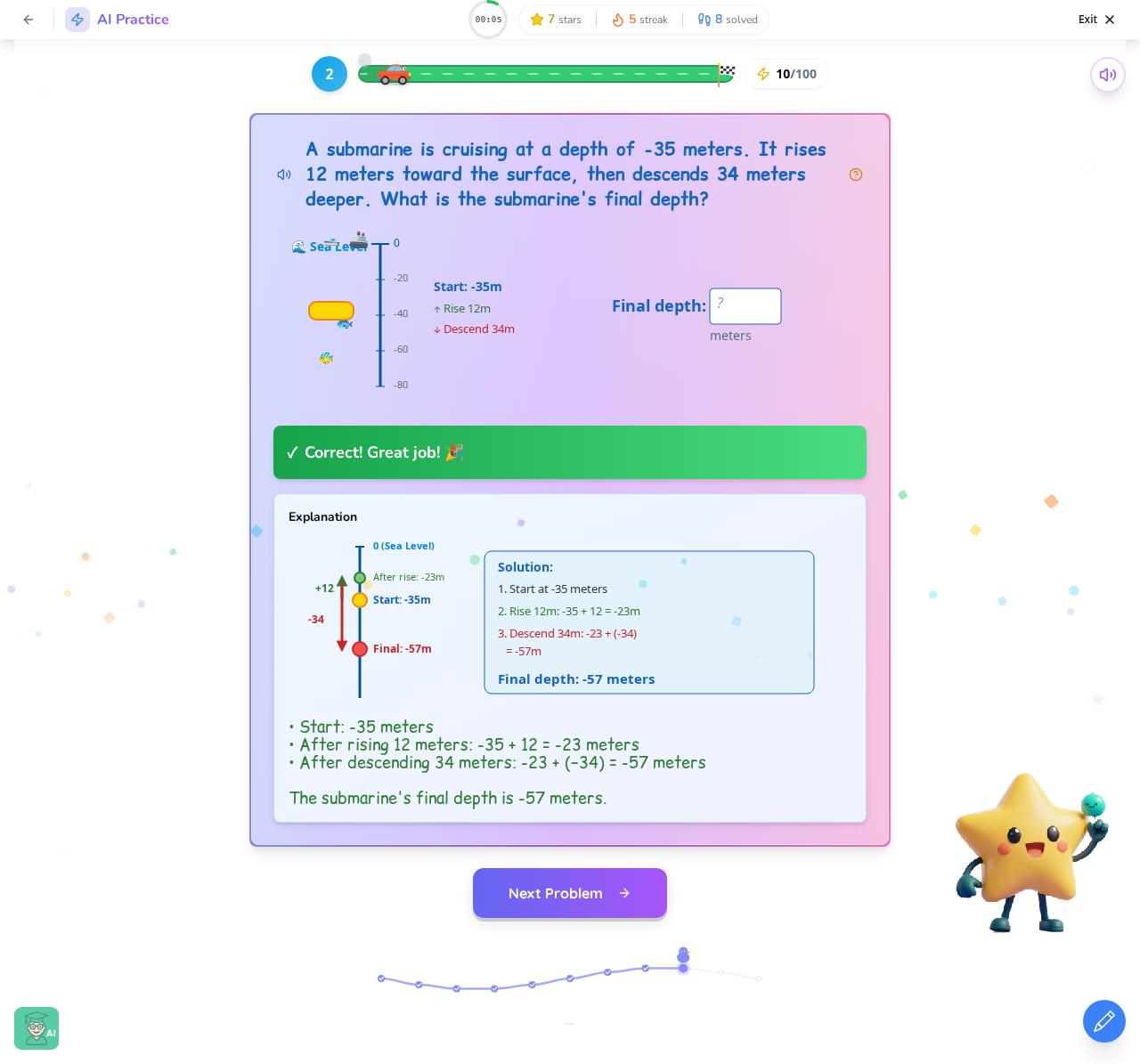
When your child practices with relatable scenarios like submarine depths, temperatures, and bank accounts, they build intuition that transfers to any integer problem they'll encounter.
How Interactive Learning Makes Integer Practice Engaging
Let's be honest: worksheets full of integer problems can feel tedious. And when practice feels like punishment, students disengage. That's why interactive, visual learning makes such a difference for mastering integer operations.
On AI Teacherly, the Adding and Subtracting Integers lesson for 6th grade transforms abstract concepts into engaging, visual experiences. Here's what makes it effective:
Step-by-step guided instruction: Students don't just see rules; they discover why the rules work through carefully sequenced explanations that build understanding.
Visual number lines: Instead of memorizing that "subtracting a negative equals addition," students watch it happen on interactive number lines. The abstract becomes concrete.
Real-world word problems: Temperature changes, bank accounts, submarine depths, and more. Students see that integers solve actual problems they might encounter.
Immediate feedback: When students practice, they know instantly whether they're on track. No waiting for graded homework to discover misconceptions.
Here's what the full interactive lesson looks like on AI Teacherly:
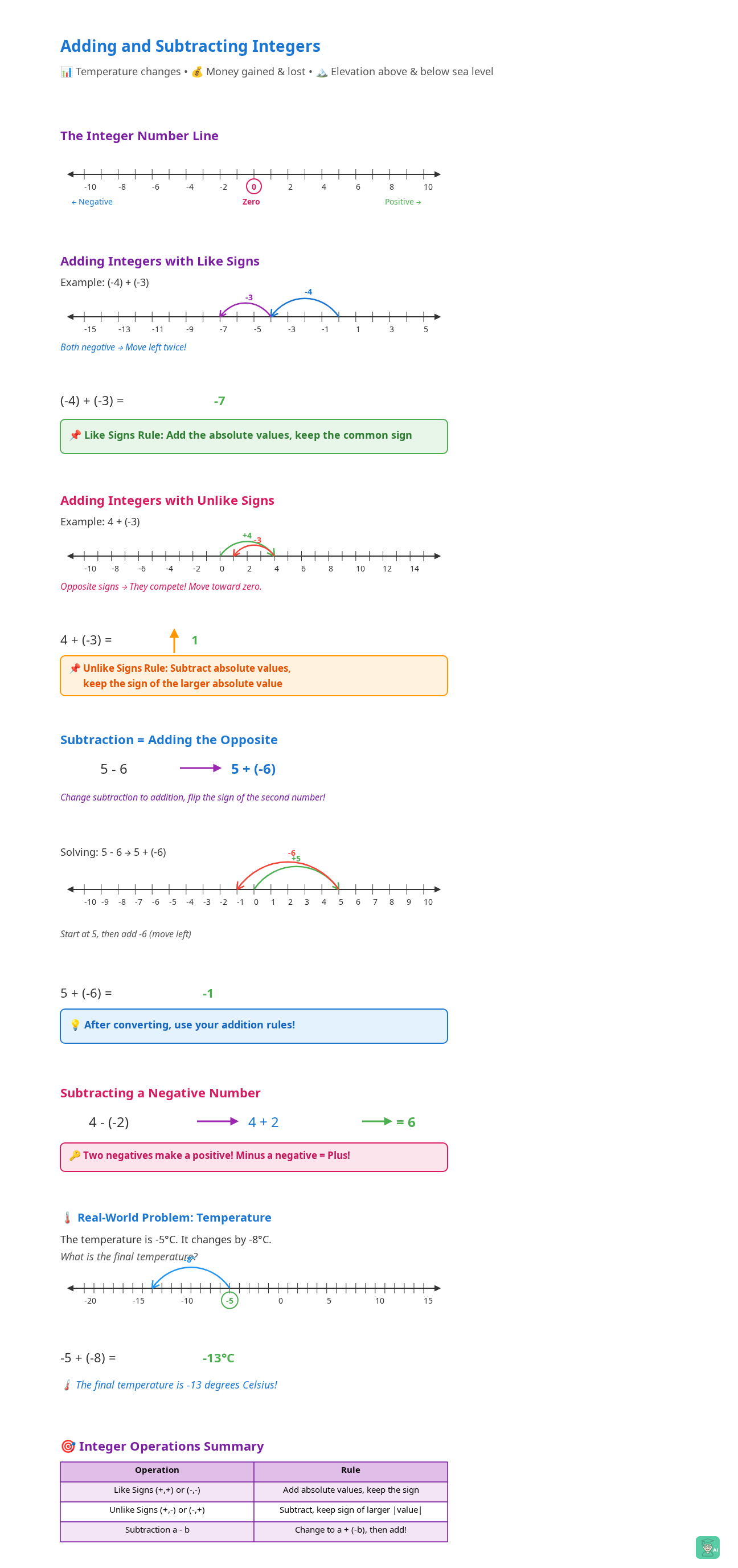
The combination of explanation, visualization, and practice creates lasting understanding. Students don't just memorize rules for a test; they internalize integer operations as intuitive skills they'll use throughout their math education.
Key Takeaways
- Integer operations follow just 3 rules: same signs add and keep, different signs subtract and keep the larger, subtraction becomes adding the opposite
- The 'negative number wall' in 6th grade is completely normal because integers break the rules children learned for 5+ years
- Number lines transform abstract integer concepts into visual, logical movements that students can see and trace
- Real-world examples like temperature, bank accounts, and elevation make integers meaningful and memorable
- Mastering integers in 6th grade is critical preparation for algebra success in 7th and 8th grade
- Interactive practice with immediate feedback builds confidence faster than traditional worksheets
- The 'minus a negative equals plus' rule makes sense when students visualize it as moving in the opposite direction
Frequently Asked Questions
What are the basic rules for adding and subtracting integers?
Three rules govern all integer operations: (1) Same signs: add the numbers and keep the sign. (2) Different signs: subtract and keep the sign of the larger absolute value. (3) Subtraction becomes adding the opposite. These rules work every time.
Why does subtracting a negative become addition?
When you subtract a negative, you're taking away a 'debt' or moving opposite to the negative direction. On a number line, subtracting -5 means moving right (positive direction), which is the same as adding 5. The two negatives cancel out.
How do you use a number line to add negative numbers?
Start at your first number on the number line. To add a positive, move right. To add a negative, move left. For example, starting at 3 and adding -7 means moving 7 spaces left, landing on -4.
What real-world examples help explain integers to kids?
Temperature changes (below zero), bank account overdrafts (negative balance), submarine depths (below sea level), and football penalties (lost yards) all use integers. These concrete examples make negative numbers meaningful and relatable.
Is it normal for 6th graders to struggle with negative numbers?
Absolutely. Integers challenge five years of math intuition where adding meant 'getting bigger' and you couldn't subtract larger from smaller. Struggling is a sign your child is grappling with genuinely difficult abstract concepts.
When do students learn integers in school?
Most students are formally introduced to integer operations in 6th grade as part of middle school math curriculum. This timing prepares them for pre-algebra and algebra, where working with positive and negative numbers is essential.
How can parents help with integer homework at home?
Draw number lines and have your child trace movements with their finger. Use real-world examples like temperature or money. Focus on the three rules. Stay patient because this concept requires rebuilding math intuition.
What's the difference between adding and subtracting integers?
Adding integers uses the same-sign and different-sign rules directly. Subtracting integers requires one extra step: convert the subtraction to addition by changing the sign of the second number, then apply the adding rules.
Ready to help your 6th grader conquer integers? Try the interactive Adding and Subtracting Integers lesson free on AI Teacherly and watch confusion turn into confidence!