Adding Three Numbers in 1st Grade: 2 Easy Tricks That Make Math Click
When your 1st grader freezes at problems like 4+7+6, two simple strategies can transform confusion into confidence. Discover the Make-Ten and Doubles tricks that make adding three numbers easy.
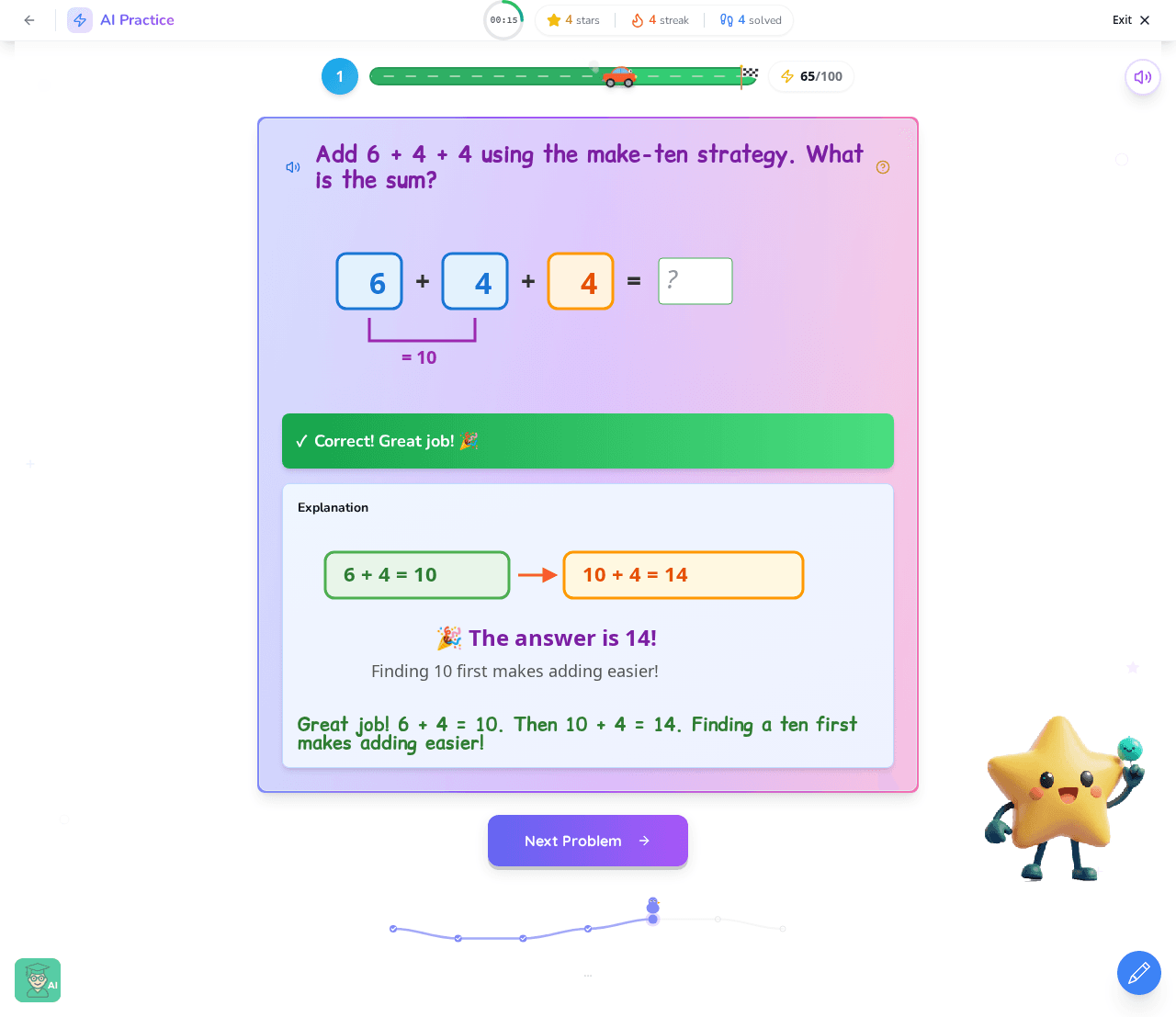
The Three-Number Addition Challenge Parents Know Too Well
You're sitting at the kitchen table helping with homework when your 1st grader sees a problem like 4 + 7 + 6 and freezes. Their eyes dart to you for rescue. Sound familiar?
Adding three numbers in 1st grade is a significant leap from the two-number addition your child mastered earlier. Suddenly, there are more numbers to track, more steps to remember, and more opportunities for frustration. Many parents feel unprepared to help because they weren't taught the strategies that make this concept manageable.
Here's the good news: you don't need to be a math teacher to guide your child through this challenge. There are two powerful, kid-friendly strategies that transform overwhelming problems into confident "I got this!" moments. In this guide, you'll discover the Make-Ten strategy and the Doubles strategy, both of which give your child a clear roadmap for tackling any three-number addition problem.
By the end of this article, you'll understand exactly how these strategies work, why they're so effective for young learners, and simple ways to practice them at home.
Why Can You Add Numbers in Any Order?
Before your child can master adding three numbers, they need to understand one magical math rule: the order doesn't matter.
This concept, called the commutative property of addition (though you don't need to use that term with your 1st grader), is a game-changer. When we add 4 + 7 + 6, we can rearrange it to 7 + 6 + 4, or 6 + 4 + 7, and we'll always get the same answer: 17.
Why does this matter? Because rearranging numbers lets your child put the "friendly" numbers next to each other. Instead of adding numbers in the order they appear, your child can look for pairs that are easier to work with.
Here's how to demonstrate this at home:
- Write down 4 + 7 + 6 and solve it together (4 + 7 = 11, then 11 + 6 = 17)
- Now rearrange it: write 6 + 4 + 7 and solve again (6 + 4 = 10, then 10 + 7 = 17)
- Show your child both answers are the same
- Ask: "Which way felt easier?"
Most kids immediately recognize that making 10 first (6 + 4) made the second step much simpler. This "aha" moment sets the foundation for the Make-Ten strategy.
What Is the Make-Ten Strategy for Adding Three Numbers?
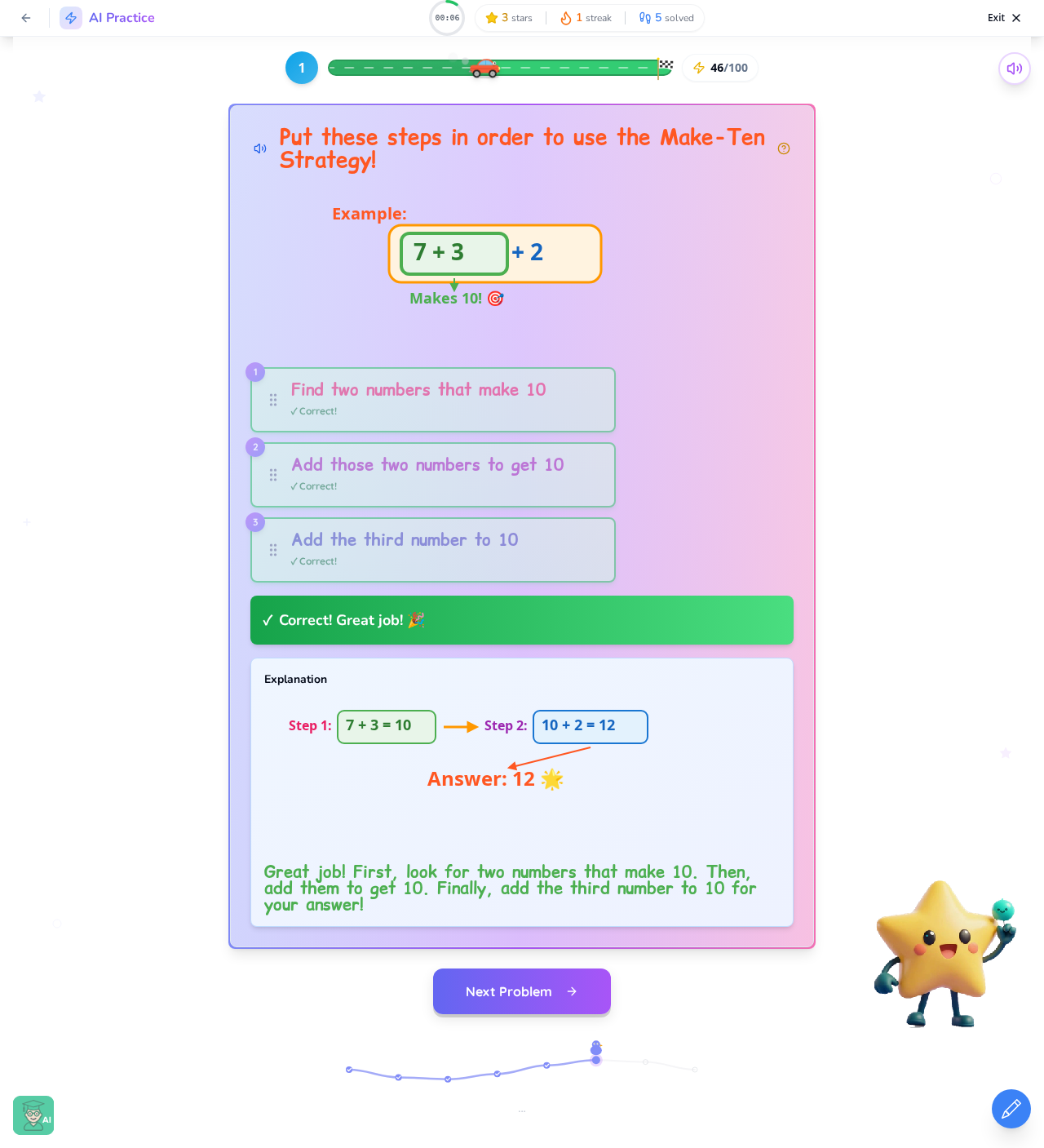
The Make-Ten strategy is the most powerful tool for adding three numbers in 1st grade. It works by finding two numbers that combine to make 10, then adding the third number to that 10.
Why 10? Because our number system is based on tens, and kids quickly learn that adding to 10 is easy. 10 + 7 = 17. 10 + 3 = 13. These feel almost automatic, even for young learners.
Here's how the Make-Ten strategy works step by step:
Example: 6 + 5 + 4
- Look for a ten-pair: Scan the numbers. Do any two add up to 10? Yes! 6 + 4 = 10
- Group the ten-pair: Mentally (or with a bracket) group 6 and 4 together
- Add the remaining number: 10 + 5 = 15
The key ten-pairs to know are:
- 1 + 9
- 2 + 8
- 3 + 7
- 4 + 6
- 5 + 5
The interactive problem below shows exactly how the Make-Ten strategy works in practice.
When your child can quickly spot these pairs, adding three numbers becomes much less intimidating. Instead of holding multiple numbers in their head, they simplify the problem to "10 plus something," which feels manageable and builds confidence.
How Do Doubles Help When There's No Ten?
Sometimes, your child will look at a three-number problem and find no combination that makes 10. That's when the Doubles strategy saves the day.
Doubles are addition facts where both numbers are the same: 2 + 2, 3 + 3, 4 + 4, 5 + 5, and so on. Kids often memorize doubles early because they're satisfying and easy to remember. The Doubles strategy uses these familiar facts as an anchor.
Example: 4 + 3 + 4
- Check for a ten-pair: 4 + 3 = 7 (not 10), 4 + 4 = 8 (not 10), 3 + 4 = 7 (not 10). No luck!
- Look for doubles: Wait, there are two 4s! That's a double.
- Use the double: 4 + 4 = 8
- Add the remaining number: 8 + 3 = 11
Doubles give your child a "known fact" to anchor their calculation. Instead of processing three separate numbers, they recognize a familiar pair and reduce the problem to simpler addition.
Pro tip for parents: If your child hasn't memorized doubles yet, practice them first! Use songs, flashcards, or visual tools (like showing two groups of the same number of objects). Once doubles feel automatic, this strategy becomes effortless.
The beauty of teaching both strategies is that your child always has a tool to use. No ten-pair? Look for doubles. No doubles? Try the Make-Ten with different groupings. This flexibility builds mathematical confidence.
See How AI Teacherly Makes It Click
Reading about these strategies is helpful, but seeing them in action makes all the difference. That's where interactive practice comes in.
On AI Teacherly, the Adding Three Numbers lesson for 1st grade walks students through both the Make-Ten and Doubles strategies using colorful visuals, guided steps, and instant feedback. Instead of passively watching a video, your child actively engages with problems designed to build strategy recognition.
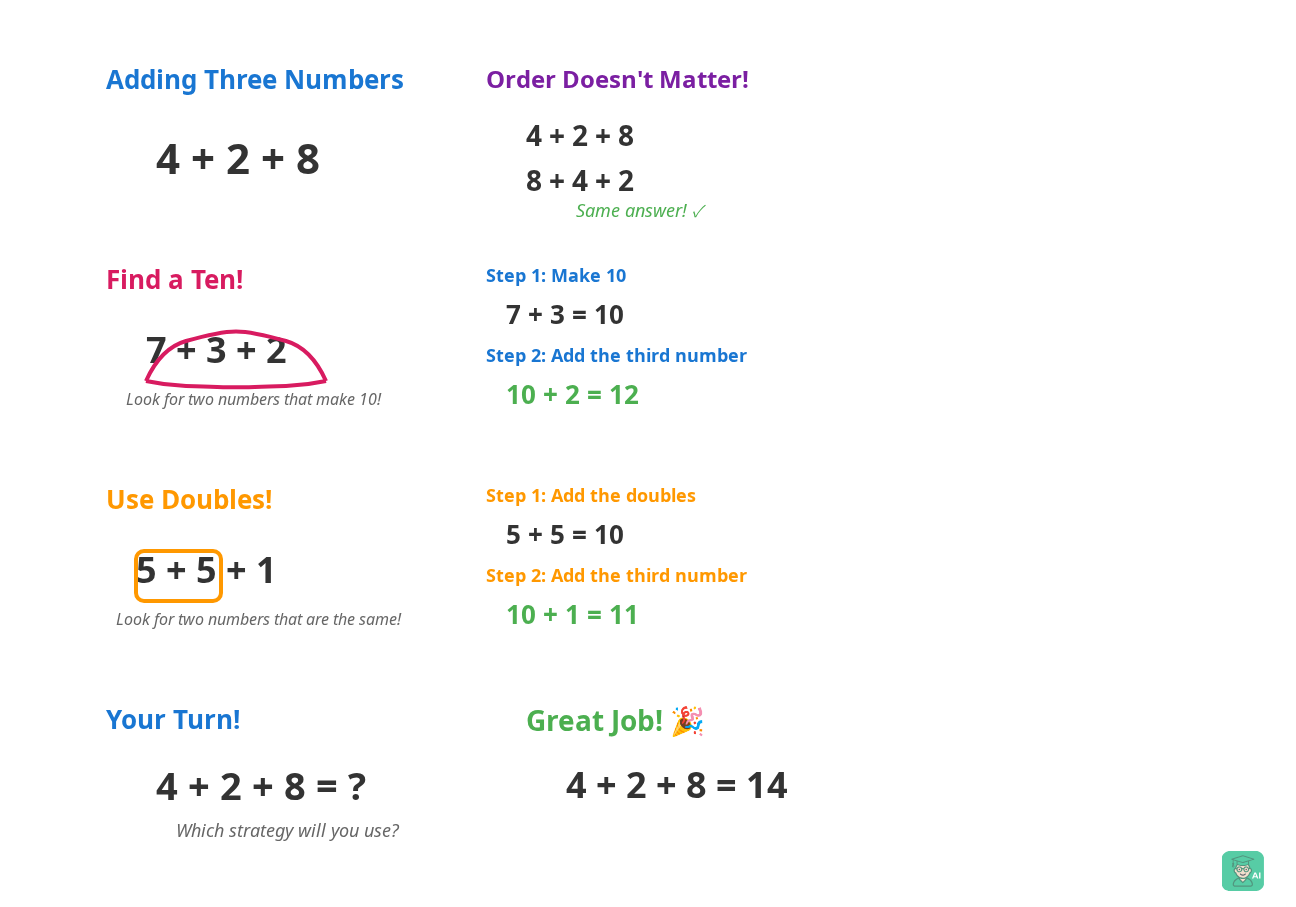
Here's what the full interactive lesson looks like on AI Teacherly:
The lesson begins by demonstrating the "order doesn't matter" concept with visual proof. Then it introduces the Make-Ten strategy with bracket notation, helping kids literally see which numbers to group. Finally, it covers the Doubles strategy for problems where ten-pairs don't exist.
What parents love about this approach:
- Visual scaffolding: Colorful manipulatives help kids see the math, not just calculate it
- Strategy cues: The lesson prompts kids to look for friendly pairs before solving
- Immediate feedback: Kids know right away if their answer is correct
- Self-paced learning: Your child can pause, retry, and master each step before moving on
After completing the lesson, most kids can confidently identify whether to use Make-Ten or Doubles and explain their reasoning. That's the kind of deep understanding that sticks.
Simple Ways to Practice Adding Three Numbers at Home
The best math learning happens when practice feels like play. Here are easy, low-prep ways to reinforce adding three numbers at home:
1. Dice Game: Roll Three Grab three dice and take turns rolling. Each player adds their three numbers using Make-Ten or Doubles. The first person to correctly call out the sum wins that round. This builds speed and strategy recognition in a fun, competitive format.
2. Grocery Store Math While shopping, point to three price tags (use just the dollar amounts for simplicity) and ask your child to add them. "We need apples for $3, bananas for $2, and grapes for $5. How much is that?" Real-world context makes math meaningful.
3. Card Game: Three-Card Addition Remove face cards from a deck. Each player draws three cards and adds them. Before solving, ask: "Do you see a ten-pair? Any doubles?" Talking through strategy builds metacognition.
4. Daily Problem Challenge Write one three-number problem on a sticky note each morning. Your child solves it before breakfast or after school. Consistency beats intensity when building math fluency.
5. "Teach Me" Time Ask your child to teach you how to add three numbers. When kids explain concepts, they solidify their own understanding. Play confused if needed, and ask them, "Wait, how did you know to put 6 and 4 together?"
What to avoid: Rushing or showing frustration. If your child struggles, go back to two-number addition or ten-pair practice before tackling three numbers again.
Key Takeaways
- The Make-Ten strategy works by finding two numbers that add to 10, then adding the third number to that 10
- The Doubles strategy uses familiar facts (like 4 + 4) as an anchor when no ten-pair exists
- Teaching your child that addition order doesn't matter empowers them to rearrange numbers for easier solving
- Memorizing ten-pairs (1+9, 2+8, 3+7, 4+6, 5+5) is essential for Make-Ten success
- Interactive practice with visual supports builds deeper understanding than worksheets alone
- Short, consistent daily practice is more effective than long, infrequent sessions
- Let your child choose which strategy to use, as building flexibility strengthens mathematical thinking
Frequently Asked Questions
What is the easiest way to add three numbers in first grade?
The easiest method is the Make-Ten strategy: find two numbers that add to 10, then add the third number. Since kids find adding to 10 intuitive, this simplifies the problem significantly.
How does the make-ten strategy work for adding three numbers?
Look for two numbers that equal 10 (like 6+4 or 3+7), group them together, then add the remaining number to 10. For example, in 6+5+4, group 6+4=10, then add 10+5=15.
What are doubles in 1st grade math?
Doubles are addition facts where both numbers are the same, like 3+3=6 or 5+5=10. Kids often memorize these early, making them useful anchors for solving harder problems.
Does the order matter when adding three numbers?
No, addition order doesn't change the sum. This is called the commutative property. Kids can rearrange 4+7+6 to 6+4+7 and still get 17, which helps them group friendly numbers together.
How can I practice adding three numbers with my child at home?
Try rolling three dice and adding the numbers, playing card games where you draw three cards to add, or using grocery prices. Always ask which strategy they'll use before solving.
When do kids learn to add three numbers in school?
Most students learn adding three numbers in the second half of 1st grade, after mastering two-number addition. It's a stepping stone toward more complex operations in 2nd grade.
What if my child can't find pairs that make ten?
That's when the Doubles strategy helps! Look for two matching numbers (like 4+4) and use that familiar fact as an anchor. If neither strategy works, add left to right.
Why do some children struggle with adding three numbers?
Adding three numbers requires holding more information in working memory and choosing a strategy. Kids who haven't memorized ten-pairs or doubles often feel overwhelmed. Practice these foundations first.
Ready to see your 1st grader confidently tackle three-number addition? Try the interactive Adding Three Numbers lesson free on AI Teacherly and watch those "I can't do it" moments turn into proud smiles!