Adding Three Numbers in 1st Grade: 2 Simple Strategies That Actually Work
Discover the two simple strategies teachers use to make adding three numbers easy for 1st graders. Learn Make-Ten and Doubles tricks you can practice at home tonight!
Why Adding Three Numbers Trips Up 1st Graders
You've seen it happen. Your 1st grader breezes through 4 + 3 like a champion, then completely freezes when they see 4 + 6 + 3. Three numbers instead of two, and suddenly math feels impossible.
Here's the good news: this struggle is completely normal. Adding three numbers is a genuine leap in complexity for young learners. Their brains are working overtime trying to hold multiple numbers while calculating, and without the right approach, it can feel overwhelming.
But here's what many parents don't realize: there are two simple strategies that professional teachers use to make three-number addition click. These aren't complicated techniques that require a math degree. They're straightforward tricks that, once your child understands them, transform frustration into confident "I got it!" moments.
In this guide, you'll learn both strategies step by step, see exactly how they work, and discover easy ways to practice them at home tonight.
What Makes Three-Number Addition Different?
When children first learn addition, they work with two numbers: 5 + 3 = 8. Simple. They can count on their fingers, use objects, or just remember the fact. But adding three numbers introduces a whole new challenge.
The working memory problem: Young children have limited working memory. With two numbers, they hold one number in mind and count up. With three numbers, they need to calculate a partial answer AND remember it while adding the third number. That's a lot for a 6-year-old brain!
The "where do I start?" confusion: Kids often don't know which two numbers to add first. Should they go left to right? Pick random pairs? Without guidance, they guess and often make the problem harder than it needs to be.
The confidence gap: Even children who know their basic addition facts can feel defeated by three-number problems. They see more numbers and assume it must be harder, sometimes giving up before they even try.
This is exactly why strategies matter. The right approach doesn't just help kids get correct answers; it gives them a clear path forward that builds genuine mathematical confidence.
The Secret Rule: You Can Add Numbers in Any Order
Before diving into the strategies, your child needs to understand one powerful mathematical secret: when adding, the order doesn't matter.
Take 4 + 6 + 3 for example:
- 4 + 6 + 3 = 13
- 6 + 4 + 3 = 13
- 3 + 4 + 6 = 13
- 6 + 3 + 4 = 13
Same numbers, different order, same answer every time! Mathematicians call this the "commutative property," but your 1st grader just needs to know the simple truth: they get to choose which two numbers to add first.
This is incredibly freeing for children. Instead of feeling stuck adding numbers in the order they appear, they can hunt for the smartest combination. They become problem-solving detectives rather than calculation robots.
Here's a fun way to prove this to your child: grab some small objects like coins, crackers, or building blocks. Make three groups of different sizes. Count the total. Then rearrange the groups and count again. Same total! Once they see this with their own eyes, the strategies below will make perfect sense.
Strategy 1: How Does the Make-Ten Strategy Work?
The Make-Ten strategy is a game-changer for three-number addition. The idea is simple: look for two numbers that add up to exactly 10, then add the third number to 10.
Why 10? Because adding to 10 is easy! 10 + 4 = 14. 10 + 7 = 17. Most children can add to 10 almost instantly. The Make-Ten strategy takes advantage of this.
Let's walk through an example:
Problem: 7 + 3 + 5 = ?
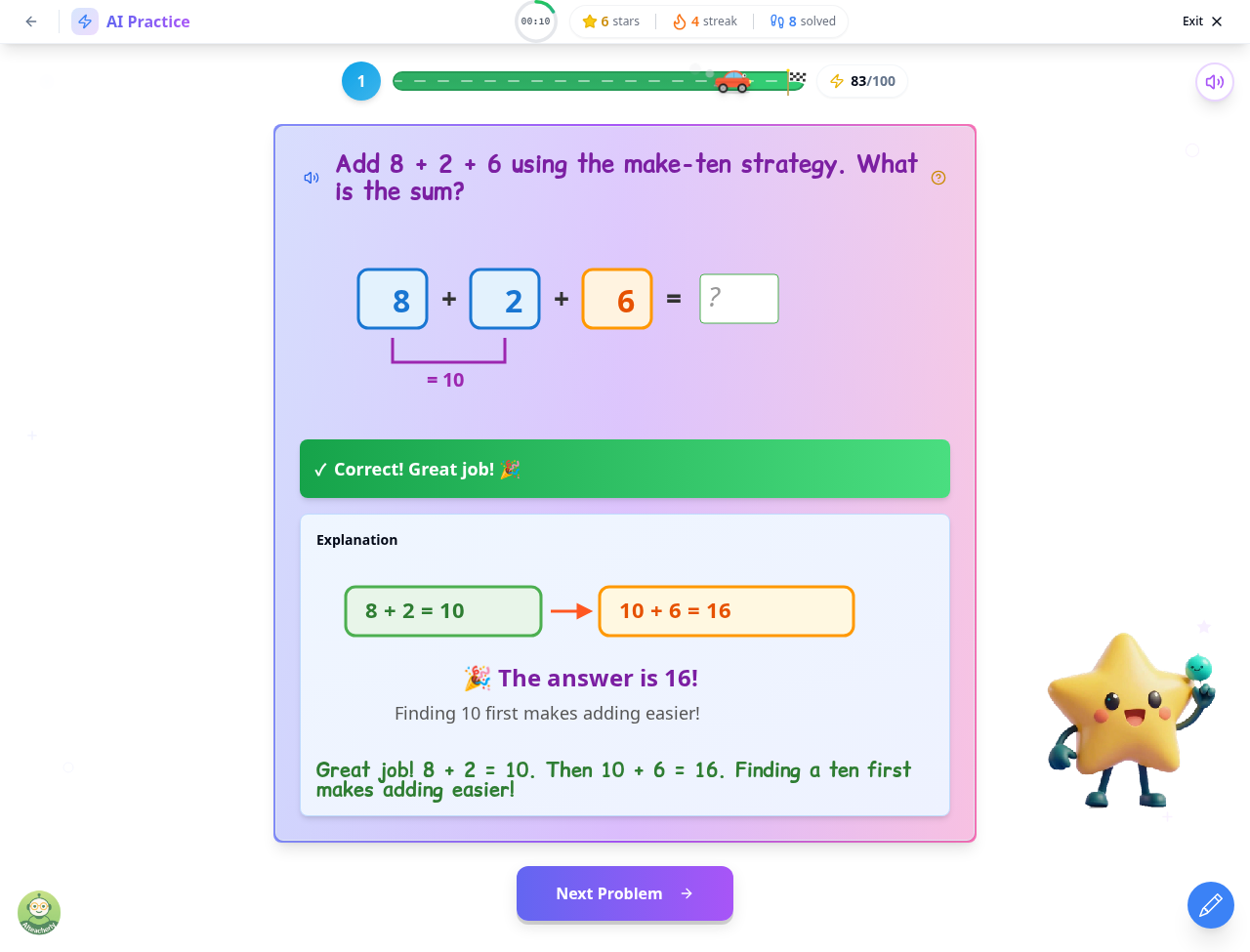
- Scan for a ten: Look at all three numbers. Do any two make 10? Yes! 7 + 3 = 10.
- Combine those first: Put parentheses around them in your mind: (7 + 3) + 5
- Add to ten: 10 + 5 = 15
That's it! Instead of struggling through 7 + 3 = 10, then 10 + 5 = 15 without a clear strategy, your child learns to spot the "friendly ten" first.
Common "Make Ten" pairs to memorize:
- 1 + 9 = 10
- 2 + 8 = 10
- 3 + 7 = 10
- 4 + 6 = 10
- 5 + 5 = 10
The interactive problem below shows exactly how the Make-Ten strategy works in practice.
Strategy 2: What Are Doubles and How Do They Help?
The Doubles strategy works when two of the three numbers are the same. Children typically memorize doubles facts early (2+2=4, 3+3=6, 4+4=8), making them perfect shortcuts.
Here's how it works:
Problem: 4 + 5 + 4 = ?
- Spot the doubles: Look for matching numbers. Here, we have two 4s!
- Add the doubles first: 4 + 4 = 8 (most kids know this instantly)
- Add the remaining number: 8 + 5 = 13
Another example with a word problem:
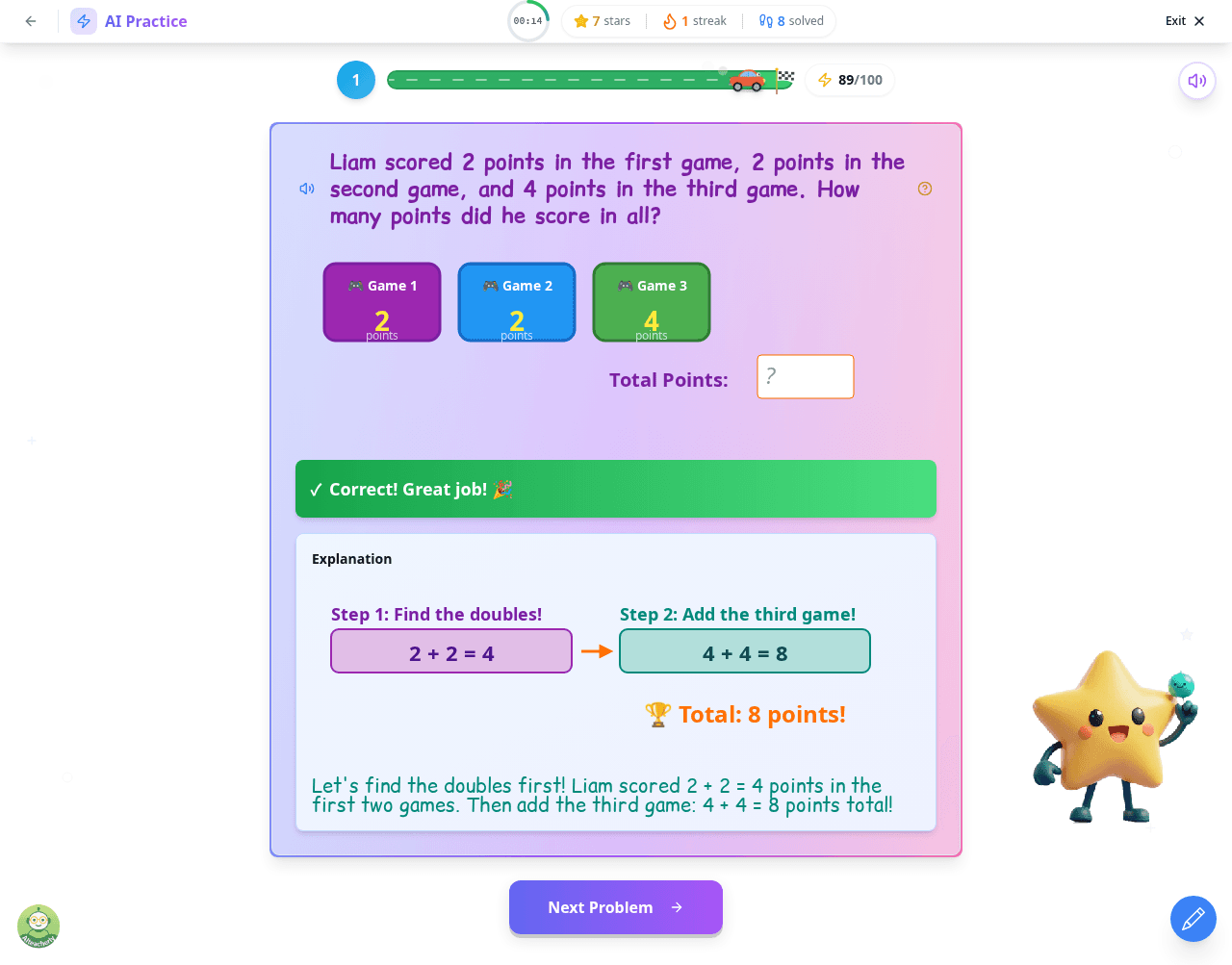
Emma scored 6 points in the first round, 6 points in the second round, and 3 points in the third round. How many points total?
- Spot the doubles: 6 + 6 = 12
- Add the third: 12 + 3 = 15
Why this strategy is powerful:
Doubles are some of the first math facts children commit to memory. By letting them use what they already know confidently, you reduce the mental load and build success momentum.
Quick doubles facts for reference:
- 1 + 1 = 2
- 2 + 2 = 4
- 3 + 3 = 6
- 4 + 4 = 8
- 5 + 5 = 10
- 6 + 6 = 12
- 7 + 7 = 14
- 8 + 8 = 16
- 9 + 9 = 18
See These Strategies in Action on AI Teacherly
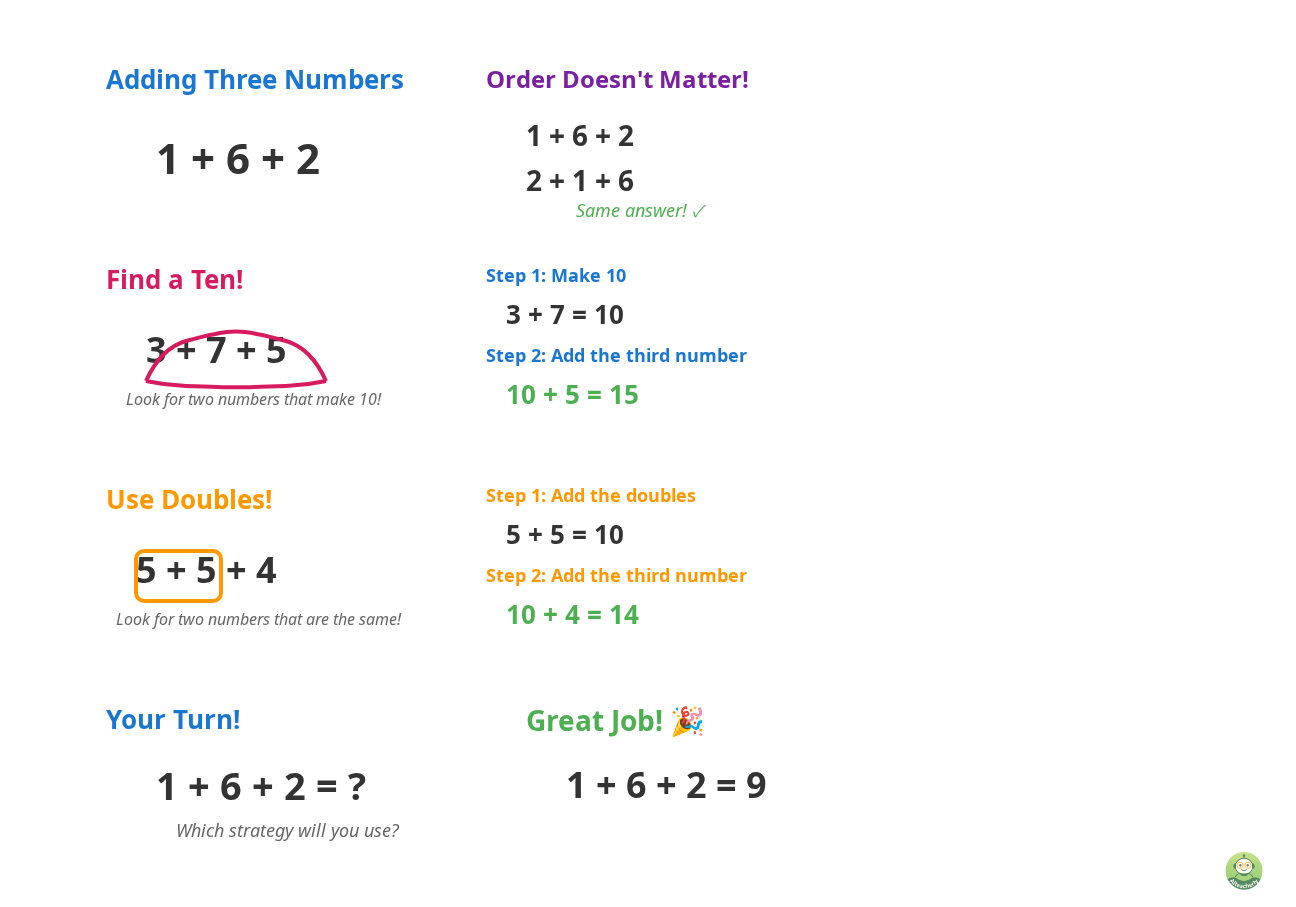
Reading about strategies is helpful, but seeing them in action makes all the difference. On AI Teacherly, the Adding Three Numbers lesson for Grade 1 walks children through both the Make-Ten and Doubles strategies with interactive, visual problems.
Here's what makes this lesson special:
Visual discovery moments: The lesson doesn't just tell kids to "find a ten." It shows numbers being rearranged and grouped, so children can actually see that order doesn't matter and watch strategic pairs form.
Real-world word problems: Instead of abstract numbers, kids solve problems about picking apples, scoring game points, and collecting stickers. These relatable scenarios help strategies stick because children connect math to their own lives.
Step-by-step guidance: Each problem breaks down the thinking process. Which two numbers should you add first? Why? What's your total? This scaffolding builds the kind of strategic thinking that transfers to future math challenges.
Immediate feedback: Children know right away if they're on track, building confidence through success rather than waiting for a parent or teacher to check their work.
Here's what the full interactive lesson looks like on AI Teacherly:
Quick Practice Ideas for Home
You don't need worksheets or special materials to practice three-number addition at home. Here are simple ways to reinforce the Make-Ten and Doubles strategies during everyday moments:
Snack time math: "You have 4 grapes, 6 strawberries, and 2 crackers. How many snacks total? Can you find a ten?"
Toy cleanup counting: "Let's count! 5 blocks in this pile, 5 in that pile, and 3 over here. Spot the doubles!"
Stair stepping: "We'll climb 3 steps, then 7 steps, then 4 more. How many total? Which two make ten?"
Score keeping: When playing simple games, add up points in groups of three. "You got 4 points, then 4, then 6. Use your doubles!"
The "Which Strategy?" game: Write three numbers on paper and ask, "Do you see a ten? Do you see doubles?" This builds the scanning habit.
Key tips for practice:
- Keep sessions short (5-10 minutes)
- Celebrate the strategy, not just the answer ("Great job spotting that doubles!")
- Let your child explain their thinking out loud
- Be patient with mistakes; they're part of learning
Consistency beats intensity. A few problems during breakfast each day builds stronger skills than a frustrating hour-long session once a week.
Key Takeaways
- Adding three numbers is challenging because it requires more working memory than two-number addition; your child's struggle is normal
- The commutative property means kids can add numbers in ANY order, freeing them to find smart combinations
- Make-Ten Strategy: scan for two numbers that equal 10, add those first, then add the remaining number
- Doubles Strategy: when two numbers match, use memorized doubles facts (like 4+4=8) as shortcuts
- Practice with real-world scenarios like snacks, toys, and games makes strategies stick better than abstract worksheets
- Short, consistent practice sessions (5-10 minutes daily) build skills faster than occasional long sessions
- Interactive lessons with visual feedback help children discover strategies rather than just memorize procedures
Frequently Asked Questions
How do I teach my child to add three numbers together?
Start by showing that addition order doesn't matter. Then teach two strategies: Make-Ten (find pairs that equal 10) and Doubles (use matching numbers). Practice with real objects like snacks or toys before moving to written problems.
What is the make-ten strategy in 1st grade math?
The make-ten strategy means finding two numbers that add to 10, adding those first, then adding the third number. For example, in 7 + 3 + 5, combine 7 + 3 = 10 first, then add 10 + 5 = 15.
What are doubles in first grade addition?
Doubles are addition facts where both numbers are the same, like 4 + 4 = 8 or 6 + 6 = 12. Kids memorize these early, making them useful shortcuts when adding three numbers that include a matching pair.
Does the order matter when adding three numbers?
No, the order doesn't change the answer. 4 + 6 + 3 equals the same as 6 + 4 + 3 or 3 + 6 + 4. This is called the commutative property, and understanding it lets children rearrange numbers to find easier combinations.
Why is adding three numbers harder than adding two?
Three-number addition requires more working memory. Children must calculate a partial sum AND remember it while adding the third number. Without strategies, they also don't know which numbers to combine first, leading to confusion.
What if there's no ten or doubles in the problem?
That's okay! Have your child add any two numbers first, then add the third. The strategies are shortcuts, not requirements. Problems like 3 + 2 + 4 can simply go left to right: 3 + 2 = 5, then 5 + 4 = 9.
When should a 1st grader be able to add three numbers?
Most 1st grade curricula introduce three-number addition mid-year. By the end of first grade, children should be able to add three single-digit numbers using strategies. Consistent practice matters more than rushing.
How can I practice three-number addition at home?
Use everyday moments: count snacks in three groups, add game scores, or count toys while cleaning up. Ask "do you see a ten?" or "spot the doubles!" to build strategic scanning habits through play.
Ready to see these strategies in action? Try the interactive Adding Three Numbers lesson free on AI Teacherly and watch your 1st grader's math confidence grow!