Adding Three Numbers in 1st Grade: 2 Simple Strategies That Actually Work
When your first grader freezes at 4 + 6 + 3, two simple strategies can transform three-number addition from overwhelming to easy. Learn the Make Ten and Doubles techniques that teachers use.
When Three Numbers Feel Like Too Many
Picture this: Your first grader has been breezing through addition homework. 5 + 3? Easy. 7 + 2? No problem. Then one day, they come home with 4 + 6 + 3, and suddenly there are tears at the kitchen table.
If this sounds familiar, you're not alone. Adding three numbers is a significant leap for young learners, and many parents feel caught off guard when their child struggles with what seems like "just one more number."
Here's the good news: There are exactly two strategies that make three-number addition click for first graders. They're not complicated, and you don't need to be a math whiz to help your child master them. In this guide, you'll learn the Make Ten and Doubles strategies that teachers use in classrooms, plus simple ways to practice at home without flashcards or worksheets.
By the end, you'll understand why adding three numbers first grade strategies work, and more importantly, how to explain them in a way that actually makes sense to a 6-year-old.
Why Is Adding Three Numbers Harder Than Adding Two?
Before diving into solutions, it helps to understand why your child might be struggling. Adding three numbers isn't just "a little harder" than adding two; it requires several new cognitive skills working together.
Working Memory Overload
When adding two numbers, children hold one number in their mind while counting up the other. With three numbers, they need to:
- Add the first two numbers
- Remember that sum
- Add the third number to their remembered answer
For young learners still developing working memory, this is like asking them to juggle while walking a tightrope.
The Order Confusion
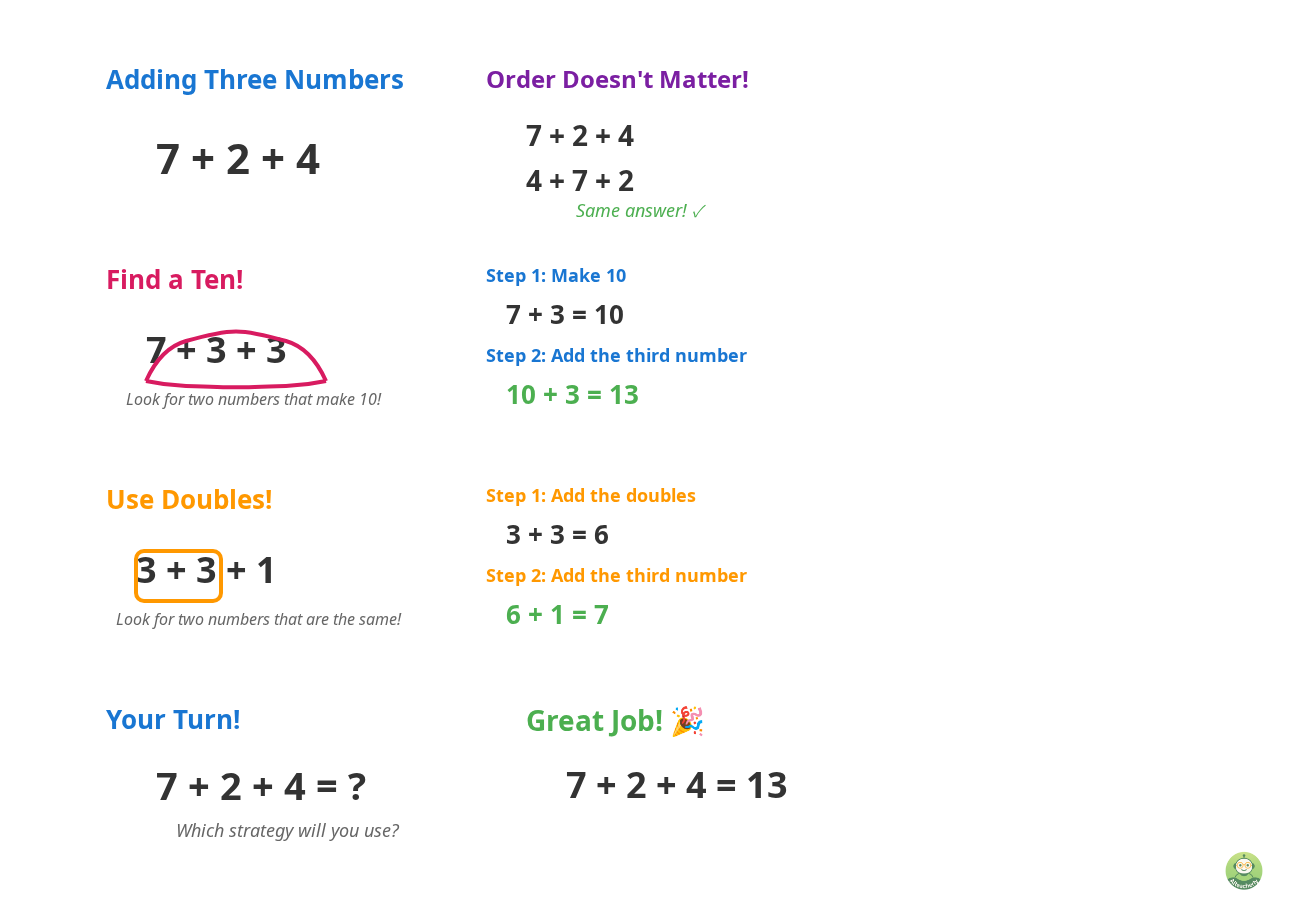
Here's something many adults take for granted: you can add numbers in any order and get the same answer. Mathematicians call this the commutative property, but first graders just need to know that 4 + 6 + 3 equals 6 + 4 + 3 equals 3 + 4 + 6. They all equal 13!
This is actually great news because it means your child can rearrange numbers to make the problem easier. As the lesson teaches: "When we add, we can add in any order. Same numbers, different order. And look! Same answer! That's the trick, order doesn't matter!"
The Strategy Gap
Most children default to counting on their fingers for every problem. While finger counting works, it becomes slow and error-prone with three numbers. The real breakthrough happens when children learn to see patterns instead of counting everything.
What Is the Make Ten Strategy and How Does It Work?
The Make Ten strategy is the most powerful tool in your child's three-number addition toolkit. It works because our number system is based on tens, making calculations with 10 incredibly easy.
How It Works
Instead of adding numbers left to right, children scan for any two numbers that add up to exactly 10. Once they spot this "friendly pair," the problem becomes much simpler.
Let's look at an example: 7 + 5 + 3
- Look at all three numbers: 7, 5, and 3
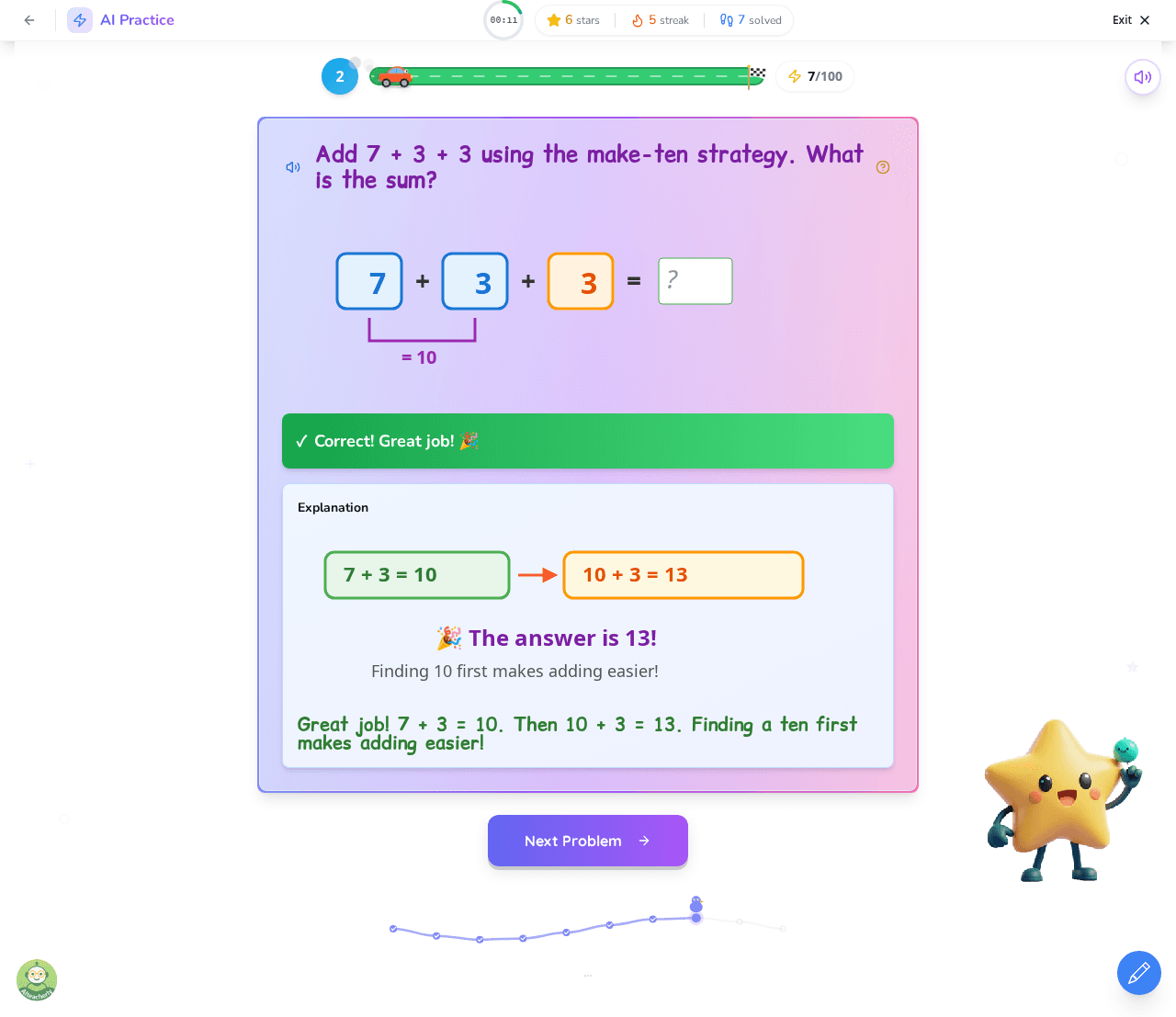
- Do any two make 10? Yes! 7 + 3 = 10
- Now the problem is just 10 + 5 = 15
As the lesson guides students: "Here's a trick! Find a Ten. Look for two numbers that make ten. They make ten! Now adding is easy."
Common "Make Ten" Pairs to Memorize
These number pairs are worth practicing until they're automatic:
- 1 + 9 = 10
- 2 + 8 = 10
- 3 + 7 = 10
- 4 + 6 = 10
- 5 + 5 = 10
The interactive problem below shows exactly how the Make Ten strategy works in practice on AI Teacherly.
Why This Strategy Matters Long-Term
The Make Ten strategy isn't just a trick for first grade. It's the foundation for mental math that children will use throughout their lives. Adults who calculate quickly in their heads often use some version of "making ten" without even realizing it.
How Do Doubles Make Three-Number Addition Easier?
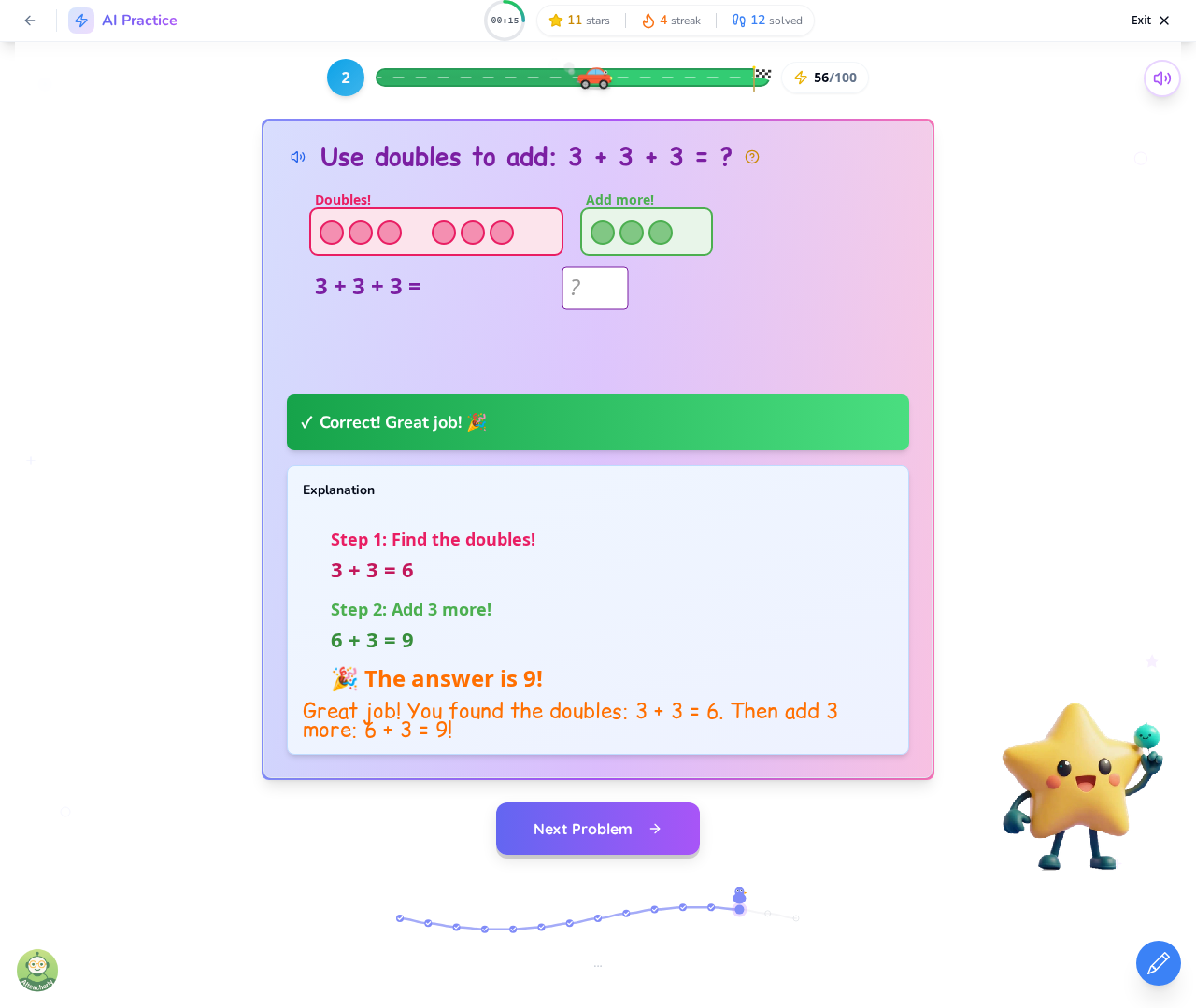
The Doubles strategy is the second key technique for adding three numbers. If your child already knows their doubles facts (2+2, 3+3, 4+4, etc.), they can use this knowledge to speed up three-number problems.
How It Works
When children spot two identical numbers in a problem, they can add those first. Doubles are usually memorized early, so they're quick to recall.
Let's try: 4 + 5 + 4
- Scan for matching numbers: There are two 4s!
- Add the doubles first: 4 + 4 = 8
- Now finish the problem: 8 + 5 = 13
The lesson explains it perfectly: "See the two matching numbers? When two numbers match, that's a double!"
Building Doubles Fluency
Most first graders learn these doubles facts:
- 1 + 1 = 2
- 2 + 2 = 4
- 3 + 3 = 6
- 4 + 4 = 8
- 5 + 5 = 10
- 6 + 6 = 12
Once these become automatic, spotting doubles in three-number problems feels like finding a shortcut.
When to Use Which Strategy?
Here's the beautiful part: your child gets to choose! As the lesson asks students: "Which strategy will you use?"
For 6 + 4 + 2, Make Ten works great (6 + 4 = 10, then add 2). For 3 + 5 + 3, Doubles is faster (3 + 3 = 6, then add 5).
Some problems work with both strategies, and that's perfectly fine. The goal is flexibility, not rigid rules.
See These Strategies in Action on AI Teacherly
Reading about strategies is helpful, but seeing them in action is transformative. That's where interactive learning platforms make a real difference.
On AI Teacherly, the Adding Three Numbers lesson guides first graders through both strategies using visual demonstrations, guided practice, and independent problem-solving. The lesson doesn't just tell children about Make Ten and Doubles; it shows them with colorful visuals and interactive exercises.
Here's what the full interactive lesson looks like on AI Teacherly:
Why Interactive Practice Beats Worksheets
Traditional worksheets present problem after problem without feedback. Children either get it right or make the same mistakes repeatedly without understanding why.
Interactive lessons work differently:
- Immediate feedback tells children if they're on the right track
- Visual models make abstract concepts concrete
- Guided discovery helps children understand why strategies work, not just how to use them
- Adaptive difficulty meets children where they are
The Adding Three Numbers lesson takes approximately 25 minutes, making it perfect for a focused practice session after school or on weekends. Children work through discovery activities, guided practice, and independent problems, all while building genuine understanding.
What Parents Love About This Approach
Many parents tell us they appreciate not having to explain math concepts themselves. The lesson does the teaching; parents just provide encouragement. That's especially valuable when children push back against parent-led instruction but happily engage with interactive content.
Simple Ways to Practice at Home Without Worksheets
You don't need to turn your kitchen into a classroom. These everyday moments naturally reinforce three-number addition strategies.
At the Grocery Store
"We need 3 apples, 7 oranges, and 2 bananas. How many pieces of fruit is that?" Let your child solve it however they want, then ask, "Did you notice that 3 + 7 makes 10? That's the Make Ten trick!"
Setting the Table
"We need 4 forks, 4 knives, and 5 spoons. How many pieces of silverware?" After they answer, point out: "You had two 4s! That's a double. 4 + 4 = 8, then plus 5 equals 13."
During Car Rides
Play "Three Number Challenge." Give your child three small numbers (keep sums under 20) and see if they can spot a Make Ten pair or doubles. Make it playful, not pressured.
The Coin Game
Put out three small groups of pennies (e.g., 6, 4, and 3). Ask: "How many pennies altogether?" Then ask: "Do any two groups make ten?" Let them physically move groups together.
What to Avoid
- Don't quiz relentlessly. Three or four problems during natural moments is plenty.
- Don't criticize finger counting. It's a valid strategy while building mental math skills.
- Don't rush the process. Strategy fluency develops over weeks and months, not days.
Signs Your Child Is Making Progress
You'll know the strategies are clicking when your child:
- Spontaneously rearranges numbers before adding
- Says things like "I see a ten!" or "There's a double!"
- Solves problems faster without counting every single number
- Shows confidence instead of frustration with three-number problems
Key Takeaways
- The Make Ten strategy works by finding two numbers that add to 10 first, making the final addition simple
- The Doubles strategy lets children use memorized facts (like 4+4=8) to speed up three-number problems
- Children can add numbers in any order, which means they can rearrange to use whichever strategy works best
- Interactive practice with immediate feedback builds understanding faster than repetitive worksheets
- Everyday moments like grocery shopping and setting the table offer natural practice opportunities
- Progress takes weeks, not days, so patience and encouragement matter more than drilling
Frequently Asked Questions
What is the make ten strategy for adding three numbers?
The Make Ten strategy involves finding two numbers in the problem that add up to 10, then adding the third number. For example, in 7 + 5 + 3, you'd add 7 + 3 = 10 first, then 10 + 5 = 15.
At what age do kids learn to add three numbers?
Most children learn to add three numbers in first grade, typically around ages 6-7. This skill builds on two-number addition mastery and is usually introduced in the second half of the school year.
Why does my first grader struggle with adding three numbers?
Three-number addition requires holding multiple values in working memory, which is still developing in young children. It also requires strategy selection, not just counting. These cognitive demands make it significantly harder than two-number addition.
Can you add three numbers in any order?
Yes! This is called the commutative property. 4 + 6 + 3 equals 6 + 4 + 3 equals 3 + 4 + 6. All arrangements equal 13. This flexibility allows children to rearrange numbers to find easier combinations.
How can I practice adding three numbers at home without worksheets?
Use everyday moments: counting fruit at the grocery store, adding silverware when setting the table, or playing number games during car rides. These natural contexts make practice feel like play rather than homework.
Is it okay for my child to use fingers when adding three numbers?
Yes, finger counting is a valid strategy while children develop mental math skills. Over time, as Make Ten and Doubles strategies become automatic, they'll naturally rely less on fingers.
What are doubles in first grade addition?
Doubles are addition facts where both numbers are the same: 2+2=4, 3+3=6, 4+4=8, and so on. Children typically memorize these early, making them useful shortcuts when spotted in three-number problems.
How long does it take to master adding three numbers?
Most first graders need several weeks to several months of consistent practice to develop fluency with three-number addition strategies. Focus on understanding over speed, and celebrate small wins along the way.
Ready to see your first grader light up with math confidence? Try the Adding Three Numbers interactive lesson free on AI Teacherly and watch the Make Ten and Doubles strategies come to life!