Why 1/4 Is Bigger Than 1/8: A Parent's Guide to 3rd Grade Fraction Comparison
Confused when your 3rd grader says 1/8 is bigger than 1/4? Learn the three fraction comparison rules, visual strategies, and simple scripts that make fraction sizes finally click.
The Fraction Comparison Confusion Every Parent Recognizes
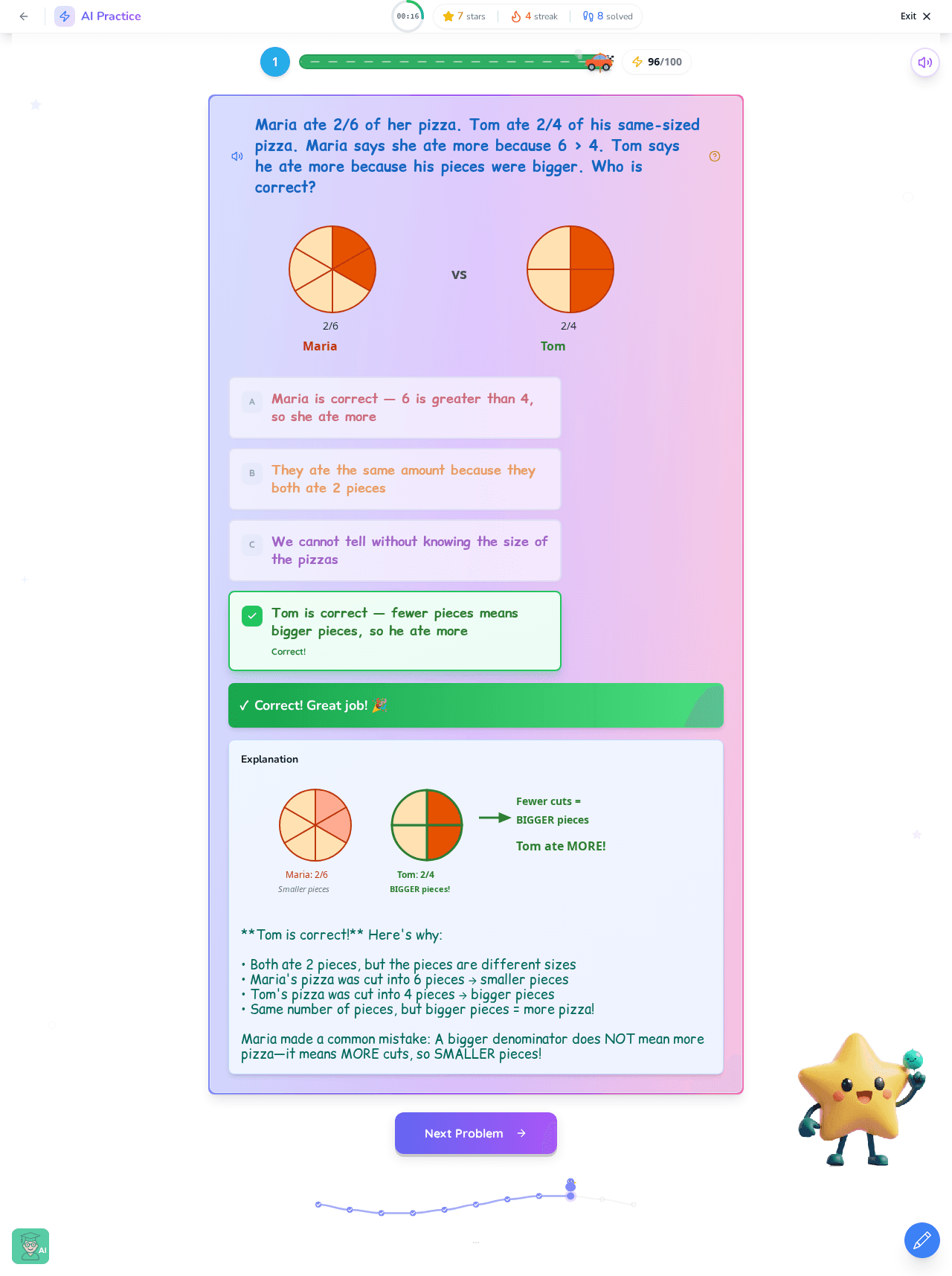
Picture this: Your 3rd grader confidently announces that 1/8 is bigger than 1/4 "because 8 is bigger than 4." You pause, knowing that's wrong, but suddenly you're not quite sure how to explain why without making things more confusing.
You're not alone. This exact moment happens in homes everywhere during the fraction units of 3rd grade. The logic seems so reasonable from a child's perspective: bigger numbers should mean bigger amounts, right?
Here's the good news: there's a simple way to help your child understand fraction comparison that actually sticks. In this guide, you'll discover the three rules 3rd graders learn for comparing fractions, why the "smaller denominator" concept trips kids up, and word-for-word scripts you can use tonight to make fraction sizes click.
Whether you're reviewing homework, preparing for a test, or just want to build your child's confidence with fractions, these visual strategies work because they connect abstract math to concrete images your child already understands.
What Are the Three Rules for Comparing Fractions?
Before diving into the tricky parts, let's establish the foundation. In 3rd grade, students learn three reliable strategies for comparing fractions. Each rule applies to a different situation.
Rule 1: Same Denominator? Compare the Numerators
When two fractions have the same denominator (bottom number), the comparison is straightforward. Same denominator means same-sized pieces. So you simply compare how many pieces you have.
- 3/5 vs 2/5? Three pieces beats two pieces. 3/5 is bigger.
- 1/8 vs 5/8? Five pieces beats one piece. 5/8 is bigger.
The script to use: "Same-sized pieces, so just compare the numerators. More pieces means a bigger fraction!"
Rule 2: Same Numerator? Smaller Denominator Wins
This is where things get counterintuitive (more on why below). When fractions have the same numerator, you're comparing the same number of pieces, but the pieces are different sizes.
- 2/3 vs 2/6? Same number of pieces, but thirds are bigger than sixths. 2/3 is bigger.
- 1/4 vs 1/8? One piece of each, but fourths are bigger than eighths. 1/4 is bigger.
The script to use: "When numerators match, bigger pieces mean a bigger fraction. Smaller denominator means bigger pieces!"
Rule 3: Use a Number Line
When neither the numerator nor denominator matches, a number line becomes your best friend. Place both fractions on a number line from 0 to 1, and the fraction further to the right is always greater.
The script to use: "The fraction further right on the number line is always greater!"
Why Do Kids Think Bigger Denominators Mean Bigger Fractions?
Here's the thing: your child isn't being careless when they say 1/8 is bigger than 1/4. They're actually applying solid logic from everything else they've learned about numbers.
In every other math context, bigger numbers mean bigger amounts:
- 8 apples is more than 4 apples
- 8 dollars is more than 4 dollars
- Level 8 is higher than level 4 in their favorite video game
So when kids see the number 8 in 1/8 and the number 4 in 1/4, their brain naturally concludes that the fraction with 8 must be larger. It makes perfect sense based on their experience!
The challenge is that denominators work differently than counting numbers. The denominator tells you how many pieces a whole is divided into, not how many pieces you have. And here's the key insight your child needs:
The more pieces you cut something into, the smaller each piece gets.
Think about it this way: If you split a pizza between 8 friends, everyone gets a smaller slice than if you split it between 4 friends. More people sharing means smaller portions for each person.
This is why the "smaller denominator wins" rule feels so backwards to kids. They have to override their instinct that bigger numbers are always better. It's not that they don't understand math; it's that fractions follow different rules than the counting numbers they've used for years.
Once you acknowledge this with your child, saying something like "I know it seems strange that the smaller number gives you the bigger fraction," you validate their thinking while opening the door to the new concept.
How to Explain 'Smaller Denominator Wins' Using Pizza Slices
The fastest way to make the "smaller denominator" concept click is through a visual your child knows intimately: pizza.
Start with a simple thought experiment:
"Imagine you have two identical pizzas. One gets cut into 4 slices, and one gets cut into 8 slices. If you grab one slice from each pizza, which slice is bigger?"
Most kids immediately visualize this correctly. The pizza cut into 4 slices has bigger slices than the pizza cut into 8 slices. This is the foundation of understanding denominators.
Now connect it to the math:
"That's exactly what happens with fractions! 1/4 means one slice when the pizza has 4 pieces. 1/8 means one slice when the pizza has 8 pieces. Fewer slices means bigger bites!"
The phrase "Fewer slices, bigger bites!" is memorable and captures the core concept perfectly. Encourage your child to say it whenever they're comparing fractions with the same numerator.
The interactive problem below shows exactly how visual fraction models make this comparison clear for students.
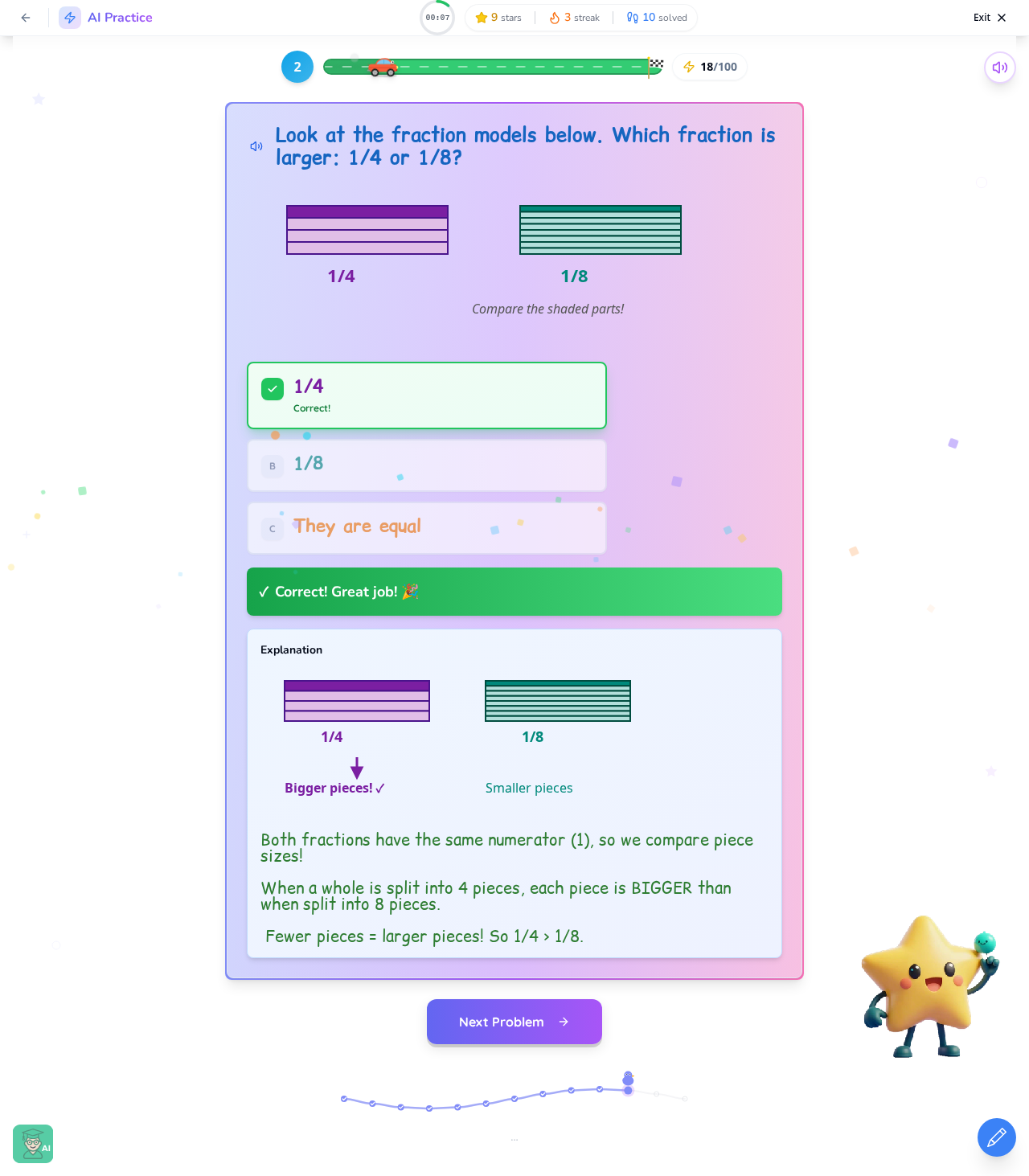
In this type of interactive problem on AI Teacherly, students see the fractions represented visually with circle models. They can literally see that the same number of shaded pieces looks bigger when the circle is divided into fewer parts. This visual confirmation helps override the "bigger number must be bigger" instinct.
See How Visual Fraction Models Make Comparison Click
Visual models transform abstract fraction comparison into something concrete and memorable. Instead of asking kids to trust a rule, visuals let them see why the rule works.
The most effective visual models for comparing fractions include:
Fraction Circles (Pizza or Pie Models) These work perfectly for understanding denominators because kids can see how cutting a whole into more pieces makes each piece smaller. Two identical circles divided differently make the comparison obvious at a glance.
Fraction Bars (Rectangle Models) These are particularly useful when comparing fractions with the same numerator. Stacking two bars of equal length, divided into different numbers of pieces, immediately shows which shaded portion is larger.
Number Lines Number lines help kids see fractions as distances or positions, which becomes crucial for comparing fractions that don't share a numerator or denominator. The visual answer is simple: further right is greater.
Here's what the full interactive lesson looks like on AI Teacherly:
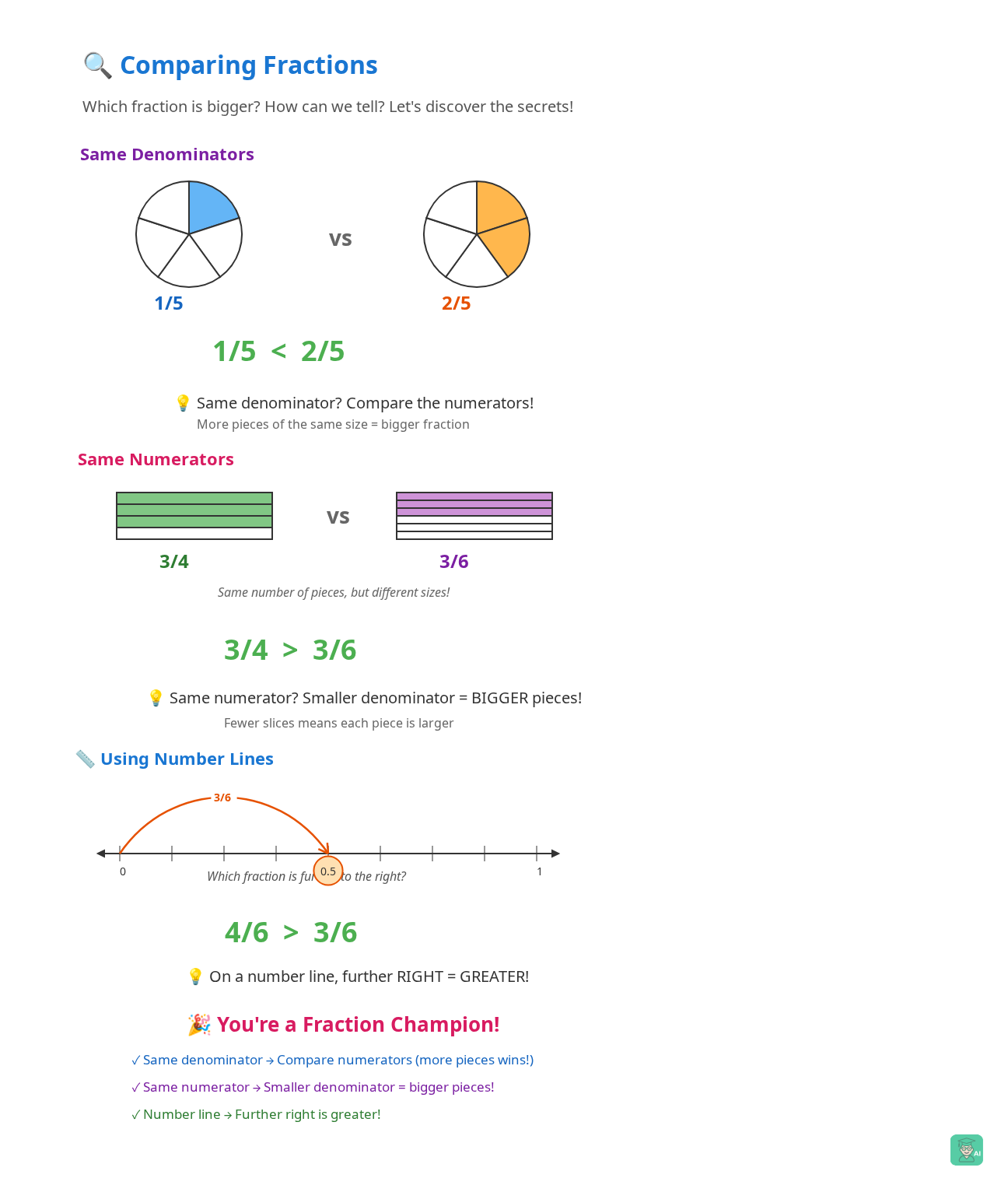
Notice how the lesson combines visual models with step-by-step explanations. Students don't just memorize rules; they build understanding through interactive exploration. Each comparison strategy gets its own focused section with immediate practice problems that reinforce the concept.
The power of these visual approaches is that they give kids a mental image to fall back on. When they encounter 2/3 vs 2/5 on a test, they can picture the pizza slices or fraction bars and confidently apply the "smaller denominator wins" rule because they've seen why it works.
Using Number Lines: When Neither Fraction Shares a Part
What happens when you need to compare fractions like 2/3 and 3/5? The numerators are different. The denominators are different. The first two rules don't apply.
This is where number lines become essential.
A number line shows fractions as positions between 0 and 1. To compare two fractions, you simply mark where each one falls on the line. The fraction further to the right is greater.
How to Use the Number Line Strategy:
- Draw a line from 0 to 1
- Mark the first fraction's position (estimate where 2/3 falls)
- Mark the second fraction's position (estimate where 3/5 falls)
- Look at which marking is further right
For 2/3 vs 3/5, students would see that 2/3 sits just past the halfway point at a position greater than 3/5. Therefore, 2/3 > 3/5.
The beauty of number lines is that they work for any fraction comparison, even when the other rules don't apply. They also help kids develop number sense about fraction sizes in general.
Tips for Parents:
- Practice estimating "benchmark" fractions first: Is this fraction closer to 0, 1/2, or 1?
- Use the benchmark as an anchor: 2/3 is past halfway, while 1/3 is before halfway
- If fractions are very close, more precision is needed (this prepares kids for finding common denominators in 4th grade)
The script to use: "When neither number matches, use a number line. The fraction further right always wins!"
Encourage your child to visualize a number line even on tests where they can't draw one. Just picturing where fractions fall relative to 0, 1/2, and 1 helps them make accurate comparisons.
Key Takeaways
- Same denominator comparison is simplest: more pieces (higher numerator) means a bigger fraction
- The 'smaller denominator wins' rule is counterintuitive because kids expect bigger numbers to mean bigger amounts
- Use the phrase 'Fewer slices, bigger bites!' to help your child remember why smaller denominators create larger pieces
- Visual models like pizza circles and fraction bars let kids SEE why the rules work, building lasting understanding
- Number lines work for any fraction comparison: the fraction further right is always greater
- Acknowledge that fractions work differently than counting numbers to validate your child's confusion before teaching the concept
- Practice with real-world visuals (actual pizza, chocolate bars, paper folding) reinforces the abstract rules
Frequently Asked Questions
How do you compare fractions in 3rd grade?
3rd graders use three rules: (1) same denominator means compare numerators, (2) same numerator means smaller denominator wins, and (3) use a number line when neither matches. Visual models help students see why each rule works.
Why is 1/4 bigger than 1/8 when 8 is the bigger number?
The denominator shows how many pieces a whole is divided into. Cutting a pizza into 4 slices gives bigger pieces than cutting it into 8 slices. Fewer slices means bigger bites, so 1/4 is larger than 1/8.
Is it normal for 3rd graders to struggle with fraction comparison?
Absolutely normal! Kids have learned for years that bigger numbers mean bigger amounts. Fractions flip this logic with denominators. This conceptual shift takes time and visual practice to master.
What visual models help kids compare fractions?
Fraction circles (pizza models), fraction bars (rectangles), and number lines are most effective. Circles show how more divisions create smaller pieces. Bars allow side-by-side comparison. Number lines show fractions as positions.
How can I explain fraction comparison without confusing my child more?
Start with pizza: ask which is bigger, one slice from a 4-slice pizza or one slice from an 8-slice pizza. Once they get this visual, connect it to fractions. Use the phrase 'Fewer slices, bigger bites!' as a memorable anchor.
What are benchmark fractions and why do they matter?
Benchmark fractions are common reference points: 0, 1/2, and 1. Teaching kids to estimate if a fraction is closer to these benchmarks builds number sense and helps compare fractions without needing exact calculations.
When should my child use a number line to compare fractions?
Use number lines when fractions don't share a common numerator or denominator. For example, comparing 2/3 and 3/5 requires placing both on a line to see which is further right (closer to 1).
How do I know if my child truly understands fraction comparison?
Ask them to explain WHY one fraction is bigger, not just which one. If they can describe that smaller denominators mean bigger pieces or draw a visual model, they understand conceptually, not just procedurally.
Ready to see your child master fraction comparison with visual, interactive lessons? Try the Comparing Fractions lesson free on AI Teacherly and watch those confusing concepts click!