Counting Back Subtraction: The Simple 1st Grade Math Strategy Parents Need to Know
Discover the counting back subtraction strategy your 1st grader is learning in class. Learn the simple 3-step method and fun ways to practice at home without worksheets.
What Is the Counting Back Strategy for Subtraction?
The counting back subtraction strategy is one of the most foundational math skills your 1st grader will learn this year. Instead of memorizing subtraction facts, children start at the bigger number and count backward to find the answer.
For example, to solve 8 − 3, your child would:
- Start at 8
- Count back three numbers: 7, 6, 5
- Land on 5, which is the answer!
This strategy builds genuine number sense rather than rote memorization. When kids understand why subtraction works (taking away means moving backward on the number line), they develop flexible thinking that helps them tackle more complex math problems later.
Many parents wonder why schools teach this method instead of just drilling facts. The answer is simple: research shows that children who understand the concept behind subtraction retain their knowledge longer and transfer it to new situations more easily. Counting back is the bridge between concrete understanding and mental math fluency.
If your child's teacher has sent home worksheets about counting back, you're in the right place. This guide will walk you through exactly how this strategy works and how you can reinforce it at home without any special materials.
The 3 Simple Steps to Counting Back
The beauty of the counting back method is its simplicity. Once your child masters these three steps, they can solve any subtraction problem within 10.
Step 1: Start at the Bigger Number
The first number in a subtraction problem (called the minuend) is always your starting point. For 7 − 2, your child starts at 7. This is the most important step because many children mistakenly start counting from zero or from the smaller number.
Step 2: Count Back the Amount Being Subtracted
Now comes the action! Your child counts backward by the second number (the subtrahend). For 7 − 2, they would say "6, 5" while holding up two fingers or making two hops backward.
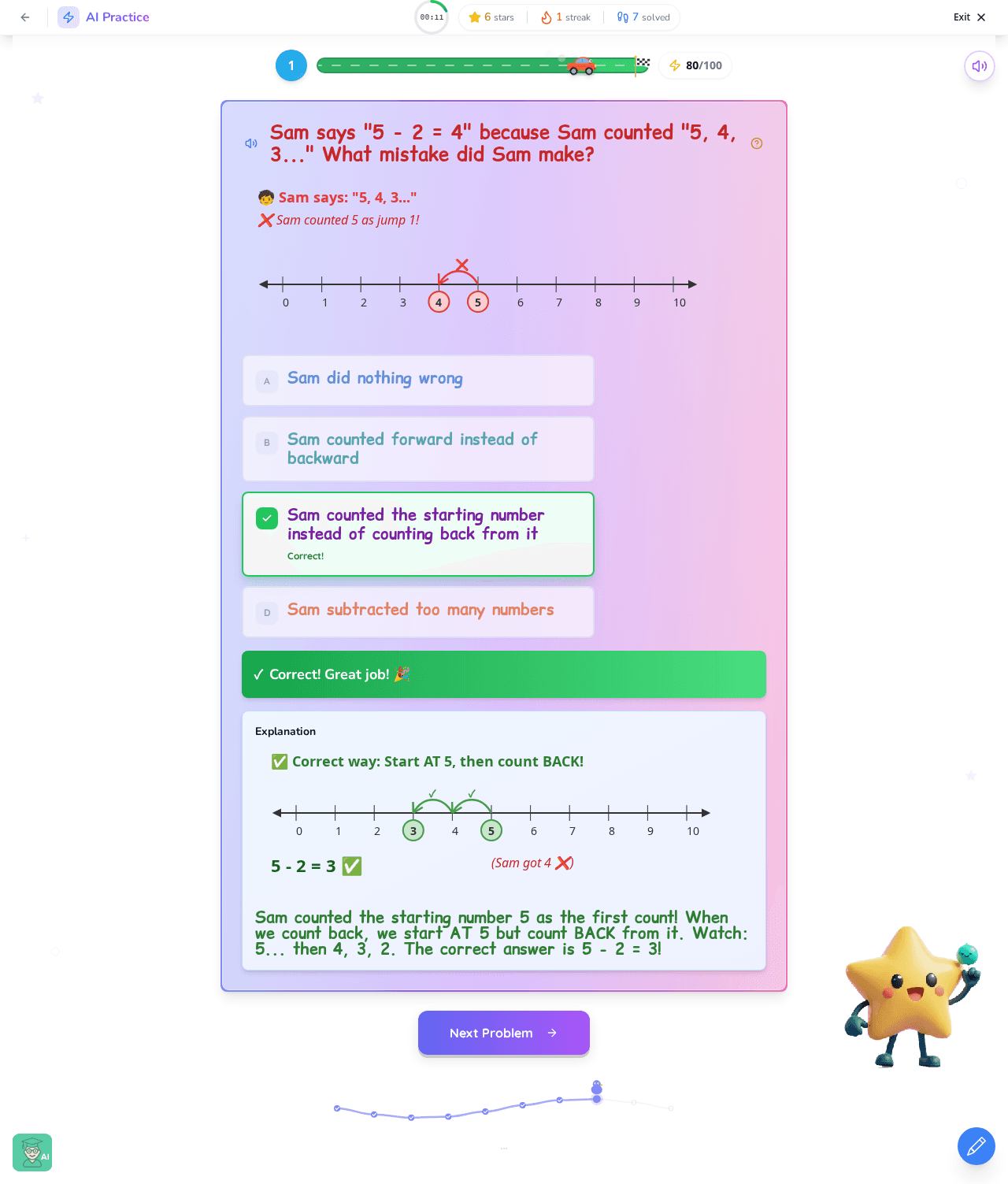
A key tip: Make sure your child does NOT count the starting number as a hop. If solving 7 − 2, the first count should be "6," not "7."
Step 3: Where You Land Is Your Answer
The number your child lands on after counting back is the answer. For 7 − 2, after saying "6, 5," they land on 5. That's it!
Practice this three-step framework with your child using small numbers first. Once they can confidently solve problems like 5 − 2 or 6 − 3, gradually increase to subtraction within 10.
How Number Lines Make Subtraction Click
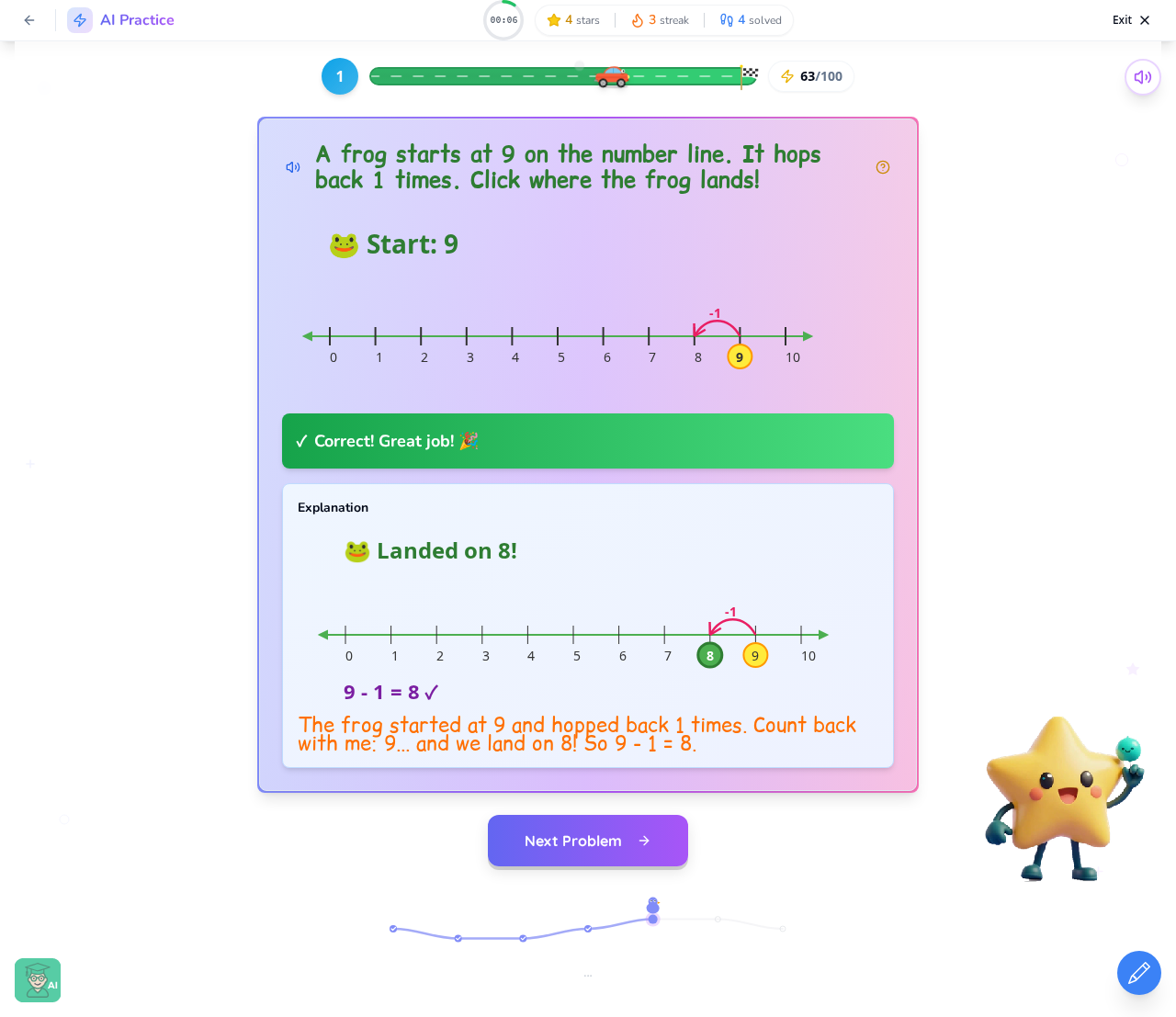
If your child is a visual learner (and most young children are), number lines are absolute game-changers for subtraction. A number line shows numbers in order from left to right, making it easy to see that counting back means moving to the left.
Here's why number lines work so well:
1. Subtraction becomes movement: Instead of an abstract concept, taking away becomes physically hopping backward on the line. Kids can literally see the answer getting smaller.
2. Mistakes become visible: If a child counts the starting number as a hop, they'll land on the wrong spot. This makes errors easier to catch and correct.
3. The strategy transfers to larger numbers: Once kids understand the hop-back pattern, they can apply it to two-digit subtraction later.
The interactive problem below shows exactly how number lines bring counting back to life. Watch how each hop goes back one number, making the strategy visual and concrete:
How to use number lines at home:
- Draw a simple number line from 0 to 10 on paper
- Place a small toy or finger on the starting number
- Have your child physically move it backward
- Celebrate when they land on the correct answer!
You can also find number lines on sidewalks (use chalk!), stairs, or even a row of shoes.
See Counting Back in Action on AI Teacherly
Reading about counting back is helpful, but seeing it in action makes all the difference. On AI Teacherly, the Subtraction: Counting Back lesson for Grade 1 brings this strategy to life with interactive problems that guide students step by step.
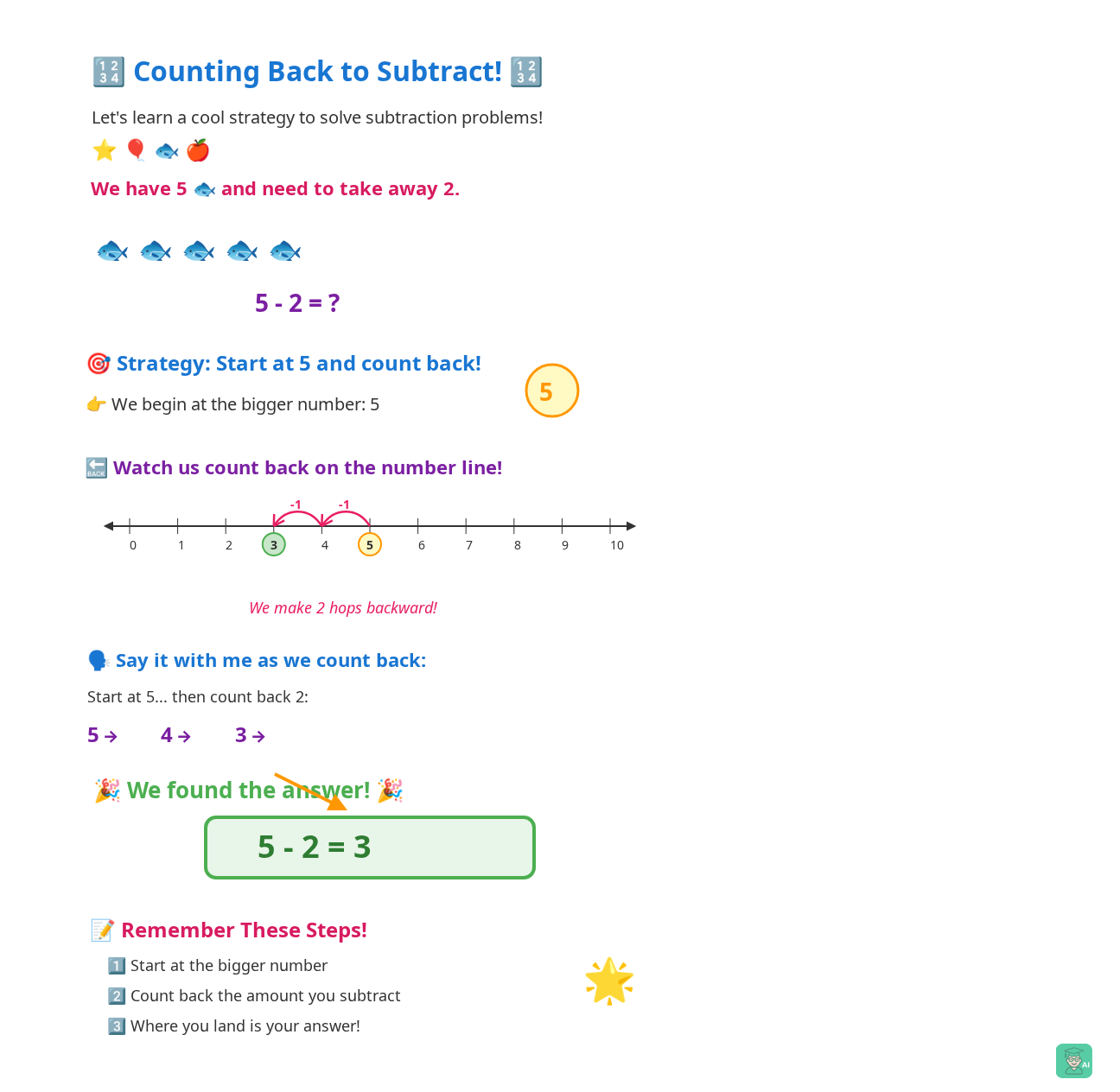
Here's what the full interactive lesson looks like on AI Teacherly:
The lesson includes:
Guided instruction: Animated demonstrations show a friendly frog hopping backward on a number line, with voiceover explanations like "Start at the bigger number, then count back!"
Interactive practice: Students tap or click to make hops on the number line, building muscle memory for the counting back motion.
Word problems: Real-world scenarios (like balloons popping or cookies being eaten) connect abstract subtraction to situations kids understand.
Error analysis: Students identify common mistakes, like counting the starting number as a hop, which deepens their understanding of why the strategy works.
What makes interactive lessons so effective is the immediate feedback. When your child makes a hop, they instantly see whether they landed on the correct answer. This self-correction builds confidence and independence.
The lesson takes about 20 minutes and covers subtraction within 10, using the same three-step framework you learned above. After completing it, most students can confidently count back without visual aids.
Fun Ways to Practice Counting Back at Home
The best part about counting back? You can practice it anywhere, no worksheets required! Here are parent-tested activities that make subtraction practice feel like play:
Stair Math Stand on a step and say a subtraction problem like "You're on step 7, go back 3!" Have your child count out loud as they walk down: "6, 5, 4... I'm on 4!" Stairs are a giant vertical number line.
Snack Subtraction Give your child 8 crackers. Say, "If you eat 2, how many will be left?" Have them count back from 8 while pretending to eat (or actually eating!) the crackers. Food makes math memorable.
Finger Counting Hold up 9 fingers. Ask, "9 minus 4?" Your child starts at 9 and folds down fingers while counting back: "8, 7, 6, 5." The answer is the number of fingers still up.
Toy Lineup Line up toy cars or stuffed animals. "There are 6 cars. 2 drive away. Count back to find how many stay!" Moving physical objects reinforces the take-away concept.
Bath Time Bubbles Blow 7 bubbles. Pop 3 while counting back. How many are left? This works with blocks, crayons, or any collection.
The key to success: Keep sessions short (5 minutes), positive, and low-pressure. If your child gets frustrated, take a break. Math confidence is built through many small, successful experiences.
Common Mistakes Kids Make (And How to Help)
Even bright children stumble when learning to count back. Recognizing these common errors helps you gently guide your child toward the correct method:
Mistake #1: Counting the Starting Number as a Hop
This is the most common error. For 8 − 3, a child might count "8, 7, 6" and say the answer is 6. But the first count should be 7, not 8!
How to fix it: Say "Start at 8, but don't count it. Now count back 3 hops." Using the word "hops" reinforces that each count is a jump away from the starting point.
Mistake #2: Starting from the Wrong Number
Some children start counting from zero or from the smaller number. For 7 − 2, they might count "1, 2, 3, 4, 5" instead of starting at 7.
How to fix it: Point to the first number in the problem and say, "This is where we begin. Put your finger here!" Physical pointing anchors the starting position.
Mistake #3: Counting Forward Instead of Backward
Subtraction requires backward counting, which is harder than forward counting. A child might accidentally go "8, 9, 10" instead of "8, 7, 6."
How to fix it: Practice counting backward without math problems first. "Count down from 10 like a rocket launch!" Once backward counting is fluent, subtraction becomes easier.
Mistake #4: Losing Track of How Many Hops
When subtracting larger numbers (like 9 − 5), kids may lose count of their hops.
How to fix it: Use fingers! Raise 5 fingers and fold one down with each hop. When all fingers are down, you've made 5 hops.
Key Takeaways
- Counting back is a foundational subtraction strategy where kids start at the bigger number and count backward to find the answer
- The three steps are simple: start at the bigger number, count back the amount being subtracted, and land on the answer
- Number lines make counting back visual and concrete, helping kids literally see subtraction as movement
- Practice anywhere using stairs, snacks, fingers, or toys; no worksheets needed
- The most common mistake is counting the starting number as a hop; remind your child to start counting from the next number down
- Interactive lessons like those on AI Teacherly provide immediate feedback that builds confidence and independence
Frequently Asked Questions
What is the counting back strategy in 1st grade math?
Counting back is a subtraction method where children start at the bigger number and count backward. For 8 minus 3, they start at 8 and count back three numbers (7, 6, 5) to find the answer is 5.
How do I teach my child to count back for subtraction?
Use the three-step method: start at the bigger number, count backward by the second number while using fingers to track hops, and the number you land on is the answer. Practice with small numbers first.
Why do schools teach counting back instead of memorizing subtraction facts?
Counting back builds number sense and conceptual understanding. Research shows children who understand why subtraction works retain knowledge longer and apply it to new problems more easily than those who only memorize facts.
How do you use a number line for subtraction?
Place your finger on the starting number, then hop backward one space for each number being subtracted. The number you land on is the answer. Each hop represents subtracting one.
Is it normal for my child to struggle with counting backward?
Yes! Counting backward is harder than counting forward because it's less practiced. Many 1st graders need extra time to build backward counting fluency. Practice counting down from 10 daily, like a rocket launch.
What is the most common counting back mistake kids make?
The most common error is counting the starting number as the first hop. For 7 minus 2, children incorrectly count '7, 6' instead of '6, 5.' Remind them the first count should be one less than the starting number.
How can I practice counting back at home without worksheets?
Use stairs (hop down while counting), snacks (eat crackers while counting back), fingers (fold down for each hop), or toys (drive cars away). Any collection of objects works for hands-on subtraction practice.
When should my child move beyond the counting back strategy?
Once your child can fluently count back for subtraction within 10, they'll gradually memorize common facts. Most children transition to fact fluency by late 1st or 2nd grade while still using counting back for harder problems.
Ready to see counting back come to life? Try the free Subtraction: Counting Back lesson on AI Teacherly and watch your 1st grader build math confidence with interactive practice!