Counting to 10 Made Easy: The Ten Frame Method Every Kindergartener Loves
Struggling to teach your kindergartener to count to 10? Discover ten frames, the visual counting tool teachers love, and learn simple ways to practice at home.
The Counting Milestone Every Kindergartener Needs to Master
That moment when your kindergartener counts to 10 without skipping a single number? It's one of those proud-parent milestones that feels like pure magic. But getting there can sometimes feel like a mystery, especially when your little one jumps from "seven" straight to "ten" or forgets "eight" exists entirely.
Here's the good news: teaching your kindergartener to count to 10 doesn't require a teaching degree or fancy materials. Teachers have a secret weapon called the ten frame, and it's surprisingly simple for parents to use at home. This visual counting tool transforms abstract numbers into something children can actually see and touch.
In this guide, you'll discover exactly what ten frames are, why they work so well for young learners, and practical ways to practice counting at home. Whether your child is just starting to learn numbers or needs extra practice to build confidence, these strategies will help make counting to 10 feel natural and fun.
What Is a Ten Frame and Why Do Teachers Love It?
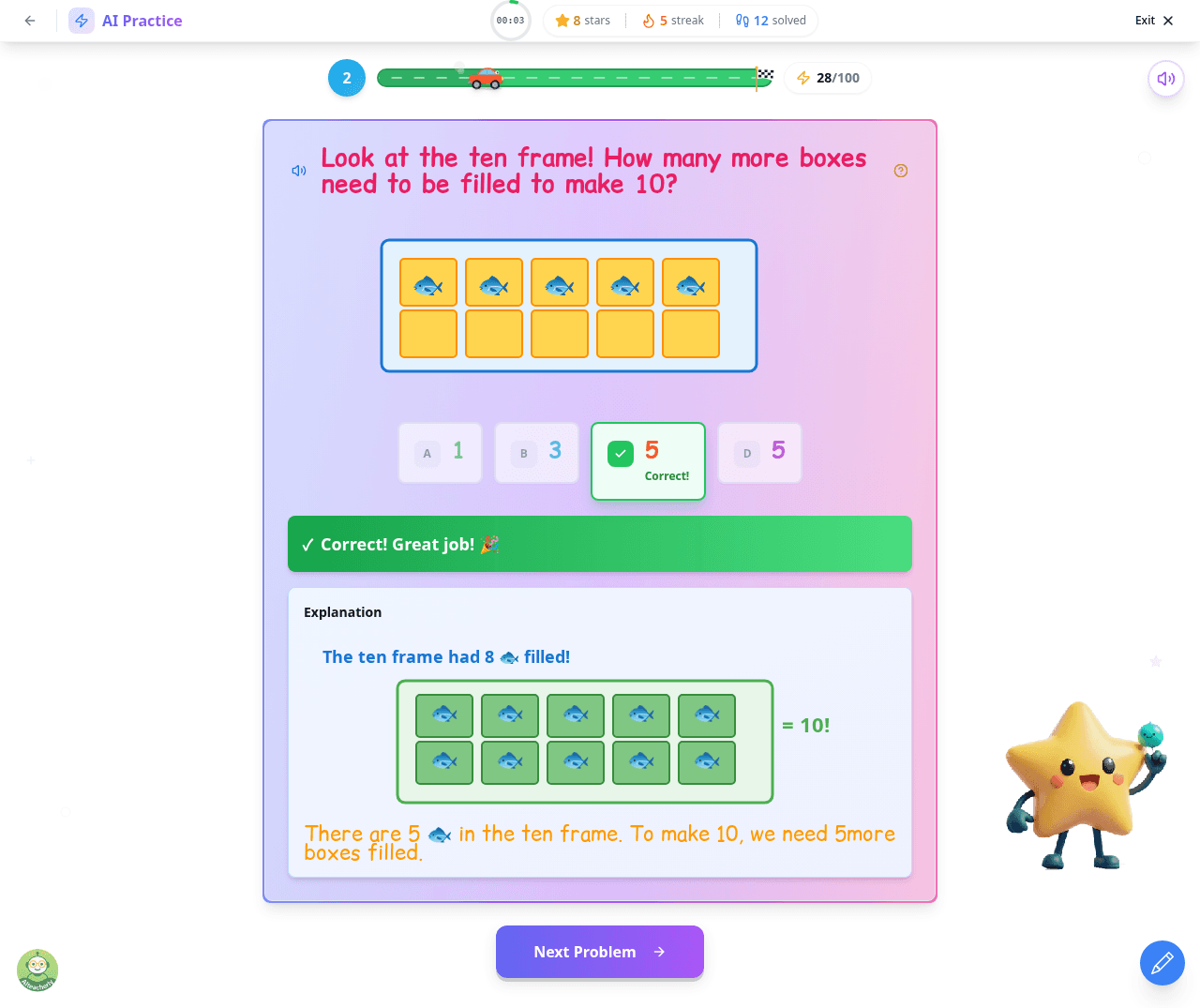
A ten frame is a simple rectangular grid with 10 boxes arranged in two rows of five. Children place objects (like counters, buttons, or stickers) into the boxes one at a time while counting. It sounds almost too simple, but this visual tool is incredibly powerful for building number sense.
Why do teachers swear by ten frames? Because they solve the biggest challenge in teaching counting: helping children understand that numbers represent real quantities, not just words to memorize in order.
When your kindergartener fills a ten frame, they can literally see:
- How many objects they've counted (filled boxes)
- How many more they need to reach 10 (empty boxes)
- The relationship between numbers (7 filled boxes means 3 empty ones)
This visual representation builds what educators call one-to-one correspondence, the understanding that each object gets counted exactly once. It's the foundation for all future math skills, from addition to multiplication.
Ten frames also help children recognize number patterns. For example, they quickly learn that 5 fills exactly one row, and 10 fills the entire frame. These mental images become shortcuts that make math feel intuitive rather than confusing.
How Do I Teach My Kindergartener to Count to 10?
The best approach to teaching counting to 10 starts with what your child already knows. Most kindergarteners can count to 5 fairly confidently, so you'll want to build from that foundation rather than starting from scratch.
Step 1: Celebrate What They Know
Start by counting to 5 together. "You already know how to count to five! One, two, three, four, five. That's amazing! Now let's go higher!" This builds confidence and frames new learning as an exciting extension, not a scary challenge.
Step 2: Introduce Numbers 6 Through 10 Gradually
Add one new number at a time. Once your child masters counting to 6 consistently, move to 7, then 8, and so on. Rushing through all five new numbers at once often leads to confusion and frustration.
Step 3: Connect Numbers to Real Objects
This is where ten frames shine. Have your child place objects into a ten frame while counting aloud. Touch each object as they say the number. This physical connection between saying "seven" and touching the seventh object is crucial for understanding that numbers represent quantities.
Step 4: Practice the Tricky Transitions
Many children stumble between 5 and 6 (the "teen" confusion) or between 7 and 8. Give extra practice with these transitions by counting objects that land on these numbers. Ask questions like, "We have 7 apples. If I add one more, how many will we have?"
3 Fun Ways to Practice Counting at Home
Learning to count shouldn't feel like homework. The best counting practice happens during everyday moments when your child doesn't even realize they're learning math. Here are three approaches that work brilliantly with kindergarteners.
1. Make a DIY Ten Frame
Grab an empty egg carton and remove two cups to create a 10-space frame. Use small toys, cereal pieces, or buttons as counters. Ask your child to fill the frame while counting, then ask, "How many empty spaces are left?" This simple activity builds both counting skills and early addition concepts.
2. Count Everything During Daily Routines
Turn snack time into counting time: "Let's count out 8 crackers for your snack!" Count stairs as you climb them, count books at bedtime, or count toys during cleanup. The key is making counting a natural part of life, not a separate "learning activity."
3. Use Interactive Digital Practice
Interactive counting activities give children immediate feedback and make learning feel like play. The problem below shows how children can actively fill ten frame boxes on screen, building the same skills they'd practice with physical manipulatives.
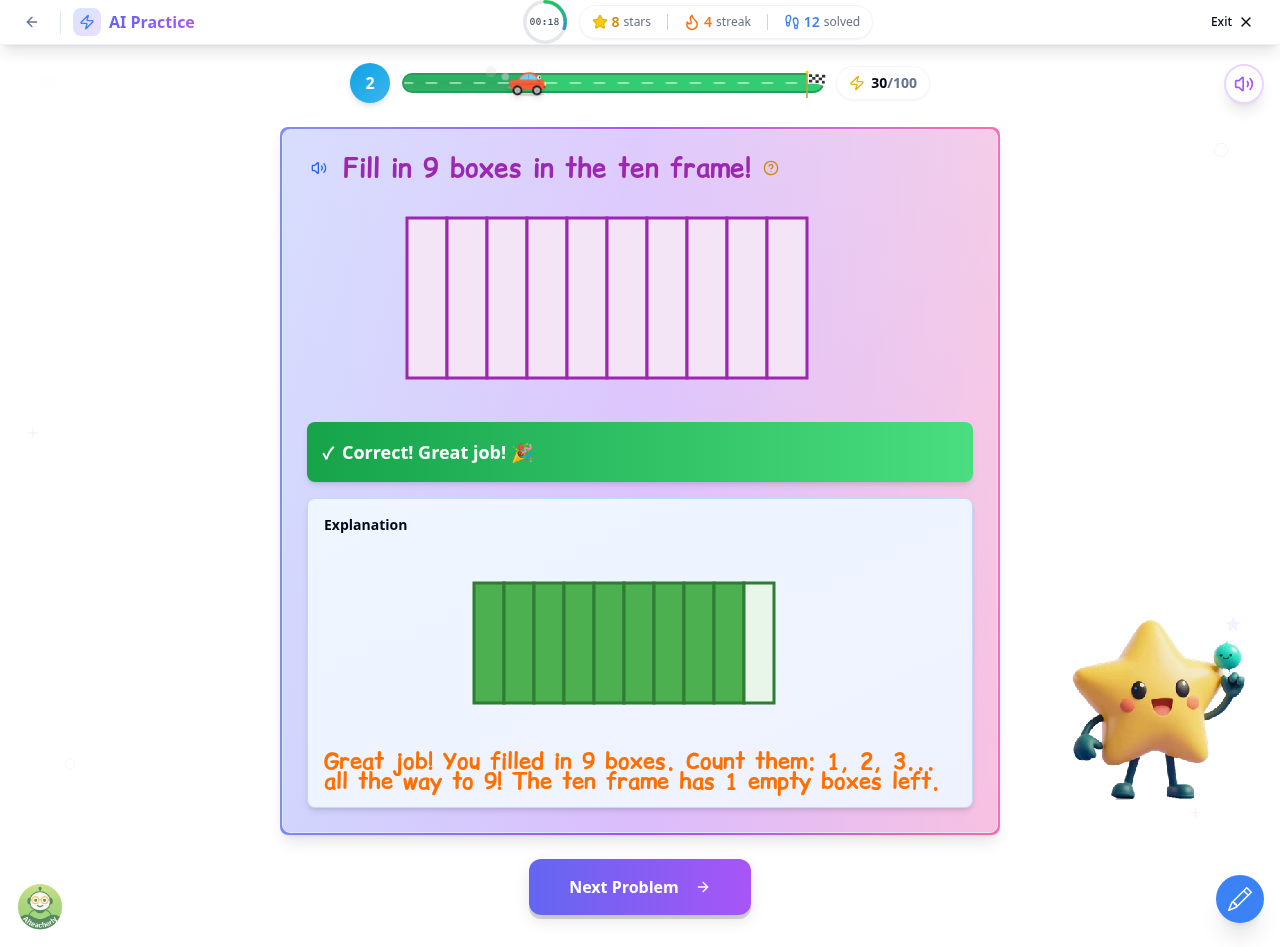
The combination of physical activities and interactive digital practice reinforces counting skills through multiple senses, helping concepts stick in your child's memory.
See Ten Frames in Action on AI Teacherly
Wondering what interactive counting practice actually looks like? The Learn to Count to 10 lesson on AI Teacherly uses ten frames exactly the way teachers do in classrooms, but with the added engagement of colorful visuals and instant feedback.
Here's what the full interactive lesson experience looks like:
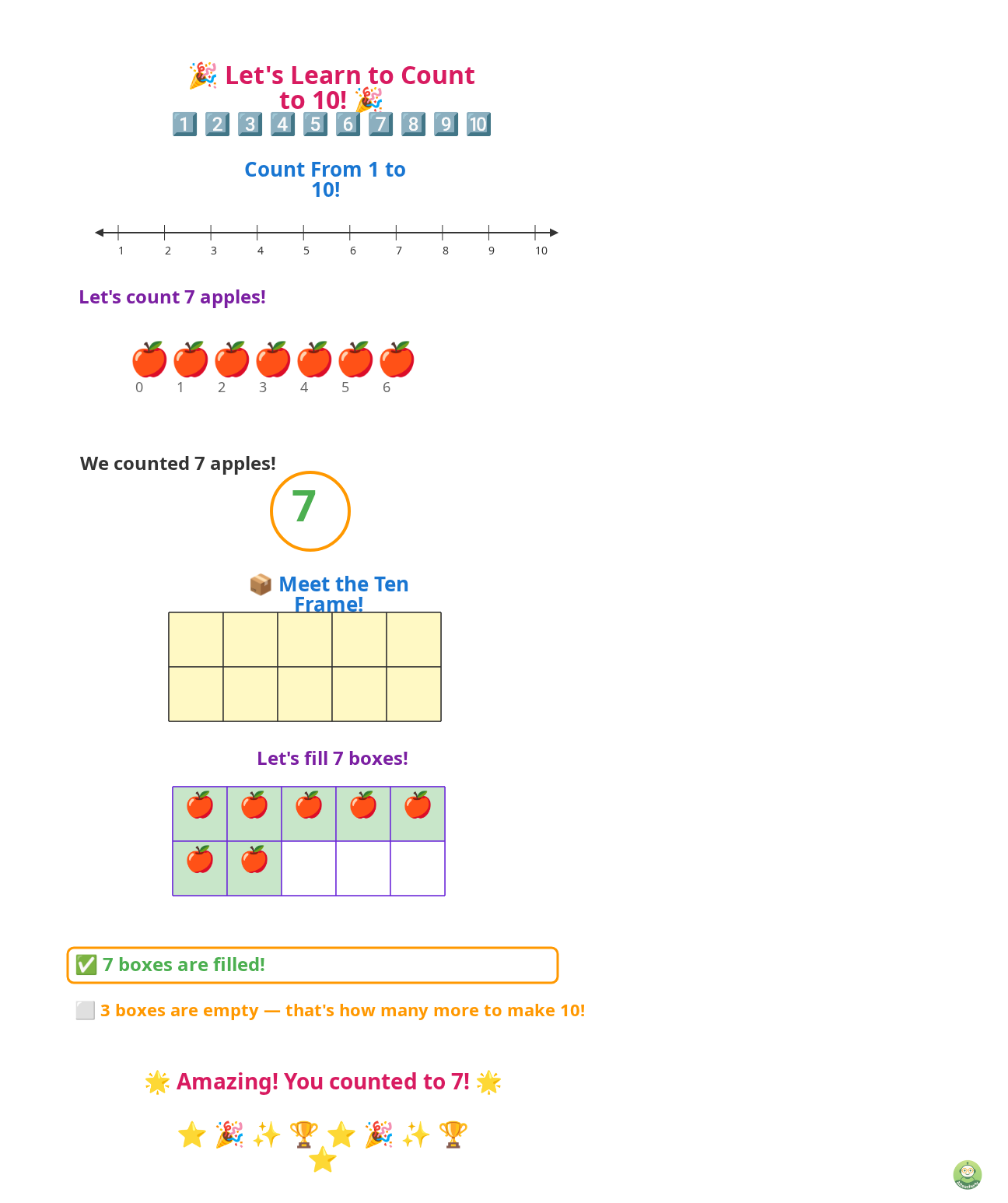
The lesson builds counting skills progressively:
- Starts with familiar territory: Children count objects they already know (1-5) to build confidence
- Introduces the ten frame: Presented as a "special counting tool" that makes math exciting
- Builds to higher numbers: Gradually extends to 6, 7, 8, 9, and 10
- Teaches "how many more": Children learn to count both filled AND empty boxes
What makes digital practice so effective is the immediate feedback. When your child selects the correct answer, they get instant encouragement. When they make a mistake, they can try again without frustration or judgment. This creates a low-pressure environment where learning feels safe.
The lesson also reinforces numeral recognition, so children connect the written symbols (6, 7, 8, 9, 10) with the quantities they represent. This dual approach prepares them for reading and writing numbers in school.
Common Counting Mistakes and How to Handle Them
If your kindergartener makes counting errors, take a deep breath. These mistakes are completely normal and actually show that your child is actively learning. Here's how to handle the most common issues.
Skipping Numbers
Many children skip numbers, especially in the 6-8 range where the words sound similar. When this happens, don't interrupt mid-count. Let them finish, then say, "Great counting! Let's try again together," and count alongside them. Hearing the correct sequence repeatedly helps it stick.
Counting the Same Object Twice
This happens when children haven't fully developed one-to-one correspondence. The solution is physical: have them touch or move each object as they count it. With ten frames, they can move counters from a pile into the boxes, which naturally prevents double-counting.
Saying Numbers in the Wrong Order
Some children memorize the counting sequence like a song but jumble the order (saying "1, 2, 3, 5, 4" for example). Slow down and emphasize the correct sequence. Use songs, rhymes, or counting books that reinforce the proper order.
Getting Frustrated and Giving Up
If your child gets upset during counting practice, it's time to take a break. Learning works best when children feel calm and confident. Return to an easier skill (counting to 5) to rebuild confidence before tackling higher numbers again.
The most important thing? Praise effort over accuracy. "I love how hard you're trying!" matters more than "That's wrong." Children who feel encouraged keep practicing; children who feel criticized avoid math altogether.
Key Takeaways
- Ten frames are visual grids with 10 boxes that help kindergarteners understand counting as quantities, not just memorized words
- Build from what your child knows (counting to 5) before introducing numbers 6 through 10 to boost confidence
- Touch-counting, where children physically touch each object as they count, prevents skipping and double-counting
- Everyday moments like snack time, bedtime, and cleanup offer natural counting practice opportunities
- Interactive digital lessons provide immediate feedback that keeps young learners engaged and motivated
- Counting mistakes are normal developmental steps, not signs of struggle. Respond with encouragement, not correction
- The "how many more to make 10" concept taught through ten frames builds essential early addition skills
Frequently Asked Questions
What is a ten frame and why do teachers use it?
A ten frame is a grid with 10 boxes in two rows of five. Teachers use it because children can visually see quantities, understand how numbers relate to each other, and build the foundation for addition by seeing filled and empty spaces.
At what age should my child be able to count to 10?
Most children can count to 10 by age 4-5, though some master it earlier or later. By the end of kindergarten (age 5-6), counting to 10 with understanding should be solid. Focus on progress, not comparison to other children.
Why does my kindergartener skip numbers when counting?
Skipping numbers is completely normal and usually happens because the counting sequence is still being memorized. Regular practice with physical objects, especially using ten frames where each item has a dedicated space, helps children internalize the correct order.
How can I make counting practice fun at home?
Turn counting into games during daily routines: count crackers at snack time, stairs while climbing, or toys during cleanup. Use DIY ten frames with egg cartons and small objects. Interactive apps also make practice feel like play rather than homework.
What comes after my child learns to count to 10?
After mastering counting to 10, children typically learn to count to 20, then to 100 by tens. They also begin simple addition and subtraction, often using ten frames to visualize combining and taking away objects.
How do ten frames help with addition later?
Ten frames teach children to see "how many more to make 10," which is the foundation for addition. When a child sees 7 counters and 3 empty spaces, they're already learning that 7 plus 3 equals 10, a concept that transfers directly to formal math.
Should I correct my child when they count wrong?
Avoid interrupting mid-count. Let them finish, then say "Great try! Let's count together" and model the correct sequence. Focus on encouragement and repeated practice rather than pointing out errors, which can make children anxious about math.
How long should counting practice sessions be for kindergarteners?
Keep practice sessions short: 5-10 minutes maximum. Young children learn best in brief, focused bursts. Multiple short sessions throughout the day are more effective than one long practice that leads to frustration and fatigue.
Ready to make counting to 10 fun and engaging? Try the interactive Learn to Count to 10 lesson on AI Teacherly, where colorful ten frames and instant feedback help your kindergartener build confidence with numbers!