Counting to 10 Made Easy: How Ten Frames Build Number Sense in Kindergarten
Discover how ten frames, the simple visual tool teachers love, help kindergarteners truly understand counting to 10. Learn easy at-home activities and see interactive lessons in action.
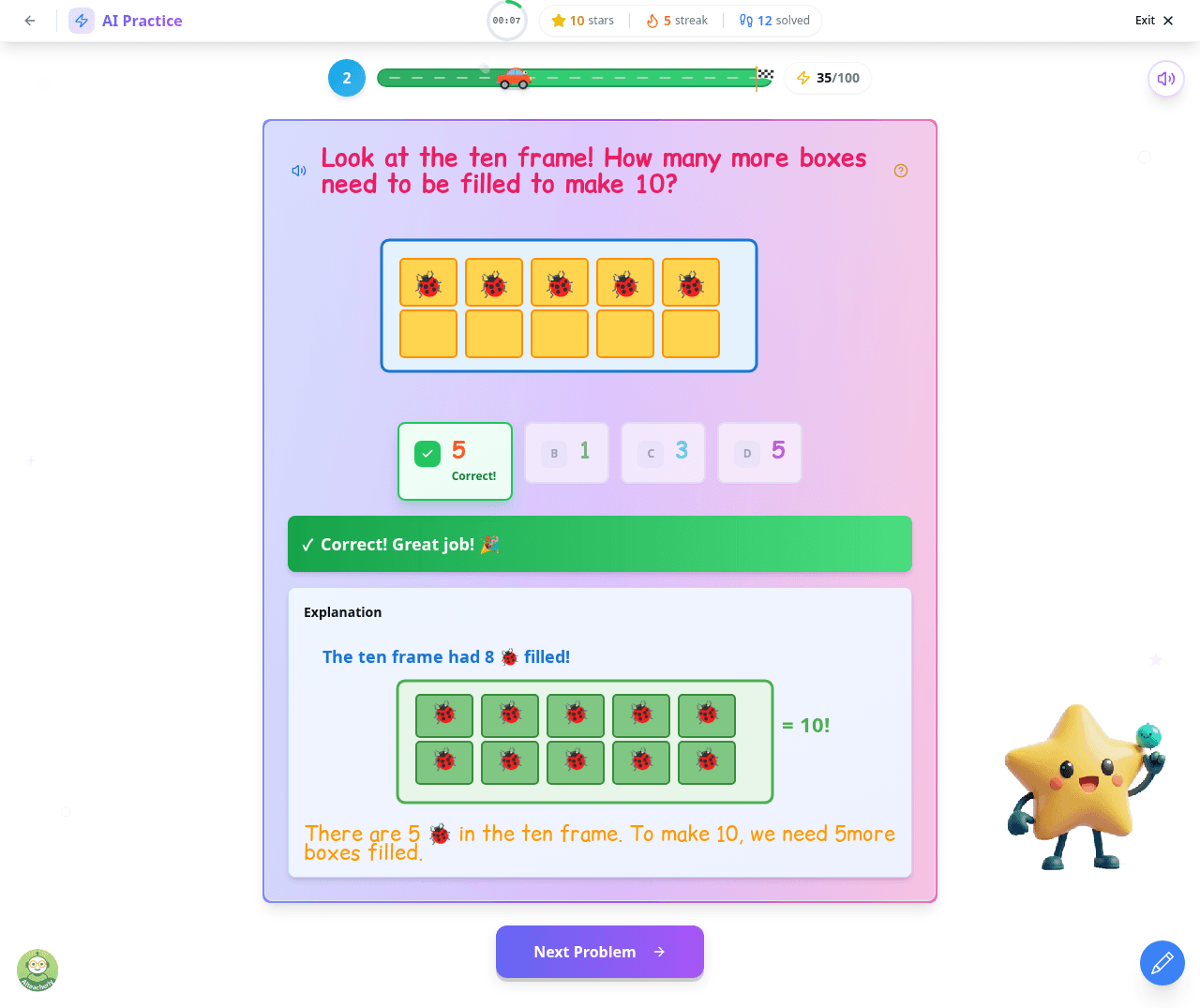
Why Counting to 10 Is a Bigger Deal Than You Think
When your kindergartener proudly counts to ten, they're doing much more than reciting numbers in order. They're building number sense, the foundational understanding that numbers represent real quantities. This skill forms the bedrock of all future math learning, from addition and subtraction to multiplication and beyond.
Here's what might surprise you: many children can recite "one, two, three..." without truly understanding what those numbers mean. They've memorized a sequence, like singing the alphabet, but haven't connected each number to an actual quantity. This is where parents sometimes feel confused. Their child can "count" to ten, yet struggles to answer "How many apples are on the table?"
The difference between rote counting and meaningful counting is called one-to-one correspondence, the ability to match each number word to exactly one object. When your child points to each toy and says a number, pausing before moving to the next, they're demonstrating this critical skill. Research shows that children who develop strong one-to-one correspondence in kindergarten perform significantly better in math throughout elementary school.
So how do you help your kindergartener make this leap from reciting numbers to truly understanding them? The answer might be simpler than you expect: a visual tool called the ten frame.
What Is a Ten Frame and Why Do Teachers Love It?
A ten frame is a simple rectangular grid with two rows of five boxes each, creating ten empty spaces. Teachers use it to help children visualize numbers from 1 to 10 by filling the boxes with counters, dots, or objects. It sounds almost too simple to be powerful, yet this humble grid is one of the most effective tools in early math education.
Why does it work so well? The ten frame provides a consistent visual structure that helps young brains organize quantities. When a child sees 7 counters in a ten frame, they don't just see "seven things." They see "five filled boxes on top, two more on the bottom, and three empty spaces." This instant visual breakdown builds number relationships naturally.
Teachers love ten frames for several key reasons:
- They show the relationship to 5 and 10: Children quickly recognize that 6 is "one more than 5" and 8 is "two less than 10"
- They prepare kids for addition: Seeing filled and empty boxes builds the foundation for understanding "how many more to make 10"
- They reduce counting errors: The organized grid helps children track which objects they've counted
- They work with any objects: Use buttons, cereal pieces, toy cars, or digital counters
The best part? You don't need to buy anything special. You can draw a ten frame on paper in seconds, or find printable versions online. Many interactive learning platforms, including AI Teacherly, offer digital ten frames that make practice feel like play.
How Do Ten Frames Help Kindergarteners Learn to Count?
Ten frames transform abstract numbers into something kindergarteners can see, touch, and understand. Instead of asking "What is 7?" a ten frame shows exactly what 7 looks like, how much space it takes up, and how it relates to other numbers.
The magic happens through visual anchoring. Children's brains are wired to recognize quantities up to about 4 instantly (a skill called "subitizing"). Beyond that, they need to count. But ten frames extend this natural ability by providing visual reference points at 5 and 10. When boxes are filled in order (left to right, top row first), a child can glance at a ten frame and recognize 6 without counting each dot individually: "I see a full row of 5, plus 1 more."
This builds several skills simultaneously:
Counting accuracy: The structured grid ensures children don't skip objects or count the same one twice. Each box holds exactly one counter, reinforcing one-to-one correspondence.
Number relationships: Children begin understanding that 8 is close to 10 (only 2 empty boxes!) while 3 is closer to 0 (lots of empty space). These relationships become intuitive rather than memorized.
Early addition readiness: The question "How many more to make 10?" becomes visual. A child sees 6 counters and 4 empty boxes, connecting counting to early addition without formal instruction.
The interactive problem below shows exactly how ten frames work in practice. Children click to fill boxes, watching quantities grow while building number sense through hands-on engagement.
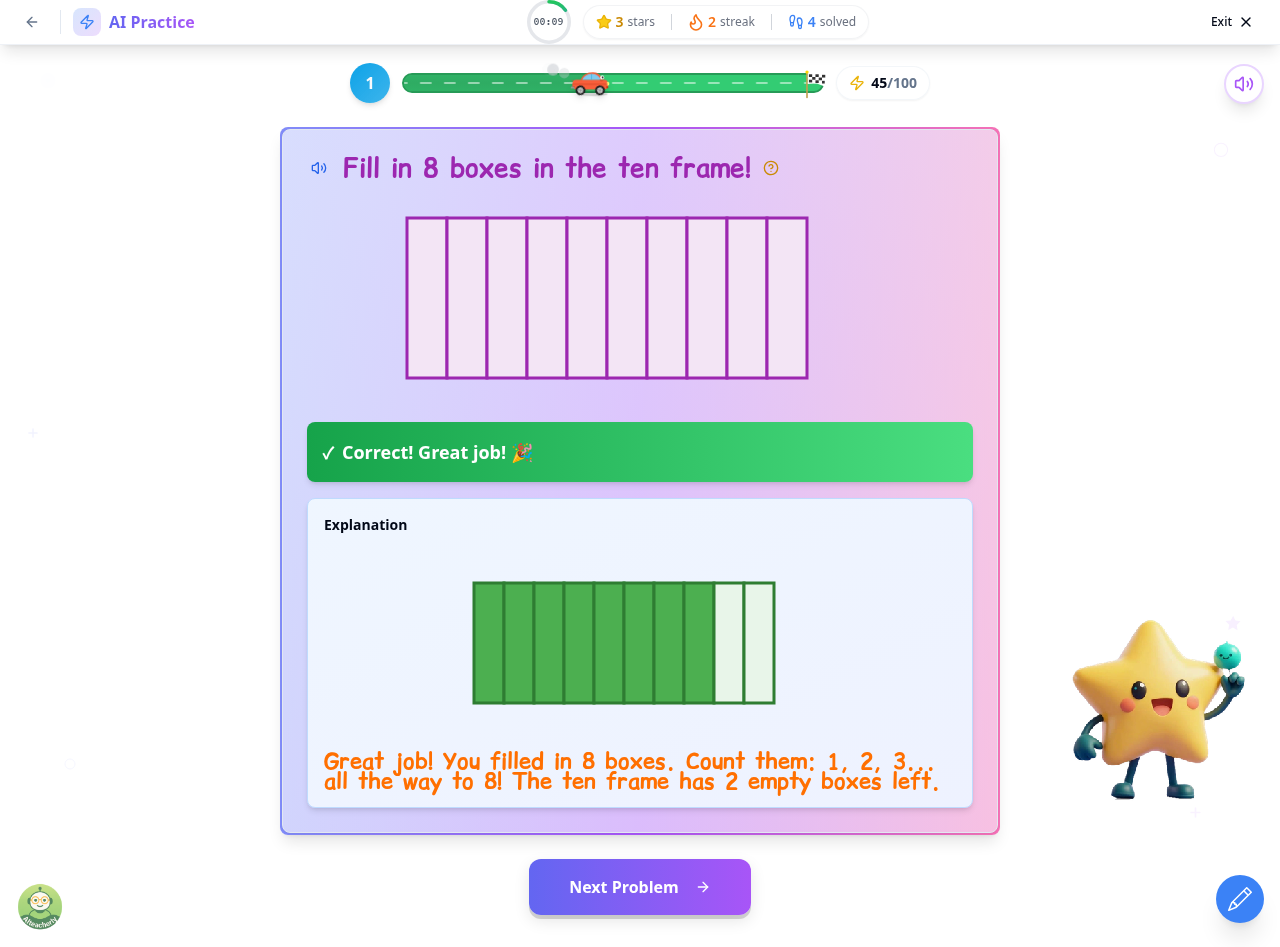
Simple Ways to Practice Counting to 10 at Home
You don't need teaching experience or fancy materials to use ten frames with your kindergartener. Here are practical, playful ways to build counting skills at home:
Make a DIY ten frame: Draw two rows of five squares on paper or cardboard. Use stickers, coins, small snacks (goldfish crackers work great!), or toys as counters. Ask your child to "show me 7" by filling the boxes.
Play "Fill the Frame" during snack time: Give your child 10 blueberries or crackers arranged in a ten frame. As they eat each one, count how many are left. This reverses the usual counting direction and builds subtraction readiness too.
Turn cleanup into counting practice: "Can you put 8 blocks in this row?" Use a drawn ten frame as a sorting guide. Children love having a specific target, and you get help tidying up!
Use the "How many more?" question: When your child shows you a number on the ten frame, ask "How many empty boxes do you see?" This simple question builds addition foundations without any formal teaching.
Count with fingers and frames together: Have your child show a number on their fingers while you show it on a ten frame. Ask "Do we both have the same amount?" This connects different representations of the same quantity.
Make it a guessing game: Quickly flash a ten frame with counters for 2 seconds, then cover it. Can your child guess how many? Start with amounts up to 5, then gradually increase. This builds number recognition speed.
The key is keeping sessions short (5 to 10 minutes), playful, and pressure-free. Your enthusiasm matters more than perfection!
See Ten Frames in Action with Interactive Learning
While homemade ten frames are wonderful, digital interactive tools take learning to another level. They provide instant feedback, colorful animations, and game-like engagement that keeps kindergarteners motivated to practice.
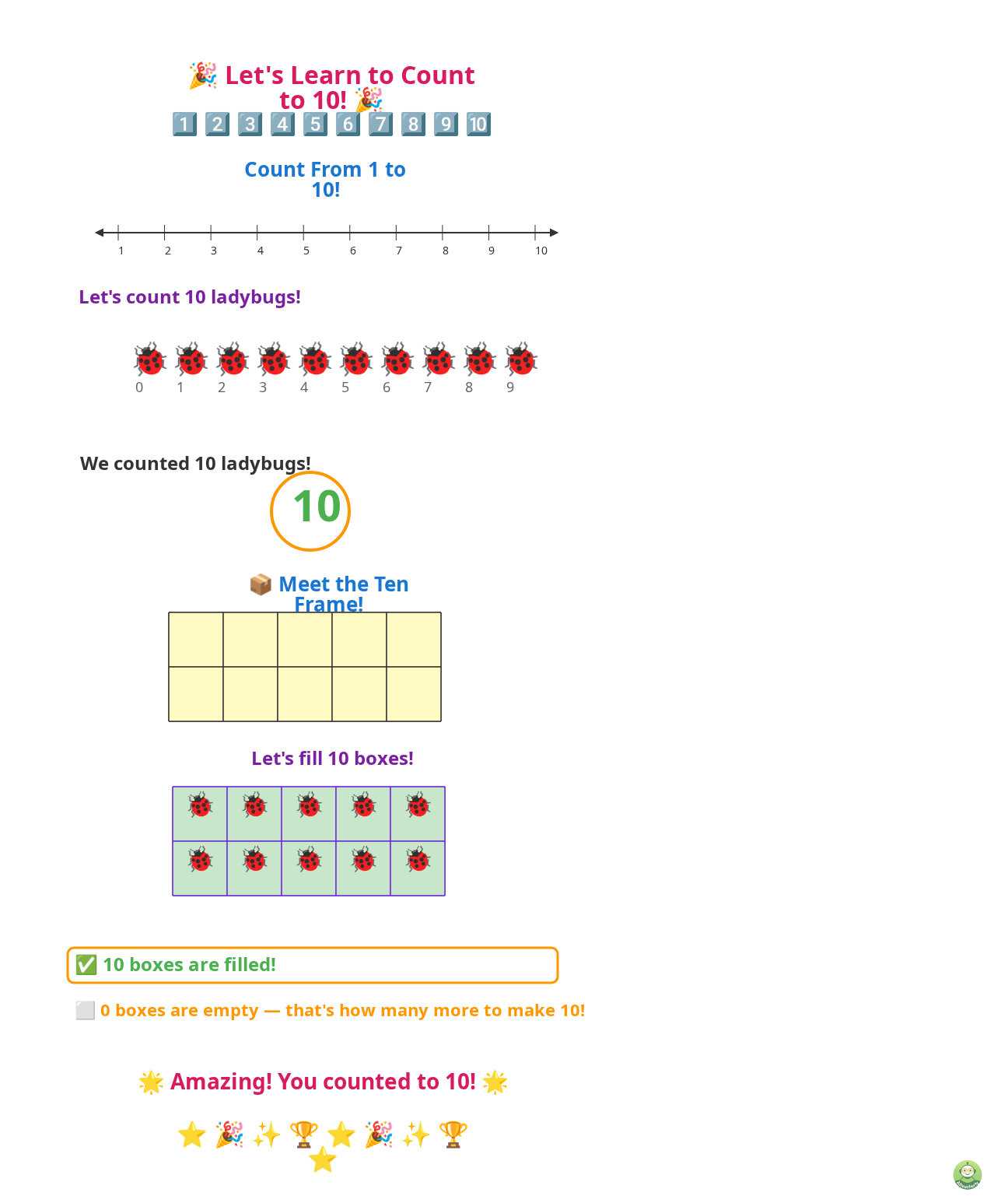
On AI Teacherly, the Learn to Count to 10 lesson uses ten frames as the core learning tool. Children don't just watch; they actively fill frames, count objects, and answer questions that build genuine number sense. The lesson adapts to your child's pace, offering encouragement and gentle correction as needed.
Here's what the full interactive lesson looks like on AI Teacherly:
What makes interactive ten frames especially effective:
- Immediate feedback: Children know right away if they've counted correctly, preventing the reinforcement of mistakes
- Visual and auditory learning: Counting is spoken aloud while objects appear, engaging multiple senses
- Progress tracking: Parents can see which numbers their child has mastered and where they need more practice
- Engagement through variety: Different problem types keep practice fresh and interesting
The lesson builds systematically, starting with familiar counting to 5, then introducing the ten frame as a visual tool, and finally extending to quantities up to 10. This scaffolded approach ensures children feel successful at each step.
Research consistently shows that children learn math best through multiple representations: seeing numbers as quantities of objects, as filled boxes in a frame, and as written numerals. Interactive lessons naturally provide this variety, building deeper understanding than any single approach alone.
Common Counting Challenges and How to Support Your Child
Even with great tools like ten frames, many kindergarteners hit bumps along the counting road. Here's how to recognize and address the most common challenges:
"My child skips numbers or repeats them." This is totally normal! It usually means they're still developing one-to-one correspondence. Slow down the counting process. Have them physically touch each object as they say the number, then move their hand away before saying the next number. Ten frames help because each box can only hold one counter.
"They can count to 10 but don't know 'how many' when I ask." This shows they haven't yet grasped cardinality, the idea that the last number counted represents the total quantity. After counting objects together, emphasize the final number: "1, 2, 3, 4, 5, 6. Six! There are 6 blocks. Can you show me 6 fingers?" Repetition of that final number builds the connection.
"My child seems stuck at 5." Many children plateau at 5 because quantities beyond 5 become harder to visualize instantly. This is exactly where ten frames shine! The top row provides a stable "5" anchor, making 6, 7, 8, and 9 feel like "5 plus a few more" rather than entirely new quantities.
"They lose interest quickly." Short attention spans are developmentally appropriate for kindergarteners. Keep practice sessions to 5 to 10 minutes maximum. Incorporate movement (jump while counting!), use preferred toys as counters, and celebrate small wins enthusiastically. Interactive digital lessons can help maintain engagement through variety and instant feedback.
"Is my child behind?" Most children count to 10 consistently by the end of kindergarten, not the beginning. If your child is still working on numbers 1 to 5, that's perfectly normal early in the year. Focus on building solid understanding rather than rushing to higher numbers.
Key Takeaways
- Ten frames are simple two-row grids that help kindergarteners visualize numbers 1 to 10 and build genuine number sense
- Counting to 10 is more than reciting numbers; it requires one-to-one correspondence and cardinality understanding
- You can practice at home with DIY ten frames using paper and everyday objects like buttons, snacks, or small toys
- Ask "How many more to make 10?" to build early addition skills naturally through ten frame practice
- Interactive digital tools provide immediate feedback and keep practice engaging for young learners
- Keep practice sessions short (5 to 10 minutes), playful, and pressure-free; enthusiasm matters more than perfection
- Most children master counting to 10 by the end of kindergarten, so avoid comparing or rushing your child
Frequently Asked Questions
What is a ten frame and why is it used in kindergarten math?
A ten frame is a rectangular grid with two rows of five boxes (10 total). Teachers use it to help children visualize numbers, understand quantity relationships, and build foundations for addition. It makes abstract numbers concrete and countable.
At what age should my child be able to count to 10?
Most children can count to 10 reliably by age 5 to 6. Kindergarteners typically master this skill by year's end. Some children count earlier while others need more time, and both are developmentally normal.
How do I teach my kindergartener to count to 10 at home?
Use a ten frame with everyday objects as counters. Have your child fill boxes one at a time while saying each number. Practice during play, snack time, or cleanup. Keep sessions short, fun, and pressure-free.
Why does my child skip numbers when counting?
Skipping numbers is common in early counting and usually indicates developing one-to-one correspondence skills. Have your child touch each object as they count and pause before moving to the next. Ten frames help by providing one box per counter.
Are ten frames better than counting on fingers?
Both are valuable! Fingers are always available and build body-based number sense. Ten frames show relationships to 5 and 10 more clearly and prepare children for addition. Using both together strengthens understanding.
What are the best counting games for kindergarteners?
Ten frame fill-up games, counting during snack time, number scavenger hunts, and interactive digital lessons work well. The best games are short, hands-on, and feel like play rather than work.
How do I know if my kindergartener has mastered counting to 10?
They can count 10 objects accurately (touching each once), tell you the total without recounting, and show you a specific number when asked. They understand that "7" means seven things, not just a word in a sequence.
Ready to make counting fun for your kindergartener? Try the free interactive Learn to Count to 10 lesson on AI Teacherly and watch your child's number sense bloom!