Division Remainders Made Easy: 3 Strategies Every 4th Grader Needs to Master
Does your child get the division right but the word problem wrong? Learn the 3 simple strategies for interpreting remainders that transform confusion into confidence.
When Getting the Math Right Still Gets the Answer Wrong
Here's a frustrating scenario many parents know too well: your child correctly divides 47 by 8 and gets 5 remainder 7. They write "5 R7" on their paper, feeling confident. But when the teacher marks it wrong, everyone is confused.
The problem? Division remainders in 4th grade word problems require more than calculation skills. They demand critical thinking about what the remainder actually means in real life.
Consider these two problems that use the exact same division:
- Problem A: "47 students need buses. Each bus holds 8 students. How many buses are needed?"
- Problem B: "47 photos are placed in an album. Each page holds 8 photos. How many FULL pages are there?"
Both problems involve 47 ÷ 8 = 5 R7. But Problem A's answer is 6 buses (you can't leave 7 students behind!), while Problem B's answer is 5 pages (those 7 extra photos don't fill another page).
This is why interpreting remainders is one of the trickiest concepts in 4th grade math. The good news? There's a simple three-strategy framework that makes these problems click. Let's break it down.
What Does It Mean to Interpret a Remainder?
When we divide in real life, there are often leftovers. But here's the tricky part: what do we do with them?
Interpreting a remainder means deciding what the leftover quantity represents in the context of the word problem. Unlike pure calculation where there's one right answer, remainder interpretation requires students to:
- Understand the real-world scenario described in the problem
- Think logically about what makes sense
- Choose the appropriate response based on context
This is why division remainders 4th grade word problems are so challenging. Students who excel at computation may struggle because the skill being tested isn't just math. It's reading comprehension combined with real-world reasoning.
The Common Core standard 4.OA.A.3 specifically requires students to "interpret remainders" in word problems. This means your child's teacher isn't just testing if they can divide; they're testing whether your child can apply mathematical thinking to realistic situations.
The secret is in the question! Teaching kids to re-read the problem and think about what makes sense in real life is the key to mastering these problems.
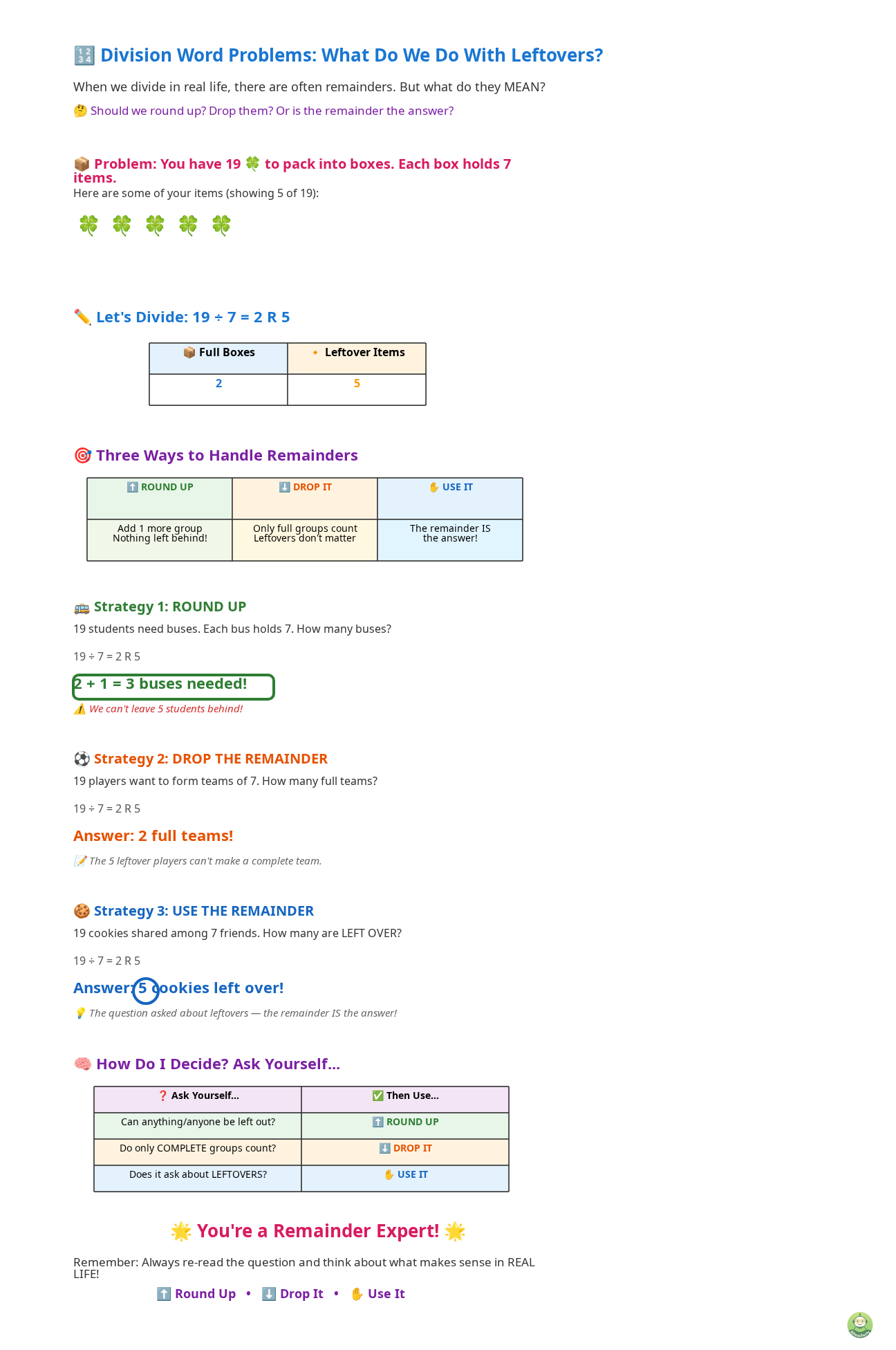
The 3 Strategies: Round Up, Drop It, or Use It
Every division remainder problem falls into one of three categories. Once your child learns to recognize which category applies, the confusion disappears.
Strategy 1: Round Up (Add One More)
When to use it: When everyone or everything needs to be included, and nothing can be left out.
Example: "32 students are going on a field trip. Each van holds 7 students. How many vans are needed?"
32 ÷ 7 = 4 R4
We can't leave 4 students behind! So we need 5 vans. The remainder tells us we need one more group.
Key phrases to watch for: "How many ___ are needed?" "Everyone must..." "Nothing can be left behind."
Strategy 2: Drop It (Ignore the Remainder)
When to use it: When only complete groups count, and partial groups don't qualify.
Example: "You have 25 apples. Gift baskets need exactly 6 apples each. How many COMPLETE gift baskets can you make?"
25 ÷ 6 = 4 R1
That extra apple can't make a complete basket. The answer is 4 baskets.
Key phrases to watch for: "How many COMPLETE/FULL...?" "Exactly ___ needed." "Only full groups count."
Strategy 3: Use It (The Remainder IS the Answer)
When to use it: When the question specifically asks about the leftover amount.
Example: "23 students sit at tables that hold 4 students each. How many students are at the last, incomplete table?"
23 ÷ 4 = 5 R3
The remainder IS what we're looking for. The answer is 3 students.
Key phrases to watch for: "How many are left over?" "How many extra?" "At the incomplete...?"
How to Know Which Strategy to Use (With Examples)
The decision-making process comes down to asking three key questions:
| Question | If YES, then... |
|---|---|
| Can anything be left out or behind? | If NO → Round Up |
| Do only complete groups count? | If YES → Drop It |
| Does the question ask about the leftovers? | If YES → Use It |
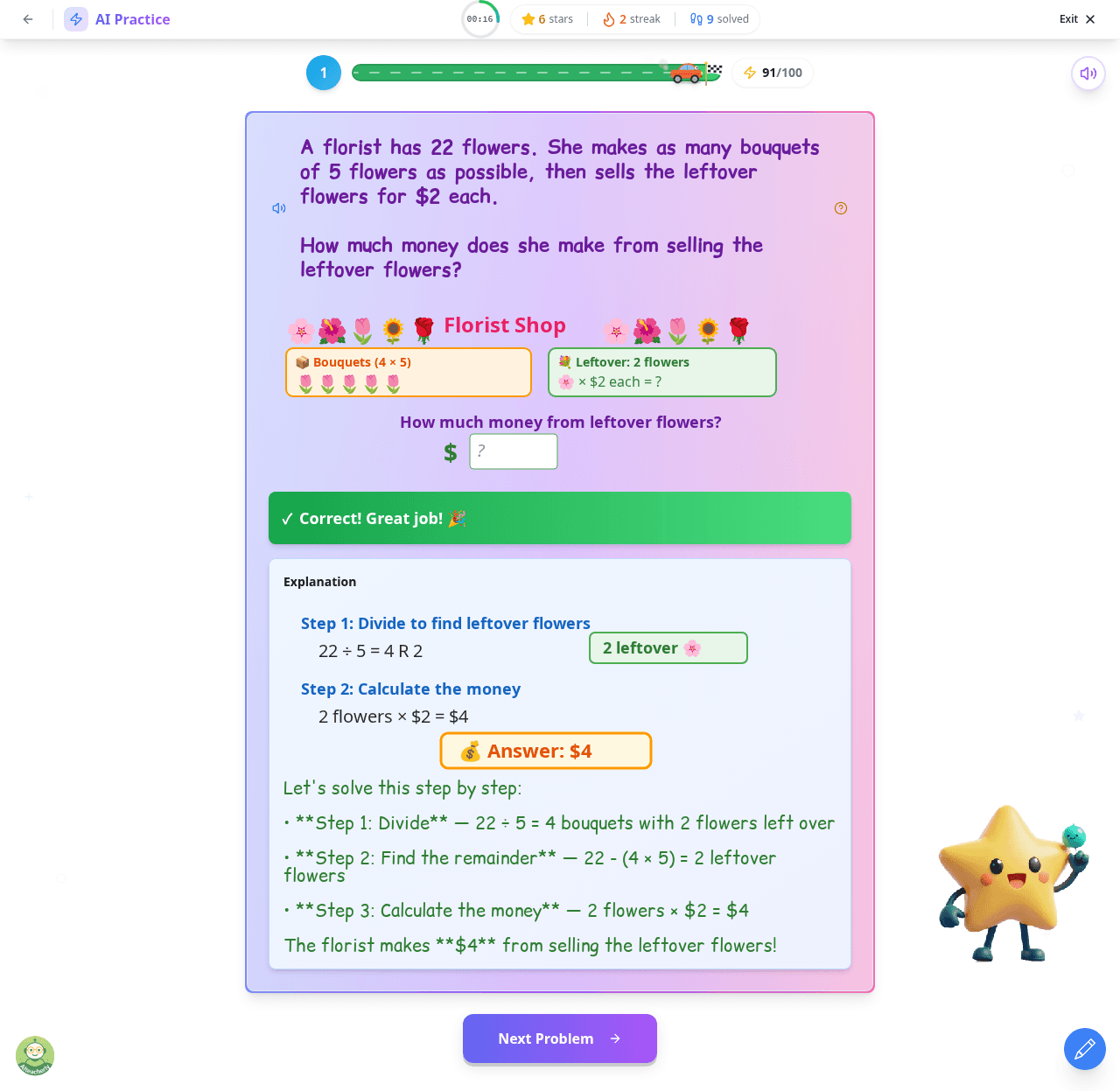
Let's practice with a real problem from AI Teacherly's interactive lesson on interpreting remainders:
The interactive problem below shows exactly how this decision-making works in practice.
Sample Problem: A school needs to transport 52 students on a field trip. Each bus holds 8 students. How many buses does the school need?
Step 1: Perform the division: 52 ÷ 8 = 6 R4
Step 2: Ask the key questions:
- Can any students be left behind? NO (we can't leave 4 kids at school!)
- Therefore: Round Up
Step 3: The answer is 7 buses.
Notice how the calculation (6 R4) is just the first step. The real thinking happens when we interpret what that remainder means. In this case, those 4 remaining students absolutely need transportation, so we must round up to the next whole number.
This is why interactive practice with varied scenarios is so valuable. Each problem reinforces the decision-making framework until it becomes second nature.
See How AI Teacherly Makes Remainder Problems Click
What makes division remainder problems especially challenging is that students need to encounter many different scenarios before the three-strategy framework becomes intuitive. This is where interactive learning shines.
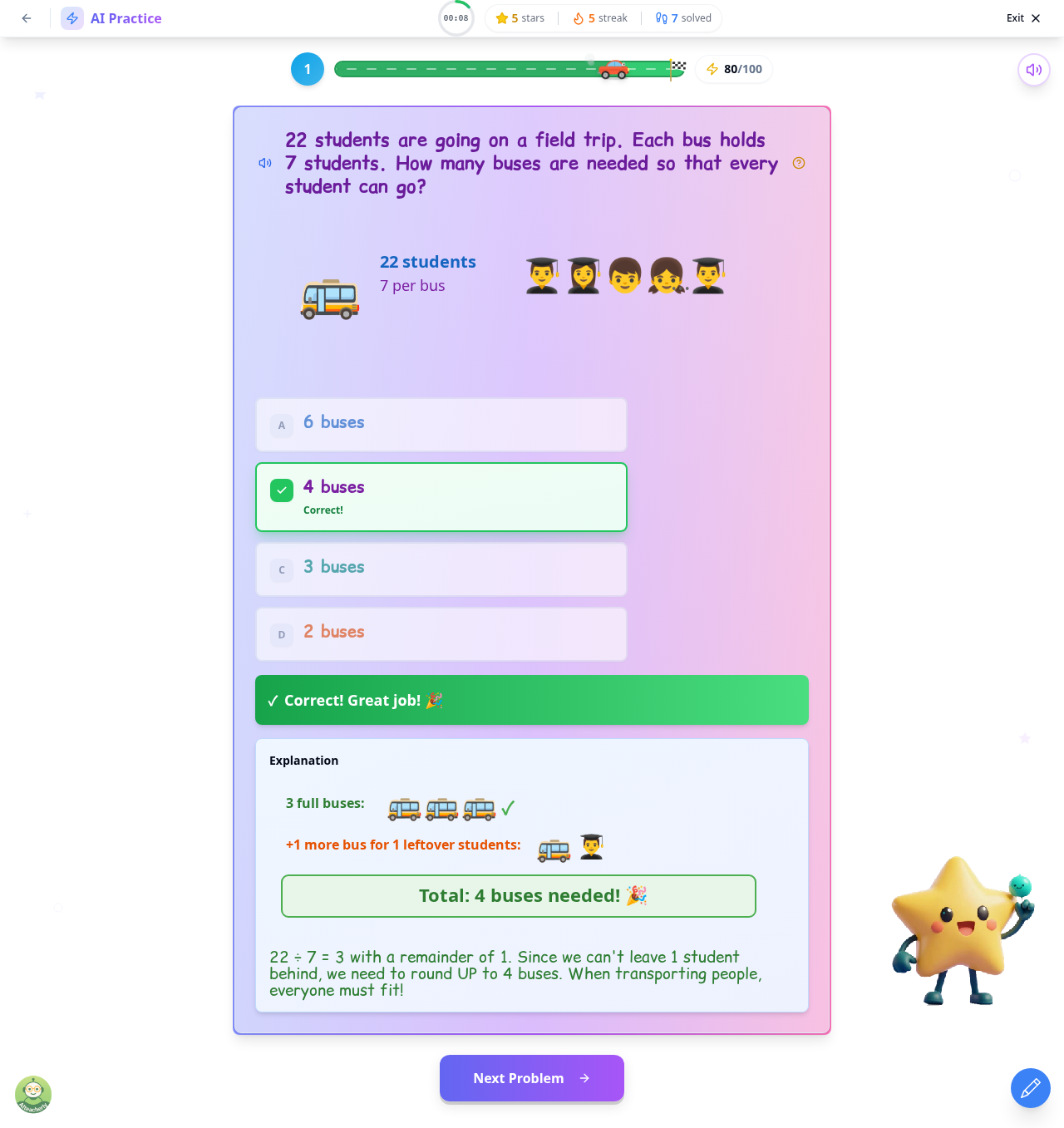
Here's what the full interactive lesson looks like on AI Teacherly:
The "Division Word Problems: Interpreting Remainders" lesson on AI Teacherly (Grade 4 Mathematics) uses a guided discovery approach that helps students build understanding step by step:
Visual Scenarios: Each problem presents a relatable real-world situation, like planning field trips, organizing teams, or sharing snacks. Students see the context before they calculate, which primes them to think about meaning.
Immediate Feedback: When a student selects an answer, they immediately learn whether their interpretation was correct. More importantly, they see why the answer makes sense in that scenario.
Progressive Challenge: The lesson starts with clear-cut examples of each strategy, then gradually introduces problems that require more careful reading and analysis.
The "Aha!" Moment: Many students experience a breakthrough when they realize that the same division problem can have different correct answers depending on context. This is the foundation of mathematical reasoning.
The lesson takes approximately 30 minutes and includes word problems covering all three remainder strategies. By the end, students have a mental checklist they can apply to any division word problem they encounter.
Practice Tips: Everyday Scenarios to Try at Home
Reinforce the three strategies with real-life situations your child encounters every day. Here are some conversation starters:
Round Up Practice
- "We have 17 cookies and want to put them in bags of 4 for the bake sale. How many bags do we need so no cookies are left out?"
- "Your birthday party has 11 kids and each car holds 4. How many cars do we need for everyone?"
- "We're planting 26 flowers and each pot holds 6. How many pots do we need?"
Drop It Practice
- "You have $23. Books cost $5 each. How many COMPLETE books can you buy?"
- "We have 15 eggs. Each recipe needs 4 eggs. How many FULL recipes can we make?"
- "You walked 19 laps. A mile is 4 laps. How many COMPLETE miles did you walk?"
Use It Practice
- "There are 14 people at dinner. Tables seat 4. How many people are at the table that isn't full?"
- "You have 25 stickers to share equally among 6 friends. How many stickers are left for you?"
- "We drove 100 miles and stopped every 30 miles. How far until the next stop?"
Pro Tip: After your child solves a problem, ask them to explain why they chose their interpretation strategy. This verbalization reinforces the decision-making process and builds confidence.
Also, try "What if?" variations: "What if the question asked how many FULL bags we could make?" This helps children see how the same numbers lead to different answers based on context.
Key Takeaways
- Division remainders require interpretation, not just calculation. The same math can yield different correct answers depending on context.
- Use the three-strategy framework: Round Up when nothing can be left behind, Drop It when only complete groups count, Use It when the question asks about leftovers.
- Key phrases signal which strategy to use: 'How many needed?' (round up), 'How many COMPLETE?' (drop it), 'How many left over?' (use it).
- Practice with real-world scenarios at home: sharing snacks, planning car rides, and organizing items builds intuition for remainder interpretation.
- Re-reading the question is essential. Teach your child to ask 'What makes sense in real life?' after every division word problem.
- Interactive lessons like those on AI Teacherly provide varied practice scenarios that make the three strategies become second nature.
Frequently Asked Questions
How do you interpret remainders in division word problems?
Interpreting remainders means deciding what to do with the leftover amount based on the problem's context. You either round up (add one more group), drop it (ignore the remainder), or use it (the remainder is your answer).
When should my child round up the remainder instead of dropping it?
Round up when nothing can be left out or behind. If a problem asks 'How many buses are needed for 25 students if each bus holds 8?', you round up to 4 buses because you can't leave 1 student without transportation.
Why does my child get division right but word problems wrong?
Division word problems test two skills: calculation AND interpretation. Your child may calculate correctly but not understand what the remainder means in context. Teaching the three-strategy framework (round up, drop, use) bridges this gap.
What grade do kids learn to interpret remainders?
Interpreting remainders is typically introduced in 3rd grade and becomes a key focus in 4th grade. Common Core standard 4.OA.A.3 specifically requires students to solve word problems and interpret remainders appropriately.
How can I practice remainder word problems at home with my child?
Use everyday scenarios: 'How many bags do we need for 17 cookies if each bag holds 4?' (round up), 'How many complete $5 toys can you buy with $23?' (drop it), 'How many leftover stickers after sharing 25 among 6 friends?' (use it).
What are common mistakes kids make with division remainder problems?
The biggest mistake is treating all problems the same, like always writing 'R' answers or always rounding up. Kids also often skip re-reading the question to understand context, missing key phrases like 'complete' or 'left over' that signal the correct strategy.
Is it normal for 4th graders to struggle with remainder word problems?
Absolutely normal. These problems combine calculation with reading comprehension and real-world reasoning. Many students find this challenging because it requires thinking beyond the numbers. Consistent practice with varied scenarios builds confidence.
How do I know if the remainder is the answer to the problem?
The remainder is the answer when the question specifically asks about leftovers. Look for phrases like 'How many are left?', 'How many extra?', or 'at the incomplete table'. If the question focuses on what remains, use the remainder directly.
Ready to make division word problems click for your child? Try the interactive 'Division Word Problems: Interpreting Remainders' lesson free on AI Teacherly and watch the three-strategy framework come to life!