Division Word Problems with Remainders: 3 Strategies Every 4th Grader Needs to Master
Master the 3 simple strategies that help 4th graders know exactly what to do with remainders in division word problems: round up, drop it, or use it.
When Getting the Math Right Still Gets the Answer Wrong
Picture this: your 4th grader works through a division problem carefully, arrives at "47 ÷ 5 = 9 remainder 2," and confidently writes down their answer. But when the homework comes back, it's marked wrong. The frustration is real, and you're left wondering what went wrong.
Here's the surprising truth: your child did the math perfectly. The problem wasn't the calculation; it was knowing what to do with that remainder.
Division word problems with remainders represent a major turning point in 4th grade mathematics. For the first time, students encounter math problems where the "right" answer depends on the situation, not just the numbers. It's their first taste of mathematical reasoning that requires judgment, not just computation.
In this guide, you'll discover the three simple strategies that transform remainder confusion into confident problem-solving. Whether you're helping with homework or preparing for tests, these methods give your child (and you!) a clear framework for tackling any division word problem.
What Does It Mean to Interpret a Remainder in Division?
Before we cover strategies, let's clarify what interpreting a remainder actually means. When we divide in real life, there are often leftovers. But here's the tricky part: what we do with those leftovers depends entirely on the situation.
Consider 23 students going on a field trip in vans that hold 6 students each. The math is simple: 23 ÷ 6 = 3 remainder 5. But what's the answer to "How many vans do we need?"
- If we say "3 vans" (ignoring the remainder), 5 students get left behind.
- If we say "3 remainder 5 vans," that's not a real-world answer.
- The correct answer is 4 vans because we must round up to include everyone.
This is what makes remainder problems challenging for kids. The same division calculation can lead to different correct answers depending on what the question is actually asking. The skill isn't doing the division; it's reading the context and making a logical decision about the leftover.
Once your child understands that remainders are decision points rather than just extra numbers to write down, everything clicks into place.
The 3 Strategies: Round Up, Drop It, or Use It
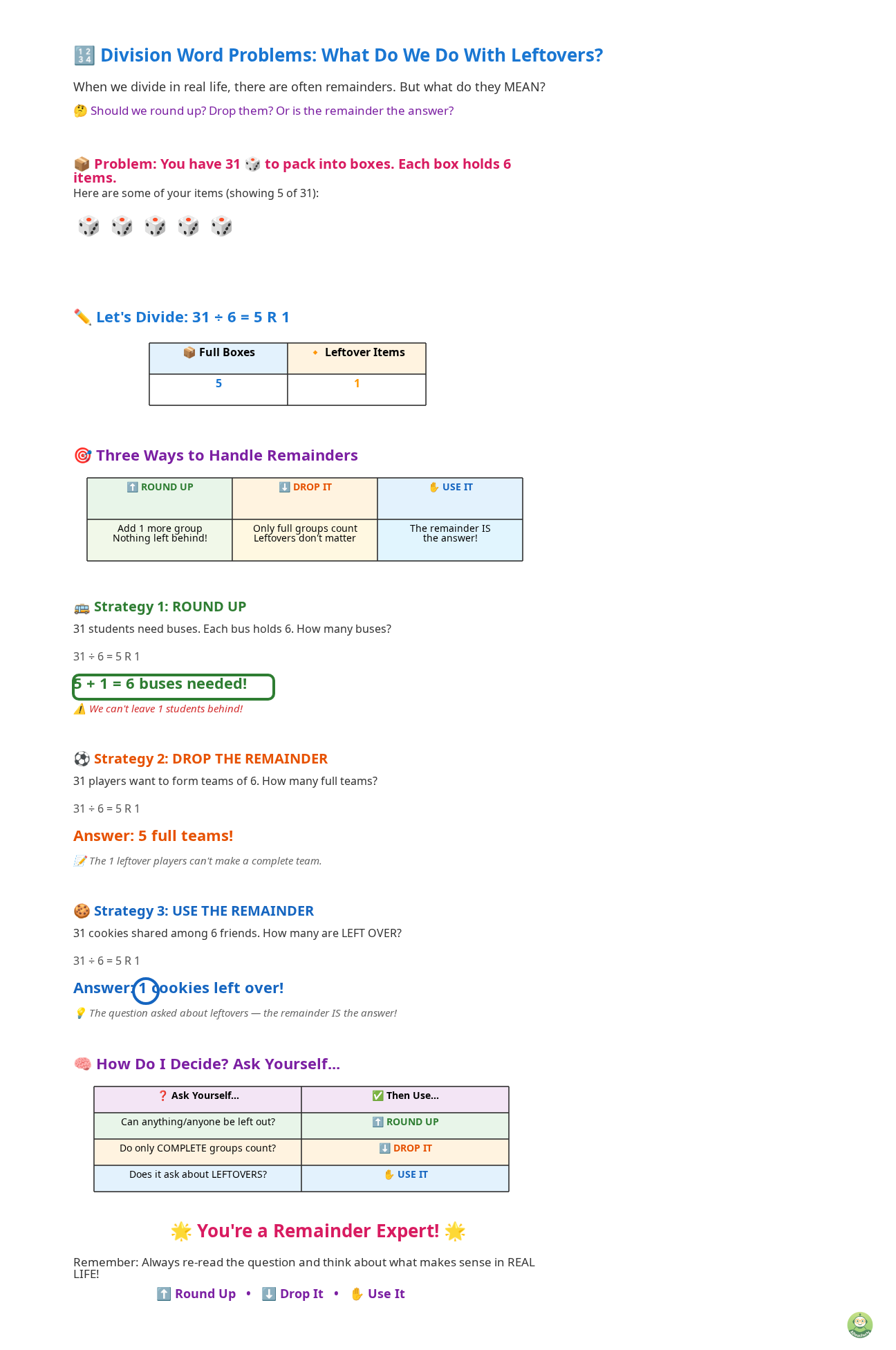
Every division word problem with a remainder falls into one of three categories. Teaching your child to identify which category applies is the key to success. Think of it as a decision-making framework:
Strategy 1: Round Up the Quotient Use this when everyone or everything needs to be included, and nothing can be left behind. The classic example is the bus problem: if 47 students need buses that hold 8 each, you need 6 buses (not 5 with remainder 7). Those 7 remaining students still need a seat!
Strategy 2: Drop the Remainder Use this when only complete groups count and partial groups don't work. If you're making teams of 5 from 23 players, you can only make 4 complete teams. The remaining 3 players can't form a team, so we drop the remainder.
Strategy 3: Use the Remainder as the Answer Sometimes the leftover IS what the question asks about. If 23 cookies are shared equally among 5 friends, each friend gets 4 cookies. But if the question asks "How many cookies are left over?" the answer is 3, the remainder itself.
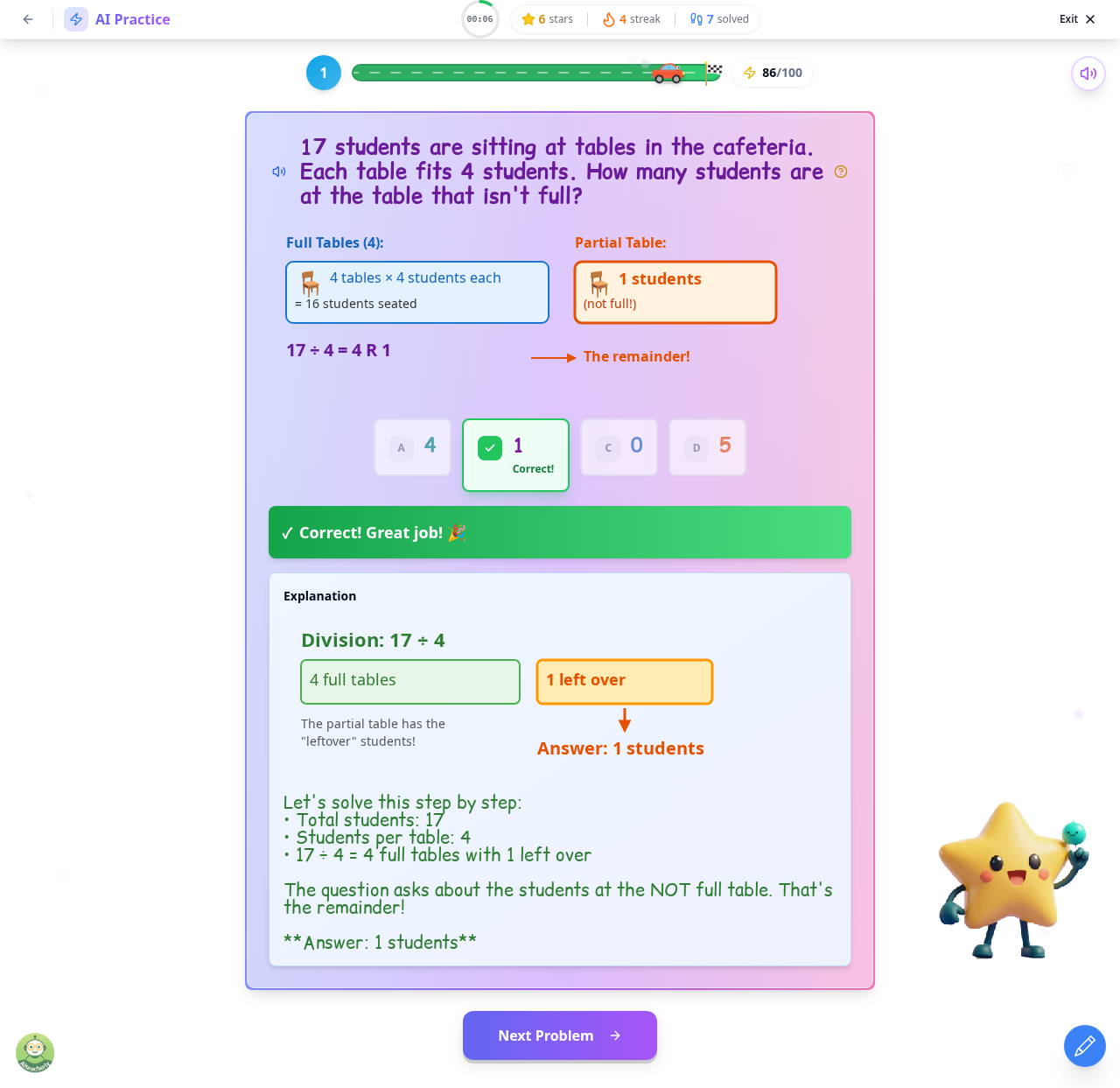
The interactive problem below demonstrates the "use the remainder" strategy with a relatable school scenario:
The secret is always in the question! Train your child to re-read the final question carefully before deciding which strategy applies.
How Do You Know Which Remainder Strategy to Use?
The biggest challenge for 4th graders isn't doing the division; it's choosing the right strategy. Here's a simple decision guide you can practice with your child:
Ask these questions about the word problem:
"Can anything be left out or left behind?"
- If NO (everyone needs a spot, everything must be included) → Round Up
- Example clues: buses, containers for shipping, rooms for people
"Do only complete groups matter?"
- If YES (incomplete groups don't count) → Drop the Remainder
- Example clues: teams, full packages, complete sets
"Is the question asking specifically about leftovers?"
- If YES → Use the Remainder as Your Answer
- Example clues: "how many are left," "how many extra," "how many remain"
Context clues that signal each strategy:
| Round Up | Drop It | Use It |
|---|---|---|
| "How many needed?" | "How many complete?" | "How many left over?" |
| "At least" | "Full groups only" | "Remaining" |
| Nothing left behind | Partial doesn't count | Leftovers matter |
Practice identifying these context clues together. After a few problems, your child will start recognizing patterns and gaining confidence in their decisions.
See How Interactive Division Practice Works
One of the most effective ways to master remainder interpretation is through interactive practice with immediate feedback. Unlike worksheets where kids wait until the next day to find out if they understood correctly, interactive lessons provide instant guidance.
On AI Teacherly, the Division Word Problems: Interpreting Remainders lesson takes 4th graders through carefully sequenced problems that build this critical skill. Here's what makes it effective:
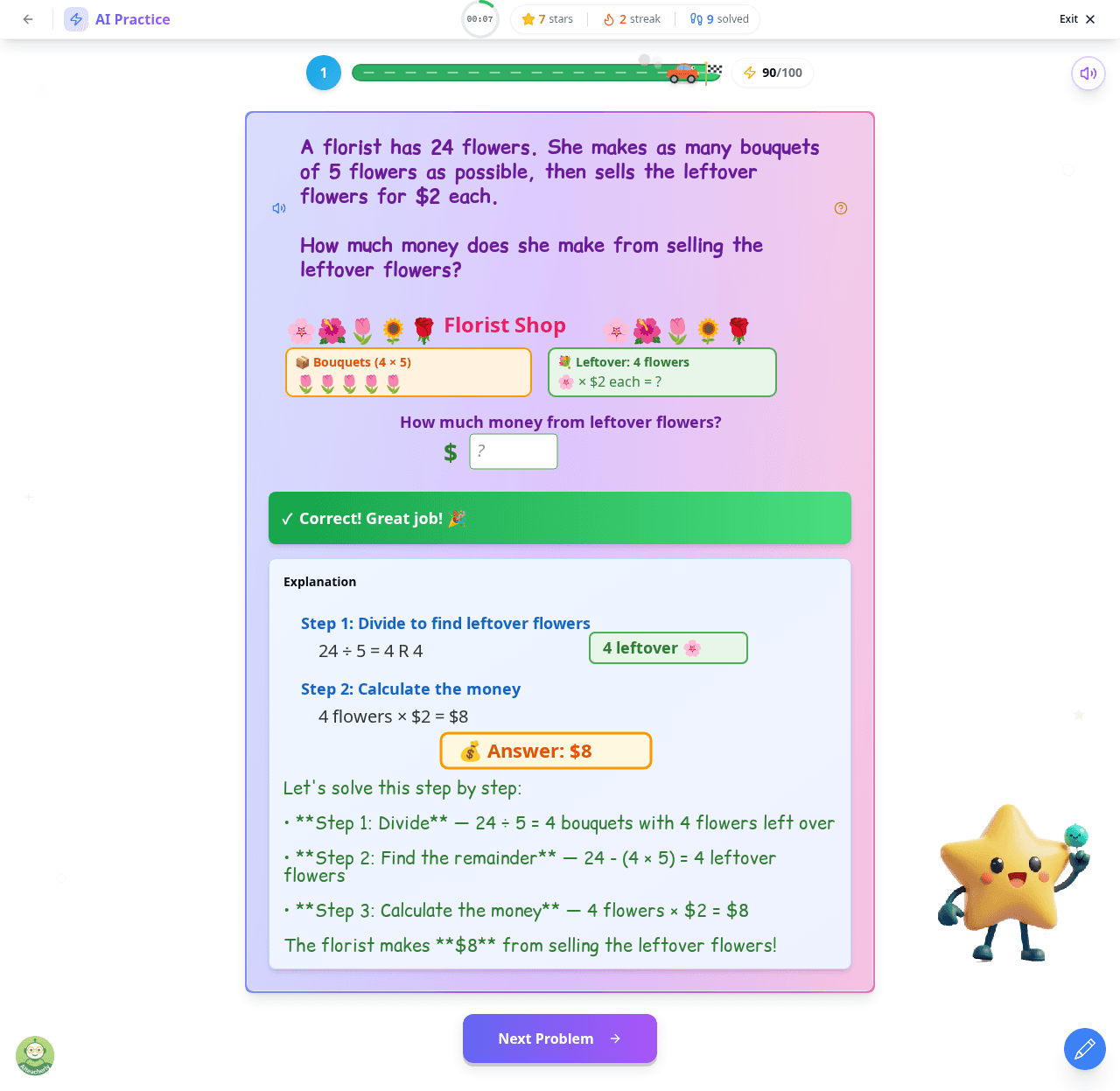
Visual Problem Representation: Each problem includes visual elements like emoji-based items, tables, and diagrams that help students see the division happening. When students can visualize 23 cookies being put into groups of 5, they understand why there are leftovers.
Real-World Scenarios: The lesson uses relatable situations like packing gift bags, arranging cafeteria tables, filling buses, and baking cookies. These aren't abstract math problems; they're situations kids encounter in daily life.
Guided Decision-Making: Rather than just marking answers right or wrong, the lesson guides students through the reasoning process. Why does this problem require rounding up? What context clues told us to drop the remainder?
Here's what the full interactive lesson looks like on AI Teacherly:
Personalized Practice: Dynamic elements like student names and varying scenarios keep practice fresh and engaging, so kids stay motivated through multiple problems.
Common Mistakes Kids Make with Remainder Word Problems
Understanding where 4th graders typically struggle helps you provide targeted support. Watch for these common pitfalls:
Mistake 1: Always Writing the Remainder in the Answer Many kids learn that division answers should include "R" followed by a number. So they write "9 R2" for every problem, even when the question asks for a whole number answer. Remind them that real-world answers rarely include "remainder" in them. We don't order "4 R2 pizzas."
Mistake 2: Always Rounding Up (or Always Dropping) Once kids learn one strategy, they sometimes apply it universally. If your child always rounds up, practice problems where dropping the remainder is correct. Variety is essential for developing true understanding.
Mistake 3: Not Re-Reading the Question Kids often calculate correctly but answer a different question than what was asked. A problem might ask "How many students won't have a seat?" but the child answers "How many buses are needed." Train them to circle or underline exactly what the question asks.
Mistake 4: Ignoring "Makes Sense" Checks After solving, kids should ask: "Does my answer make sense in real life?" If the answer to "How many full teams?" is a decimal or includes a remainder, something went wrong.
Practice tip: After your child solves a problem, ask them to explain WHY they chose their strategy. This verbalization strengthens their reasoning skills.
Key Takeaways
- Remainders aren't mistakes; they're decision points that require understanding the real-world context
- The three strategies are: Round Up (when nothing can be left out), Drop It (when only complete groups count), and Use It (when the leftover is what's being asked about)
- Context clues in the word problem tell your child which strategy to use; train them to identify key phrases
- Always re-read the final question before deciding what to do with the remainder
- Interactive practice with immediate feedback accelerates mastery more than worksheets alone
- Have your child explain their reasoning out loud to strengthen their decision-making skills
- This skill builds critical thinking that extends far beyond math class
Frequently Asked Questions
What does it mean to interpret a remainder in division?
Interpreting a remainder means deciding what to do with the leftover amount based on the problem's context. The same division can require rounding up, dropping the remainder, or using the remainder as your answer.
When should my child round up the remainder in a word problem?
Round up when everyone or everything must be included and nothing can be left behind. Classic examples include buses for students, containers for shipping items, or rooms for overnight guests.
When should the remainder be dropped or ignored?
Drop the remainder when only complete groups count. Examples include forming sports teams (partial teams can't play), filling complete packages for sale, or making full sets of items.
When is the remainder itself the answer to a word problem?
Use the remainder as your answer when the question specifically asks about leftovers, such as 'How many are left over?' or 'How many extra?' or 'How many won't fit?'
Why are division word problems with remainders so hard for kids?
These problems require judgment beyond pure calculation. For the first time, the 'right' answer depends on context, not just math. Kids must read carefully and think logically about real-world situations.
How can I help my 4th grader with division remainders at home?
Practice the 3-strategy framework (round up, drop it, use it) with real scenarios. Have your child identify context clues, re-read questions carefully, and explain their reasoning out loud.
What grade do kids learn to interpret remainders?
Interpreting remainders is typically introduced in 4th grade as part of division standards. It builds on basic division facts learned in 3rd grade and prepares students for more complex problem-solving.
Are there online resources for practicing division remainder problems?
Yes! AI Teacherly offers an interactive Division Word Problems lesson specifically for interpreting remainders. It includes visual problems, real-world scenarios, and immediate feedback to build mastery.
Ready to turn remainder confusion into confident problem-solving? Try the interactive Division Word Problems: Interpreting Remainders lesson free on AI Teacherly and watch your 4th grader master this critical skill!