Equal Groups and Arrays: The Visual Secret to 3rd Grade Multiplication Success
Discover how equal groups and arrays transform multiplication from confusing to crystal clear for 3rd graders. Visual strategies and at-home activities that actually work.
Why Multiplication Feels Hard (And How Visuals Change Everything)
That moment when your 3rd grader stares blankly at a multiplication worksheet can feel discouraging. But here's what most parents don't realize: that blank stare doesn't mean your child is bad at math. It usually means they need to see what multiplication actually means before they can work with it.
Multiplication is one of the most important mathematical concepts your child will learn. It forms the foundation for fractions, division, algebra, and countless real-world applications. Yet traditional teaching often jumps straight to memorizing times tables without building the conceptual understanding that makes those facts stick.
The solution? Equal groups and arrays. These two visual models transform multiplication from an abstract set of rules into something concrete that children can see, touch, and understand. When kids grasp these concepts, multiplication stops being a mystery and becomes logical.
In this guide, you'll discover exactly how equal groups and arrays work, why they're so effective for 3rd graders, and simple ways to practice these concepts at home. No math degree required.
The best part? Once your child understands why multiplication works, memorizing facts becomes dramatically easier because they have a mental picture to fall back on.
What Are Equal Groups in Multiplication?
Equal groups are exactly what they sound like: collections of items where every group has the same number. This simple concept is the foundation of all multiplication.
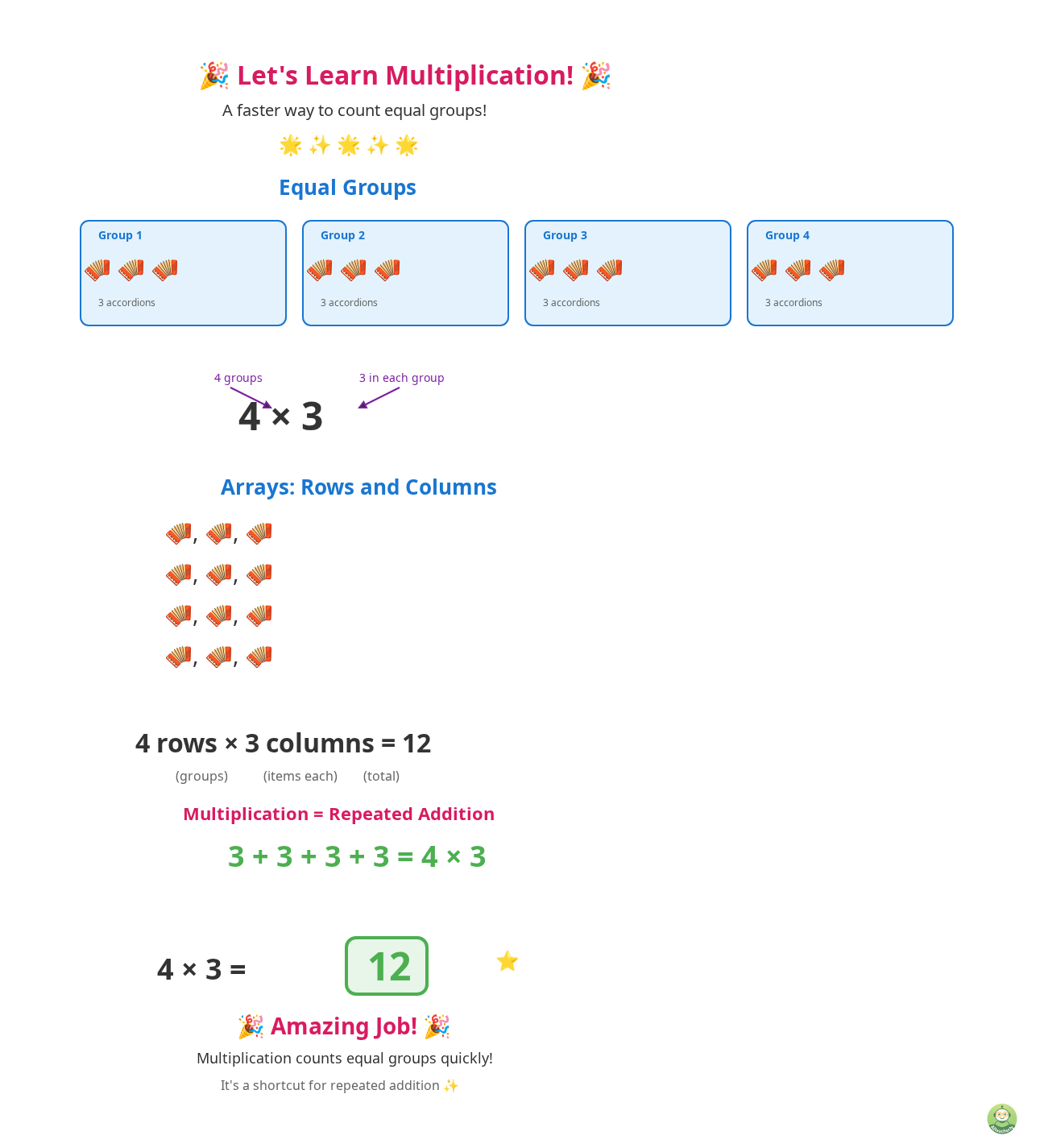
Think about it this way: if you have 4 bags of apples and each bag contains 3 apples, you have 4 equal groups of 3. Instead of counting every single apple (3 + 3 + 3 + 3 = 12), multiplication gives us a shortcut: 4 × 3 = 12.
Here's the key insight that helps children understand multiplication expressions:
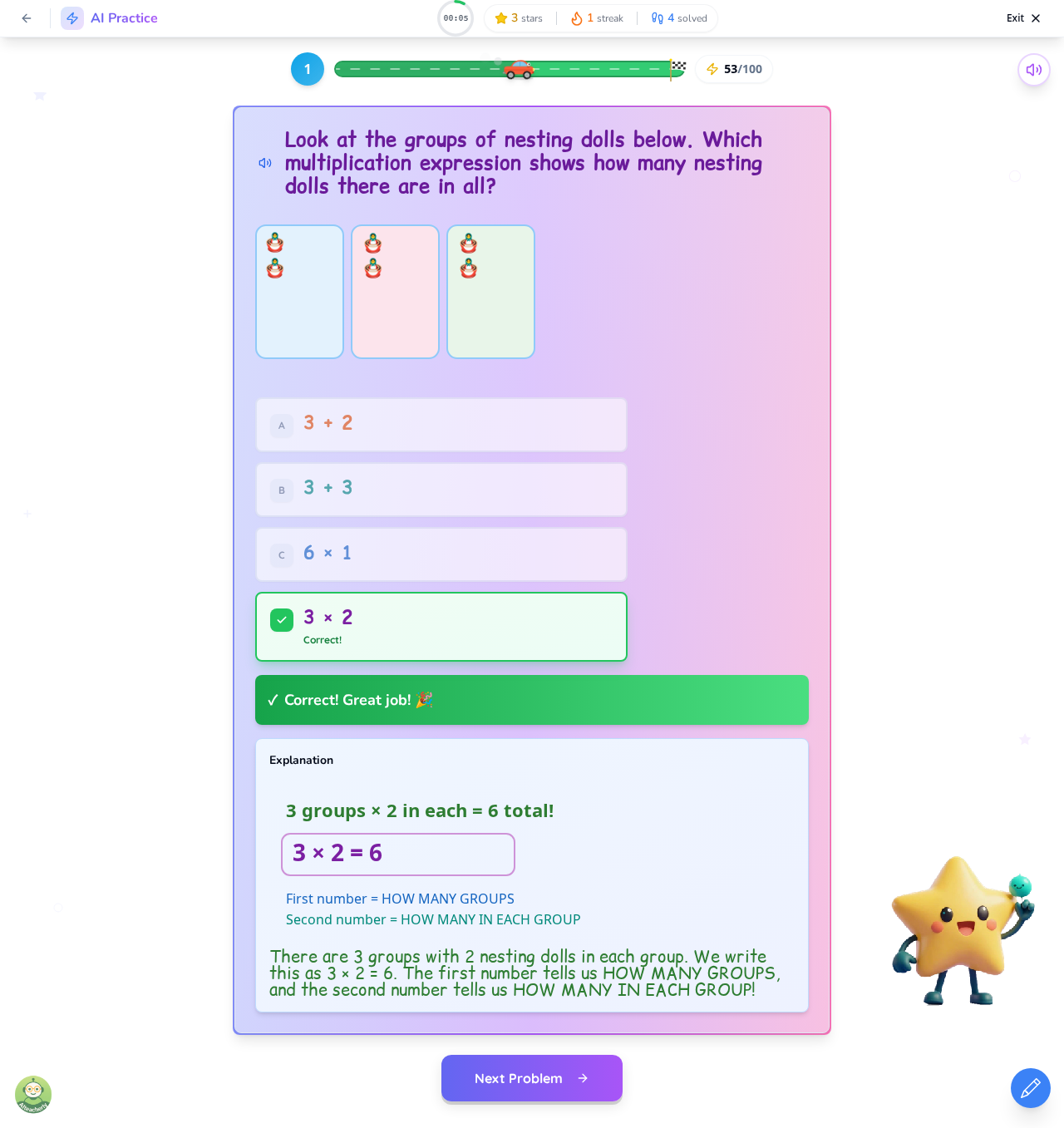
- The first number tells us how many groups we have
- The second number tells us how many items are in each group
So when your child sees 5 × 2, they should picture 5 groups with 2 items in each group.
Why does this matter? Because when children understand that multiplication is just a faster way to count equal groups, the concept clicks. They're not memorizing random number combinations; they're using a mathematical shortcut that makes sense.
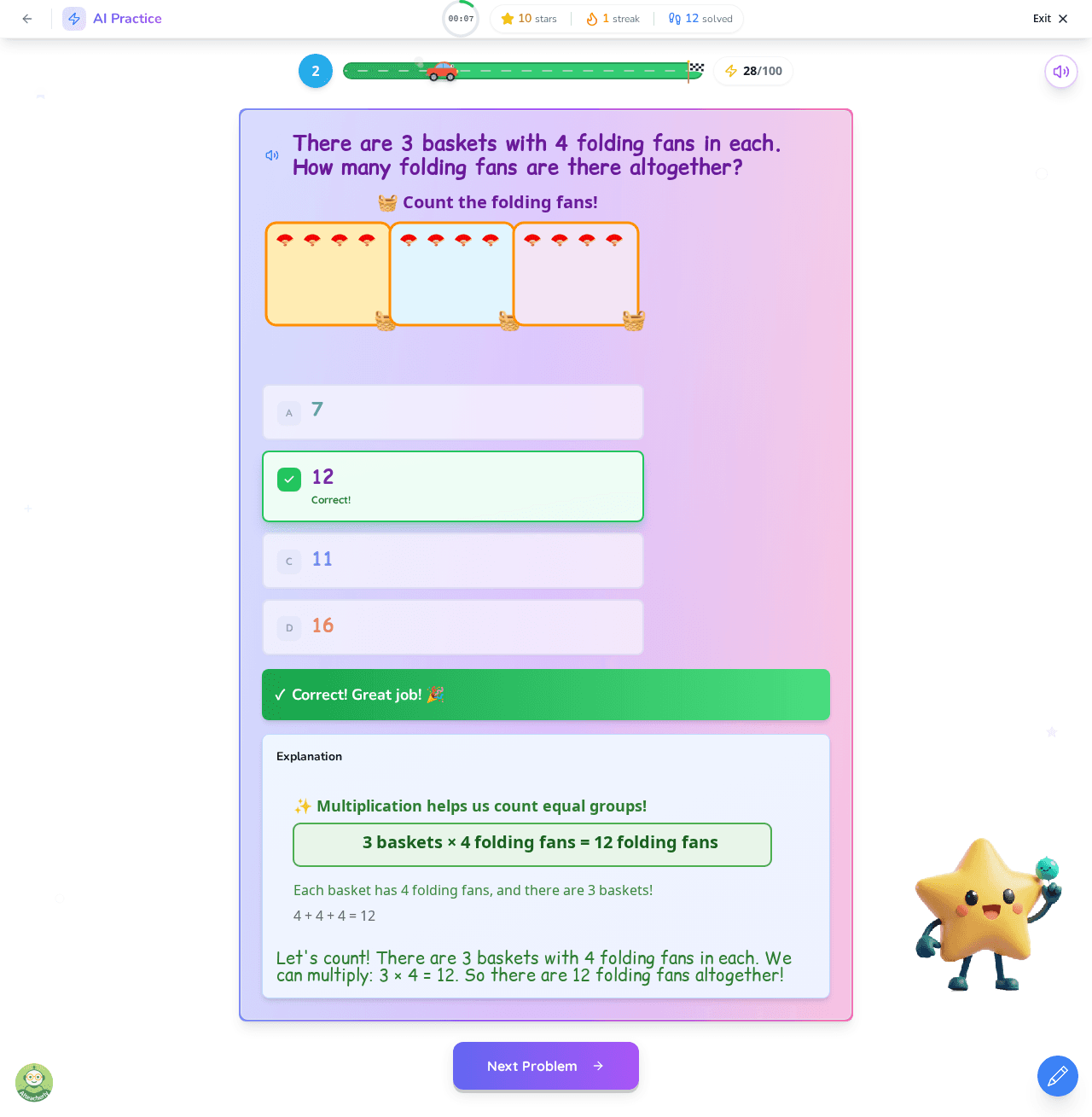
The interactive problem below shows exactly how equal groups work in practice:
Common equal groups you can point out at home:
- Egg cartons (2 rows of 6 eggs = 2 × 6)
- Packs of juice boxes (3 rows of 4 boxes = 3 × 4)
- Muffin tins (2 rows of 6 spots = 2 × 6)
- Windows with panes (various arrangements)
Once your child can identify and count equal groups in everyday objects, they've built a strong mental model for multiplication.
How Do Arrays Help Kids Understand Multiplication?
An array is simply equal groups organized into rows and columns. If equal groups are multiplication's foundation, arrays are its visual framework.
Imagine taking those 4 groups of 3 apples and arranging them neatly: 4 rows with 3 apples in each row. Now you have an array! The same multiplication fact (4 × 3 = 12) is represented in an organized visual pattern.
Here's why arrays are so powerful for learning:
1. They show the structure of multiplication Rows represent the number of groups. Columns represent items in each group. Children can literally see that 4 × 3 means "4 rows of 3."
2. They prepare kids for advanced math Arrays directly connect to area (length × width), which students will encounter later. The same visual model scales up as math gets more complex.
3. They reveal the commutative property When children see that a 4 × 3 array (4 rows of 3) contains the same number of objects as a 3 × 4 array (3 rows of 4), they discover that order doesn't change the answer in multiplication. This is a powerful realization!
How to practice arrays at home:
- Use square crackers or cheese cubes arranged on a plate
- Look at tile floors or brick walls
- Arrange toys in rows and columns
- Draw arrays on graph paper
The transition from scattered equal groups to organized arrays helps children see that the same multiplication fact can be shown in different ways. This flexibility builds deeper mathematical understanding.
The Secret Connection: Repeated Addition and Multiplication
Here's the breakthrough moment that makes multiplication click for most children: multiplication is just a shortcut for repeated addition.
When your child adds 4 + 4 + 4, they're essentially solving 3 × 4. The multiplication expression is simply a faster, more efficient way to write the same thing.
Let's look at this in action:
- 2 + 2 + 2 + 2 + 2 = 10 → This is the same as 5 × 2 = 10
- 3 + 3 + 3 + 3 = 12 → This is the same as 4 × 3 = 12
- 5 + 5 + 5 = 15 → This is the same as 3 × 5 = 15
Why teaching this connection matters:
When children understand that multiplication is a shortcut for adding the same number repeatedly, several things happen:
- Multiplication makes logical sense instead of feeling like arbitrary rules
- Fact checking becomes possible. If your child forgets 6 × 4, they can figure it out: 4 + 4 + 4 + 4 + 4 + 4 = 24
- Skip counting connects naturally. Counting by 5s (5, 10, 15, 20...) is essentially the 5 times table!
Practice tip for parents: Start with repeated addition problems, then show how multiplication writes the same thing more efficiently. Ask questions like:
- "You added 3 four times. How could we write that with multiplication?"
- "If 7 × 2 means 'seven groups of two,' how would you write that as addition?"
This bridge between addition and multiplication gives children a safety net. Even when memory fails, understanding provides a path to the answer.
Special Rules: Why 0 and 1 Work the Way They Do
Two multiplication rules often confuse children because they seem strange: anything times 0 equals 0, and anything times 1 equals itself. But with equal groups, these rules become obvious!
The Zero Rule: Anything × 0 = 0
Ask your child: "If you have 5 empty bags with 0 cookies in each bag, how many cookies do you have total?"
The answer is clearly zero! It doesn't matter how many groups you have; if there's nothing in each group, you have nothing. Visual models make this intuitive:
- 5 × 0 = 5 groups of 0 = 0
- 100 × 0 = 100 groups of 0 = 0
The One Rule: Anything × 1 = Itself
Now imagine: "You have 7 bags, and each bag has exactly 1 cookie. How many cookies total?"
Seven bags with 1 cookie each gives you 7 cookies. When every group has just one item, your total equals the number of groups:
- 7 × 1 = 7 groups of 1 = 7
- 12 × 1 = 12 groups of 1 = 12
Why this matters for learning:
When children memorize these rules without understanding, they often mix them up or forget them under pressure. But when they can visualize why the rules work, the logic sticks.
Quick practice questions:
- "If I have 20 boxes with nothing inside, what do I have?"
- "If I line up 8 toys, and each spot has 1 toy, how many toys?"
These "trick" questions become easy when children think in terms of groups!
Practice Multiplication with Equal Groups and Arrays on AI Teacherly
Understanding equal groups and arrays is one thing; practicing until the concept becomes automatic is another. That's where interactive learning makes a real difference.
The Introduction to Multiplication: Equal Groups and Arrays lesson on AI Teacherly gives 3rd graders hands-on practice with these exact concepts. Instead of staring at worksheets, children interact with colorful visual problems that reinforce the connection between groups, arrays, and multiplication expressions.
Here's what the full interactive lesson looks like on AI Teacherly:
What makes this approach effective:
Visual Learning Built In: Every problem uses images, not just numbers. Children see the groups, count them, and connect visuals to multiplication expressions.
Immediate Feedback: When children make mistakes, they learn why and can try again immediately. No waiting for a teacher to grade papers.
Progressive Difficulty: Problems start with basic equal groups and gradually introduce arrays and more complex scenarios. Children build confidence step by step.
Real-World Context: Problems feature baskets, boxes, rows of objects, and scenarios children recognize from daily life.
Engagement Without Nagging: Gamified elements keep children motivated without requiring parents to constantly encourage practice.
For parents who want their children to truly understand multiplication (not just memorize it temporarily), interactive visual practice is invaluable. Twenty minutes of engaged practice beats an hour of frustrated worksheet battles.
Try the lesson free and see the difference visual, interactive learning makes for your 3rd grader's multiplication journey.
5 Easy Ways to Practice Equal Groups at Home
You don't need special materials or a teaching background to reinforce equal groups and arrays at home. Here are five simple activities that turn everyday moments into multiplication practice:
1. Snack Math When serving snacks, arrange them in groups. "I'm giving you 3 groups of 4 crackers. How many crackers is that?" Let your child count to verify, then introduce the multiplication shortcut.
2. The Egg Carton Game Empty egg cartons are perfect for arrays! Place small objects (beans, coins, small toys) in different arrangements. "You made 2 rows of 5. What multiplication fact is that?" Then rearrange: "Now it's 5 rows of 2. Did the total change?"
3. Window Pane Counting Look at windows with panes, tiles on floors, or bricks on walls. Ask your child to identify the rows and columns, then figure out the total. "That window has 3 rows of 4 panes. How many panes altogether?"
4. Setting the Table Make table setting a math activity. "We need 4 place settings, and each person gets 3 utensils. How many utensils do we need total?" Real-world applications show why multiplication matters.
5. LEGO Building Challenges Challenge your child to build arrays with LEGO bricks. "Build a rectangle that's 5 studs by 3 studs. How many studs is that?" The physical manipulation reinforces the visual concept.
The key to all these activities: Ask your child to explain their thinking. Hearing them describe "4 groups of 3" or "3 rows of 5" tells you they truly understand the concept, not just guessing answers.
Key Takeaways
- Equal groups mean every group has the same number of items, and this concept is the foundation of all multiplication
- Arrays organize equal groups into rows and columns, giving children a powerful visual framework that prepares them for advanced math
- Multiplication is a shortcut for repeated addition, so 4 × 3 is the same as 3 + 3 + 3 + 3
- The rules for 0 and 1 become intuitive when children visualize them: 5 groups of 0 is nothing, and 7 groups of 1 is 7
- Visual, interactive practice (like AI Teacherly lessons) builds understanding faster than worksheet memorization
- Everyday objects like egg cartons, window panes, and snacks are perfect tools for practicing equal groups at home
- When children understand WHY multiplication works, memorizing facts becomes dramatically easier
Frequently Asked Questions
What are equal groups in multiplication?
Equal groups are collections where every group has the same number of items. For example, 4 bags with 3 apples each is 4 equal groups of 3. Multiplication (4 × 3 = 12) is the shortcut for counting all items instead of adding 3 + 3 + 3 + 3.
How do I explain multiplication to my 3rd grader?
Start by showing equal groups of real objects like snacks or toys. Explain that multiplication is a faster way to count when groups have the same number. The first number tells how many groups; the second tells how many in each group.
What is the difference between equal groups and arrays?
Equal groups can be scattered or informal, while arrays organize the same items into neat rows and columns. Both represent the same multiplication fact. Arrays help children see structure and prepare them for area concepts later.
Why does my child struggle with multiplication even after memorizing times tables?
Memorization without understanding often fails under pressure or in new contexts. Children who can visualize equal groups and arrays have a mental backup when memory fails and can apply multiplication to word problems more easily.
How does repeated addition connect to multiplication?
Multiplication is a shortcut for repeated addition. Adding 3 + 3 + 3 + 3 is the same as 4 × 3. Teaching this connection helps children understand why multiplication works and gives them a way to figure out forgotten facts.
What everyday objects can I use to practice multiplication?
Egg cartons, muffin tins, window panes, LEGO bricks, tile floors, snack packs, and place settings all work great. Any objects that can be arranged in equal groups or rows and columns help reinforce multiplication concepts.
When should my child know their multiplication facts?
Most curricula introduce multiplication in 2nd grade and expect fluency with facts up to 10 × 10 by the end of 3rd grade. Focus on understanding equal groups first, then build speed with regular practice using visual and interactive methods.
Why is anything times zero equal to zero?
Because zero groups of anything or any number of empty groups both equal nothing. If you have 5 bags with 0 cookies each, you have no cookies. Visualizing this makes the rule intuitive rather than something to memorize.
Ready to make multiplication click for your child? Try the Introduction to Multiplication: Equal Groups and Arrays lesson free on AI Teacherly and watch understanding grow!