Equal Groups and Arrays: The Visual Secret to 3rd Grade Multiplication Success
Discover how equal groups and arrays transform confusing multiplication into visual concepts 3rd graders actually understand. Learn practical strategies to practice at home with everyday items.
Why Multiplication Feels Hard (And the Visual Fix That Changes Everything)
That moment when your 3rd grader stares blankly at a multiplication problem doesn't mean they're bad at math. It means they need to see what multiplication actually looks like.
Here's the thing most parents don't realize: multiplication is just fast counting. It's a shortcut for adding the same number over and over again. But when kids only see symbols like 4 × 3 = 12, those numbers feel abstract and meaningless.
The visual fix? Equal groups and arrays.
These two concepts are the foundation of how modern math curricula introduce multiplication, and there's good reason for it. Research shows that students who build conceptual understanding through visual models retain multiplication facts longer and can apply them to new situations more effectively than students who simply memorize times tables.
In this guide, you'll discover exactly what equal groups and arrays are, why schools teach multiplication this way, and practical ways to reinforce these concepts at home using items you already have. By the end, you'll feel confident supporting your child's multiplication journey, even if "new math" feels unfamiliar.
What Are Equal Groups in Multiplication?
Equal groups means exactly what it sounds like: every group has the same number of items. This simple idea is the building block of all multiplication.
When your child sees a problem like 3 × 4, here's what they're learning to visualize:
- 3 tells us how many groups we have
- 4 tells us how many items are in each group
- The answer (called the product) is the total when we count everything
So 3 × 4 means "3 groups with 4 in each group," which equals 12 total items.
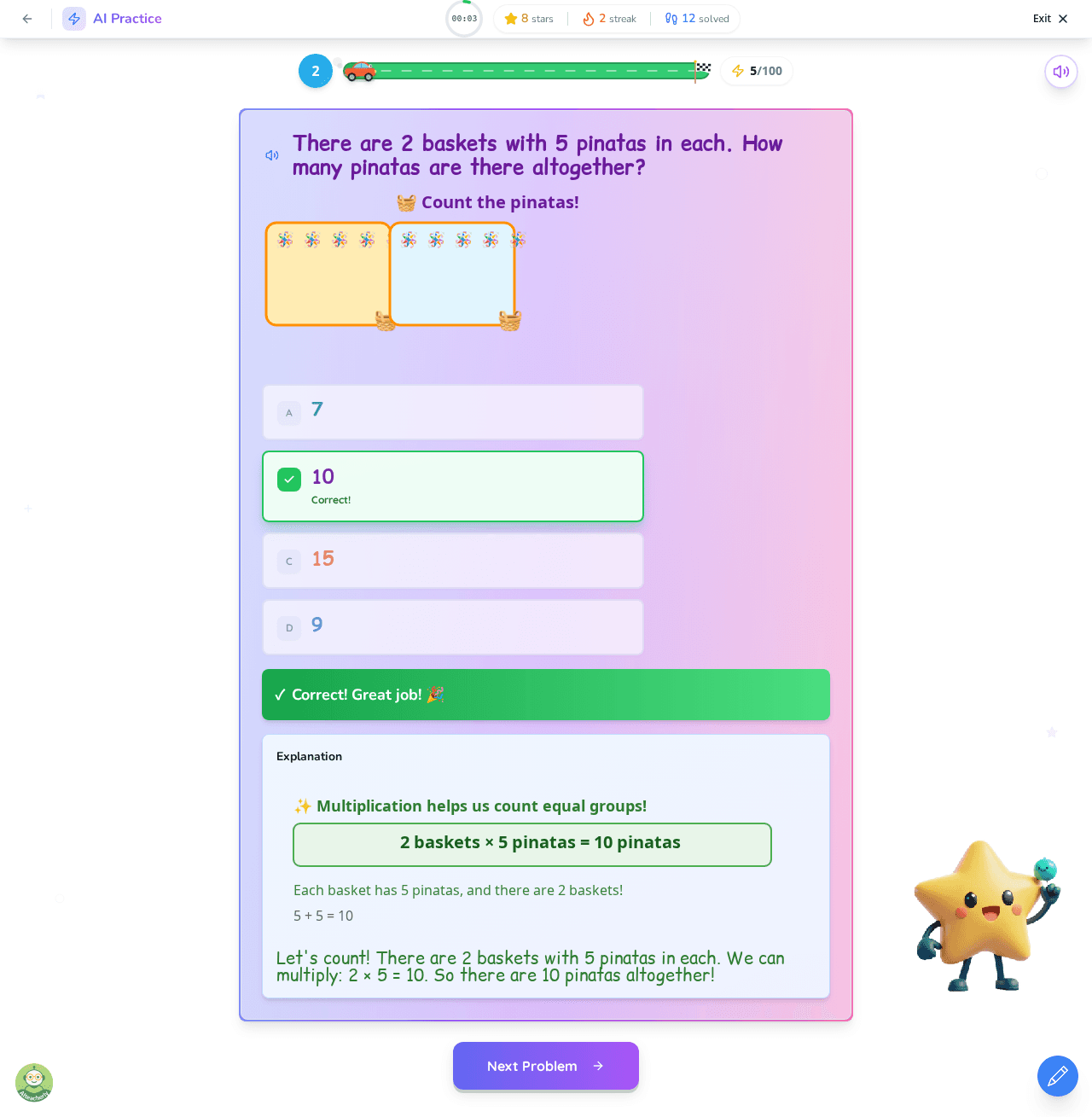
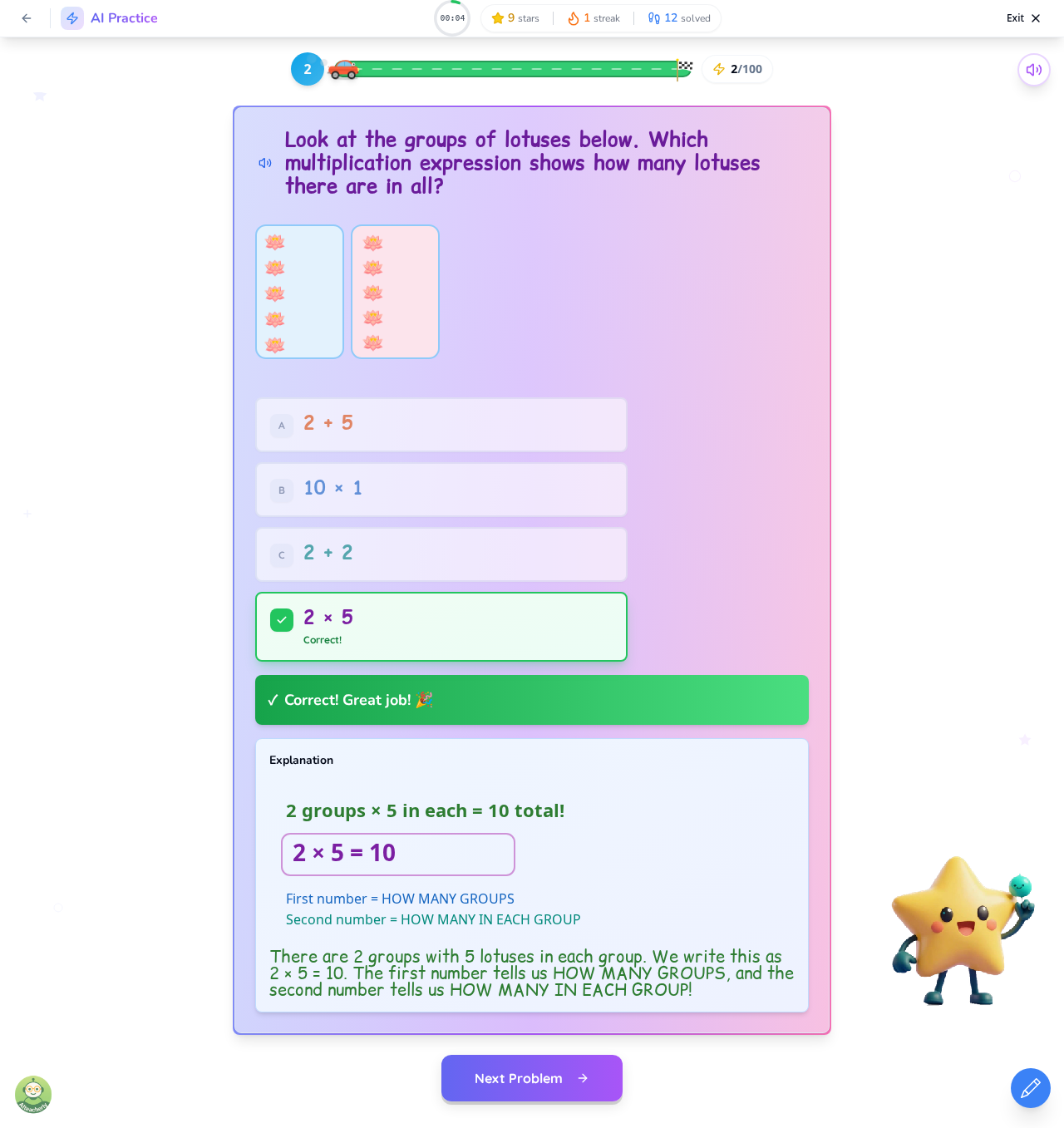
The interactive problem below shows exactly how students learn to connect visual groups to multiplication expressions:
Why This Matters So Much
When children understand that the first number represents groups and the second number represents items per group, multiplication transforms from random memorization into logical counting. They can figure out answers even for facts they haven't memorized yet.
Consider the difference:
- Memorization approach: "3 times 4 is... um... I forgot"
- Conceptual approach: "3 groups of 4... that's 4 + 4 + 4... that's 12!"
The second child can always find the answer. The first child is stuck without the memorized fact.
How Do Arrays Make Multiplication Easier to Understand?
An array is simply equal groups organized into neat rows and columns. Think of it as the "organized version" of equal groups scattered around.
Here's the powerful insight: the same multiplication fact can be shown two different ways.
Take 3 × 4 again:
- As equal groups: 3 separate piles with 4 items in each
- As an array: 3 rows with 4 items in each row (or 4 columns with 3 in each)
Both equal 12. Same math, different visual arrangement.
Why Arrays Are Especially Helpful
Arrays help children see multiplication patterns more clearly because items line up in an organized grid. This makes counting easier and helps kids notice important properties:
- Rows become groups: In a 3 × 4 array, the 3 rows are your groups
- Columns show items per group: The 4 columns show how many in each row
- Commutative property becomes visible: A 3 × 4 array looks different from a 4 × 3 array, but both have 12 squares. Kids can literally see that order doesn't change the total.
Arrays also prepare students for later math concepts like area (which is just arrays of square units) and eventually algebra. This visual foundation pays dividends for years to come.
The Secret Connection: Repeated Addition and Multiplication
Before your child can truly understand multiplication, they need to see that it's just a shortcut for repeated addition.
Consider 4 × 5 (4 groups of 5):
- Repeated addition: 5 + 5 + 5 + 5 = 20
- Multiplication shortcut: 4 × 5 = 20
Same answer. Multiplication is just faster.
This connection is explicitly taught in quality multiplication lessons because it builds on what kids already know. Your child can already add. Showing them that multiplication is just "adding the same number over and over, but quicker" makes the new concept feel achievable rather than scary.
Special Cases That Make Sense Now
Once children understand equal groups, the rules for multiplying by 0 and 1 become obvious:
- Multiplying by 1: One group of anything is just that thing. 1 × 7 = 7 (one group of 7 is still 7)
- Multiplying by 0: Zero groups means nothing there. 0 × 8 = 0 (zero groups of 8 is zero items)
- Multiplying anything by 0: Any number of empty groups is still nothing. 6 × 0 = 0 (6 groups with 0 in each is 0 total)
These "rules" aren't arbitrary when kids can visualize the groups. Empty groups? Nothing there. One group? Just that many. It makes logical sense.
5 Household Items to Practice Equal Groups Tonight
You don't need special math manipulatives to practice equal groups at home. Here are everyday items that work perfectly:
1. Egg Cartons A standard egg carton is a 2 × 6 array (2 rows, 6 columns = 12 eggs). Use small objects like buttons, coins, or dried beans to create different multiplication problems. "Put 3 beans in each section of this row. How many beans for 4 sections?"
2. Muffin Tins Muffin tins come in various sizes (6, 12, or 24 cups) and provide perfect "groups" for sorting items. "If each muffin cup gets 2 blueberries, how many blueberries do we need for 6 cups?"
3. Ice Cube Trays Ice cube trays are natural arrays. Count rows and columns, then multiply. This is a great tactile way to see how arrays work.
4. Shoe Organizers Over-the-door shoe organizers with clear pockets make excellent giant arrays. Kids can see the rows and columns clearly, and you can put small toys in pockets to create visual multiplication problems.
5. LEGO Bricks LEGO baseplates and bricks are perfect for building arrays. A 2×4 brick shows 2 rows of 4 studs. Kids can physically build multiplication facts and count the total studs.
Quick Practice Script Try this conversation at dinner: "I see 4 plates on the table, and each plate has 3 pieces of chicken. That's 4 groups of 3. Can you tell me the multiplication problem? What's the total?"
See How Interactive Lessons Bring Multiplication to Life
While hands-on practice at home is invaluable, interactive digital lessons take visual learning to another level by combining narration, animations, and immediate feedback.
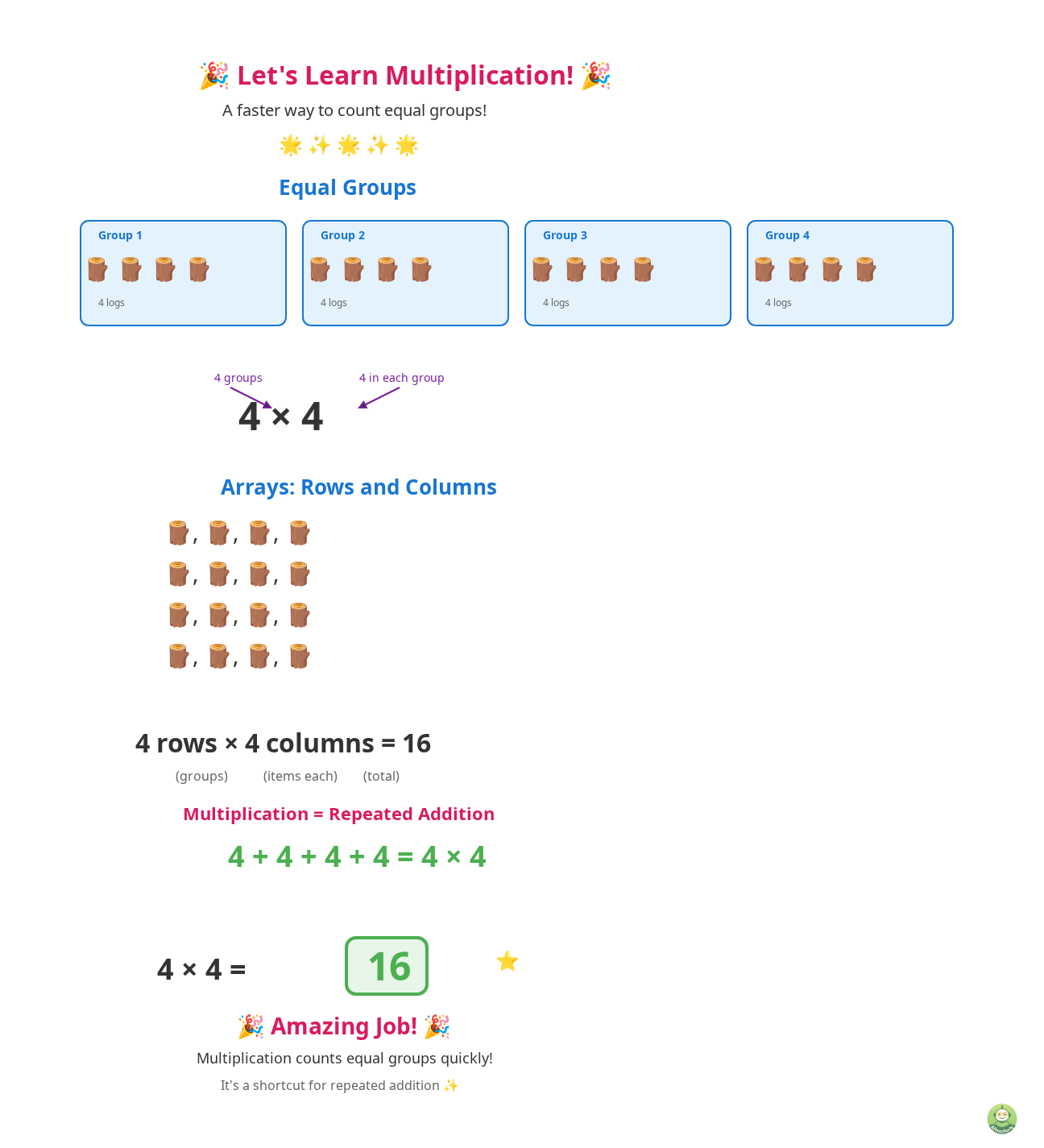
Here's what the full interactive experience looks like on AI Teacherly:
In the Introduction to Multiplication: Equal Groups and Arrays lesson for Grade 3, students journey through a carefully scaffolded sequence:
Visual Introduction: Narrated instruction explains that "multiplication is a super fast way to count things when they're in equal groups," with animated examples showing groups forming
Guided Discovery: Students see how the first number tells us "how many groups" while the second number tells us "how many in each group"
Interactive Practice: Problems like the one shown let students match visual groups to multiplication expressions, building the connection between what they see and the mathematical notation
Array Connection: The lesson then shows how the same equal groups can be arranged into organized arrays (rows and columns), reinforcing that it's the same math in a different visual format
Repeated Addition Bridge: Students explicitly see that multiplication is "just a shortcut for adding the same number over and over," with side-by-side comparisons
This structured approach builds understanding layer by layer, ensuring kids don't just memorize facts but truly grasp what multiplication means.
Key Takeaways for Parents
Here's what to remember as you support your 3rd grader's multiplication journey:
Multiplication is visual first: Before memorizing times tables, kids need to SEE what multiplication looks like through equal groups and arrays
Equal groups = same number in each: The first number is how many groups; the second is how many per group
Arrays organize the concept: Rows and columns make patterns visible and prepare kids for area, graphs, and algebra later
Repeated addition is the bridge: 4 × 3 is the same as 3 + 3 + 3 + 3. This connection makes multiplication feel like something kids can already do
Household items work great: Egg cartons, muffin tins, LEGO bricks, and ice cube trays are all perfect tools for practicing at home
Conceptual understanding prevents forgetting: Kids who understand WHY multiplication works retain facts longer than those who only memorize
It's okay if this feels different from your experience: Modern math teaching prioritizes understanding over rote memorization, and research supports this approach
Key Takeaways
- Multiplication is visual first: kids need to SEE equal groups and arrays before memorizing times tables
- Equal groups means the same number in each group; the first number is how many groups, the second is how many per group
- Arrays organize equal groups into rows and columns, making multiplication patterns visible
- Repeated addition (4 × 3 = 3+3+3+3) bridges what kids know to the new multiplication concept
- Use household items like egg cartons, muffin tins, and LEGO bricks for hands-on practice
- Conceptual understanding prevents the 'memorize and forget' cycle with multiplication facts
- Modern math teaching prioritizes understanding over rote memorization, and research supports this approach
Frequently Asked Questions
What are equal groups in multiplication?
Equal groups means every group has the same number of items. In multiplication like 3 × 4, the first number (3) tells you how many groups, and the second (4) tells you how many in each group. The total is your answer.
How do arrays help children understand multiplication?
Arrays organize equal groups into neat rows and columns, making patterns visible. Kids can see that 3 × 4 (3 rows of 4) equals the same 12 as 4 × 3 (4 rows of 3), helping them understand the commutative property visually.
What household items can I use to teach multiplication at home?
Egg cartons, muffin tins, ice cube trays, LEGO bricks, and shoe organizers all work great. These everyday items naturally form arrays or equal groups that kids can fill with small objects to visualize multiplication.
Why is repeated addition taught before multiplication tables?
Repeated addition shows kids that multiplication is just a shortcut for adding the same number multiple times. This connection (4 × 5 = 5+5+5+5 = 20) makes multiplication feel achievable since kids already know how to add.
How is multiplication taught differently now than when I was in school?
Modern curricula emphasize visual understanding through equal groups and arrays before memorization. Research shows this conceptual approach helps kids retain facts longer and apply multiplication to new situations more effectively.
When should my child start memorizing multiplication facts?
After they understand the concept through equal groups and arrays. Most curricula introduce memorization in mid-to-late 3rd grade, once the visual foundation is solid. Understanding first prevents the 'memorize and forget' cycle.
What if my child understands equal groups but struggles with the symbols?
This is common and normal. Practice connecting visual groups to written expressions like 3 × 4 = 12. Have them say 'three groups of four equals twelve' while pointing to each part. The AI Teacherly lesson does this explicitly.
Is it okay to just teach times tables through memorization?
While memorization has its place, starting with understanding makes facts stick better. Kids who only memorize often forget facts or can't apply them to word problems. Build the visual foundation first, then add fluency practice.
Ready to make multiplication click for your 3rd grader? Try the interactive Equal Groups and Arrays lesson free on AI Teacherly and watch your child discover that multiplication is just fast counting!