Cracking Fraction Division: Why Dividing Makes Numbers Bigger (And How to Teach It)
Struggling to explain 5th grade fraction division? Discover why dividing makes numbers bigger and learn simple visual ways to teach your child at home.
Introduction: The Great Fraction Division Mystery (Why Does Division Make Numbers Bigger?)
For years, children are taught a comforting mathematical truth: division makes things smaller. If you have 10 cookies and share them among 5 friends, everyone gets 2 cookies. The number shrinks. So, when your 5th grader hits fraction division and discovers that dividing a number can actually make it bigger, confusion naturally sets in. How can 4 divided by one-half equal 8?
This cognitive leap is one of the biggest hurdles in upper elementary mathematics. When kids rely solely on memorized shortcuts like keep-change-flip, they often forget the steps and lose confidence. Mastering how to explain fraction division starts with shifting the focus away from rote rules and toward visual intuition. By tapping into how children naturally perceive quantities, you can turn a frustrating homework battle into an empowering "aha" moment.
What Does Fraction Division Actually Mean in 5th Grade?
In 5th grade, mathematics shifts from basic arithmetic to proportional reasoning. Fraction division is split into two primary scenarios: dividing a fraction by a whole number, and dividing a whole number by a fraction. Each scenario tells a completely different story.
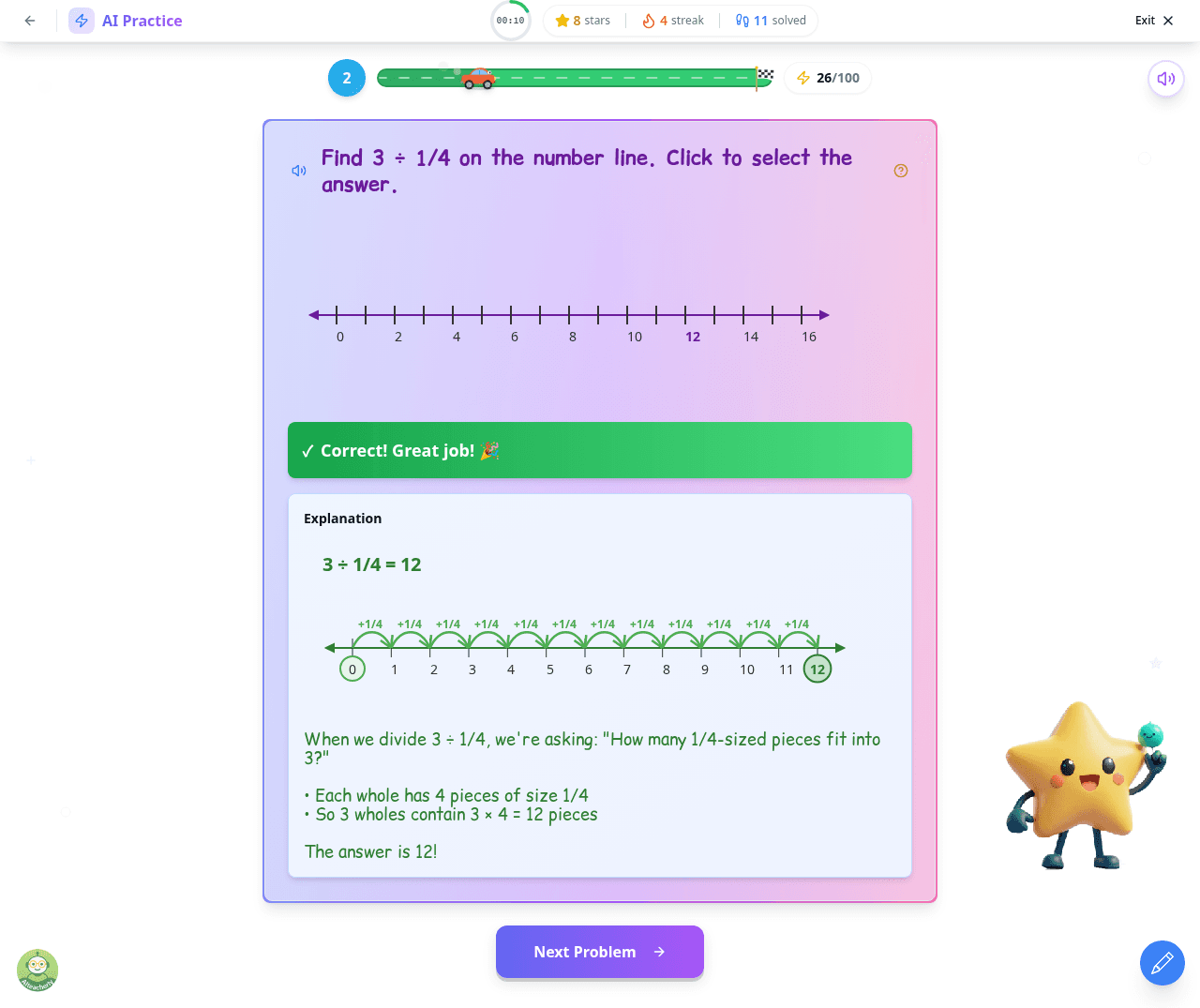
When you divide a fraction by a whole number, such as one-half divided by 3, you are slicing an existing fraction into even smaller pieces. The answer is smaller. But when you divide a whole number by a fraction, such as 3 divided by one-fourth, you are asking how many one-fourth pieces fit inside 3 wholes. Because you can pack four one-fourth pieces into a single whole, 3 wholes hold 12 pieces. The result is larger. Understanding this distinction is the secret to unlocking fraction confidence.
Visualizing Fraction by Whole Number Division (Area Models)
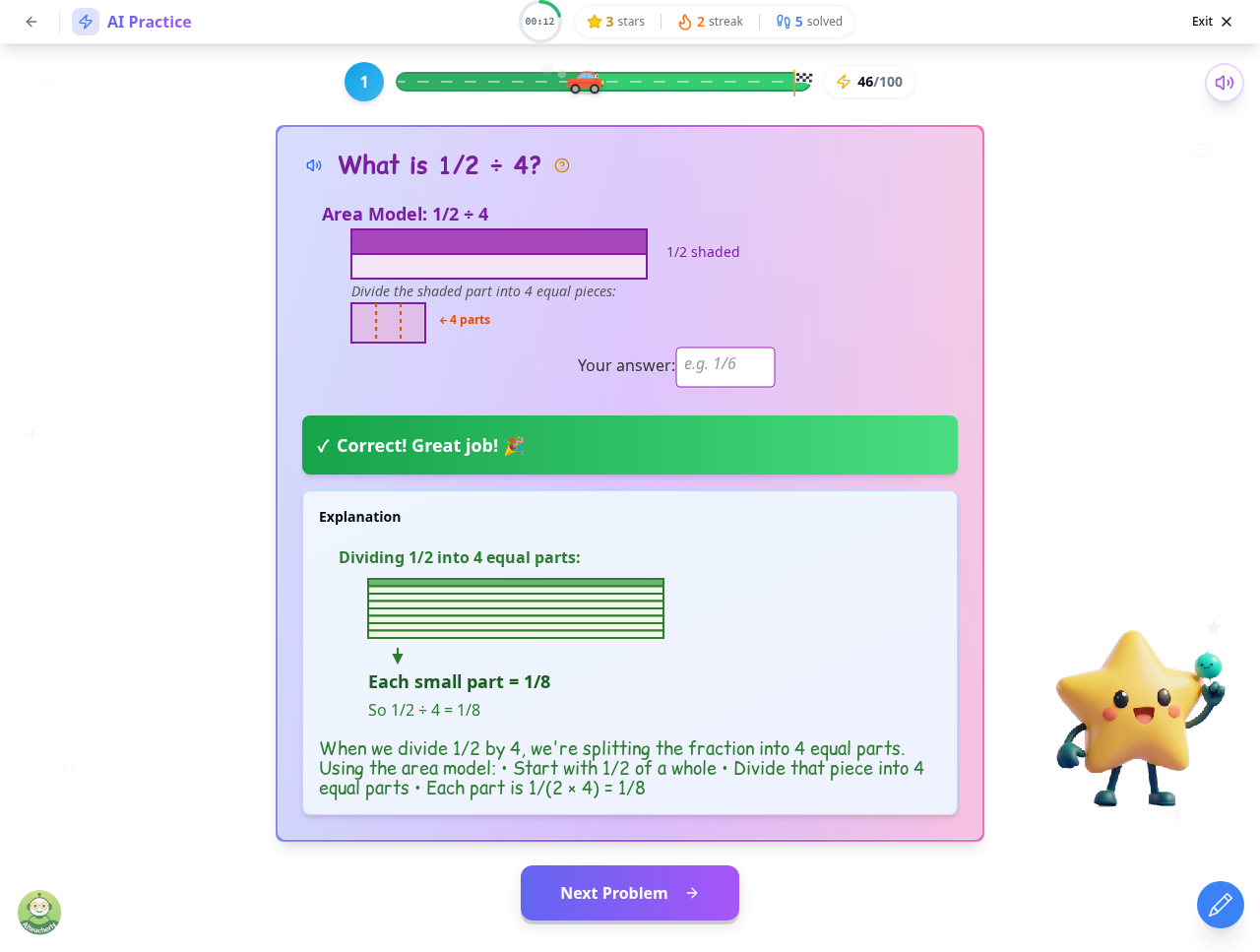
Area models are powerful tools for illustrating fraction division because they let students physically see parts of a whole being divided. Imagine drawing a square to represent a whole garden plot, then shading in three-fourths of it. If you need to divide that three-fourths shaded area among 3 people, you divide the shaded section horizontally into 3 equal rows.
The interactive problem below shows exactly how area models break fractions into smaller equal parts. Each small resulting rectangle represents one share of the original fraction. By counting these shaded parts against the total grid, students see instantly that sharing a fraction results in a smaller piece without needing complicated formulas.
Visualizing Whole Number by Fraction Division (Number Lines)
When shifting to whole numbers divided by unit fractions, number lines become your best friend. Picture a number line stretching from 0 to 3. If your math problem asks you to calculate 3 divided by one-third, you are essentially asking: how many one-third hop lengths does it take to travel from 0 to 3?
Because each single whole integer contains three individual one-third segments, a journey across 3 wholes requires 9 total hops. The number line makes this completely undeniable. Students watch the jumps accumulate, realizing that dividing by a fraction smaller than 1 is really an act of measurement rather than reduction. This visual proof eliminates the mystery behind why quotients grow larger.
3 Ways to Practice Fraction Division Without Frustration at Home
Supporting your 5th grader does not require a degree in advanced mathematics. You can build strong conceptual foundations right at your kitchen table with three simple strategies. First, use real-world objects like measuring cups or strips of paper to model sharing scenarios. If you have 2 cups of flour and each recipe batch requires one-third of a cup, measure out the scoops together.
Second, encourage your child to draw pictures before writing equations. Whenever they encounter a division symbol with fractions, ask them to sketch a quick bar or number line representing what is happening. Third, embrace mistakes as part of the puzzle. When an answer comes out larger than the starting number, celebrate that discovery rather than correcting it immediately. Letting children question their own assumptions builds deep, lasting mathematical resilience.
How AI Teacherly Makes Visual Math Click for Kids
Helping children bridge the gap between abstract numbers and visual models is where interactive technology shines. Platforms designed for upper elementary learners provide scaffolded environments where students can manipulate shapes, test hypotheses, and see immediate feedback without pressure.
Here's what the full interactive lesson looks like on AI Teacherly: In the AI Teacherly lesson Understanding Fraction Division with Visual Models, 5th graders explore area grids and dynamic number lines that respond instantly to their inputs. Instead of staring at a static worksheet, students drag partition lines and test different fraction combinations, transforming abstract confusion into clear, tactile understanding.
Key Takeaways
- Understand why dividing by a fraction yields a larger quotient rather than a smaller one
- Use area models to visualize sharing fractions into smaller equal parts
- Use partitioned number lines to measure how many unit fractions fit into whole numbers
- Delay rote algorithms until children develop solid conceptual visualization skills
- Incorporate interactive platforms like AI Teacherly to make abstract math tangible
Frequently Asked Questions
Why does dividing fractions give a bigger answer?
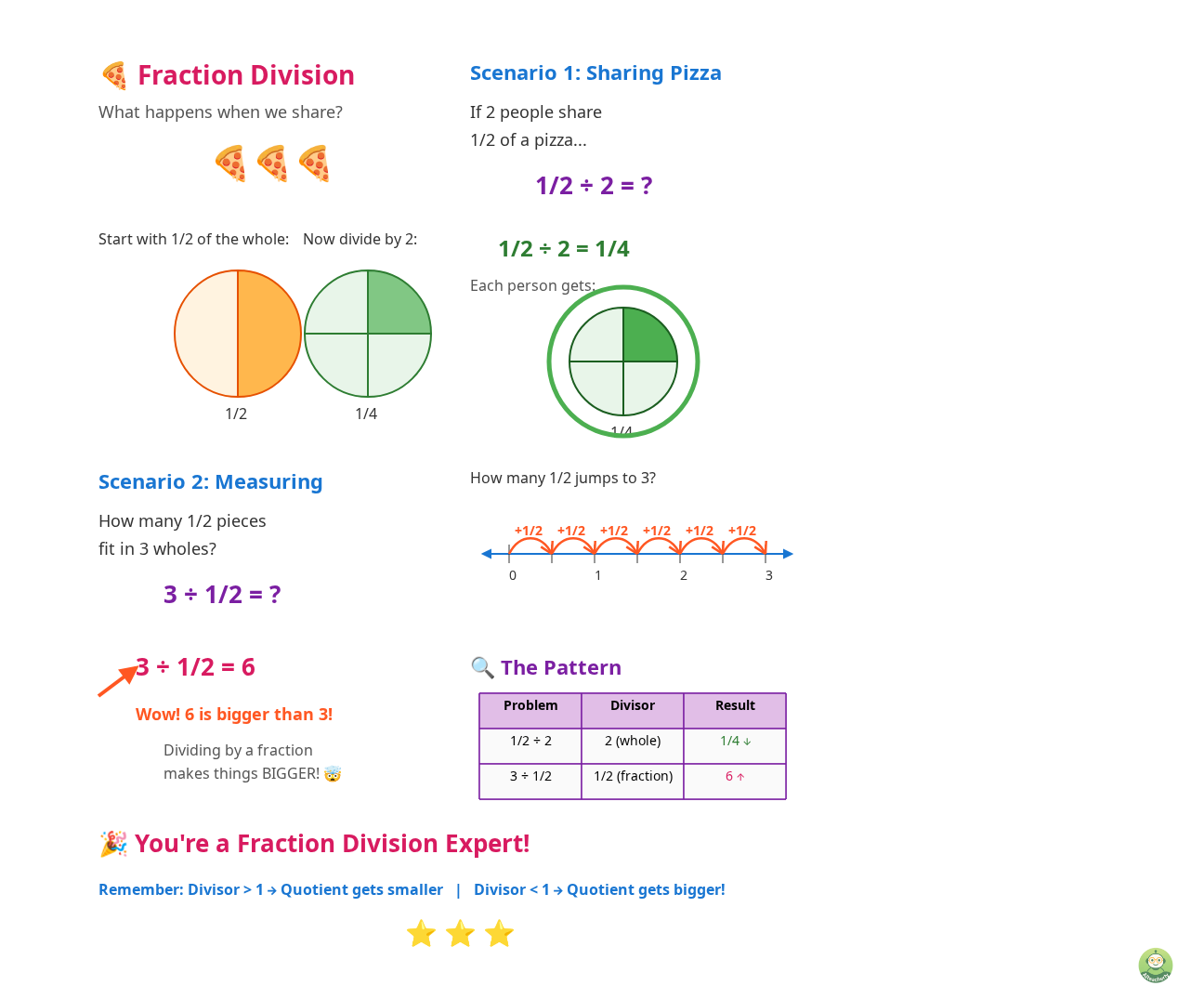
Division by a fraction actually measures how many fraction-sized pieces fit into a whole or another fraction. When you divide a whole number by a fraction smaller than one, you end up with more total pieces than you started with, which makes the quotient larger than the original number.
How can I help my 5th grader understand fraction division at home?
You can teach fraction division at home by using everyday objects like pizzas, measuring cups, or paper strips. Instead of rushing to the standard keep-change-flip algorithm, encourage your child to draw area models or count jumps on a number line to see what is happening mathematically.
What is the difference between dividing a fraction by a whole number versus a whole number by a fraction?
Dividing a fraction by a whole number splits a part into even smaller pieces, resulting in a smaller fraction. Conversely, dividing a whole number by a unit fraction asks how many fractional parts fit into that whole, resulting in a much larger number.
Do kids need to know keep-change-flip in 5th grade?
While the algorithm is taught later, relying on it too early in 5th grade leads to rote memorization without true comprehension. Building visual intuition first ensures students understand why the algorithm works when they encounter it in upper grades.
What are visual models for fraction division?
Visual models are geometric representations like area grids or partitioned number lines that show mathematical operations visually. They allow students to literally see fraction division in action rather than blindly following abstract rules.
Is it normal for a 5th grader to struggle with fraction division?
It is completely normal! Because children spend years learning that division always reduces quantities, transitioning to fraction division challenges their intuition. Using visual tools and guided practice bridges this cognitive gap quickly.
Ready to make math click for your child? Explore interactive lessons on fraction division and more, completely free on AI Teacherly today!