Fact Families for 2nd Grade: The Math Shortcut That Turns One Fact Into Four
Discover how fact families transform 2nd grade math by connecting addition and subtraction. Learn what every parent should know about this powerful math shortcut.
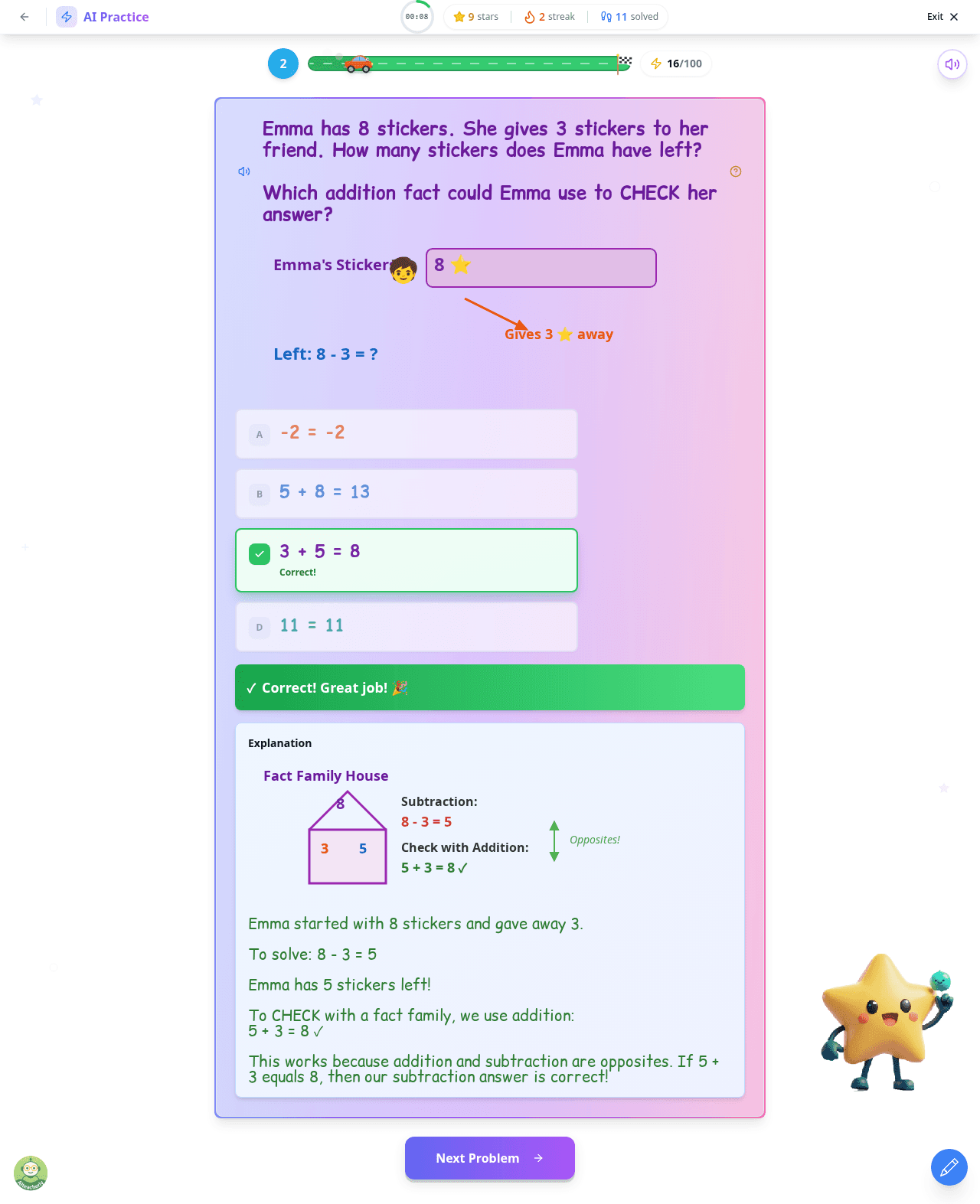
The Math Shortcut Your 2nd Grader Needs to Know
Picture this: your child is working on homework and stares at a subtraction problem they "should" know. You can see the frustration building. They can quickly tell you that 3 + 5 = 8, but when faced with 8 - 5 = ?, they freeze up. Sound familiar?
Here's the good news: there's a simple concept called fact families that can transform this struggle into confidence. Once your child understands fact families, they'll realize that knowing one addition fact actually means they already know three more math facts. It's like a secret code that unlocks faster problem-solving.
In this guide, we'll break down exactly what fact families are, why they matter for your 2nd grader's math success, and how you can practice them at home without boring worksheets. You don't need to be a math expert to help your child master this concept. By the end, you'll understand why teachers emphasize fact families and how this foundational skill sets your child up for success with multiplication and division in later grades.
What Is a Fact Family in Math?
A fact family is a group of related math facts that use the same three numbers. Think of it like a small family where three numbers "live together" and can be arranged in different ways to create four related equations: two addition facts and two subtraction facts.
Let's look at a simple example using the numbers 3, 5, and 8:
- 3 + 5 = 8
- 5 + 3 = 8
- 8 - 5 = 3
- 8 - 3 = 5
Notice how all four equations use the exact same three numbers? That's a fact family! The two addition facts show that you can add numbers in any order and get the same answer (this is called the commutative property, but your 2nd grader doesn't need that vocabulary yet). The two subtraction facts show how subtraction "undoes" addition using those same numbers.
The beauty of fact families is that knowing one fact means knowing three more. If your child memorizes 3 + 5 = 8, they automatically have the tools to figure out 5 + 3, 8 - 5, and 8 - 3. This dramatically reduces the number of facts they need to memorize while building genuine number sense.
Many parents wonder, "Is this new math? I don't remember learning this." Fact families aren't new. They're simply a way of teaching the relationship between addition and subtraction that helps children understand math rather than just memorize it.
How Do Addition and Subtraction Connect in Fact Families?
Understanding how addition and subtraction connect is the real magic of fact families. These operations are inverse operations, which simply means they undo each other. When your child grasps this connection, subtraction stops being a separate skill to memorize and becomes a natural extension of addition facts they already know.
Here's how to explain it simply: Addition puts numbers together, and subtraction takes them apart. If 3 + 5 puts numbers together to make 8, then 8 - 5 takes them apart to get back to 3. The numbers stay the same; we're just looking at them from a different direction.
This is where interactive practice becomes incredibly valuable. When children can see and manipulate the relationships between numbers, the connection clicks in a way that worksheets alone can't achieve.
The interactive problem below shows exactly how fact families work in practice:
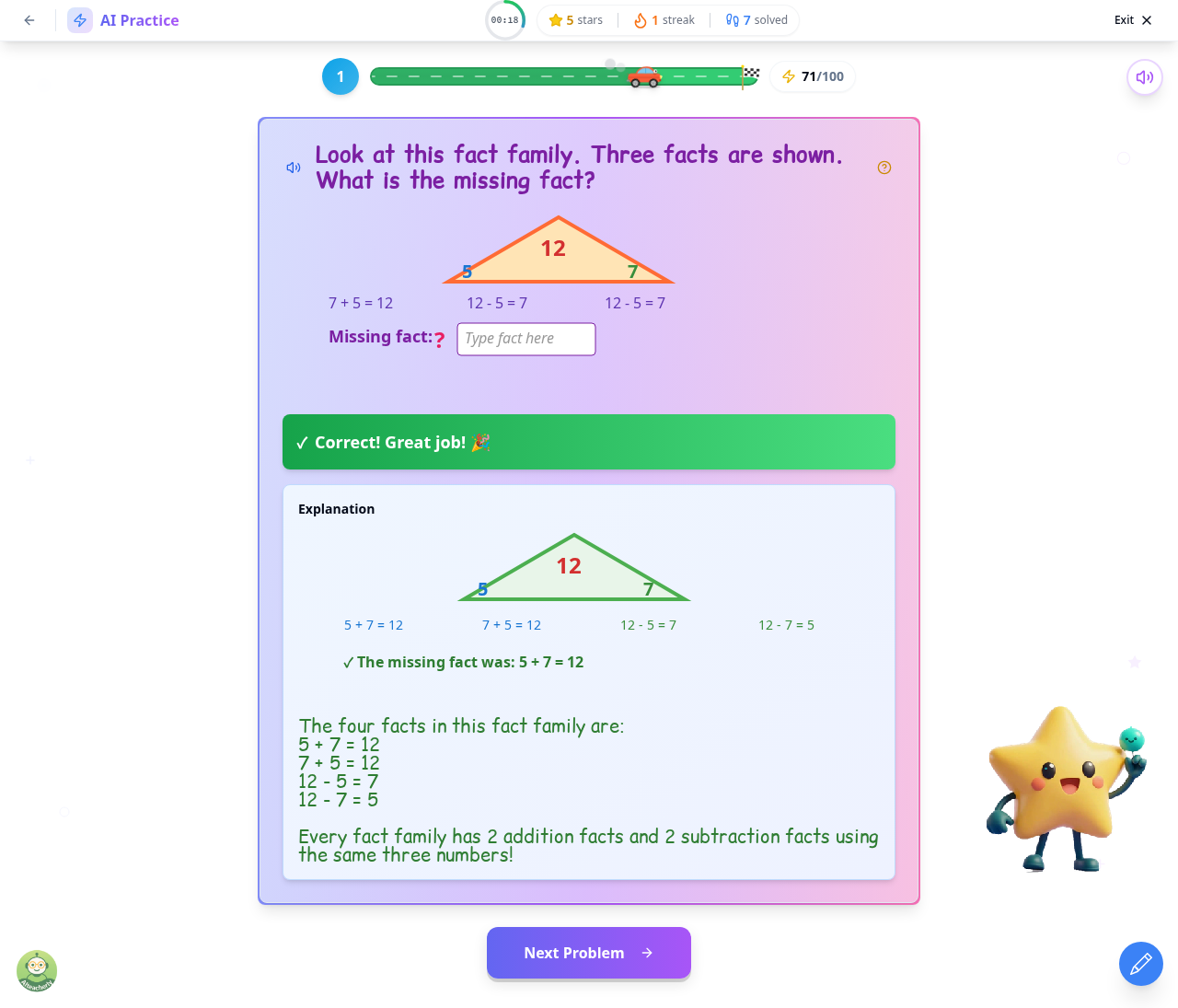
In this type of exercise, students see all four facts together and fill in the missing piece. This visual representation helps children see the pattern: the same three numbers appear in every equation. When kids practice identifying the missing number in a fact family, they're building the mental flexibility to approach subtraction problems using their addition knowledge.
The "aha moment" happens when children realize: "I don't have to memorize 8 - 5 separately. I can just think about 5 + ? = 8, and I already know that answer!"
Why Are Fact Families Important for Your Child's Math Success?
You might wonder if fact families are worth the time when your child could just memorize math facts. Here's why teachers emphasize this concept in 2nd grade: fact families build number sense, which is the foundation for all future math learning.
1. Reduces Memorization Overload
Instead of memorizing four separate facts, your child learns to recognize the relationship between three numbers. This approach is more sustainable and reduces the cognitive burden on young learners. Children who understand fact families often perform better on timed math tests because they have multiple pathways to the answer.
2. Strengthens Problem-Solving Skills
When children understand that subtraction and addition are connected, they become flexible thinkers. If they can't immediately recall 12 - 7, they can think: "What number plus 7 equals 12?" This flexibility is essential for word problems and mental math.
3. Prepares for Multiplication and Division
Here's the long-term benefit parents should know: fact families return in 3rd grade with multiplication and division. The same concept applies: 3 × 4 = 12, 4 × 3 = 12, 12 ÷ 4 = 3, and 12 ÷ 3 = 4. Children who master addition and subtraction fact families transition more smoothly to multiplication and division.
4. Builds Confidence
Perhaps most importantly, understanding fact families gives children confidence. Instead of feeling like they need to memorize hundreds of separate facts, they see the patterns and connections. Math starts to make sense rather than feeling like arbitrary rules to follow.
How to Practice Fact Families at Home (Without Worksheets)
The best news? You don't need to create elaborate lesson plans or buy expensive materials to reinforce fact families at home. Here are practical, engaging ways to practice:
Use Everyday Objects
Grab some small items: crackers, toys, coins, or buttons. If you have 3 red buttons and 5 blue buttons (8 total), have your child create all four fact family equations. Physically moving objects makes the concept concrete.
Play "Fact Family Detective"
Give your child three numbers and challenge them to find all four facts. Start with small numbers like 2, 3, 5 and work up to larger combinations. Make it a game: "Can you crack the code and find all four facts in this family?"
Number Bond Cards
Create simple cards with three numbers on each. During car rides or waiting rooms, flash a card and ask your child to name all four related facts. This turns practice into a quick, no-pressure activity.
Look for Fact Families in Daily Life
At the grocery store: "We have 4 apples and 6 oranges. That's 10 pieces of fruit. What's the fact family?" Connecting math to real situations helps children see why this matters beyond homework.
Use Interactive Digital Practice
Interactive lessons provide immediate feedback and visual representations that worksheets can't match. When children can see the relationships between numbers on screen and get instant confirmation of their answers, learning accelerates.
The key is keeping practice short, positive, and connected to things your child already enjoys. Five minutes of engaged practice beats thirty minutes of frustrated worksheet time.
See Fact Families in Action on AI Teacherly
Understanding fact families is one thing; practicing them in an engaging way is another. The Fact Families lesson on AI Teacherly is designed specifically for 2nd graders to explore the connection between addition and subtraction through interactive problems.
Here's what the full interactive lesson looks like on AI Teacherly:
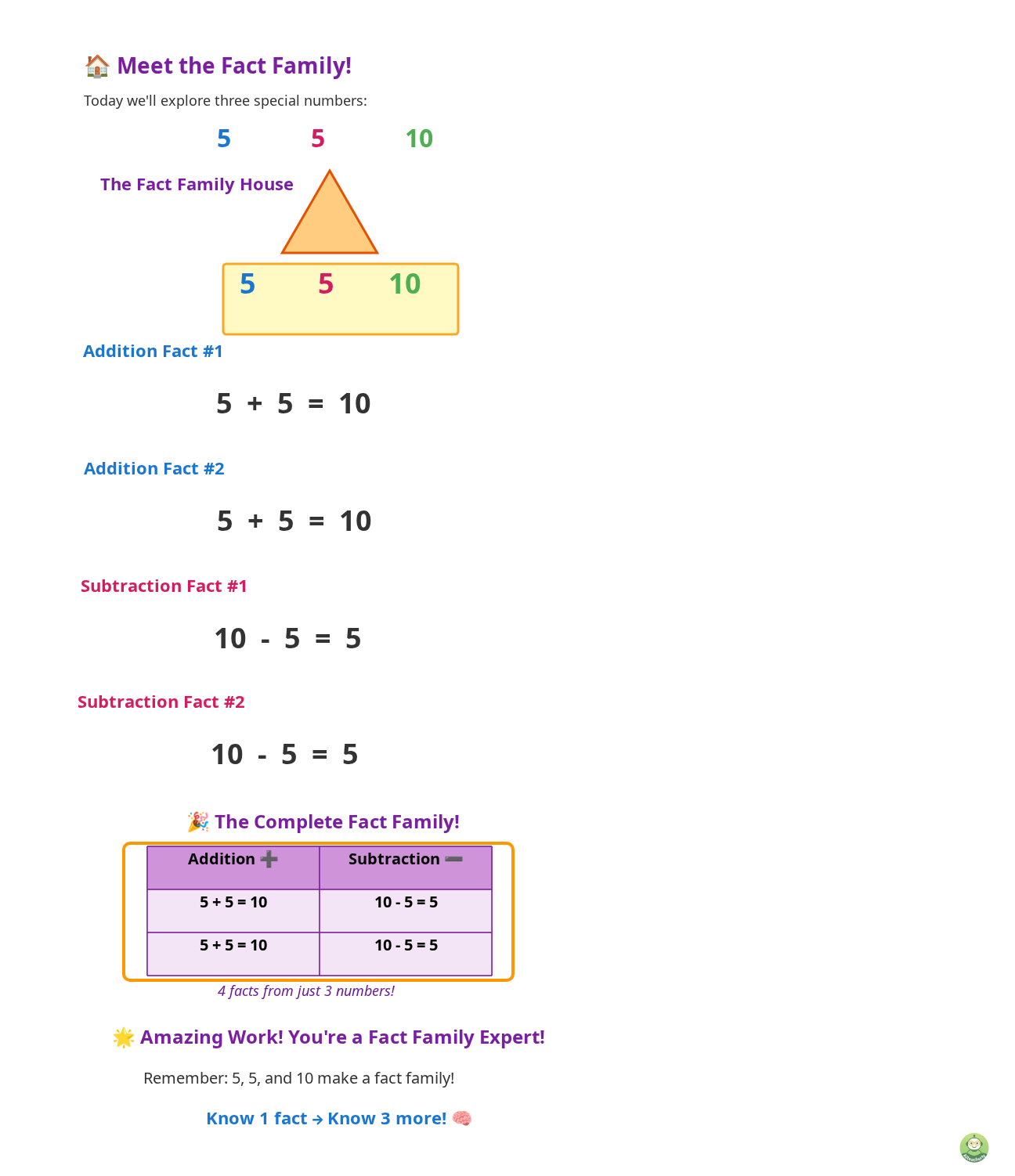
The lesson uses visual models and guided discovery to help children see the relationships between numbers. Instead of just memorizing, students interact with problems that reinforce the core concept: four facts from just three numbers.
What makes interactive practice effective for fact families:
- Visual representations help children see the connection between all four facts
- Immediate feedback lets children learn from mistakes in the moment
- Progressive difficulty builds confidence before introducing challenge
- Real-world word problems show how fact families apply to everyday situations
The lesson includes various problem types: fill-in-the-blank challenges, ordering activities, and word problems that connect fact families to situations your child might encounter with toys, snacks, or everyday objects.
For parents who feel uncertain about explaining math concepts, interactive lessons do the heavy lifting while you provide encouragement and celebrate progress.
Key Takeaways
- A fact family uses three numbers to create four related math facts (two addition, two subtraction)
- Understanding fact families reduces memorization burden and builds genuine number sense
- When kids know one addition fact, they can figure out three related facts instantly
- Fact families prepare children for multiplication and division in 3rd grade
- Practice with everyday objects, games, and interactive lessons rather than drill worksheets
- This concept helps children see subtraction as connected to addition rather than a separate skill to memorize
Frequently Asked Questions
What is a fact family in 2nd grade math?
A fact family is a group of four related math facts using the same three numbers. For example, with 3, 5, and 8: 3+5=8, 5+3=8, 8-5=3, and 8-3=5. Understanding these relationships helps children solve problems faster.
How many facts are in a fact family?
There are four facts in a complete fact family: two addition facts and two subtraction facts. All four equations use the same three numbers arranged in different ways.
Why do teachers use fact families to teach math?
Teachers use fact families because they show children how addition and subtraction are connected. This builds number sense and reduces memorization burden since knowing one fact helps solve three others.
How can I help my child practice fact families at home?
Use everyday objects like toys or snacks to create groups, play "fact family detective" games with number cards, or use interactive digital lessons. Keep practice short and positive for best results.
Is the fact family concept new math?
No, fact families aren't new math. They're a teaching method that helps children understand the relationship between addition and subtraction rather than memorizing facts in isolation.
How do fact families help with subtraction?
Fact families show that subtraction is the inverse of addition. If a child knows 4+3=7, they can solve 7-3=? by thinking "what plus 3 equals 7?" using their addition knowledge.
When do kids learn fact families in school?
Fact families are typically introduced in 1st grade and mastered in 2nd grade as part of addition and subtraction fluency. The concept returns in 3rd grade for multiplication and division.
What's the difference between fact families and memorizing math facts?
Memorizing treats each fact as separate. Fact families teach the relationship between numbers so children understand why facts work together. This builds problem-solving skills, not just recall.
Ready to make math click for your 2nd grader? Try the interactive Fact Families lesson free on AI Teacherly and watch your child discover the connection between addition and subtraction!