Fact Families for First Graders: How 3 Numbers Unlock 4 Math Facts Your Child Needs
Discover how fact families connect addition and subtraction for first graders. Learn the 'parts and whole' method to turn math struggles into confident problem-solving at home.
The Math Shortcut Hiding in Plain Sight
Has your first grader ever breezed through addition problems only to freeze up the moment subtraction appears? You're not alone. This is one of the most common patterns parents notice during homework time, and there's a reason for it.
Here's the good news: there's a simple math concept that can transform your child's subtraction struggles into confident problem-solving. It's called fact families, and it's the bridge that connects what your child already knows (addition) to what feels challenging (subtraction).
In this guide, you'll discover exactly what fact families are, why they matter for your first grader's math journey, and practical ways to reinforce this concept at home. By the end, you'll have the tools and language to help your child see that subtraction isn't something new to fear; it's just addition turned around.
What Is a Fact Family in First Grade Math?
A fact family is a group of related math facts that use the same three numbers. These three numbers create four connected equations: two addition facts and two subtraction facts.
Let's look at a simple example. Take the numbers 3, 5, and 8:
- Addition facts: 3 + 5 = 8 and 5 + 3 = 8
- Subtraction facts: 8 - 3 = 5 and 8 - 5 = 3
See how all four equations use only those three numbers? That's the magic of fact families. Teachers often describe this using "parts and whole" language:
- The parts are the two smaller numbers (3 and 5)
- The whole is the larger number (8)
When you add the parts together, you get the whole. When you subtract one part from the whole, you get the other part. As the lesson puts it: "Two parts and one whole. Together they make our whole!"
This relationship is why fact families are so powerful. Your child isn't memorizing four separate facts; they're understanding one relationship that unlocks all four.
Why Fact Families Make Subtraction Click
Many first graders find subtraction harder than addition, and there's a developmental reason for this. Addition feels natural because it's "putting things together." Subtraction feels trickier because "taking away" requires working backward.
Fact families solve this problem by reframing subtraction entirely. Instead of thinking of subtraction as a separate, harder operation, children learn that subtraction is just addition backwards.
Here's how this works in practice. If your child knows that 4 + 6 = 10, they can use that knowledge to solve 10 - 6 = ? without starting from scratch. They simply ask themselves: "What number plus 6 equals 10?" The answer (4) is already in their mental toolkit.
As the lesson teaches children: "If you know the addition fact, you can figure out the subtraction facts too!"
This approach offers three major benefits:
- Less memorization: Instead of memorizing hundreds of isolated facts, children recognize patterns and relationships
- Stronger number sense: Children develop deeper understanding of how numbers work together
- Built-in checking: Knowing related facts helps children verify their answers
When subtraction stops feeling like a completely different skill, math anxiety decreases and confidence grows.
How to Explain Parts, Whole, and the Four Facts
Explaining fact families at home doesn't require a teaching degree. The key is using consistent language and visual examples your child can see and touch.
Start with concrete objects. Gather 8 small items like LEGO bricks, buttons, or cereal pieces. Split them into two groups: 3 in one pile and 5 in another.
- Point to each pile: "These are the parts: 3 and 5."
- Push them together: "When we combine them, we get the whole: 8."
- Separate them again: "If we take away 3 from 8, we're left with 5."
Use the "family" metaphor. Tell your child: "These three numbers belong together like a family. They're related, and they help each other out." The lesson reinforces this by saying: "Three numbers make four math facts. They're a family because they belong together!"
Show all four facts together. Write out the complete fact family and point out the patterns:
- 3 + 5 = 8
- 5 + 3 = 8
- 8 - 3 = 5
- 8 - 5 = 3
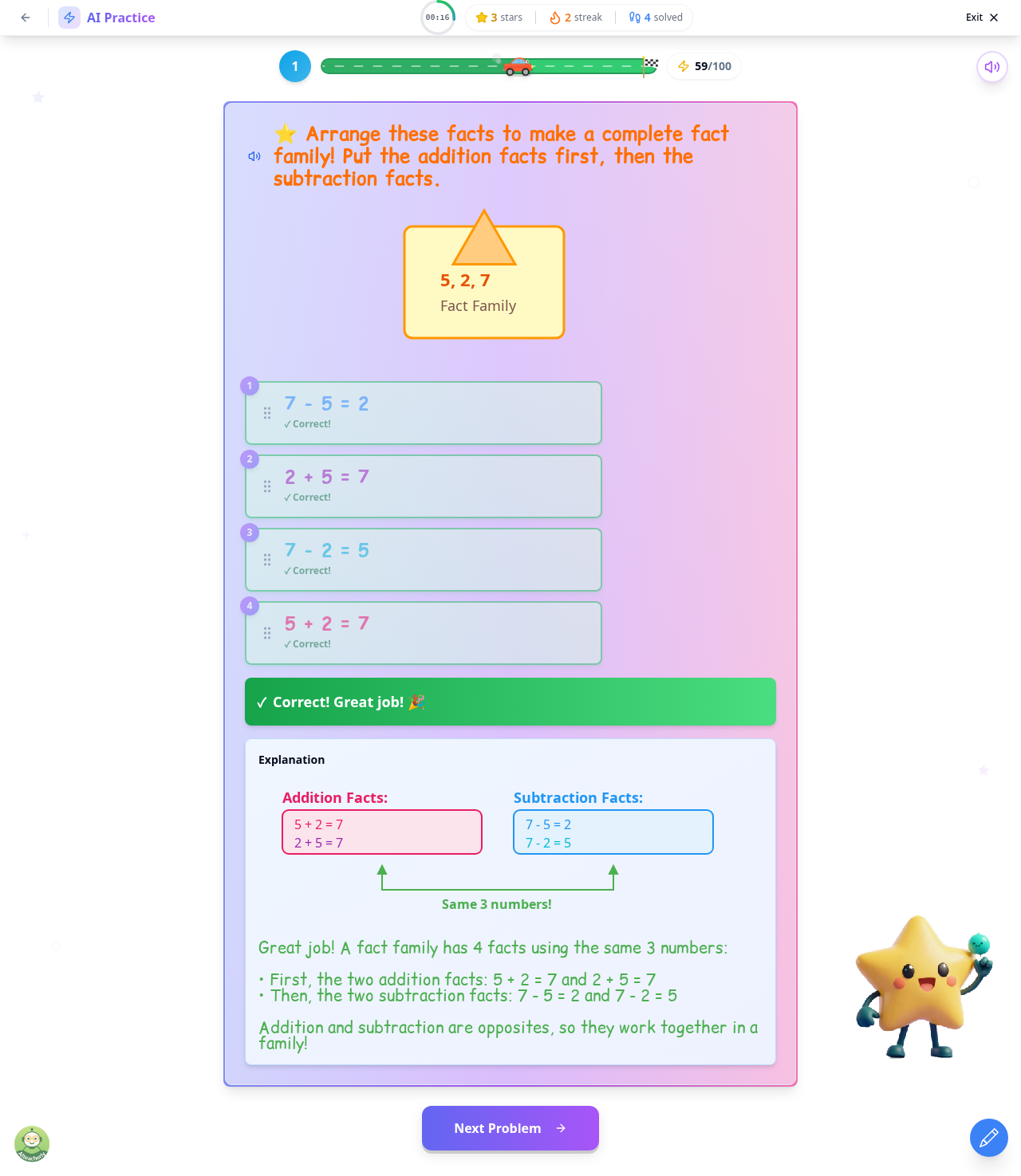
The interactive activity below shows exactly how students learn to arrange all four facts in a fact family, demonstrating the relationship between parts and whole.
Highlight the commutative property. When your child notices that 3 + 5 and 5 + 3 both equal 8, celebrate that discovery! As the lesson says: "We switched the numbers, but the sum is the same!" This insight reinforces that math has patterns they can rely on.
See How Interactive Fact Family Practice Works
Understanding fact families conceptually is important, but children need hands-on practice to make the knowledge stick. This is where interactive learning shines.
In the Fact Families: Relating Addition and Subtraction lesson on AI Teacherly, first graders work through a carefully designed progression:
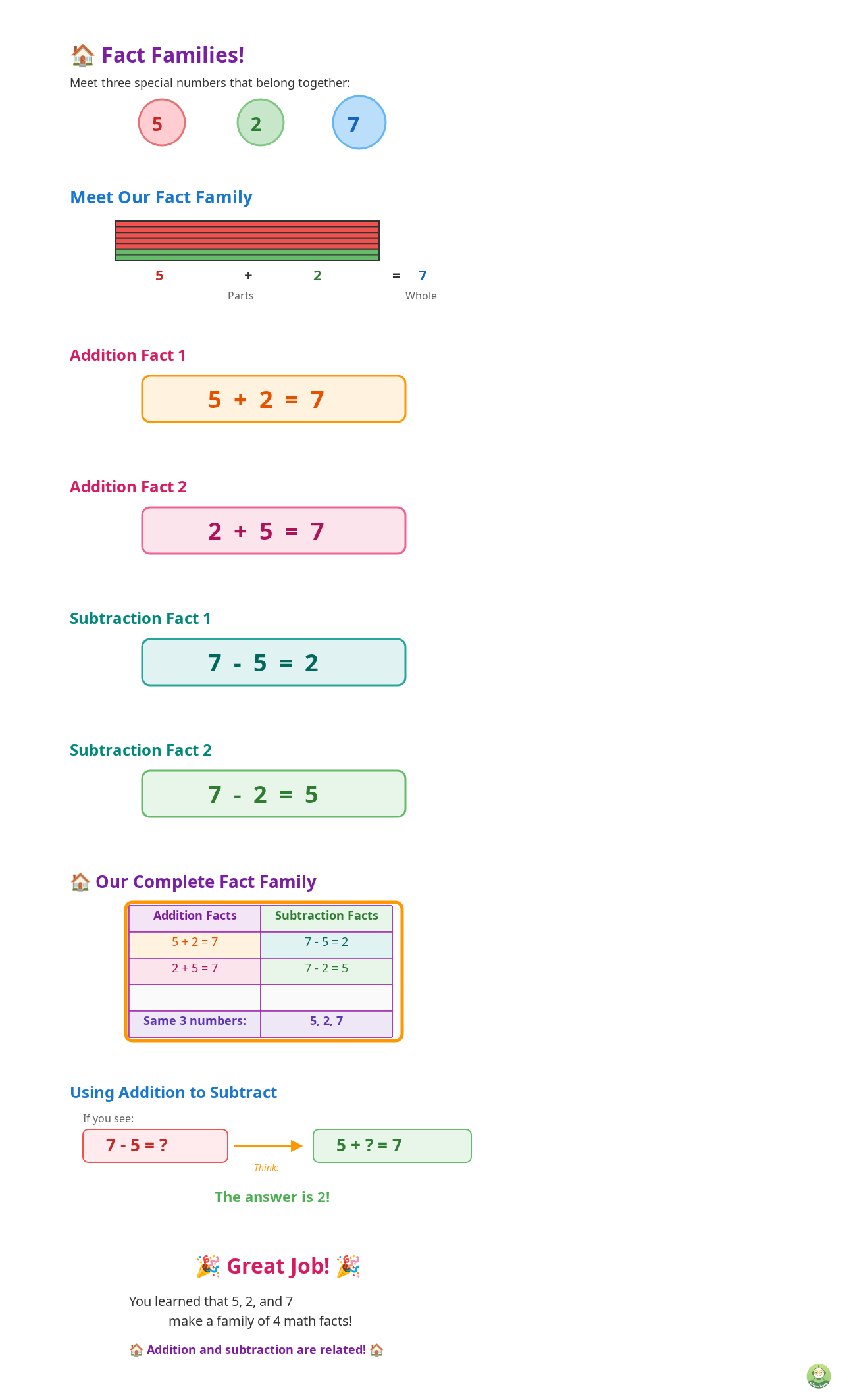
Step 1: Visual introduction. Children see the parts (shown in different colors) combine to form the whole. This visual representation makes the abstract concept concrete.
Step 2: Building addition facts. Students practice creating both addition sentences using the same three numbers, discovering for themselves that the order doesn't change the sum.
Step 3: Connecting to subtraction. The lesson reveals that "Subtraction is just addition backwards!" Children see how the same three numbers create subtraction facts by starting with the whole and removing one part.
Step 4: Interactive practice. Students drag, drop, and type to complete fact families, getting immediate feedback on their work.
Here's what the full interactive lesson looks like on AI Teacherly:
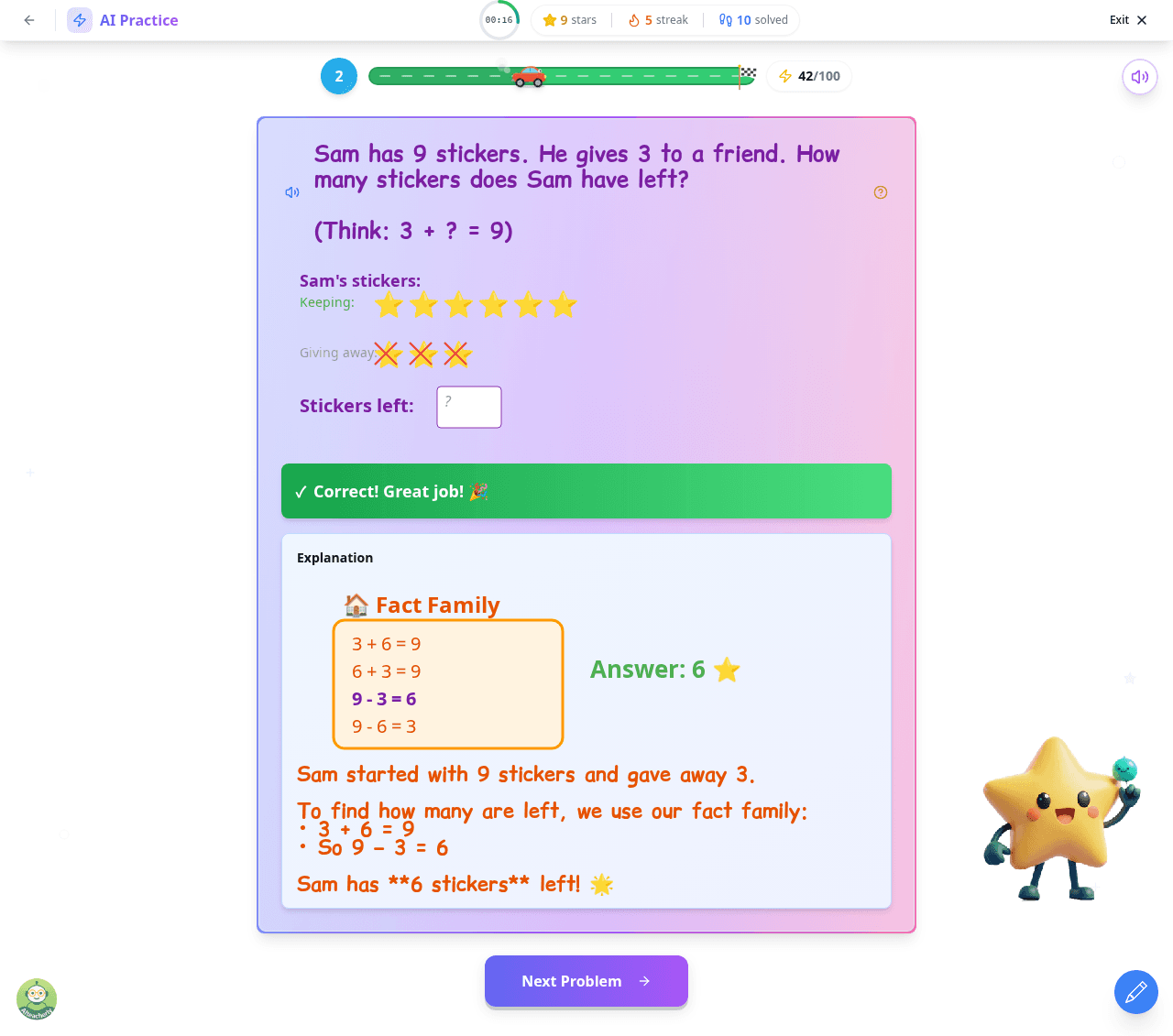
Step 5: Real-world application. Word problems like sharing stickers or dividing toys help children see fact families in everyday contexts.
The lesson takes about 25 minutes and includes built-in narration, so children can work through it independently or with minimal guidance. For parents worried about teaching concepts "wrong," this structured approach ensures children learn using the same vocabulary and methods their teachers use.
Simple Ways to Practice Fact Families at Home
Beyond interactive lessons, you can reinforce fact families through everyday activities. Here are five parent-tested ideas that take just a few minutes:
1. Snack Time Math Give your child 10 crackers or grapes. Ask them to split them into two groups and tell you all four facts. "You have 4 here and 6 there. What facts can you make?" Switch up the totals to practice different families.
2. Fact Family Triangles Draw a triangle and write one number at each corner (for example, 2, 7, 9). Have your child write all four related equations. This visual tool helps children see how the three numbers connect.
3. Mystery Number Game Say an addition fact and challenge your child to give you the related subtraction facts. "If 6 + 3 equals 9, what subtraction facts can you tell me?" This builds the mental flexibility to move between operations.
4. Dice or Card Games Roll two dice or flip two cards, add them together, then have your child state all four facts in the family. For example, rolling 4 and 5: "4 + 5 = 9, 5 + 4 = 9, 9 - 4 = 5, 9 - 5 = 4."
5. Story Problems Create simple word problems using your child's interests: "You had 8 Pokemon cards. You gave 3 to your friend. How many do you have left? Now, what addition fact helped you figure that out?"
The goal isn't perfection; it's building familiarity. Even five minutes of fact family practice a few times a week makes a noticeable difference in math fluency.
Key Takeaways
- Fact families show that three numbers create four related math facts: two addition and two subtraction equations
- Teaching your child that 'subtraction is just addition backwards' transforms their approach to subtraction problems
- Use 'parts and whole' language to make abstract math concepts concrete and visual for first graders
- Knowing one addition fact automatically unlocks the related subtraction facts, reducing memorization
- Short, consistent practice sessions (even 5-10 minutes) build fact family fluency more effectively than long cramming sessions
- Interactive lessons ensure your child learns using the same vocabulary and methods as their classroom teacher
Frequently Asked Questions
What is a fact family in first grade math?
A fact family is a group of four related equations using the same three numbers: two addition facts and two subtraction facts. For example, 2, 5, and 7 make the family: 2+5=7, 5+2=7, 7-2=5, and 7-5=2.
How many facts are in a fact family?
Every fact family contains exactly four facts: two addition equations and two subtraction equations. All four facts use the same three numbers arranged in different ways.
Why do teachers use fact families to teach subtraction?
Fact families help children see that subtraction is connected to addition, not a separate skill. When kids realize subtraction is 'addition backwards,' they can use their addition knowledge to solve subtraction problems more easily.
How can I practice fact families with my child at home?
Try using snacks to make groups, drawing fact family triangles, playing dice games where you state all four facts, or creating simple word problems. Even 5-10 minutes of practice a few times weekly builds fluency.
Is it normal for my child to find subtraction harder than addition?
Yes, this is very common. Addition feels natural because it's 'putting together,' while subtraction requires working backward. Fact families help bridge this gap by connecting subtraction to addition your child already knows.
When should my first grader know their fact families?
Most first graders work on fact families throughout the school year. By the end of first grade, children should understand the concept and work with fact families for numbers up to 20. Fluency continues developing in second grade.
What are the 'parts' and 'whole' in a fact family?
The 'parts' are the two smaller numbers that add together, and the 'whole' is the larger number (the sum). For the family 3, 4, 7: parts are 3 and 4, and the whole is 7.
How do fact families reduce math memorization?
Instead of memorizing four separate facts, children learn one relationship between three numbers. Understanding this pattern means knowing one addition fact automatically gives you three more related facts.
Ready to make fact families click for your first grader? Try the interactive Fact Families: Relating Addition and Subtraction lesson free on AI Teacherly. With visual models, guided narration, and hands-on practice, your child will discover that subtraction is just addition turned around!