Help Your Child With 2-Digit Division: A Parent's Guide to Modern Math Methods
Struggling to help your 5th grader with division homework? Learn the partial quotients method schools teach today and discover practical ways to support without the frustration.
Why 2-Digit Division Trips Up So Many 5th Graders (And Their Parents)
If you've ever looked at your 5th grader's math homework and felt completely lost, you're not alone. Division by 2-digit numbers is consistently ranked as one of the most challenging topics in elementary math, and it's exactly when many parents realize that math instruction has changed significantly since they were in school.
Here's the reality: the jump from dividing by single digits (like 6 ÷ 2) to dividing by two-digit numbers (like 468 ÷ 12) represents a massive leap in complexity. Students must now estimate, track multiple steps, and interpret what leftover numbers actually mean in real situations. It's no wonder homework time can turn into a frustration fest for the whole family.
But here's the good news: you absolutely can help your child with 2-digit division, even if the methods look unfamiliar. The techniques schools teach today, like partial quotients, are actually designed to be more intuitive than the traditional algorithm many of us memorized. This guide will walk you through exactly what your child is learning and give you practical strategies to support them without accidentally creating confusion.
By the end of this article, you'll understand the modern approach to division, know how to help your child interpret remainders correctly, and have specific questions you can ask during homework time that actually build their confidence.
What Is the Partial Quotients Method and Why Do Schools Teach It?
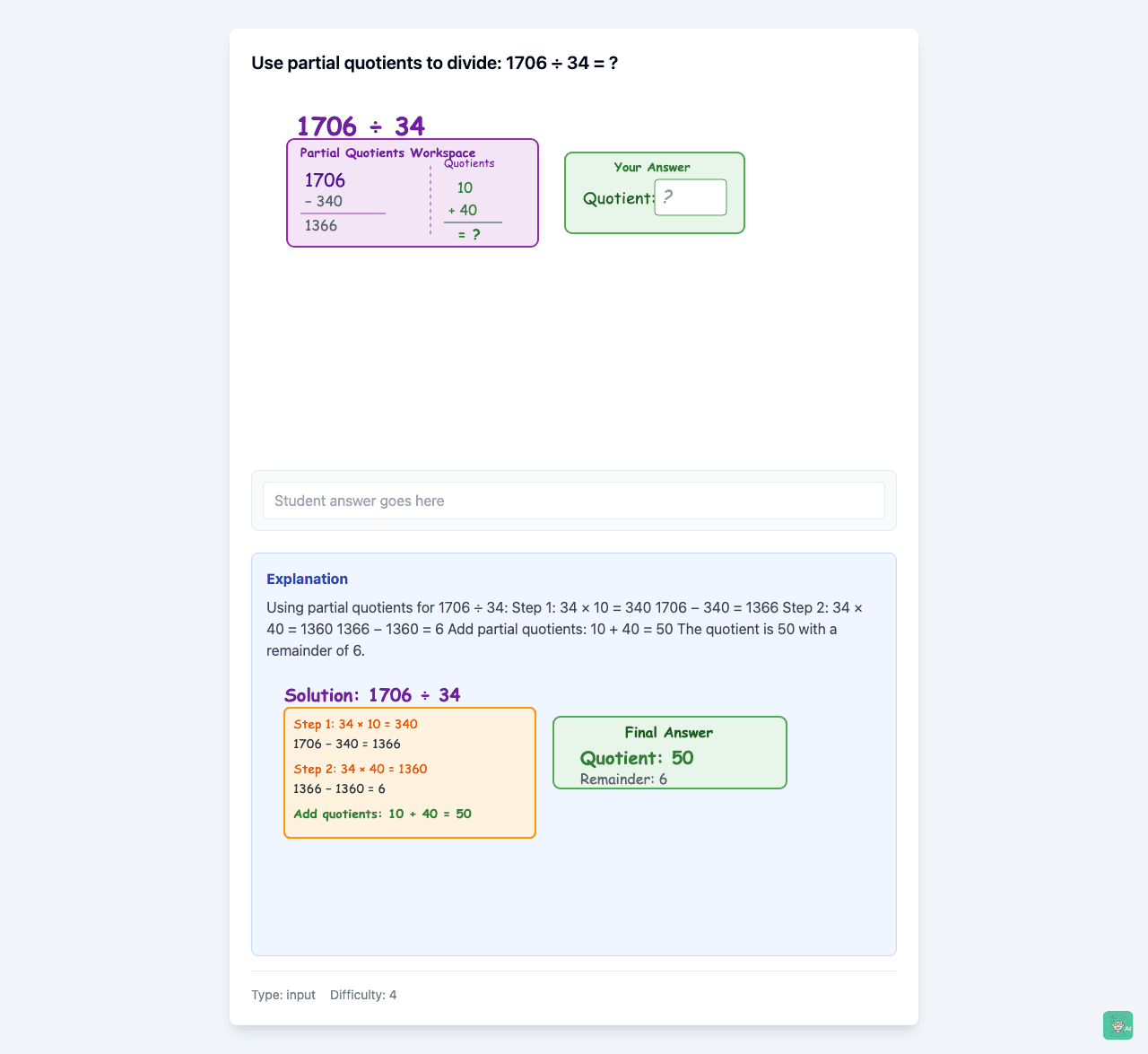
The partial quotients method is a division strategy that breaks intimidating problems into smaller, more manageable pieces. Instead of trying to find the exact answer in one step (like the traditional long division algorithm), students subtract "chunks" they're comfortable with, then add those chunks together at the end.
Why is this approach gaining popularity? Because it meets kids where they are. If a child isn't sure how many times 23 goes into 184, they don't have to guess perfectly on the first try. They can start by subtracting 23 five times (that's 115), see they have 69 left, subtract 23 twice more (that's 46), and find they have 23 remaining for one final subtraction. The partial quotients (5 + 2 + 1) add up to 8, giving them the answer.
This method has several advantages that make it particularly effective for young learners:
- Reduces anxiety: Kids don't have to get the "perfect" first guess
- Builds number sense: Students work with numbers that make sense to them
- Shows the reasoning: Every step has visible logic, making it easier to find and fix errors
- Flexible approach: There's more than one correct path to the answer
The interactive problem below shows exactly how partial quotients works in practice on AI Teacherly, with step-by-step scaffolding that guides students through each chunk of the division process.
Many parents worry that this "new math" will confuse their children or that it's inferior to traditional methods. The truth is that partial quotients develops deeper understanding. Students who learn this way often have stronger estimation skills and better number sense, which serves them well in algebra and beyond.
How to Help Your Child Estimate Before Dividing
Estimation is the secret weapon of successful division, and it's a skill you can reinforce at home without needing to remember any specific algorithm. When your child starts a division problem, the first question to ask is: "What's your estimate?"
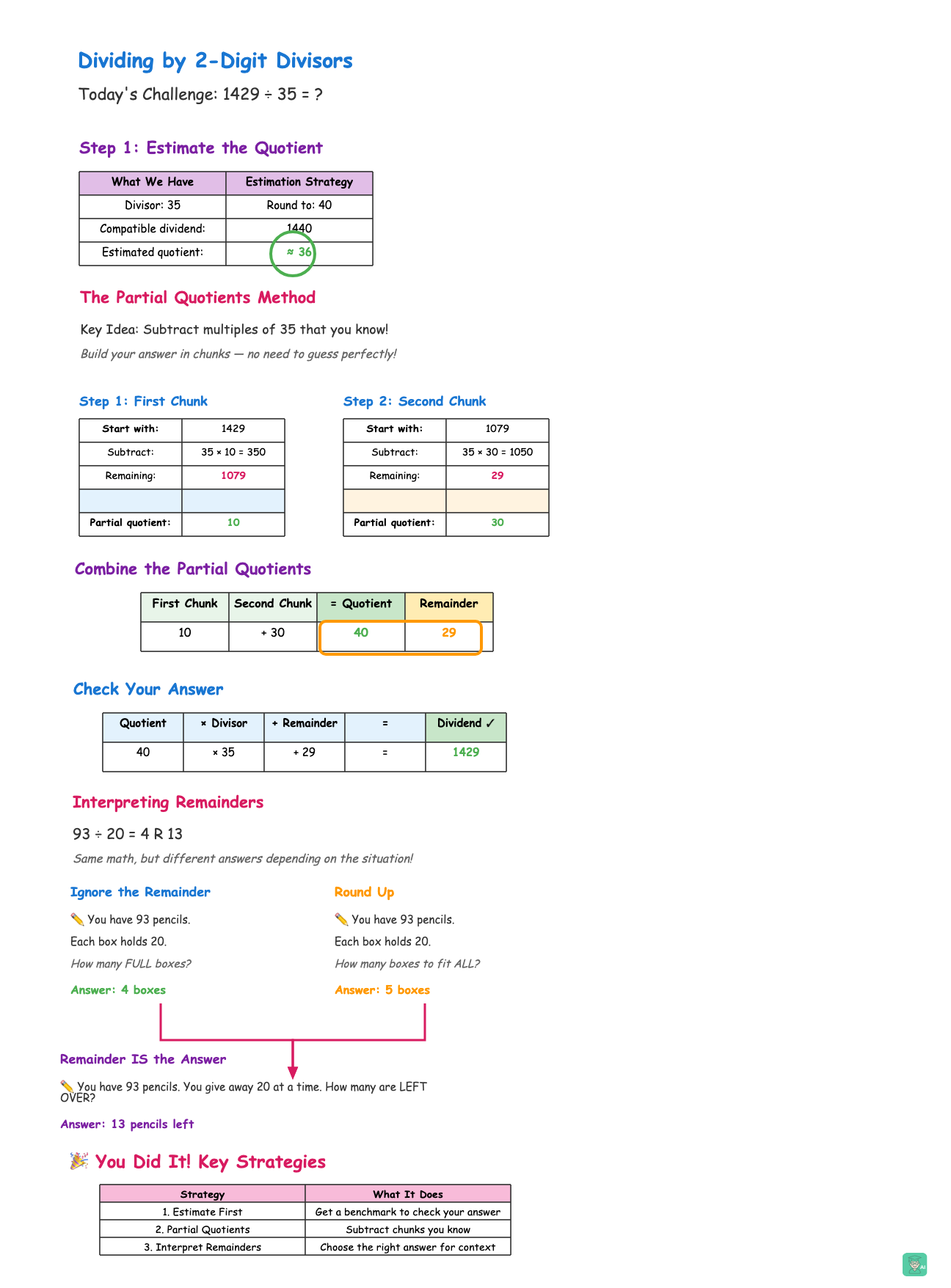
Here's the technique schools teach, and it's brilliantly simple: have your child round the divisor to the nearest ten to create "compatible numbers." For example:
- Dividing by 23? Round to 20 for easier mental math
- Dividing by 48? Round to 50
- Dividing by 31? Round to 30
Let's say your child needs to solve 276 ÷ 23. By rounding 23 to 20, they can quickly estimate: "20 goes into 276 about 13 or 14 times." This gives them a target to check their actual answer against. If they calculate an answer of 47, they know something went wrong because that's way off from their estimate.
Practical tips for parents:
- Make estimation a habit: Before any calculation, ask "What do you think the answer will be close to?"
- Celebrate reasonable estimates: The goal isn't perfection; it's developing number sense
- Use real-life examples: "If we have 156 photos and can fit about 12 on each page, roughly how many pages will we need?"
- Praise the process: When their estimate is close to their final answer, point out that their number sense is growing
This estimation step also helps students catch their own errors. A child who estimates "about 10" and then calculates "87" will naturally pause and recheck their work, building self-correction habits that will serve them throughout their math education.
What Do Remainders Really Mean? Three Real-World Scenarios
Here's something that surprises many parents: the same division problem can have three different correct answers depending on the real-world context. This is one of the most important concepts in 5th grade division, and it's where critical thinking meets calculation.
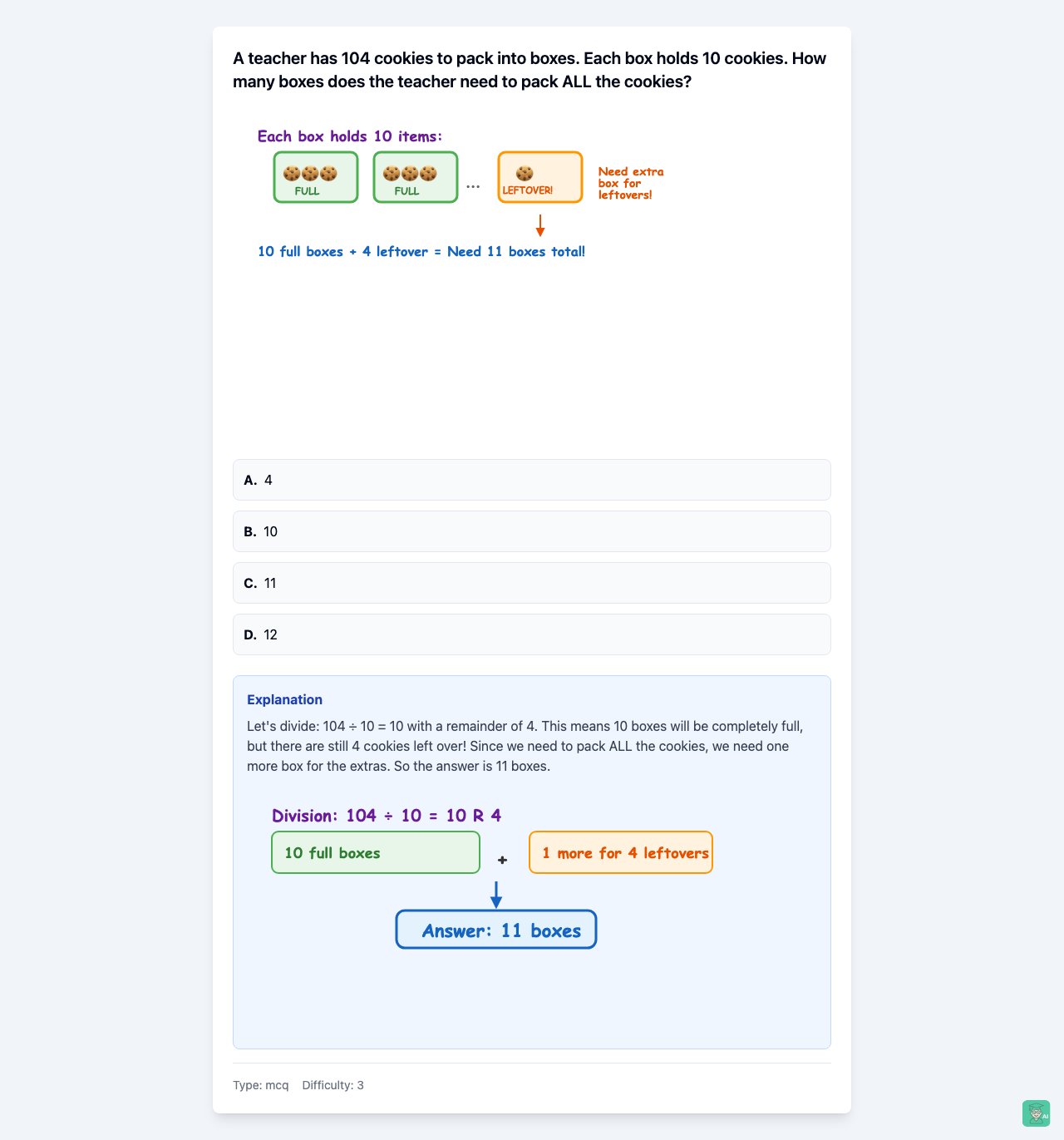
Let's use an example: 25 ÷ 4 = 6 remainder 1. In pure math terms, that's the answer. But watch what happens in real situations:
Scenario 1: Ignore the Remainder Problem: "You have 25 students and want to form teams of 4. How many complete teams can you make?" Answer: 6 teams (the remaining student can't form a complete team)
Scenario 2: Round Up Problem: "You have 25 books to pack, and each box holds 4 books. How many boxes do you need?" Answer: 7 boxes (you need that extra box for the remaining book!)
Scenario 3: The Remainder IS the Answer Problem: "You have 25 stickers to share equally among 4 friends. How many stickers are left over?" Answer: 1 sticker (the remainder itself is what we're looking for)
The interactive problem below illustrates this concept beautifully, showing students how to think through real-world scenarios and determine what to do with that remainder.
How to help at home: When your child encounters remainder problems, ask: "What does this situation really need? All the items? Complete groups? Or the leftover amount?" This question transforms division from a mechanical process into genuine problem-solving.
As the AI Teacherly lesson puts it: "Same division, three different answers. Context matters!" This insight is what separates students who truly understand division from those who can only calculate it.
How Your Child Can Check Their Own Work
One of the most valuable skills your 5th grader can develop is self-verification. Instead of asking you "Is this right?" every few minutes, they can learn to check their own division answers using multiplication. This builds independence and catches errors before they become habits.
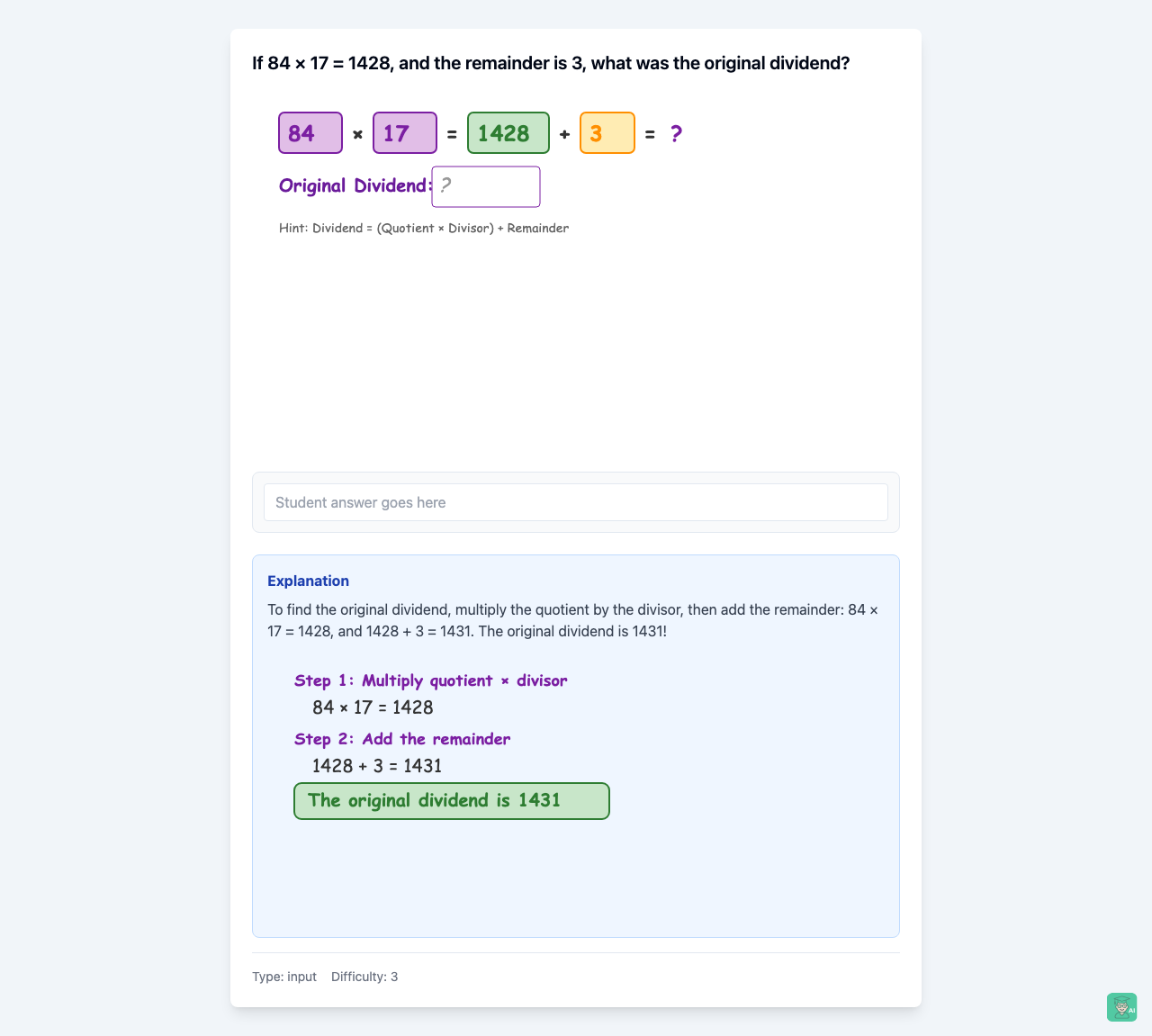
The formula is simple and works every time:
Quotient × Divisor + Remainder = Original Number (Dividend)
Let's see it in action. If your child solves 157 ÷ 12 and gets 13 remainder 1, they can verify:
- 13 × 12 = 156
- 156 + 1 = 157 ✓
If the check doesn't equal the original number, something went wrong in the calculation, and they know to go back and find the error.
The interactive exercise below demonstrates this multiplication check method, showing students exactly how to verify their division work.
Tips for reinforcing this at home:
- Make checking non-negotiable: "Great, you got an answer! Now prove it's right."
- Praise the process: When they catch their own error through checking, celebrate that more than getting it right the first time
- Model it yourself: When helping with homework, show your checking work out loud
- Point out the connection: This reinforces that multiplication and division are inverse operations, a key mathematical concept
This self-checking habit does more than ensure correct answers. It builds metacognition (thinking about thinking), develops persistence, and gives your child the confidence to tackle harder problems knowing they have a tool to verify their work.
Practical Tips: Supporting Your Child Without Causing Confusion
Here's the honest truth many parents need to hear: you don't need to re-teach yourself division to help your child succeed. In fact, trying to show them "your way" can sometimes backfire, creating confusion when they return to class using different terminology and methods.
Instead, focus on these support strategies that work regardless of which algorithm is being taught:
Ask questions, don't give answers:
- "Walk me through what you're thinking."
- "What's your estimate for this problem?"
- "Does that answer make sense? Why or why not?"
- "How can you check your work?"
Create a positive homework environment:
- Schedule math homework when your child is alert, not exhausted
- Remove distractions and have scratch paper available
- Normalize struggle: "This is hard work, and your brain is growing!"
- Take breaks if frustration builds; it's okay to step away for 5 minutes
Know when to use resources:
- Interactive platforms like AI Teacherly can provide the guided practice your child needs
- Video explanations of specific methods can help both of you understand the current approach
- Don't hesitate to email the teacher if your child is consistently struggling; they want to help!
Avoid these common mistakes:
- Don't say "That's not how we did it in my day" (this undermines the teacher's method)
- Don't do the problems for them to "save time"
- Don't express your own math anxiety; kids pick up on it quickly
Your role isn't to be a math teacher. It's to be a supportive coach who helps your child develop problem-solving resilience. The specific method matters less than the confidence and persistence they build along the way.
Key Takeaways for Helping With 2-Digit Division
Supporting your 5th grader through 2-digit division doesn't require you to become a math expert. It requires understanding the modern approach and knowing the right questions to ask. Here's what to remember:
- Partial quotients is designed to reduce anxiety: Your child can subtract comfortable chunks rather than needing perfect estimates on the first try
- Estimation is the foundation: Ask "What's your estimate?" before every problem to build number sense
- Context determines what to do with remainders: The same calculation can have different answers depending on the real-world situation
- Multiplication is the checking tool: Quotient × Divisor + Remainder should equal the original number
- Your job is coach, not teacher: Ask guiding questions rather than demonstrating your method
- Interactive practice accelerates learning: Platforms like AI Teacherly provide the scaffolded, visual practice that builds genuine understanding
- Struggle is growth: Normalize difficulty and celebrate persistence, not just correct answers
The skills your child develops through 2-digit division, like estimation, logical reasoning, self-verification, and contextual thinking, will serve them well beyond elementary math. Your support during this challenging topic can build the confidence they need for algebra and beyond.
Ready to give your child engaging, interactive practice with 2-digit division? The Dividing by 2-Digit Divisors lesson on AI Teacherly walks students through partial quotients, remainder interpretation, and self-checking strategies with visual scaffolding that makes these concepts click.
Key Takeaways
- Partial quotients breaks division into manageable chunks, reducing anxiety and building number sense
- Estimation using compatible numbers (rounding to nearest 10) is the secret weapon for division success
- The same division problem can have three different answers depending on real-world context
- Children can self-check using multiplication: Quotient × Divisor + Remainder = Original Number
- Parents should ask guiding questions rather than demonstrating their own methods
- Interactive platforms provide scaffolded practice that builds genuine understanding
- Struggling with 2-digit division is normal; persistence matters more than perfection
Frequently Asked Questions
What is the partial quotients method for division?
Partial quotients is a division strategy where students subtract comfortable chunks from the dividend rather than finding the exact answer in one step. They add these partial quotients together at the end to get the final answer, reducing anxiety and building number sense.
Why does my child's division look different than how I learned it?
Schools now often teach partial quotients because research shows it builds deeper number sense and reduces math anxiety. Rather than memorizing steps, students develop flexible thinking that serves them better in advanced math.
How do I help my child with division without confusing them?
Focus on asking guiding questions like 'What's your estimate?' and 'Does that answer make sense?' rather than showing your old method. Your role is coach, not teacher, and these questions work regardless of which algorithm is being used.
Is it normal for 5th graders to struggle with 2-digit division?
Absolutely. The jump from 1-digit to 2-digit divisors is one of the biggest leaps in elementary math. It requires estimation, multi-step tracking, and contextual reasoning. Most students need significant practice before it clicks.
What are compatible numbers in division?
Compatible numbers are rounded versions of the actual numbers that make mental math easier. For example, when dividing by 23, students round to 20 to estimate quickly. This gives them a target answer to check their work against.
How can my child check their division answers?
Use the multiplication check: Quotient × Divisor + Remainder should equal the original number. For example, if 157 ÷ 12 = 13 R1, check: 13 × 12 + 1 = 157. If it doesn't match, there's an error to find.
Should I teach my child the traditional long division algorithm?
It's best to support the method their teacher is using rather than introducing alternatives that might create confusion. Partial quotients develops the same skills while building stronger number sense. You can always mention other methods exist once they've mastered the current approach.
What do the different types of remainders mean in word problems?
The same remainder can mean different things: sometimes you ignore it (forming complete teams), sometimes you round up (needing boxes for ALL items), and sometimes the remainder IS the answer (stickers left over). Context determines the correct interpretation.
Ready to make 2-digit division click for your child? Try the interactive Dividing by 2-Digit Divisors lesson free on AI Teacherly and watch their confidence grow!