Help Your Child Solve Multi-Step Word Problems: A Parent's 4-Step Guide
Feeling stuck when your 5th grader asks for word problem help? Discover the simple 4-step system teachers use to break down complex problems, and learn how to guide your child without giving away the answer.

Why Multi-Step Word Problems Trip Up 5th Graders (And Their Parents)
That sinking feeling when your child asks for homework help and you see a word problem with multiple steps? You're not alone. Multi-step word problems are one of the most challenging concepts in 5th grade math, and they trip up kids and parents alike.
Here's the thing: these problems aren't just testing math skills. They're testing reading comprehension, logical thinking, and the ability to organize information. That's a lot to juggle at once! Your child might be perfectly capable of multiplication and division, but when those operations are buried inside a paragraph about packages, prices, and leftover items, everything suddenly feels overwhelming.
The good news? There's a systematic approach that works every time. In this guide, you'll learn the exact 4-step system used in classrooms to break down complex word problems. You'll also discover how to help your child without simply giving them the answer (which, let's be honest, doesn't help anyone in the long run).
By the end of this article, you'll feel confident guiding your 5th grader through even the trickiest multi-step problems. No math degree required.
What Are Multi-Step Word Problems and Why Do They Matter?
A multi-step word problem is exactly what it sounds like: a math problem that requires more than one operation to solve. Instead of a simple "What is 24 divided by 4?" question, your child might face something like this:
"Sarah needs 47 balloons for a party. Balloons come in packages of 6 and cost $3 per package. How much will Sarah spend on balloons?"
This single problem requires three separate steps: division (how many packages?), interpreting the remainder (can you buy part of a package?), and multiplication (what's the total cost?). Each step builds on the previous one, and making an error anywhere along the chain affects the final answer.
Why do 5th graders struggle with these problems?
Several factors make multi-step problems particularly challenging:
- Information overload: There's a lot of data to process and organize
- Hidden operations: The problem doesn't say "divide then multiply" outright
- Remainder confusion: Kids often don't know what to do when numbers don't divide evenly
- Losing track: It's easy to solve one step and forget there's more to do
Why do these problems matter for your child's future?
Multi-step word problems build critical thinking skills that extend far beyond math class. They teach kids to analyze situations, plan approaches, and check whether answers make sense in real-world contexts. These are exactly the skills your child will need in middle school, high school, and beyond.
The 4-Step System That Works Every Time
Here's the secret that makes multi-step word problems manageable: a consistent system. When your child follows the same four steps every time, even the most complicated problems become approachable.
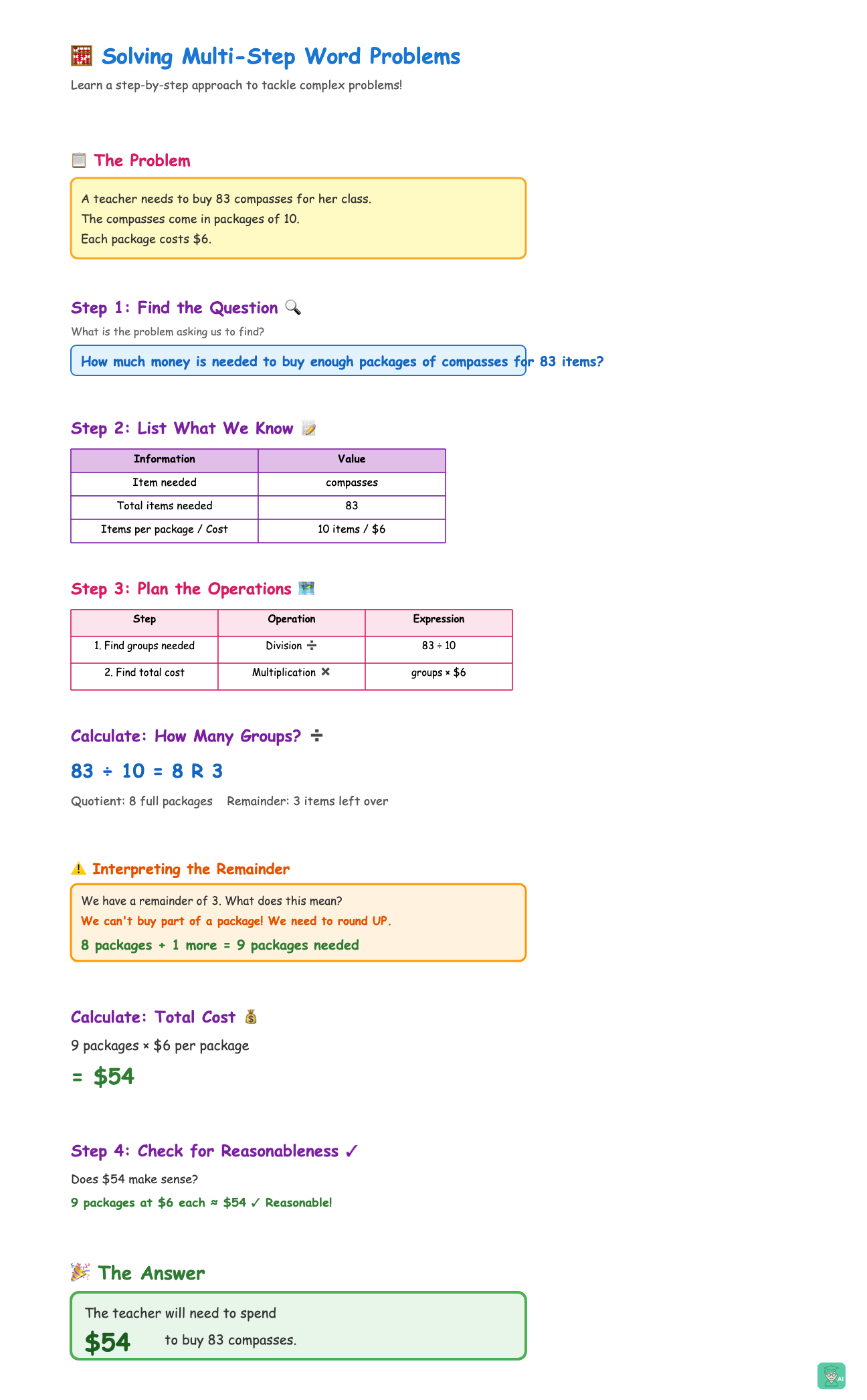
Step 1: Find the Question First
Before any math happens, your child needs to identify exactly what the problem is asking. This sounds obvious, but it's the step kids skip most often! Encourage your child to underline the question or say it out loud: "The problem wants me to find out how much Sarah will spend."
Step 2: List the Facts
Next, pull out all the important information and organize it. Many teachers recommend making a simple list or table:
- Sarah needs: 47 balloons
- Balloons per package: 6
- Cost per package: $3
This step helps your child see what they're working with and prevents important details from getting lost.
Step 3: Plan the Operations
Now comes the math thinking. Your child should identify which operations to use and in what order. The key insight here is that words become math, step by step. "How many packages" signals division. "Total cost" signals multiplication.
Step 4: Solve and Check for Reasonableness
Finally, do the math and then ask: "Does this answer make sense?" If Sarah ends up spending $3,000 on balloons, something went wrong! This final check catches errors before they become wrong answers.
The interactive problem below shows exactly how this 4-step system works in practice, guiding students through each phase of problem-solving.
How to Help Your Child Without Giving Away the Answer
Here's the parenting dilemma: you want to help your child succeed, but you also know that doing the problem for them doesn't build real understanding. The solution is to become a guide rather than an answer-giver.
Ask questions instead of giving instructions:
Instead of saying "First you need to divide," try asking:
- "What is the problem asking you to find?"
- "What information do you have to work with?"
- "What operation might help you figure out how many packages?"
These questions lead your child to discover the solution path themselves, which builds much stronger problem-solving skills.
Validate the struggle:
When your child says "This is too hard," resist the urge to jump in and simplify. Instead, acknowledge their feelings: "I can see this one is tricky. Let's break it into smaller pieces." This teaches persistence, which is arguably more important than any single math skill.
Use the same language as the classroom:
One common frustration parents face is teaching methods that differ from what the teacher uses. This can confuse kids and create conflict. When possible, stick to the 4-step system rather than introducing your own shortcuts. The consistency helps your child feel confident in their approach.
Know when to step back:
If your child is getting frustrated and you're both losing patience, it's okay to take a break. Math anxiety is real, and pushing through tears rarely leads to learning. Come back to the problem later with fresh eyes.
What Should Kids Do When There's a Remainder?
Remainders are where multi-step word problems get really interesting, and where many kids make mistakes. The key lesson: what you do with a remainder depends on the real-world context.
Let's go back to Sarah's balloon problem. She needs 47 balloons, and they come in packages of 6.
47 ÷ 6 = 7 remainder 5
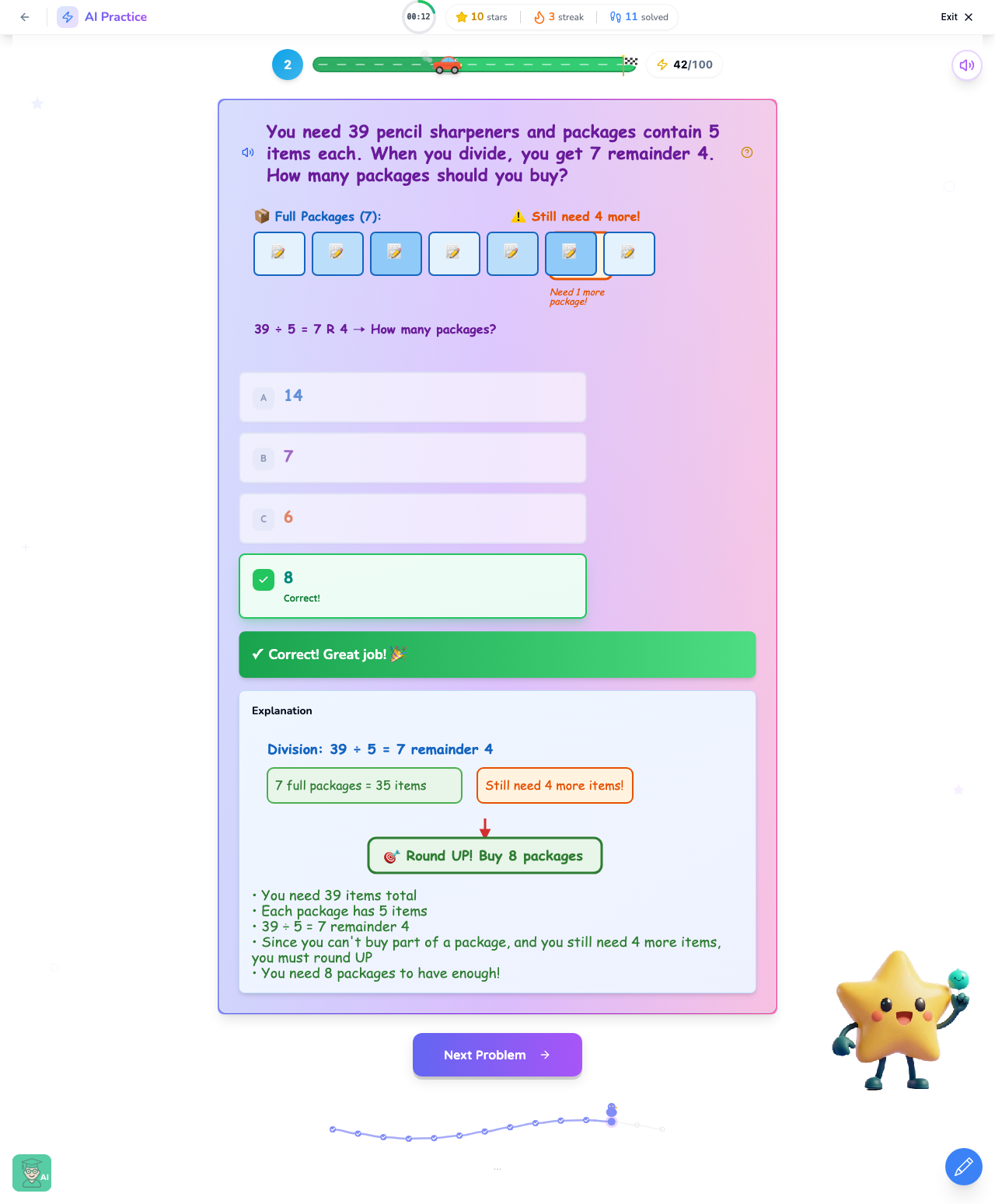
So Sarah needs 7 full packages plus 5 extra balloons. But here's the critical question: Can Sarah buy part of a package?
The answer is no! Stores don't sell partial packages. So even though the math says 7 remainder 5, Sarah actually needs to buy 8 packages to have enough balloons.
This "remainder interpretation" skill is one of the most valuable things your child will learn from multi-step problems. It teaches them to think about what answers mean in real life, not just what the calculator shows.
Different remainder scenarios:
- Round up: When you need "at least" a certain amount (packages, buses for a field trip)
- Round down: When you can only use complete groups (teams of 4 players)
- Use the remainder: When the leftover amount is the answer (how many extras?)
The interactive example below demonstrates exactly this concept, showing students how to interpret what their remainder means in context.
Common Mistakes to Watch For (And How to Fix Them)
When helping your child with multi-step word problems, watch for these common errors:
Mistake #1: Starting to calculate before reading the whole problem
Kids often grab the first numbers they see and start doing math. The fix: require your child to read the entire problem once before picking up a pencil. Then have them identify the question before touching any numbers.
Mistake #2: Using the wrong operation
When a problem mentions "each" or "per," kids sometimes multiply when they should divide (or vice versa). The fix: have your child explain in their own words what they're trying to find. "I need to figure out how many groups" points to division. "I need to find the total" often points to multiplication.
Mistake #3: Stopping after one step
Multi-step problems require multiple steps (obvious, but kids forget!). The fix: after each calculation, have your child check back with the original question. "Did I answer what the problem asked?" If not, there's more work to do.
Mistake #4: Ignoring the remainder
As discussed above, remainders matter. The fix: when division produces a remainder, always ask, "What does this leftover amount mean in the real situation?"
Mistake #5: Writing an answer without units
An answer of "24" is incomplete. 24 what? Dollars? Packages? Balloons? The fix: require your child to include units in every answer. This also serves as a reasonableness check, because "24 dollars" for balloons sounds reasonable, while "24 packages" might prompt a second look.
Practice Ideas You Can Try at Home Tonight
The best way to build confidence with multi-step word problems is through practice, but it doesn't have to feel like extra homework. Here are some engaging ways to work on these skills at home:
Turn shopping trips into math problems:
"We need 14 juice boxes for your class party. They come in packs of 3 for $4 each. How much will we spend?" Real-world context makes abstract math meaningful, and your child will remember these problems because they actually happened.
Use cooking and baking:
"This recipe makes 12 cookies, but we need 30 for the bake sale. How many batches do we need? If each batch uses 2 eggs, how many eggs total?" Bonus: you get cookies at the end.
Play "What's the Question?":
Give your child some facts and have them create the word problem. "Dad drove 45 miles. Gas costs $3 per gallon. The car gets 15 miles per gallon." What questions could we ask? This reverse engineering builds deep understanding of problem structure.
Try interactive online practice:
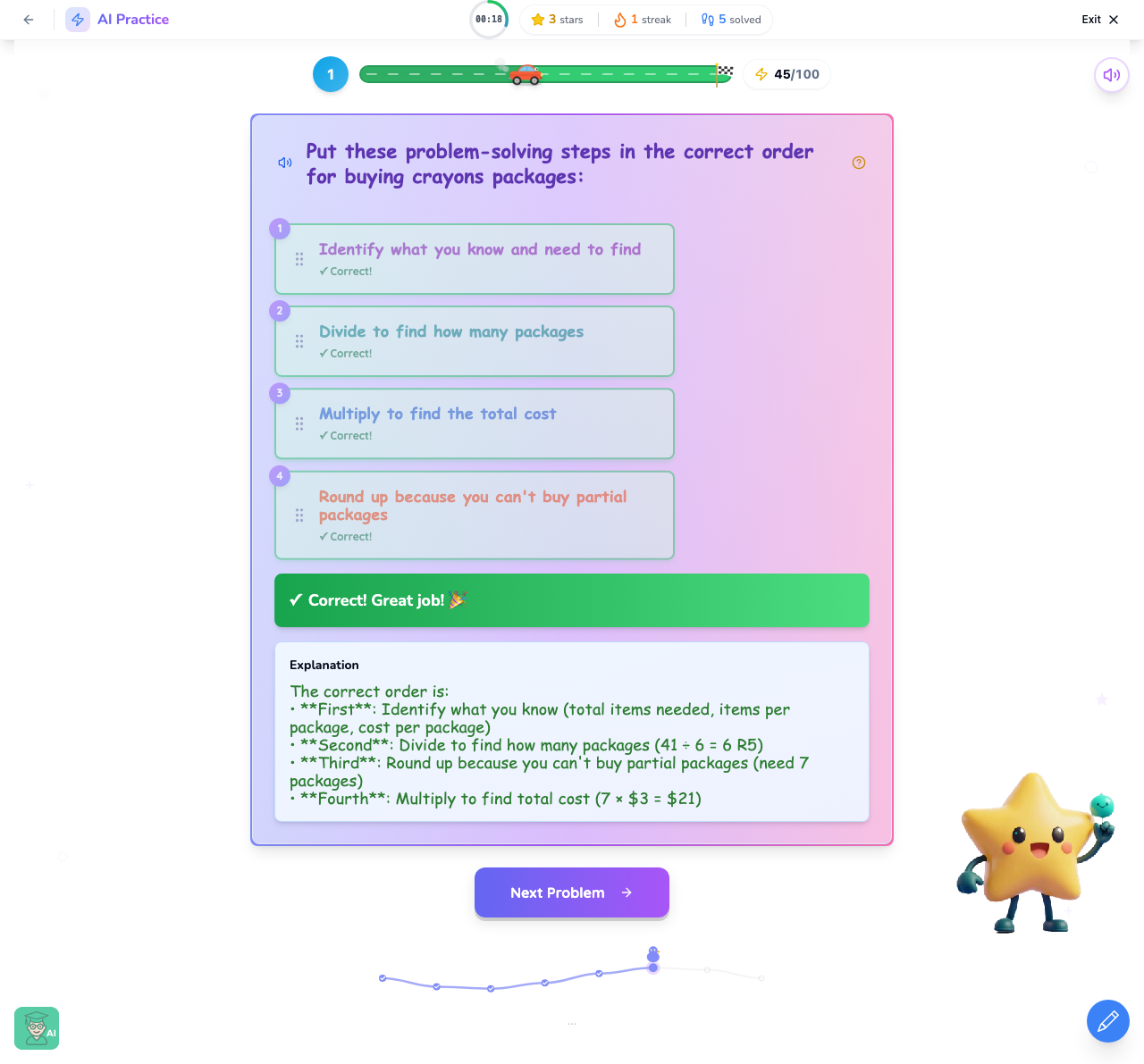
Platforms like AI Teacherly offer interactive word problem lessons where kids can work through problems step by step with immediate feedback. The drag-and-drop activities, like the ordering problem shown below, make practicing feel more like a game than a worksheet.
The key is consistency: even 10 to 15 minutes of practice a few times per week builds lasting skills.
Key Takeaways for Parents
Let's summarize what you've learned about helping your child conquer multi-step word problems:
Use the 4-step system consistently: Find the question, list the facts, plan operations, check for reasonableness. This framework works for every multi-step problem.
Guide with questions, not answers: Ask "What is the problem asking?" instead of telling your child what to do. This builds independent problem-solving skills.
Teach remainder interpretation: The math answer and the real-world answer aren't always the same. Help your child think about what remainders mean in context.
Watch for common mistakes: Starting before reading fully, stopping after one step, and forgetting units are fixable habits once you know to look for them.
Make practice feel natural: Shopping trips, cooking, and interactive online lessons turn skill-building into everyday moments rather than homework battles.
Stay patient: Multi-step problems are genuinely challenging. Validate your child's effort and take breaks when frustration builds.
Remember: your goal isn't to make word problems easy. It's to give your child a reliable system for tackling hard problems. That skill will serve them far beyond 5th grade math.
Key Takeaways
- Use the 4-step system every time: Find the question, list facts, plan operations, check reasonableness
- Guide your child with questions rather than giving direct answers to build independent problem-solving
- Teach remainder interpretation: rounding up, down, or using the leftover depends on real-world context
- Watch for common mistakes like starting calculations before reading fully or stopping after just one step
- Turn everyday activities like shopping and cooking into natural word problem practice
- Stay patient and take breaks when needed, as math anxiety can block learning
Frequently Asked Questions
What is a multi-step word problem in 5th grade math?
A multi-step word problem requires more than one mathematical operation to solve. For example, a problem might need division to find how many packages, then multiplication to find total cost.
How can I help my child with word problems without giving the answer?
Ask guiding questions instead of providing instructions. Try "What is the problem asking you to find?" or "What operation might help here?" This builds independent thinking skills.
Why does my child struggle with multi-step word problems?
These problems combine reading comprehension, logical sequencing, and multiple math operations. The information overload and hidden operations make them challenging for most 5th graders.
What should my child do when a word problem has a remainder?
Interpret the remainder based on context. Round up when you need enough (packages, buses), round down for complete groups only (teams), or use the remainder when asked about leftovers.
How do I know if my child's word problem answer is reasonable?
Check if the answer makes real-world sense. If buying party supplies costs $3,000 or a trip takes 500 hours, something went wrong. Always include units to help spot errors.
What are the steps to solve a multi-step word problem?
Follow four steps: 1) Find the question being asked, 2) List all important facts, 3) Plan which operations to use and in what order, 4) Solve and check if the answer is reasonable.
How can I practice word problems with my child at home?
Turn real situations into problems: shopping trips, cooking recipes, planning events. Interactive platforms like AI Teacherly also provide engaging practice with immediate feedback.
Is it normal for my child to find multi-step problems difficult?
Yes, completely normal. Multi-step problems are one of the most challenging 5th grade math concepts because they require reading, organizing, and calculating across multiple steps.
Ready to make word problems less stressful? Try the interactive Multi-Step Word Problems lesson free on AI Teacherly and watch your child's confidence grow!