Master 6th Grade Percents at Home: A Parent's Guide to Percent Relationships
Master 6th grade percents at home without the frustration. Learn how to break down percent relationships, find missing parts, and support your child's math confidence.
Introduction: Demystifying Middle School Percents
Middle school math brings a wave of new concepts, and for many families, finding percent relationships marks the moment when homework stops looking like simple arithmetic and starts looking like abstract puzzle-solving. If your child comes home staring blankly at a word problem about tax, discounts, or survey results, you are not alone. Math anxiety hits every parent when decimals and percents enter the picture, but you do not need a math degree to help your child master percent relationships at home.\n\nThe secret to conquering sixth-grade math is shifting away from memorizing random formulas and toward understanding proportional relationships. When you break down how percents connect parts to wholes in everyday contexts, you can turn kitchen table frustration into a moment of genuine clarity and success.
What Are Percent Relationships in 6th Grade Math?
In sixth-grade mathematics, percent relationships form the bridge between fractions, decimals, and ratios. At its core, a percent is simply a ratio comparing a number to 100. The word percent literally means per one hundred.\n\nStudents encounter three main variables in these problems: the part, the percent, and the whole. Every single percent problem asks the student to find one of these three pieces while knowing the other two. When children understand that percents are not separate rules to memorize, but rather flexible relationships they already recognize from splitting food or counting money, the entire topic becomes approachable. Before solving any percent problem, teach your child to pause and ask one simple question: What am I actually solving for here?
The Core Formula: Finding Part, Percent, or Whole
To successfully solve percent word problems, students must become comfortable identifying the three core components. Think of it as a triangle where each corner depends on the other two. \n\nFirst, there is the part, which represents the subset or the piece you are examining. Second is the percent, which is the rate per 100. Third is the whole, which represents the total baseline value. In the Finding Percent Relationships lesson from the sixth-grade curriculum, students practice recognizing how these three elements interact in real-world scenarios. If a student knows the part and the whole, they can find the percent. If they know the percent and the whole, they can find the part. Mastering this triad removes the guesswork from homework time.
How to Calculate What Percent One Number Is of Another
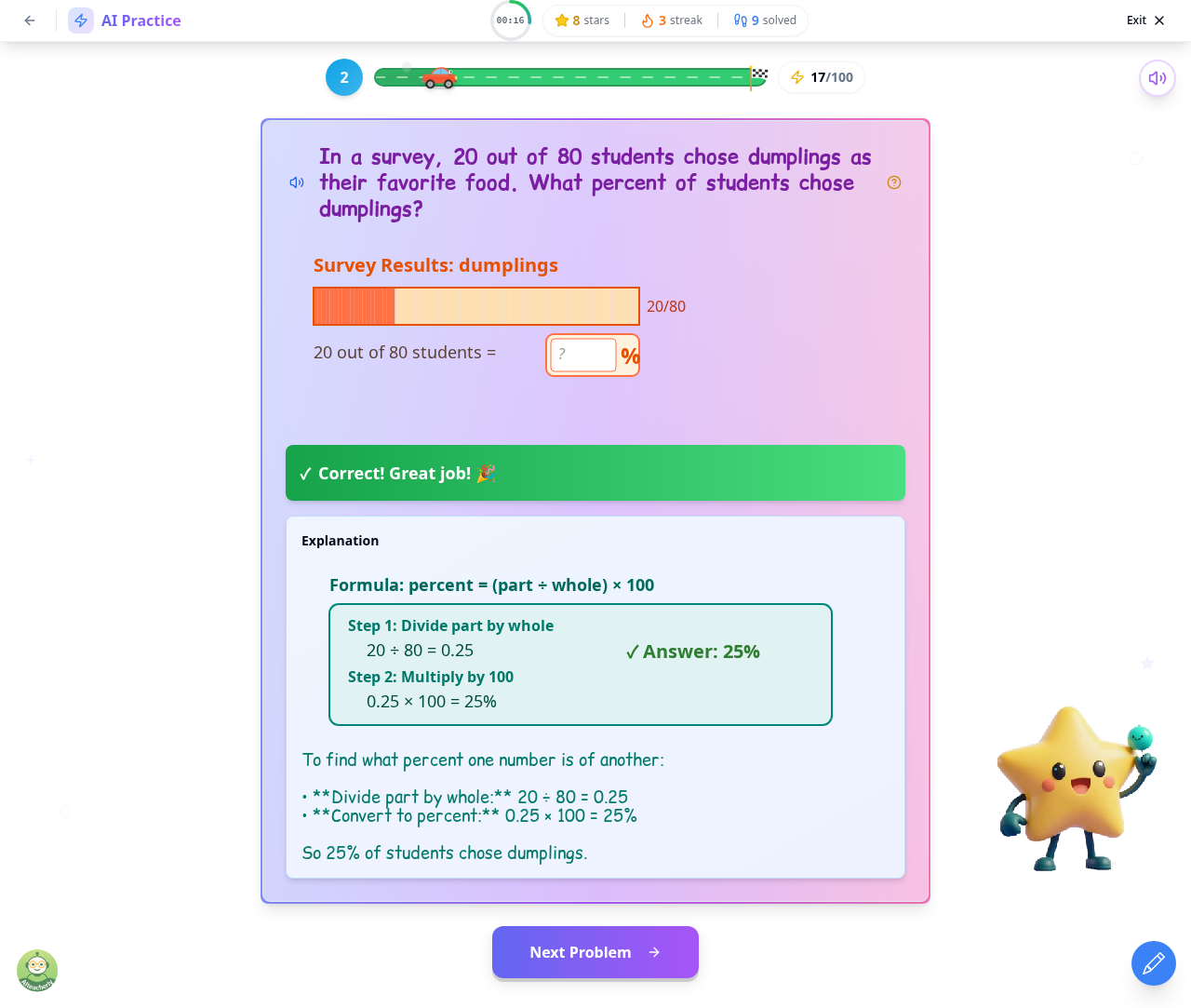
One of the most common stumbling blocks in sixth grade is figuring out what percent one number is of another. For instance, if a survey shows that 12 out of 40 students prefer reading over video games, what is that percentage?\n\nThe interactive survey problem setup calculating what percent one number is of another in 6th grade math appears below.\n\nTo solve this, remind your child to set up a division problem: part divided by the whole. In this case, divide 12 by 40, which gives you 0.30. Next, convert that decimal into a percentage by multiplying by 100, resulting in 30 percent. Breaking the process into these two manageable steps prevents confusion and builds lasting computational confidence.
Working Backwards: How to Find the Total Goal
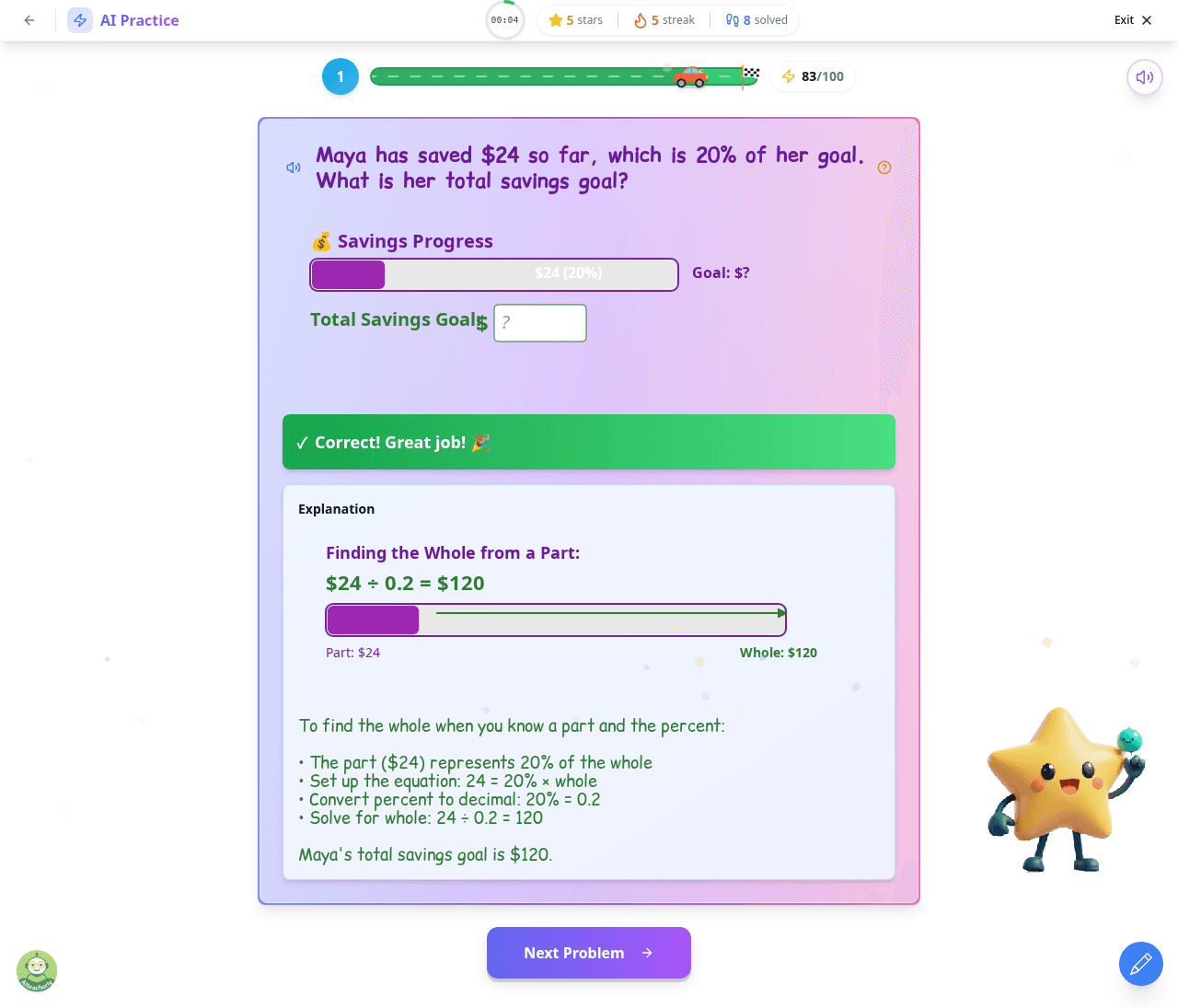
Finding a percent of a number is straightforward, but working backwards to find the total whole often causes students to freeze. For example, if 15 students represent 25 percent of the entire school club, how many total members are in the club?\n\nWhen tackling this type of problem, remind your child of a golden rule: the whole is always larger than the part when working with percentages under 100. To solve it, convert the percentage into a decimal by moving the decimal point two places to the left, turning 25 percent into 0.25. Then, divide the part by that decimal: 15 divided by 0.25 equals 60 total members. Visualizing the total as four groups of 15 makes this abstract calculation instantly click.
See How Interactive Math Practice Works on AI Teacherly
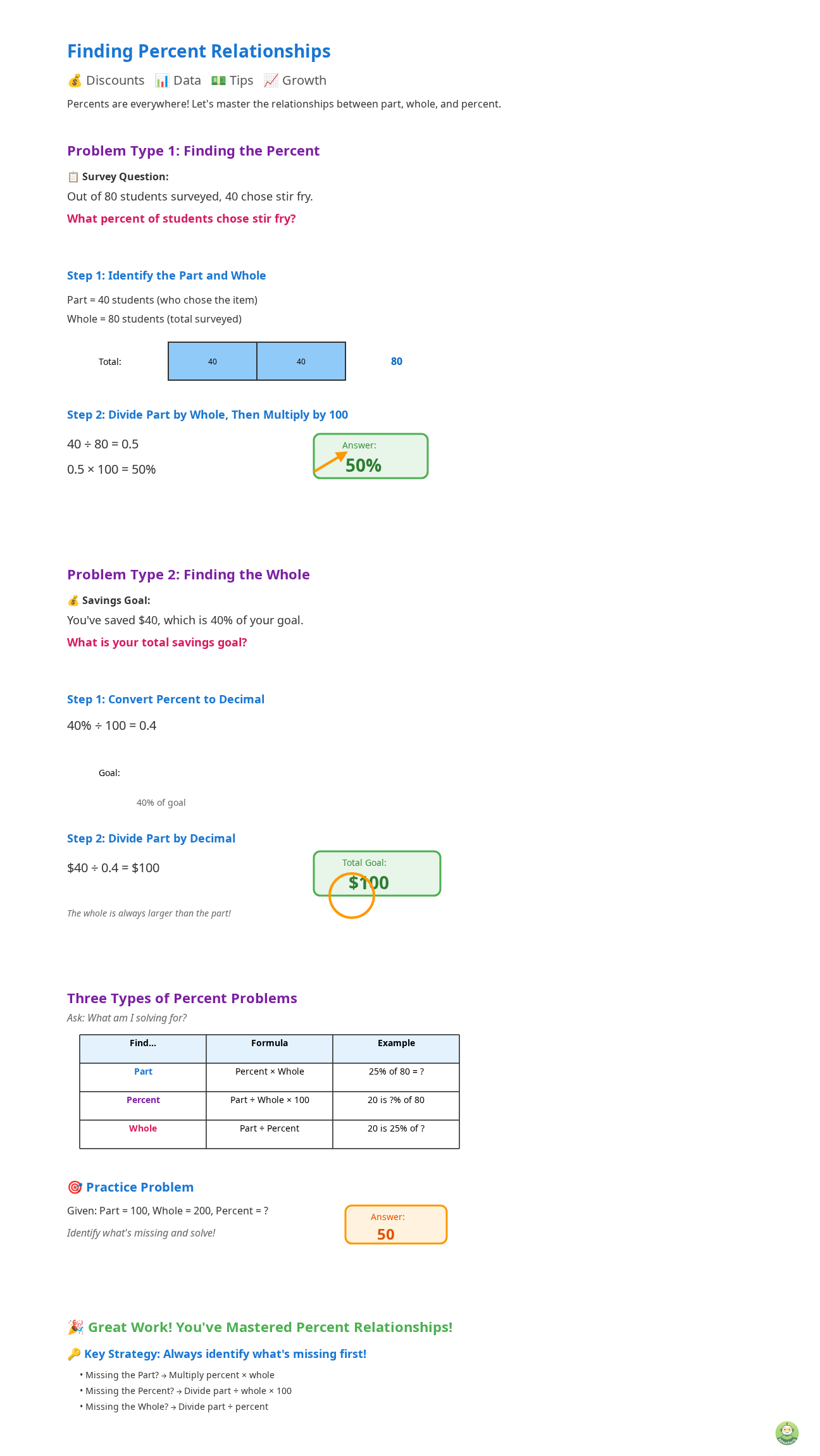
Helping your child practice these concepts does not require hours of drilling with flashcards. Interactive digital learning tools provide the scaffolding and immediate feedback that textbooks often lack.\n\nThe full interactive lesson overview showing structured problem layouts and visual practice tools appears below.\n\nPlatforms like AI Teacherly turn abstract math concepts into engaging visual experiences where students can test hypotheses, correct mistakes instantly, and build proportional reasoning skills at their own pace. When children see their progress update in real-time, math transforms from a chore into a rewarding challenge.
Key Takeaways
- Always start by identifying what is missing: the part, the percent, or the whole in the word problem.
- Remember that the whole is always larger than the part when working backwards from a percentage.
- Convert percents into decimals by moving the decimal point two places to the left before dividing or multiplying.
- Use real-world situations like grocery discounts and restaurant tips to make proportional reasoning stick.
- Leverage interactive digital platforms like AI Teacherly to provide immediate feedback and scaffolded support.
Frequently Asked Questions
How do I explain what a percent is to my 6th grader?
To explain a percent, compare it to 100 equal pieces of a whole, like a dollar with 100 pennies or a pizza cut into 100 slices. A percent simply tells you how many of those 100 pieces you have.
What is the easiest way to find the whole when given a part and percent?
When working backwards from a part and percent, divide the part by the decimal form of the percent. For example, if 15 is 25 percent of a number, divide 15 by 0.25 to find the total of 60.
Why do kids struggle with percent word problems?
Students often freeze because traditional worksheets present percents as abstract rules rather than proportional relationships. When children learn to identify the part, the whole, and the percent in real-world scenarios, the confusion disappears.
How can I practice percent relationships during everyday activities like shopping?
Grocery shopping and cooking are fantastic opportunities. When you see a shirt on sale for 20 percent off, ask your child to calculate the savings or turn dinner tipping into a fun calculation challenge.
Is it normal for 6th grade math percents to feel confusing at first?
Yes, absolutely. Sixth-grade math marks the transition from basic arithmetic to proportional reasoning. Shifting from concrete numbers to ratios and percents takes time, and feeling stuck at first is a normal part of the learning curve.
What are the three parts of a percent problem in 6th grade?
The three key components of every 6th-grade percent problem are the part, the percent, and the whole. Identifying which of these three pieces is missing is the first step to solving any problem.
How do I teach percent relationships to my middle schooler?
To calculate what percent one number is of another, divide the part by the total whole, then multiply the decimal result by 100. For example, if 12 out of 40 students play sports, divide 12 by 40 to get 0.30, which equals 30 percent.
Ready to transform homework time into a breakthrough moment? Explore Finding Percent Relationships and hundreds of other interactive 6th-grade math lessons free on AI Teacherly today!