Mastering 4th Grade Rounding: How to Teach Nearest Thousand at Home
Master 4th-grade rounding! Learn simple, visual ways to teach your child how to round 4-digit numbers to the nearest thousand at home without frustration.
Introduction: Why 4th Grade Rounding Trips Kids Up (And How You Can Fix It)
Fourth-grade mathematics brings exciting new milestones, but it also introduces concepts that can cause homework headaches around the kitchen table. Among these, rounding 4-digit numbers to the nearest thousand frequently trips students up. If your child stares blankly at numbers like 3,420 and hesitates whether to write 3,000 or 4,000, you are not alone. Many parents feel unequipped to explain place value rules without resorting to confusing jargon. The good news is that mastering rounding does not require endless drilling or frustration. By shifting away from rote memorization and using visual strategies, you can transform math time into an engaging experience that builds genuine number sense and confidence.
What Is Rounding to the Nearest Thousand? (A Quick Parent Refresher)
To help your child effectively, it helps to start with a clear, grounded definition. What is rounding to the nearest thousand in 4th grade? Simply put, rounding means finding a cleaner, simpler number that is close to the exact value. Instead of working with exact numbers like 4,312, mathematicians use rounded numbers like 4,000 for quick estimations, mental calculations, and checking whether answers make sense. For 4th graders, this means looking at 4-digit numbers spanning from 1,000 to 9,000 and determining which major thousand mark the number sits closest to on the number line. Understanding this concept gives children a powerful mental tool for everyday estimation and advanced arithmetic.
The Golden Rule: How to Check the Last Three Digits
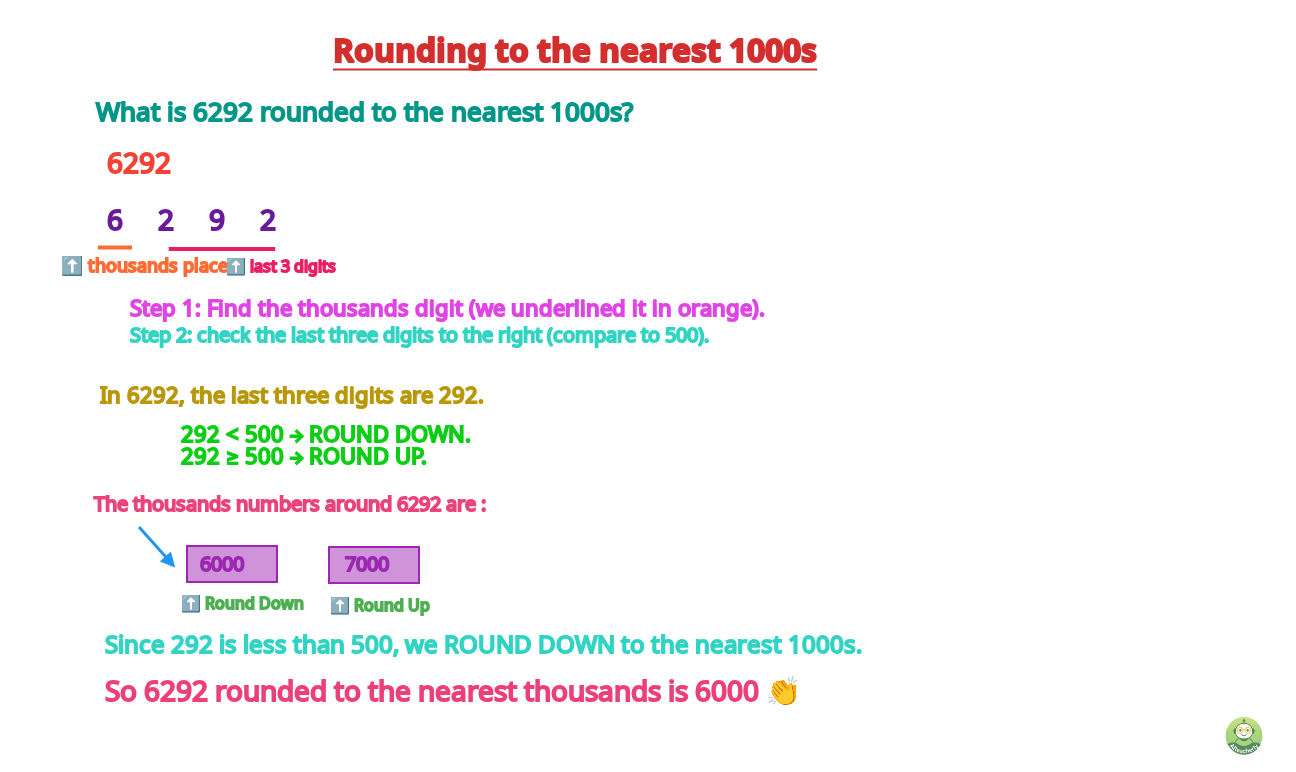
The golden rule of rounding comes down to examining the digits that follow the target place value. When rounding to the nearest thousand, your child needs to look at the thousands place digit and then check the very next digit to the right: the hundreds place. The magic midpoint is 500. If the hundreds digit is 5 or greater, the rule is to round up to the next thousand. If the hundreds digit is less than 5, the rule is to round down, keeping the thousands digit the same. Breaking this rule down into a two-step checklist takes the mystery out of the process and gives students a reliable method every single time.
3 Easy Ways to Use Visual Number Lines at Home
Worksheets full of isolated numbers can make math feel like a chore. Instead, bring numbers to life using visual number lines drawn on paper or whiteboards. Draw a line with 3,000 on the left end and 4,000 on the right end, marking 3,500 right in the middle. Ask your child to place numbers like 3,420 or 3,780 onto the number line. When children can physically see that 3,420 sits to the left of the midpoint while 3,780 sits to the right, the rounding decision becomes self-evident. This visual approach eliminates guessing and fosters deep, intuitive comprehension.
Real-World Practice: Word Problems Made Simple
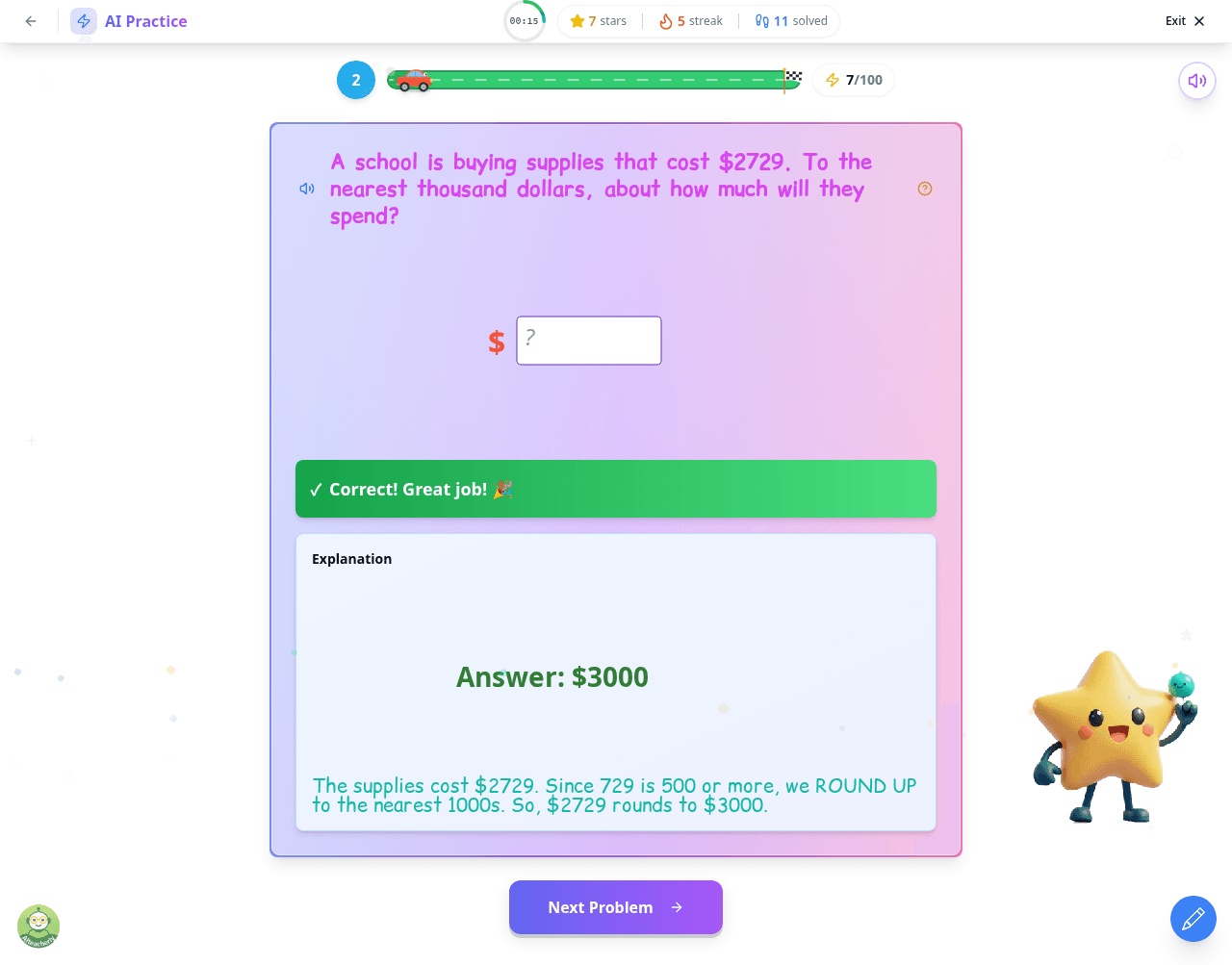
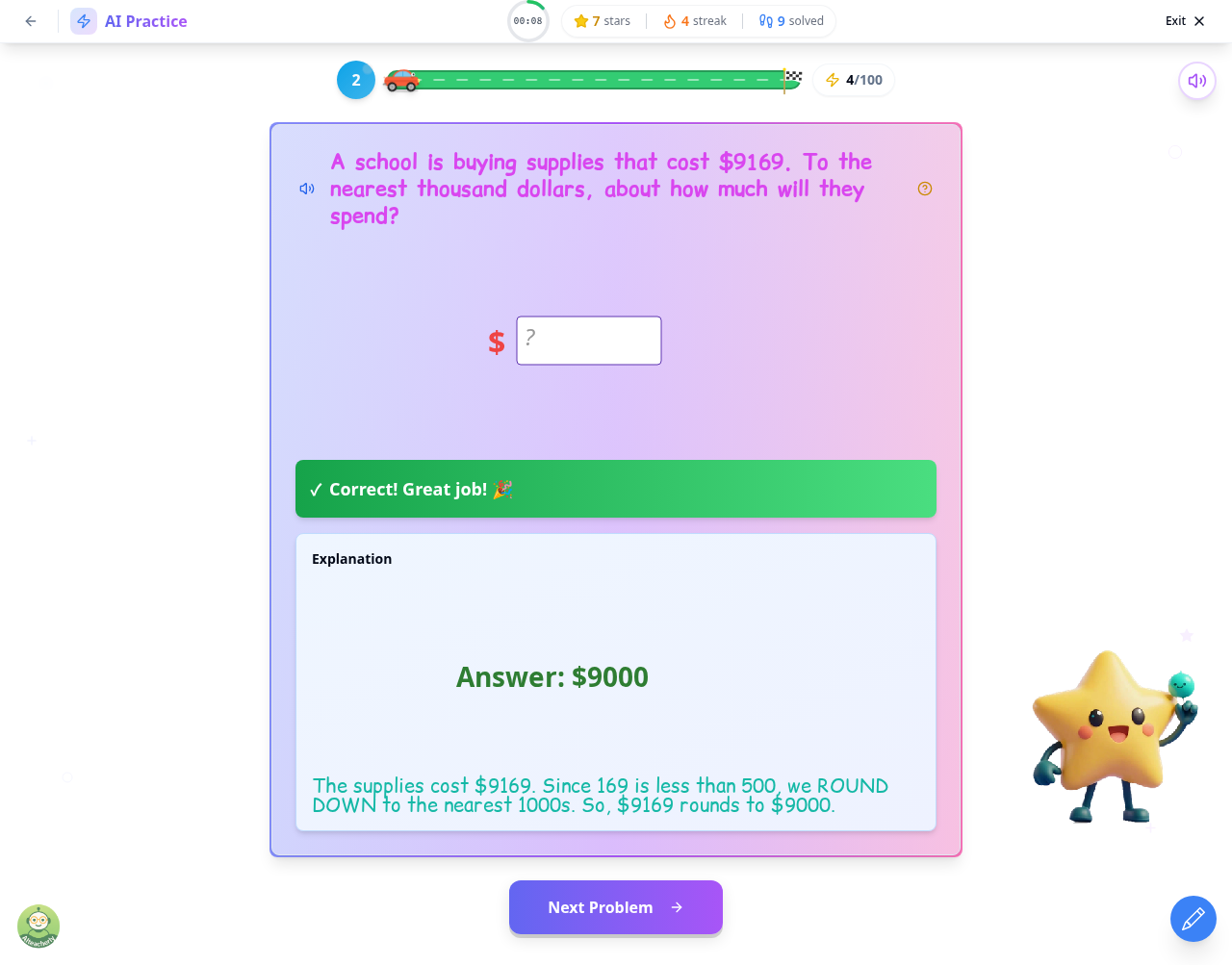
Abstract numbers become much easier to digest when tied to real-world scenarios that children encounter daily. Word problems involving money, stadium seating capacities, or school supply budgets make rounding practical and meaningful. The interactive problem below shows exactly how PEMDAS and estimation work in practice within real-world word problem formats. Here's what the interactive problem looks like during guided practice:
The interactive problem above demonstrates how 4th-grade math concepts apply directly to everyday scenarios. When children solve problems about money and quantities, they realize that rounding is not just a school rule, but a practical superpower used by shoppers, builders, and scientists every day.
See How AI Teacherly Makes Math Practice Stress-Free
Keeping 4th graders engaged during study sessions requires variety and immediate, encouraging feedback. Digital platforms can bridge the gap between school lessons and home practice without causing screen-time guilt. Here's what the full interactive lesson looks like on AI Teacherly:
Platforms like AI Teacherly turn foundational concepts like rounding into interactive journeys with visual manipulatives, instant feedback, and scaffolded hints. Instead of arguing over worksheets, parents can guide children through self-paced lessons where every correct answer builds momentum and self-assurance.
Key Takeaways
- Identify the thousands place digit and isolate the remaining three digits to make comparison easier.
- Use the 500 midpoint rule: 500 or higher rounds up to the next thousand, while below 500 rounds down.
- Leverage visual number lines rather than rote worksheets to build lasting number sense.
- Connect abstract numbers to real-world scenarios like money, distances, and school supplies.
- Keep practice sessions short, positive, and interactive using platforms like AI Teacherly.
Frequently Asked Questions
What is rounding to the nearest thousand in 4th grade?
Rounding to the nearest thousand in 4th grade means taking a 4-digit number and finding the nearest multiple of 1,000 (such as 3,000 or 4,000) so it is easier to estimate or work with mentally.
How do I teach rounding to the nearest thousand?
To teach rounding at home, use place value arrows and number lines. Have your child identify the thousands digit and look at the hundreds digit. If the hundreds digit is 5 or more, round up; if it is less than 5, round down.
When do you round up or down to the nearest 1000?
You round up when the hundreds digit is 5, 6, 7, 8, or 9 (meaning the number is at or past the 500 midpoint). You round down when the hundreds digit is 0, 1, 2, 3, or 4.
Why is my 4th grader struggling with place value and rounding?
Frustration often happens when rules are memorized mechanically without visual understanding. Using number lines helps children see distance, turning an abstract rule into a clear visual concept.
Are number lines better than worksheets for learning rounding?
Yes! Number lines are far superior to rote worksheets because they let children physically or visually see which thousand a number is closer to, building true number sense rather than memorization.
Why do kids need to learn rounding to the nearest thousand?
Teaching rounding in 4th grade builds essential estimation skills used in everyday life for budgeting, measuring, and checking the reasonableness of calculated answers.
Ready to make math practice engaging and stress-free? Explore interactive 4th-grade math lessons and rounding activities free on AI Teacherly today!