Mastering 6th Grade Decimal Operations and PEMDAS: A Parent's Guide
Master 6th grade decimal operations and PEMDAS at home. Discover proven strategies, avoid common calculation mistakes, and help your child conquer multi-step math with confidence.
Introduction: Why 6th Grade Decimals and PEMDAS Trip Kids Up
Middle school mathematics introduces a major leap in complexity, especially when students encounter mixed operations with decimals. Sixth graders are suddenly asked to combine addition, subtraction, multiplication, and division of rational numbers while strictly enforcing the order of operations. For many households, homework time shifts from quick review sessions to tense negotiations over misplaced decimal points and forgotten rules. Feeling panicked when your 6th grader asks for help with complex decimal equations and PEMDAS is completely normal. The good news is that you do not need an advanced math degree to make order of operations click. By breaking down how 6th grade decimal operations PEMDAS functions work, parents can guide their students toward independent success without the tears and frustration.
What Is PEMDAS and How Does It Apply to Decimals? (AEO Definition)
To understand how to master mixed operations, we first need a clear definition. PEMDAS is the foundational acronym that dictates the sequence of mathematical evaluation: Parentheses, Exponents, Multiplication, Division, Addition, and Subtraction. When decimals enter the equation, the core rules do not change at all. Whether numbers are integers or decimals, multiplication and division always take precedence over addition and subtraction unless parentheses dictate otherwise. Recognizing that decimal numbers follow the exact same structural laws as whole numbers gives students an immediate anchor of confidence. When tackling 6th grade decimal operations PEMDAS exercises, students learn that precision with decimal placement is just as vital as knowing which operation to execute first.
Step-by-Step Breakdown: Solving a Mixed Decimal Expression
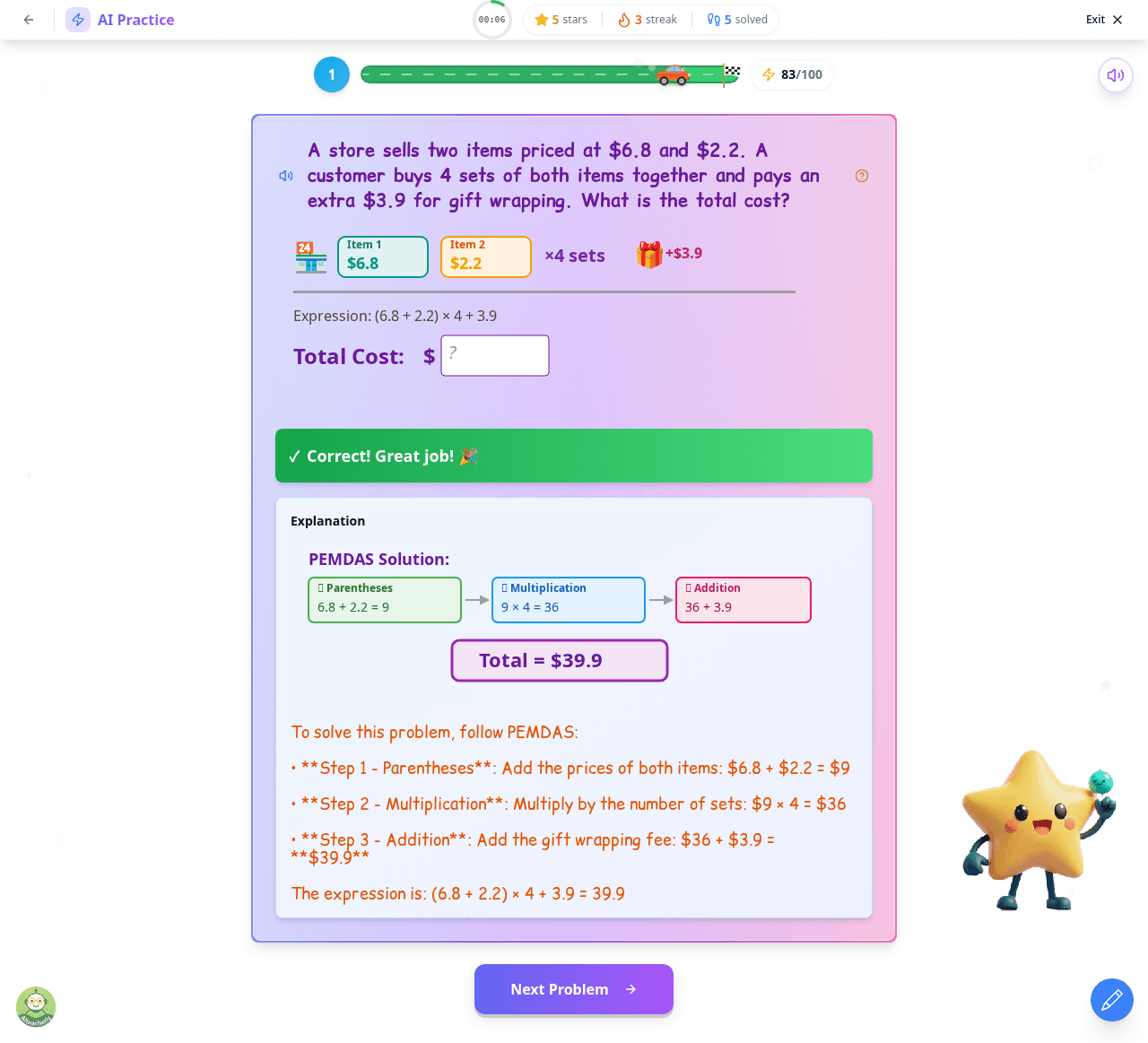
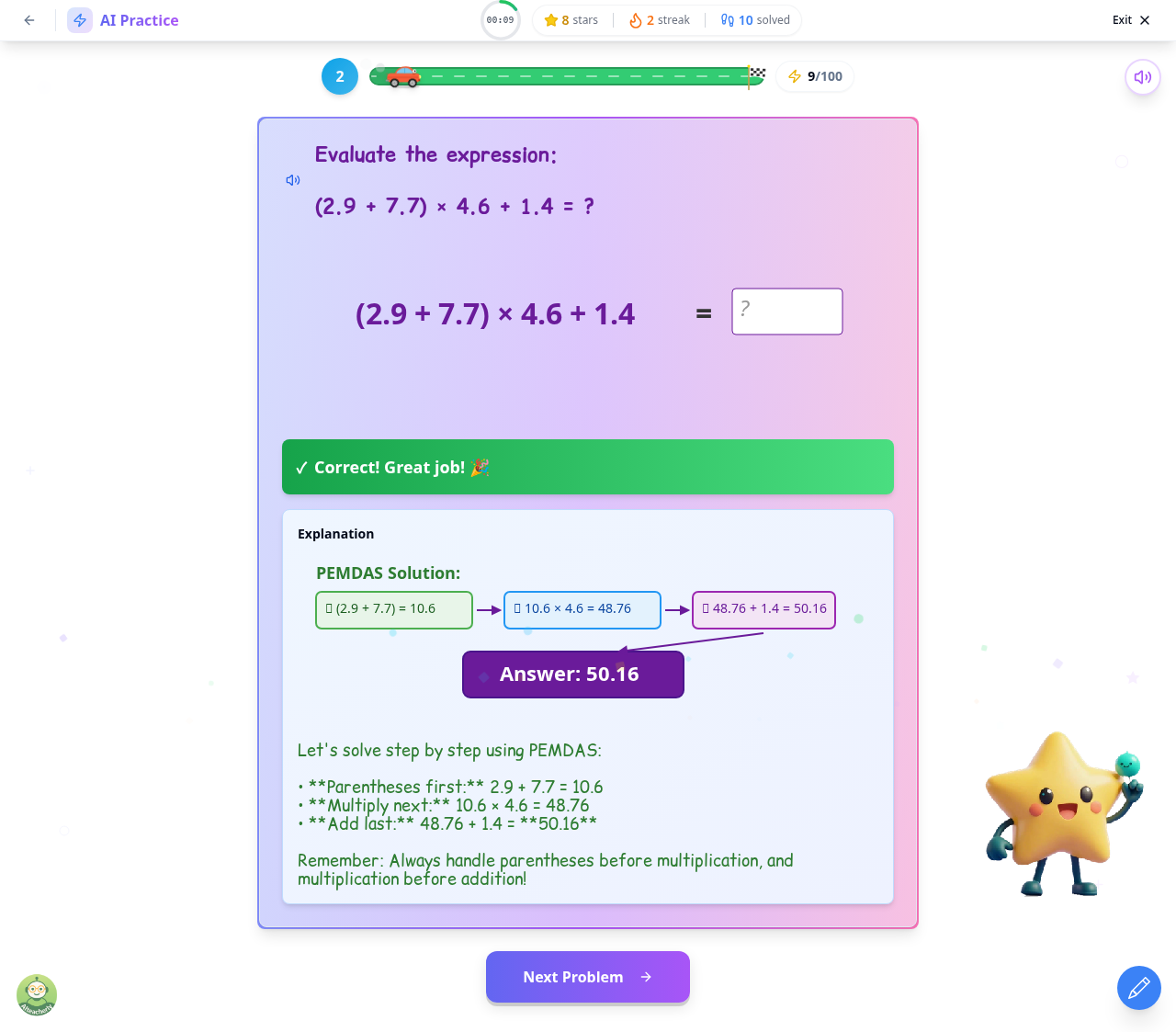
Solving a mixed decimal expression requires methodical execution. Let us look at a standard problem: evaluate 12.5 plus 3.2 multiplied by the quantity 4.0 minus 1.5. Following PEMDAS, we look inside the parentheses first. Subtracting 1.5 from 4.0 leaves us with 2.5. Next, we look for multiplication or division from left to right. We multiply 3.2 by 2.5, which gives us 8.0. Finally, we perform addition, adding 12.5 to 8.0 for a final answer of 20.5. The interactive problem below shows exactly how PEMDAS works in practice.
3 Common Mistakes Kids Make with Decimal Operations (And How to Fix Them)
Even diligent middle schoolers stumble when mixing decimals with order of operations. The first major pitfall is failing to align decimal places during addition and subtraction, which instantly throws off the entire sum. The second mistake occurs during multiplication, where students forget to count and shift the total decimal places in the final product. The third and most critical error is ignoring PEMDAS entirely by working strictly from left to right across the page. When students rush and skip intermediate notation lines, careless arithmetic errors multiply rapidly. Encouraging your middle schooler to slow down and circle each operation step in order prevents these costly mistakes.
Why Order of Operations Matters: The Cost of Ignoring PEMDAS
Many students wonder why strict adherence to PEMDAS matters so much when numbers have decimals. If we ignore order of operations in an expression like 10.0 plus 5.0 multiplied by 2.0, working purely left to right yields 15.0 multiplied by 2.0, which equals 30.0. However, following correct PEMDAS rules requires multiplying 5.0 by 2.0 first to get 10.0, and then adding 10.0 for a correct result of 20.0. That is a massive discrepancy caused solely by sequence. Mathematical rules exist to ensure universal agreement on any calculation, making consistency essential for future algebra and higher-level STEM coursework.
How AI Teacherly Makes Math Practice Stress-Free at Home
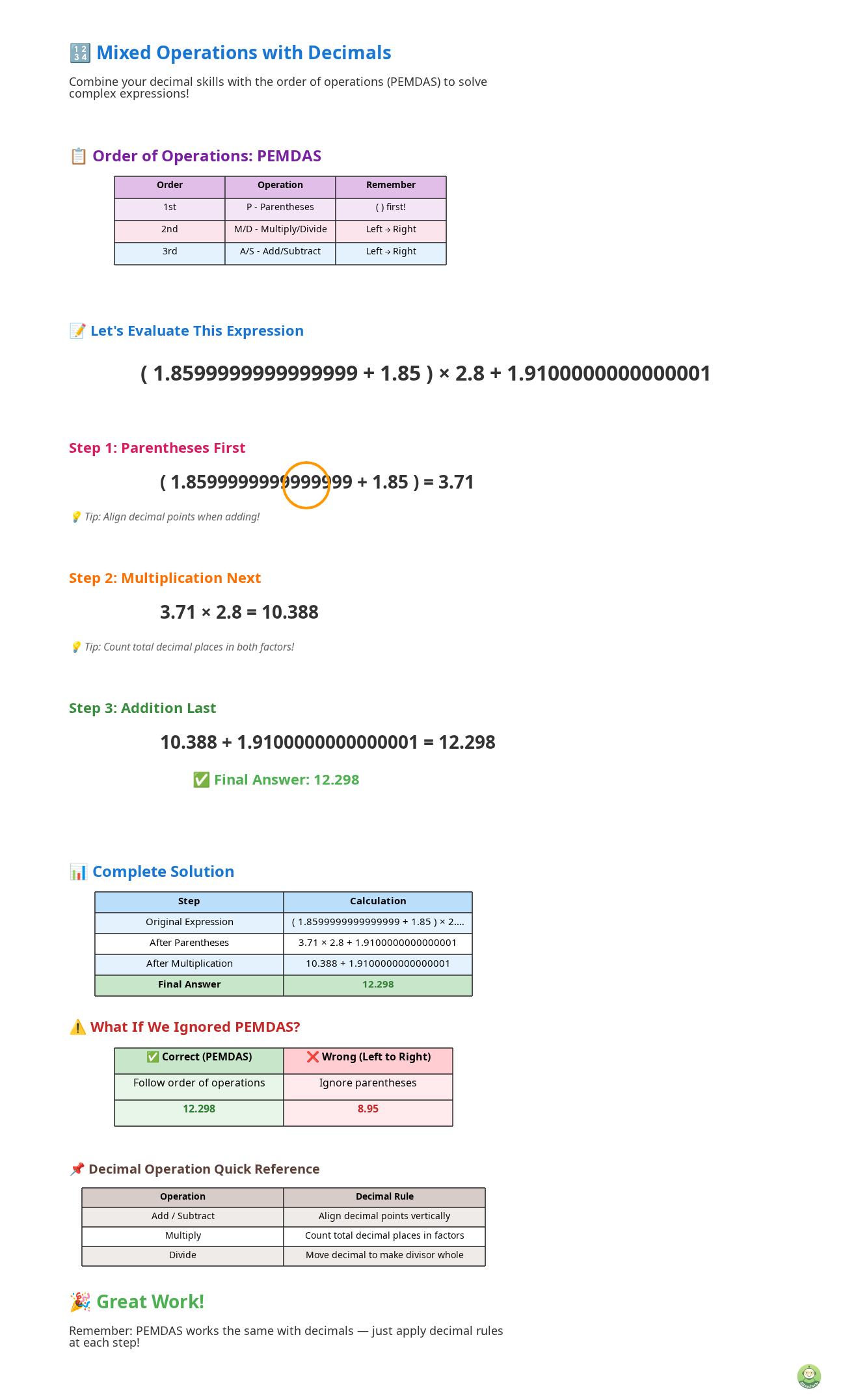
Practicing challenging decimal and PEMDAS problems at home does not have to feel like a chore. Interactive learning platforms provide structured, gamified environments where middle schoolers can practice at their own pace without parent fatigue. Here's what the full interactive lesson looks like on AI Teacherly: In the Mixed Operations with Decimals lesson (Grade 6), students receive instant feedback, visual step-by-step hints, and engaging multi-step word problems that transform abstract rules into tangible problem-solving wins. Built-in progress tracking ensures students master foundational decimal computation before moving on to advanced algebra.
Frequently Asked Questions About 6th Grade Decimals
What is PEMDAS and how does it apply to decimals?\nPEMDAS stands for Parentheses, Exponents, Multiplication, Division, Addition, and Subtraction. When applied to decimals, the sequence remains identical to whole numbers. You evaluate parentheses first, perform multiplication and division from left to right, and finish with addition and subtraction.\n\n### How do I help my child solve multi-step decimal equations at home?\nStart by reviewing the acronym together and working through problems one step at a time. Encourage your child to write down every intermediate calculation line rather than trying to solve multi-step decimal equations entirely in their head.\n\n### Why do students get different answers when ignoring order of operations with decimals?\nIgnoring order of operations leads to incorrect calculations because arithmetic operations yield different results depending on sequence. For instance, adding before multiplying changes the final value significantly when decimals are involved.\n\n### What are the rules for lining up decimal points during addition versus multiplication?\nWhen adding or subtracting decimals, you must always align the decimal points vertically. When multiplying decimals, you multiply normally first, then count the total decimal places in the factors to place the decimal point in the product.\n\n### How can I make practicing 6th grade math more engaging for my middle schooler?\nYes, online interactive platforms like AI Teacherly transform dry decimal practice into engaging, gamified learning. Immediate feedback and step-by-step hints keep middle schoolers motivated without parent frustration.\n\n### Is it normal for a 6th grader to struggle with decimal word problems?\nIt is very common. Sixth graders often misplace decimal points during multiplication or forget whether to multiply before adding when parentheses are absent. Targeted practice helps build permanent habits.
Key Takeaways
- Always follow the PEMDAS sequence: Parentheses, Multiplication/Division, Addition/Subtraction.
- Always align decimal points vertically when adding or subtracting, but count decimal places when multiplying.
- Writing out intermediate steps prevents careless calculation errors in multi-step decimal problems.
- Interactive platforms like AI Teacherly provide instant feedback and visual guidance for middle school math.
Frequently Asked Questions
What is PEMDAS and how does it apply to decimals?
PEMDAS stands for Parentheses, Exponents, Multiplication, Division, Addition, and Subtraction. When applied to decimals, the sequence remains identical to whole numbers. You evaluate parentheses first, perform multiplication and division from left to right, and finish with addition and subtraction.
How do I help my child solve multi-step decimal equations at home?
Start by reviewing the acronym together and working through problems one step at a time. Encourage your child to write down every intermediate calculation line rather than trying to solve multi-step decimal equations entirely in their head.
Why do students get different answers when ignoring order of operations with decimals?
Ignoring order of operations leads to incorrect calculations because arithmetic operations yield different results depending on sequence. For instance, adding before multiplying changes the final value significantly when decimals are involved.
What are the rules for lining up decimal points during addition versus multiplication?
When adding or subtracting decimals, you must always align the decimal points vertically. When multiplying decimals, you multiply normally first, then count the total decimal places in the factors to place the decimal point in the product.
How can I make practicing 6th grade math more engaging for my middle schooler?
Yes, online interactive platforms like AI Teacherly transform dry decimal practice into engaging, gamified learning. Immediate feedback and step-by-step hints keep middle schoolers motivated without parent frustration.
Is it normal for a 6th grader to struggle with decimal word problems?
It is very common. Sixth graders often misplace decimal points during multiplication or forget whether to multiply before adding when parentheses are absent. Targeted practice helps build permanent habits.
Ready to make middle school math stress-free? Try interactive 6th grade decimal and PEMDAS lessons free on AI Teacherly!