Multi-Step Word Problems for 4th Graders: The Detective Method That Actually Works
Multi-step word problems don't have to mean homework meltdowns. Learn the detective method that transforms how your 4th grader approaches complex math problems, one clue at a time.
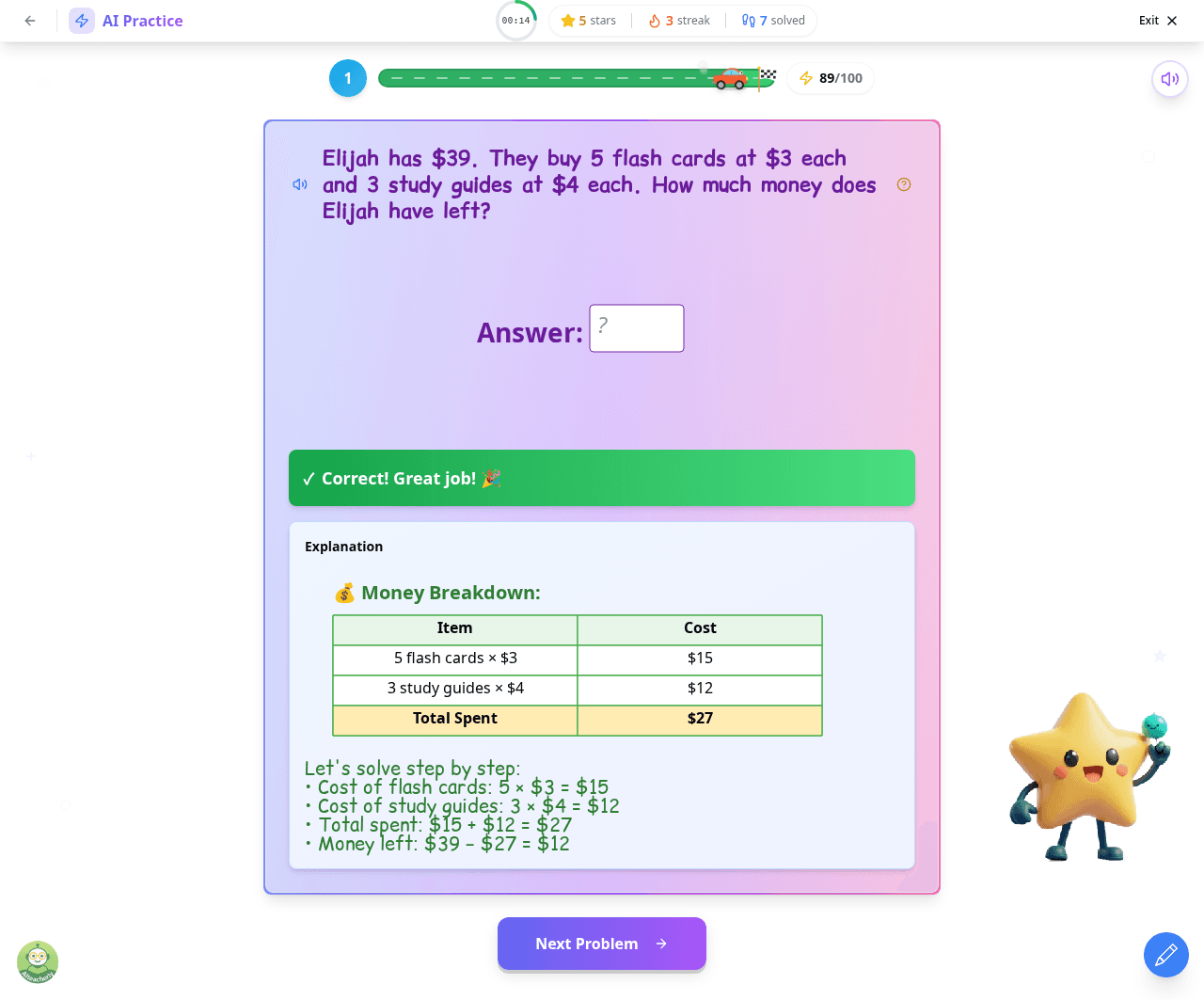
Why Multi-Step Word Problems Trip Up Even Smart 4th Graders
Your 4th grader aced single-step math problems all through 3rd grade. Then suddenly, homework time became a battlefield. Sound familiar?
Multi-step word problems represent one of the biggest jumps in 4th grade mathematics. Unlike simple "add these two numbers" questions, these problems require students to identify multiple pieces of information, determine which operations to use, and execute calculations in the correct order.
Here's what makes these problems particularly challenging for 4th graders:
- Information overload: Problems contain multiple numbers and details, making it hard to know what's important
- Hidden operations: The problem doesn't say "multiply then subtract" outright
- Sequencing matters: Doing steps in the wrong order gives wrong answers, even with correct calculations
- Working memory strain: Kids must hold intermediate results while planning next steps
The good news? Struggling with multi-step word problems isn't a sign that your child is "bad at math." It's a sign they need a systematic approach to break down complex problems into manageable pieces. That's exactly what the detective method provides.
What Are Multi-Step Word Problems and Why Do They Matter?
A multi-step word problem is a math problem that requires two or more calculations to reach the final answer. Unlike single-step problems (like "What is 24 + 15?"), multi-step problems present a real-world scenario where students must figure out what to calculate and in what order.
Here's a typical example your 4th grader might encounter:
"Maya has $50. She buys 3 books that cost $8 each and 2 notebooks that cost $4 each. How much money does Maya have left?"
To solve this, a student must:
- Calculate the cost of books (3 × $8 = $24)
- Calculate the cost of notebooks (2 × $4 = $8)
- Find the total spent ($24 + $8 = $32)
- Subtract from the starting amount ($50 - $32 = $18)
Why do these problems matter so much?
Multi-step word problems aren't just math exercises. They build critical thinking skills that transfer to everyday life. When your child learns to break down a complex math problem, they're also learning to:
- Analyze situations before acting
- Create step-by-step plans
- Evaluate whether answers make sense
- Persist through challenges
These skills become increasingly important as students advance through middle school and beyond. The 4th grade focus on multi-step problems lays the foundation for algebraic thinking in later years.
How Do You Solve Multi-Step Word Problems Step by Step?
The secret to solving multi-step word problems isn't being a math genius. It's having a reliable system that works every time. Here's the four-step process that helps 4th graders tackle even the trickiest problems:
Step 1: Read and Identify the Facts
First, read the entire problem carefully. Then identify:
- What numbers are given?
- What is the problem asking you to find?
- What keywords give clues about operations?
Step 2: Plan Your Steps
Before calculating anything, map out the sequence of operations. Ask: "What do I need to figure out first? What comes next?" Writing this plan prevents the common mistake of jumping straight into random calculations.
Step 3: Execute Each Calculation
Work through your plan one step at a time. Write down each intermediate answer. This helps kids track where they are in multi-step problems and makes it easier to find mistakes.
Step 4: Check Your Answer
Ask: "Does this answer make sense in the story?" If Maya started with $50 and bought things, she can't have $75 left. This reality check catches errors that pure calculation review might miss.
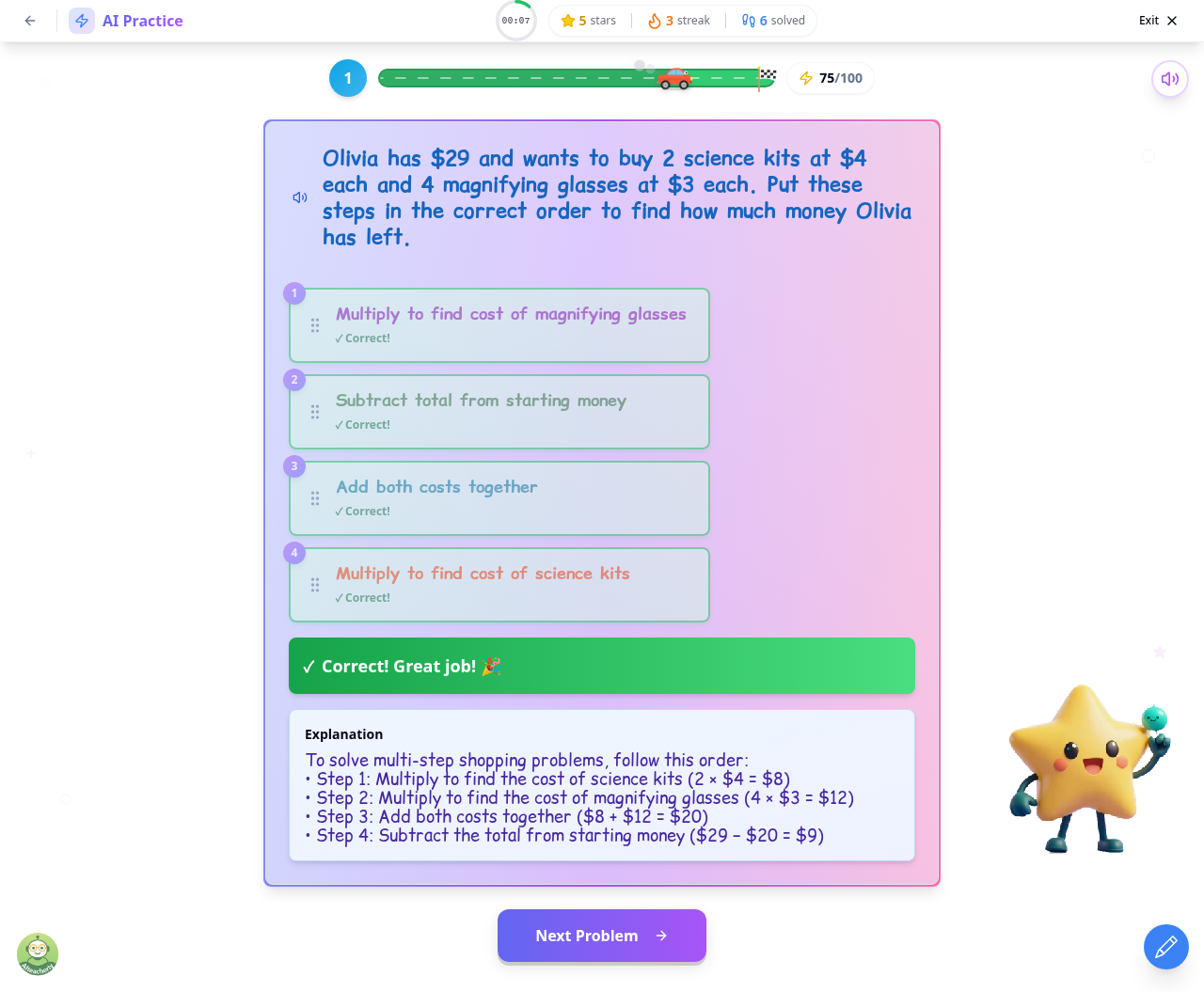
The interactive problem below shows exactly how this planning process works in practice. Students arrange the operations in the correct sequence before solving, reinforcing the habit of planning first.
The Detective Method: Teaching Your Child to Break Down Complex Problems
Kids love stories, mysteries, and feeling like heroes. That's why framing problem-solving as detective work transforms how children approach challenging math.
Here's how to introduce the detective method at home:
"Every word problem is a mystery to solve. You're the detective, and the clues are hidden in the words."
Clue-Finding Phase
Teach your child to circle or highlight:
- All the numbers in the problem
- The question being asked (usually the last sentence)
- Keywords that hint at operations
Case Planning Phase
Detectives don't rush in. They plan. Ask your child:
- "What's the first thing we need to figure out?"
- "Once we know that, what's next?"
- "How will we get to our final answer?"
Solving the Case Phase
Work through each step, celebrating small wins: "We found the first clue. Now let's use it to find the next one!"
Case Closed Check
Good detectives verify their solutions. Ask: "Does our answer make sense in the story? Could the answer really be this number?"
This approach works because it:
- Makes abstract processes concrete and fun
- Gives kids a repeatable framework
- Reduces anxiety by focusing on one clue at a time
- Builds confidence through small successes
Remember: You don't need to be a math expert to guide your child through this process. You just need to ask good questions and let them do the thinking.
Keyword Clues: How to Know Which Operations to Use
One of the biggest struggles for 4th graders is knowing which operation to use and when. The detective method relies heavily on recognizing keyword clues hidden in the problem text.
Addition Clues
- Total, altogether, combined, in all
- Sum, plus, increased by
- "How many in total?"
Subtraction Clues
- Left, remaining, difference
- Fewer, less than, decreased by
- "How many more?" or "How much change?"
Multiplication Clues
- Each, every, per
- Times, groups of, rows of
- "3 bags with 5 apples each"
Division Clues
- Split equally, shared, distributed
- Each person gets, divided among
- "How many in each group?"
The Tricky Part: Order Matters
In multi-step problems, you might use several operations. The word "left" at the end of a problem tells you subtraction comes last, even if you need to multiply and add first.
For example: "Sam has $20. He buys 4 erasers at $2 each. How much does Sam have left?"
The word "left" is a big clue. It tells you to subtract at the end. But first, you need to find out how much Sam spent (4 × $2 = $8). Then subtract from $20.
Practice Tip: When reviewing homework, ask your child to underline the keyword clues before solving. This builds the habit of reading carefully rather than grabbing numbers and guessing operations.
See How AI Teacherly Makes Multi-Step Problems Click
Explaining the detective method is one thing. Getting your child to practice it consistently is another. That's where interactive learning platforms like AI Teacherly bridge the gap between understanding concepts and mastering them.
The Multi-Step Word Problems with All Operations lesson for Grade 4 brings everything we've discussed to life:
Guided Discovery Approach
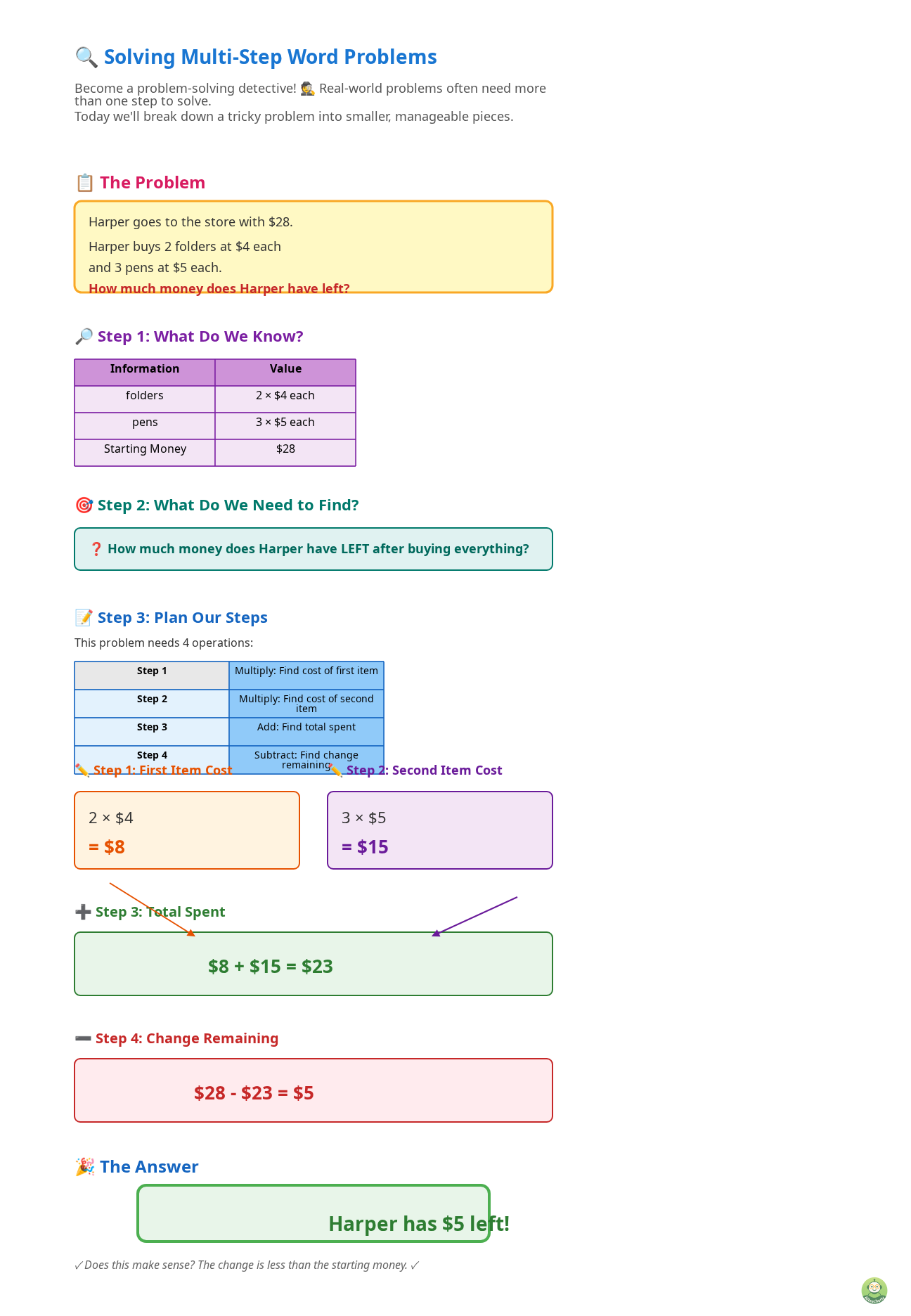
Rather than just presenting problems, the lesson walks students through the detective thinking process. As one lesson prompt explains: "Some problems need more than one step to solve. We'll break them into smaller pieces, just like a detective!"
Visual Step Tracking
Arrows and visual cues show students where each answer came from and how it connects to the next step. This makes the abstract process of multi-step problem-solving concrete and visible.
Real-World Scenarios
The problems use relatable contexts like shopping, sharing items, and everyday situations. When kids see math in familiar scenarios, the "why does this matter?" question answers itself.
Here's what the full interactive lesson looks like on AI Teacherly:
Immediate Feedback
Students don't have to wait for a parent or teacher to check their work. They get instant feedback on each step, reinforcing correct thinking and catching mistakes before they become habits.
Scaffolded Difficulty
The lesson starts with simpler problems and gradually increases complexity. This builds confidence before challenging students with harder multi-step scenarios.
Common Mistakes Kids Make (And How to Fix Them)
Even with the detective method, 4th graders often fall into predictable traps. Knowing these common mistakes helps you guide your child past them:
Mistake #1: Solving in the Wrong Order
The Problem: Kids do calculations in the order numbers appear, not the logical sequence.
The Fix: Always plan before calculating. Ask: "What do we need to know before we can answer the final question?"
Mistake #2: Missing Hidden Steps
The Problem: Students calculate two quantities but forget to combine them for the final answer.
The Fix: Re-read the question after solving. "We found how much the books cost AND the notebooks cost. But what did the problem actually ASK?"
Mistake #3: Using the Wrong Operation
The Problem: Kids see "how many" and always add, even when the problem requires subtraction or multiplication.
The Fix: Focus on keyword clue practice. Make a game of finding operation hints before solving.
Mistake #4: Forgetting to Check if the Answer Makes Sense
The Problem: A student calculates that someone ended up with MORE money after buying things.
The Fix: Build the reality check habit. Ask: "If Maya bought things, could she have MORE money than she started with?"
Mistake #5: Giving Up When Overwhelmed
The Problem: Long problems trigger anxiety, and kids freeze or rush through carelessly.
The Fix: Remind them: "We only need to find ONE clue at a time." Breaking the problem down reduces the overwhelm factor.
When you see these mistakes, resist the urge to just give the answer. Instead, ask guiding questions that help your child discover the error themselves. This builds lasting problem-solving skills.
Key Takeaways
- Multi-step word problems require a systematic approach, not just math skills. The detective method gives kids a repeatable framework for any complex problem.
- Keywords in word problems are operation clues. Words like 'left,' 'each,' and 'total' tell students which calculations to perform and in what order.
- Planning before calculating is essential. Have your child map out steps before touching any numbers to avoid the common 'wrong order' mistake.
- Breaking problems into smaller pieces reduces overwhelm. Focus on finding one clue at a time rather than solving the whole problem at once.
- Reality checks catch errors. Always ask 'Does this answer make sense in the story?' after solving.
- You don't need to be a math expert to help. Your job is to ask guiding questions and let your child do the detective work.
- Interactive practice with immediate feedback builds confidence faster than worksheets alone.
Frequently Asked Questions
What is a multi-step word problem in 4th grade math?
A multi-step word problem requires two or more calculations to reach the final answer. Unlike single-step problems, students must determine what to calculate and in what order, often using multiple operations like multiplication, addition, and subtraction together.
How do I teach my child to solve multi-step word problems?
Use the detective method: First, identify the facts and keywords. Then, plan the steps before calculating. Execute each step one at a time, writing down intermediate answers. Finally, check if the answer makes sense in the story context.
What keywords help identify which operation to use in word problems?
Addition clues include 'total,' 'altogether,' and 'combined.' Subtraction clues include 'left,' 'remaining,' and 'difference.' Multiplication clues include 'each,' 'every,' and 'groups of.' Division clues include 'split equally' and 'shared.'
Why does my child struggle with word problems but not regular math?
Word problems require reading comprehension, identifying relevant information, and planning multiple steps, not just calculation skills. Many kids who compute well struggle with the critical thinking and sequencing that word problems demand.
What order do you solve multi-step word problems?
The order depends on the problem's logic, not how numbers appear. First, identify what the final question asks. Then work backwards: what do you need to calculate to answer that? Plan the sequence before calculating anything.
Should my child write out all the steps when solving word problems?
Yes, especially while learning. Writing each step helps track progress through the problem, makes errors easier to find, and reinforces the habit of systematic thinking. Once the method becomes automatic, kids can do more mentally.
How can I make word problems less overwhelming for my 4th grader?
Frame it as detective work: one clue at a time. Have your child circle numbers, underline the question, and identify keywords before attempting any calculations. Breaking the problem into small pieces reduces anxiety significantly.
Is my 4th grader behind if they struggle with multi-step word problems?
Not necessarily. Multi-step problems are challenging for most 4th graders because they represent a significant jump in complexity. Struggling is normal and expected. What matters is building systematic problem-solving skills through practice.
Ready to help your 4th grader crack multi-step word problems like a detective? Try the interactive Multi-Step Word Problems lesson free on AI Teacherly and watch their confidence soar!