Multi-Step Word Problems for 5th Graders: A Parent's Guide to Breaking Down the Confusion
That sinking feeling when your 5th grader asks for help with word problems? Learn the 5-step method that transforms confusion into confidence, no math degree required.
Why Multi-Step Word Problems Feel So Overwhelming
That sinking feeling when your 5th grader asks for help with their math homework? You're not alone. Multi-step word problems represent one of the biggest hurdles in 5th grade mathematics, and they look nothing like the straightforward arithmetic most parents remember.
Here's the truth: multi-step word problems for 5th graders aren't just about calculating numbers. They require reading comprehension, identifying what the question is actually asking, choosing the right operations, and interpreting the answer in context. That's a lot of cognitive work packed into a single homework question.
The good news? There's a systematic approach that works every single time. In this guide, you'll learn the exact 5-step method that helps children (and parents) break down even the most confusing word problems into manageable pieces. By the end, you'll have the confidence to guide your child through their homework without the frustration.
Whether your child is preparing for standardized tests or simply struggling with nightly homework, this parent-friendly guide will transform the way you both approach 5th grade math word problems.
What Are Multi-Step Word Problems and Why Do 5th Graders Struggle?
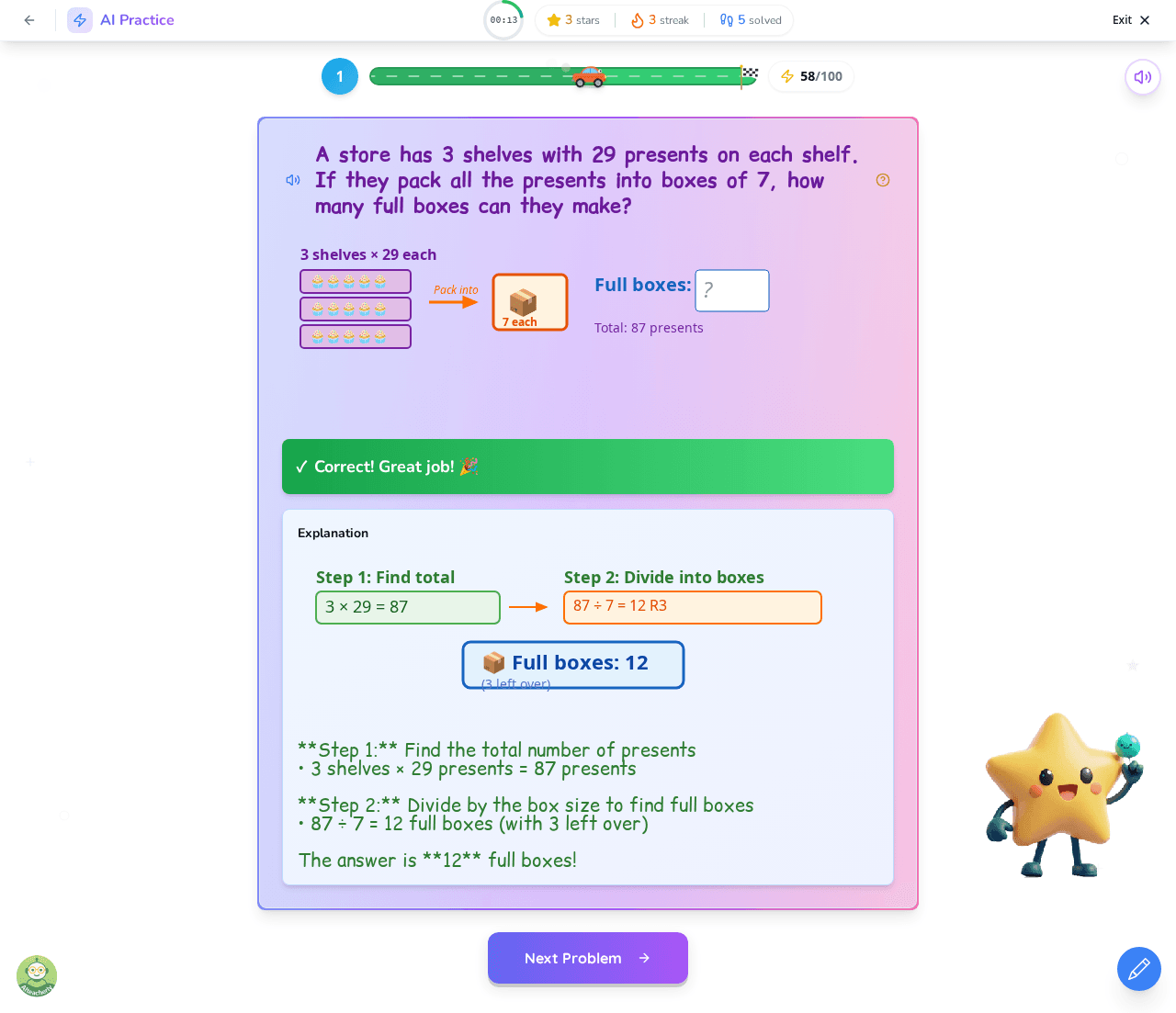
Multi-step word problems are math questions that require two or more operations to solve. Unlike simple problems such as "What is 24 divided by 6?", multi-step problems embed the math within real-world scenarios and require students to figure out which operations to use and in what order.
For example, a typical 5th grade multi-step problem might read: "Emma has 47 stickers. She buys 3 more packs of 8 stickers each. If she wants to share all her stickers equally among 5 friends, how many stickers will each friend get?"
This single problem requires:
- Multiplication (3 packs × 8 stickers)
- Addition (47 + new stickers)
- Division (total ÷ 5 friends)
- Interpretation of any remainder
Why do 5th graders struggle? There are several reasons:
- Reading comprehension barriers: The math is hidden within paragraphs of text
- Multiple operations: Students must identify not just one, but several steps
- Order matters: Doing operations in the wrong sequence gives wrong answers
- Variables are introduced: Using letters like "n" to represent unknowns feels like algebra (because it is!)
- Remainder interpretation: The trickiest part for many students is knowing what to do with leftover numbers
Understanding why these problems are challenging is the first step toward conquering them. The struggle is normal and expected; it's a critical developmental milestone in algebraic thinking for 5th grade students.
The 5-Step Method to Break Down Any Word Problem
Here's the secret that transforms word problem panic into problem-solving confidence: break big problems into smaller pieces. This 5-step method works for virtually any multi-step word problem your child will encounter.
Step 1: Read and Identify What You Know Read the problem completely (yes, the whole thing) and underline or highlight the numbers and key information. What quantities are given? What facts do you have to work with?
Step 2: Identify What You Need to Find What is the question actually asking? Circle the question. This becomes your target, and you can use a variable (like "n") to represent the unknown.
Step 3: Plan Your Operations Decide which math operations you need. Look for clue words: "total" often means addition or multiplication; "each" or "equally" often signals division; "how many more" suggests subtraction.
Step 4: Write the Equation and Solve Translate your plan into a mathematical equation. Solve step by step, showing your work.
Step 5: Check Your Answer Plug your answer back into the original problem. Does it make sense? Did you answer the actual question that was asked?
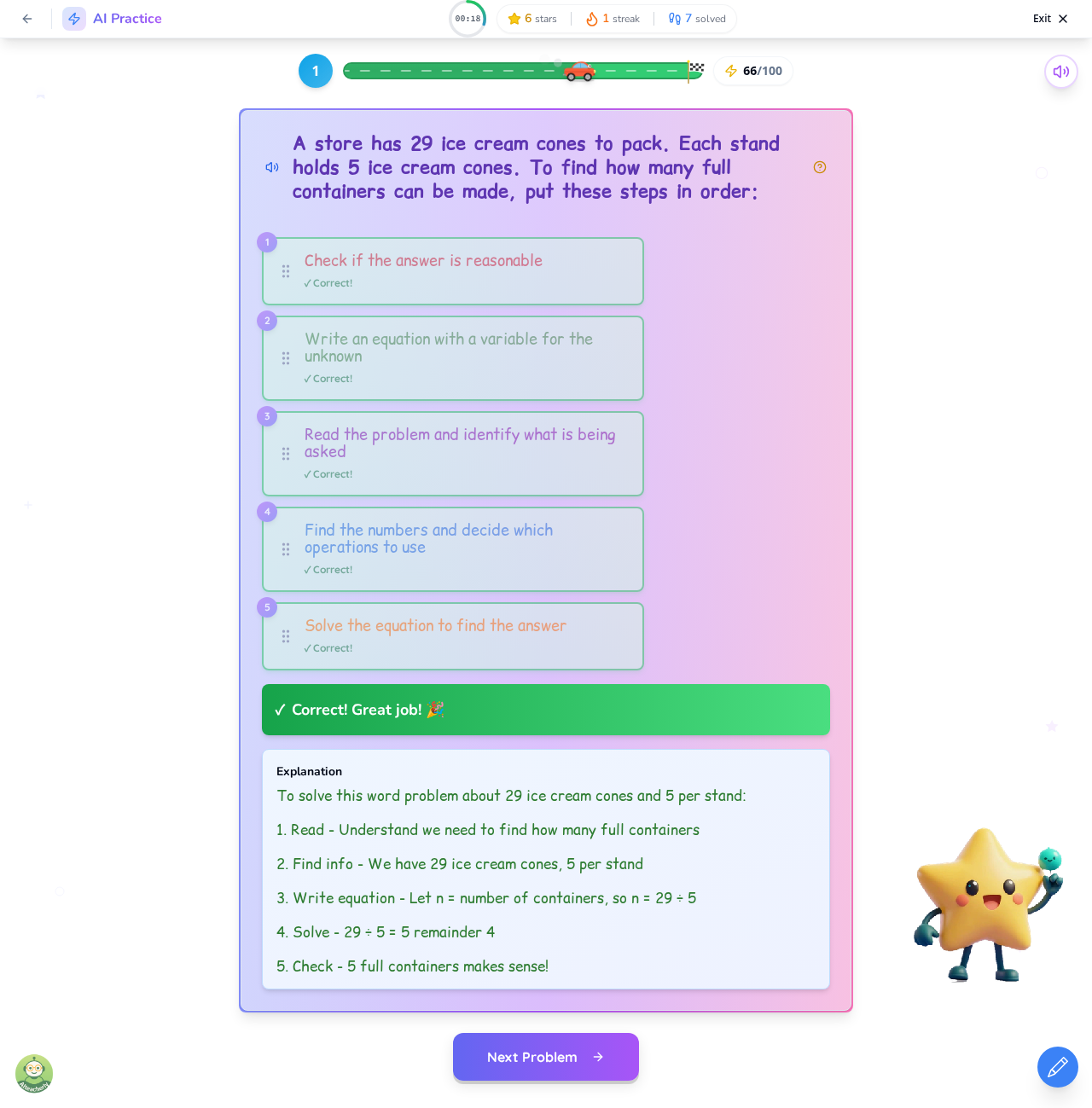
The interactive problem below shows exactly how students practice arranging these steps in the correct sequence.
This systematic approach removes the guesswork and builds the algebraic thinking skills your child needs for middle school and beyond. When your child says "I don't know where to start," now you have a clear response: "Let's start with Step 1. What do we know?"
How Do You Know What to Do With the Remainder?
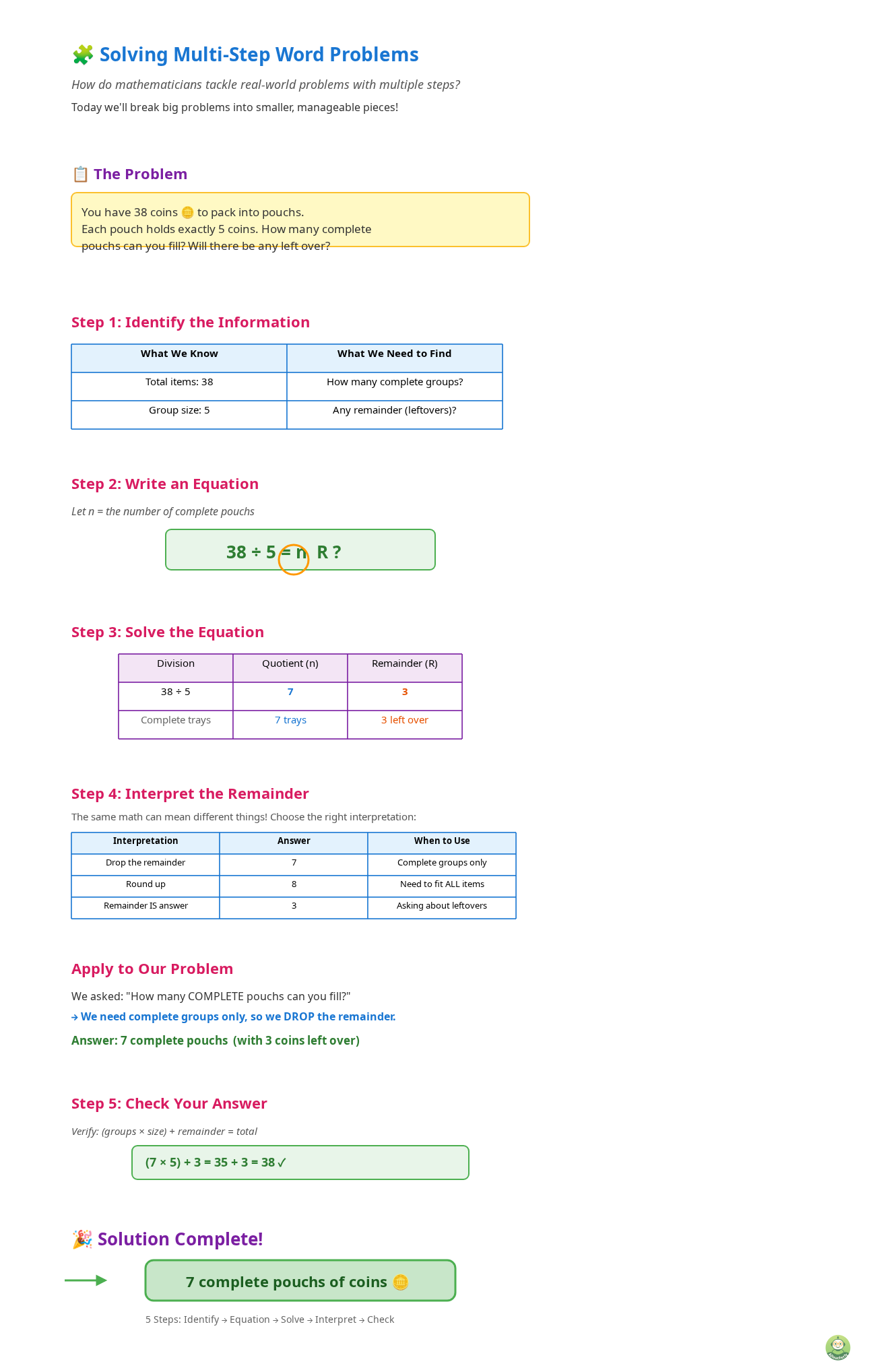
Here's the tricky part most parents miss: the same division problem can have three different correct answers depending on context. This is where many 5th graders (and parents helping them) get confused.
Consider this division: 47 ÷ 5 = 9 remainder 2
The mathematical answer is the same, but what you do with that remainder depends entirely on what the problem is asking:
Scenario 1: Drop the Remainder "You have 47 pencils to put into boxes that hold 5 each. How many FULL boxes can you make?" Answer: 9 boxes (you drop the remainder because you can only count complete boxes)
Scenario 2: Round Up "You have 47 students going on a field trip. Each bus holds 5 students. How many buses do you need?" Answer: 10 buses (you round up because ALL students need a seat, even if the last bus isn't full)
Scenario 3: Use the Remainder as Your Answer "You have 47 pencils to put into boxes of 5. How many pencils will be LEFT OVER?" Answer: 2 pencils (the remainder itself is what you're looking for)
The context tells you which interpretation to use. Teach your child to ask: "What is the question really asking? Do I need full groups, enough for everyone, or what's left over?"
This insight about word problems with remainders is one of the most valuable concepts in 5th grade math because it teaches children that math isn't just about calculating; it's about reasoning.
See How Interactive Learning Makes Word Problems Click
Reading about word problems is one thing. Actually practicing them with immediate feedback is what builds real confidence and skill. That's where interactive learning platforms like AI Teacherly make a significant difference.
Here's what the full interactive lesson looks like on AI Teacherly:
In the Solving Multi-step Word Problems with Equations lesson, 5th graders work through carefully sequenced problems that build skills progressively. Instead of staring at a worksheet hoping the answer appears, students:
- Interact with visual models that make abstract concepts concrete
- Get instant feedback so they know immediately if they're on the right track
- Practice the 5-step method with guided prompts that scaffold their thinking
- Tackle remainder interpretation through relatable real-world scenarios (field trips, packing boxes, sharing supplies)
The lesson specifically addresses writing equations from word problems by teaching students to use variables like "n" as placeholders for unknowns. This isn't scary algebra; it's simply giving a name to what you're solving for.
What parents appreciate most is that each problem builds on the previous one. Students aren't just drilling random calculations; they're developing the systematic thinking skills that transfer to every future math challenge.
The estimated 45-minute lesson can be broken into shorter sessions, perfect for after-school practice that doesn't feel like endless homework.
Common Mistakes Parents Make When Helping (And What to Do Instead)
Even with the best intentions, parents can accidentally make word problems harder. Here are the most common pitfalls and what to do instead:
Mistake 1: Solving the Problem for Them When homework is taking forever and bedtime is approaching, it's tempting to just give the answer. But this robs your child of the productive struggle that builds real understanding.
Do this instead: Ask guiding questions. "What do we know?" "What is the problem asking?" "What should we try first?" Let them do the thinking.
Mistake 2: Teaching Your Method Instead of Their School's Method You might have a perfectly valid way to solve the problem, but if it conflicts with what the teacher is teaching, your child ends up confused.
Do this instead: Ask your child to show you how their teacher wants them to solve it. Learn their vocabulary and approach. The 5-step method in this article aligns with standard curriculum approaches.
Mistake 3: Focusing Only on the Answer If your child gets the right answer but can't explain their reasoning, they haven't truly mastered the skill.
Do this instead: Ask them to explain their thinking out loud. "How did you know to multiply first?" "Why did you round up the remainder?" This verbal processing deepens understanding.
Mistake 4: Marathon Homework Sessions Trying to power through when your child is frustrated and tired is counterproductive. Stress blocks learning.
Do this instead: Take breaks. A 5-minute movement break or snack can reset the brain. If frustration is high, it's okay to stop and return to the problem fresh the next day.
Remember: your role isn't to be the math teacher. Your role is to be the calm, supportive guide who helps your child use the strategies they're learning.
Key Takeaways
- Multi-step word problems require multiple operations and are a critical 5th grade milestone for developing algebraic thinking
- Use the 5-step method: identify knowns, identify the question, plan operations, write the equation, and check your answer
- Remainder interpretation is context-dependent: drop it for complete groups, round up when everyone needs to be included, or use the remainder itself when that's what the question asks
- Variables like 'n' are simply placeholders for unknowns, not scary algebra symbols
- Ask guiding questions instead of solving problems for your child to build lasting understanding
- Interactive practice with immediate feedback accelerates learning more than worksheets alone
- Short, focused practice sessions are more effective than marathon homework battles
Frequently Asked Questions
What are multi-step word problems and why do 5th graders struggle with them?
Multi-step word problems require two or more operations to solve. 5th graders struggle because they must read carefully, identify multiple operations, determine the correct order, and interpret remainders in context, all within real-world scenarios.
How do you solve multi-step word problems in 5th grade?
Use the 5-step method: identify what you know, identify what to find, plan your operations, write and solve the equation, then check your answer by substituting back into the original problem.
How do I know when to round up or drop the remainder in word problems?
Context determines remainder handling. Drop the remainder for complete groups only. Round up when everyone must be included (like buses for a field trip). Use the remainder as your answer when asking what's left over.
What does the variable 'n' mean in word problem equations?
The variable 'n' is simply a placeholder representing the unknown number you're solving for. It's not advanced algebra; it's just a way to name what you're looking for before you calculate it.
Why is my child good at math facts but struggles with word problems?
Word problems require reading comprehension, identifying operations, and reasoning skills beyond calculation. A child can know their math facts perfectly but struggle with translating real-world scenarios into mathematical operations.
How can parents help with math word problems without solving them?
Ask guiding questions instead of giving answers: 'What do we know?' 'What is the question asking?' 'What should we try first?' Let your child do the thinking while you provide structure and encouragement.
How long should my 5th grader practice word problems each day?
Aim for 15-20 minutes of focused practice. Short, consistent sessions are more effective than long homework marathons. If frustration builds, take a break and return with fresh eyes.
What's the best way to check word problem answers?
Substitute your answer back into the original problem to verify it makes sense. Ask: 'Does this answer the actual question?' and 'Is this result reasonable for the real-world scenario described?'
Ready to turn word problem struggles into success? Try the interactive Multi-step Word Problems lesson free on AI Teacherly and watch your child's confidence grow!