Multiplication Facts for 6, 7, 8, and 9: Two Simple Tricks That Actually Work
Those multiplication facts for 6, 7, 8, and 9 have stumped generations of kids. Discover two powerful tricks that transform the hardest times tables into easy wins.
Why Do Kids Struggle with Multiplication Facts for 6-9?
If your child breezes through their 2s, 5s, and 10s but hits a wall with multiplication facts for 6, 7, 8, and 9, they're in excellent company. These four numbers are universally considered the trickiest times tables, and there's a good reason why.
Unlike smaller numbers, the 6-9 facts don't follow obvious patterns that children can see immediately. The 2s are just counting by twos. The 5s always end in 0 or 5. The 10s? Simply add a zero. But when kids reach 6 × 7 or 8 × 9, there's no apparent shortcut, and that's where frustration sets in.
Here's the thing: most kids try to memorize these facts through sheer repetition, drilling flash cards until the answers stick. But research shows this approach often creates math anxiety rather than fluency. Children start associating multiplication with stress, which actually makes recall harder.
The good news? There ARE patterns hiding in these numbers. Once your child discovers them, those "impossible" facts become genuinely easy. Let's look at two powerful tricks that transform the hardest multiplication facts into quick wins.
The 9 Times Table Trick: Digits Always Add to 9
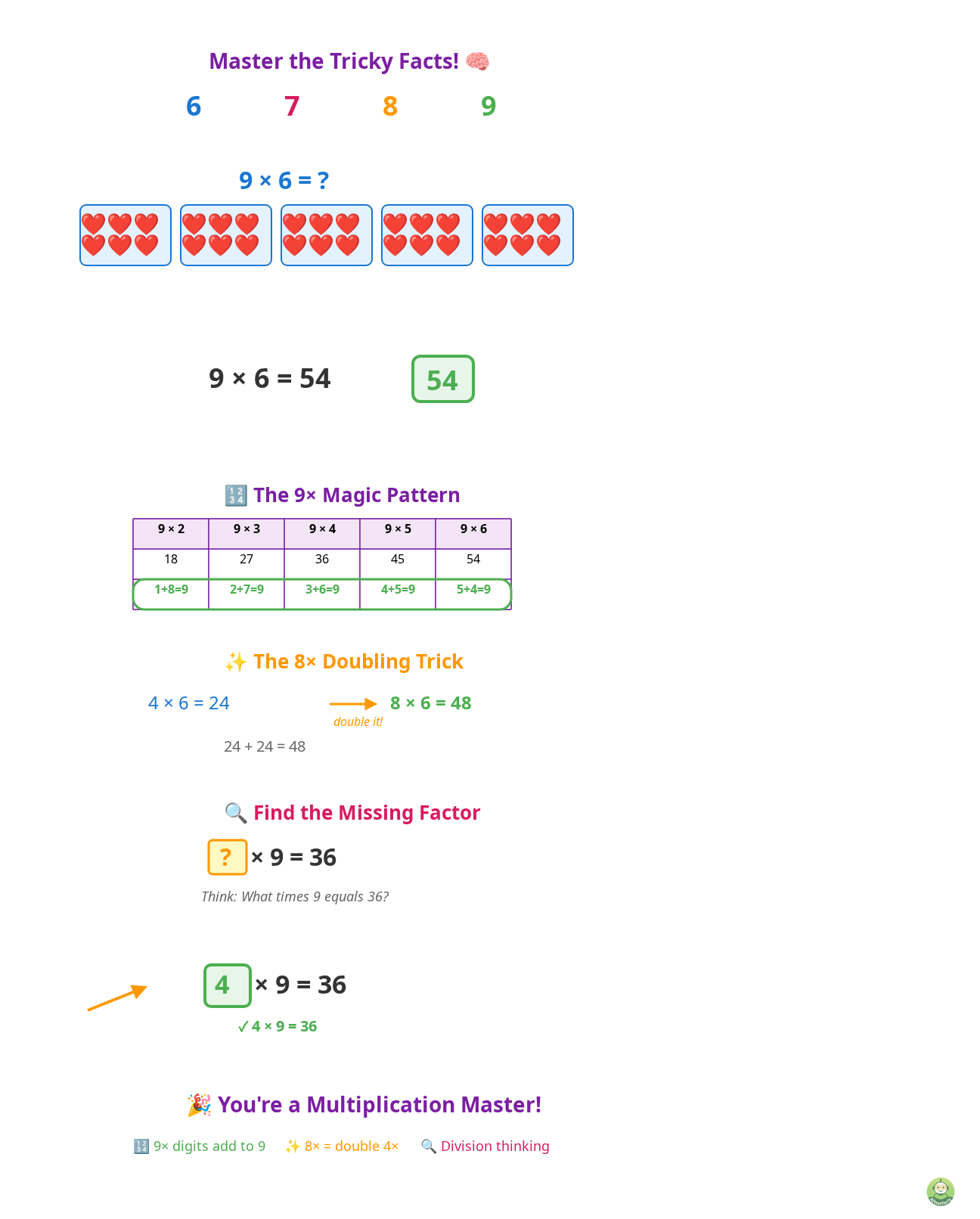
Here's a cool trick for nines that will genuinely excite your child: every single answer in the 9 times table has digits that add up to 9. No exceptions.
Let's test it together:
- 9 × 2 = 18 → 1 + 8 = 9 ✓
- 9 × 3 = 27 → 2 + 7 = 9 ✓
- 9 × 4 = 36 → 3 + 6 = 9 ✓
- 9 × 7 = 63 → 6 + 3 = 9 ✓
- 9 × 9 = 81 → 8 + 1 = 9 ✓
This pattern works all the way up to 9 × 10 (and beyond, if you add the digits of 99, 108, etc.). Why does this matter? It gives your child a built-in answer checker. If they calculate 9 × 8 and get 74, they can quickly add 7 + 4 = 11. That's not 9, so they know to try again.
There's an even faster trick for the 9s: the tens digit is always one less than the number you're multiplying by. For 9 × 7, the tens digit is 6 (one less than 7), and since the digits must add to 9, the ones digit is 3. Answer: 63.
Once children internalize this pattern, the 9 times table stops being memorization and becomes a quick mental calculation. That's the difference between fragile memory and real number sense.
The Doubling Strategy: How 4s Unlock Your 8s
Now for the trick that unlocks the 8 times table: if your child knows their 4s, they already know their 8s. They just need to double.
Think about it: 8 is simply 4 + 4, or double 4. So any 8× fact is just the 4× fact doubled:
- 8 × 3: Start with 4 × 3 = 12, then double it → 24 ✓
- 8 × 6: Start with 4 × 6 = 24, then double it → 48 ✓
- 8 × 7: Start with 4 × 7 = 28, then double it → 56 ✓
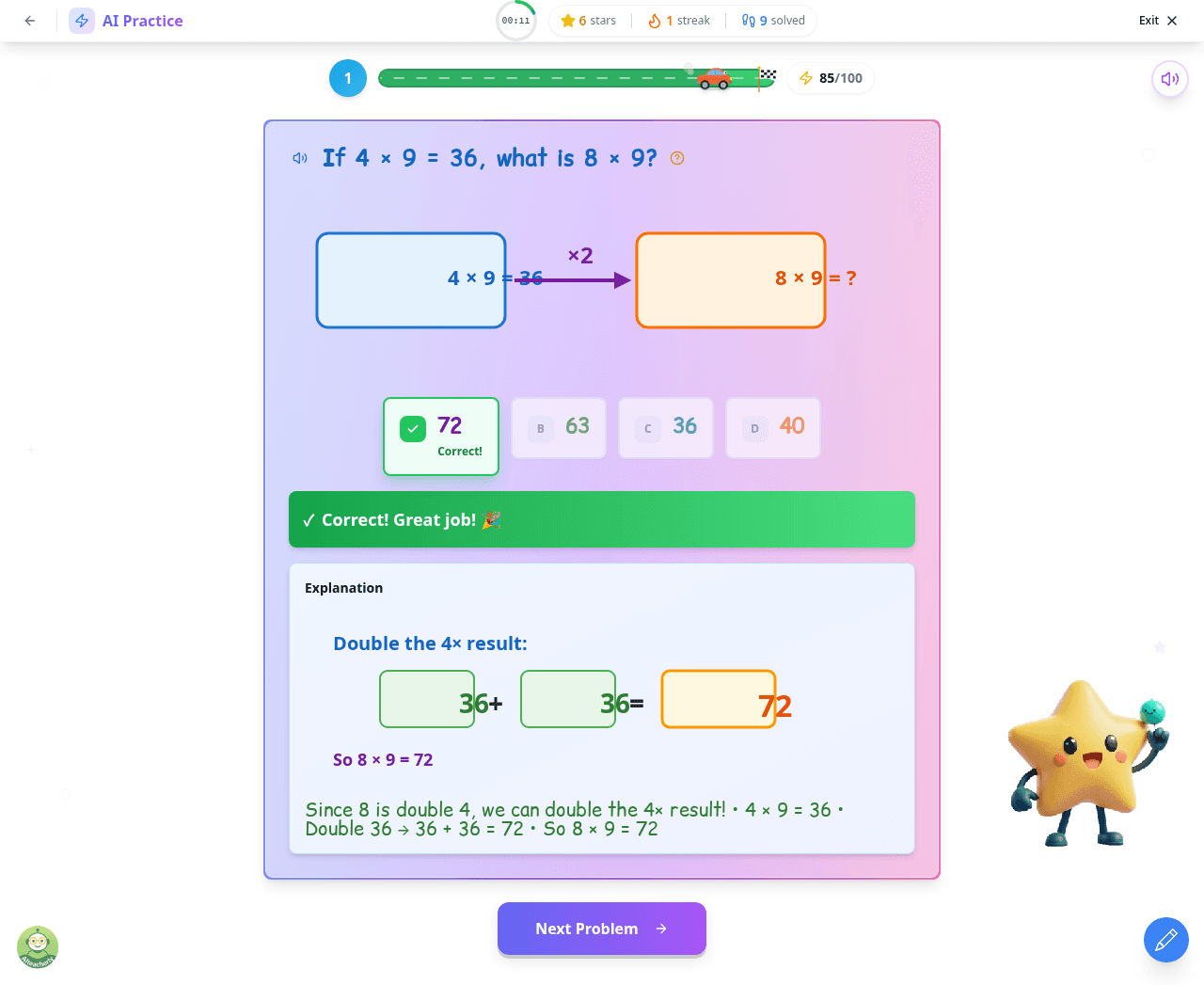
- 8 × 9: Start with 4 × 9 = 36, then double it → 72 ✓
This strategy is powerful because most children find the 4 times table manageable. Doubling is also a skill they've practiced since early elementary math. By combining two things they already know, the "hard" 8s become surprisingly accessible.
The interactive problem below shows exactly how this doubling strategy works in practice:
You can extend this thinking to 6s too: since 6 = 3 + 3 (double 3), your child can double any 3× fact to get the 6× fact. For example, 6 × 7 = double (3 × 7) = double 21 = 42.
These doubling strategies build genuine mathematical thinking rather than rote memorization. Your child learns to see multiplication as connected operations, not isolated facts.
Finding Missing Factors: The Multiplication-Division Connection
Once your child has these tricks for finding products, there's one more skill that ties everything together: finding missing factors. This is where multiplication and division reveal themselves as two sides of the same coin.
When children see a problem like "? × 7 = 56," they often freeze. But here's the secret: they can flip the problem around using division thinking. If 7 groups of something equals 56, then dividing 56 by 7 gives the missing number.
This connection is incredibly powerful for several reasons:
First, it reduces what kids need to memorize. If they know 8 × 7 = 56, they automatically know 56 ÷ 7 = 8 and 56 ÷ 8 = 7. That's three facts for the price of one.
Second, it helps children self-check their work. Unsure if 9 × 6 = 54? Divide 54 by 9. If you get 6, you've confirmed your answer.
Third, it builds algebraic thinking. Finding missing factors is essentially solving simple equations, which prepares children for more advanced math.
At home, you can reinforce this by occasionally presenting multiplication facts "backwards." Instead of asking "What's 8 × 6?", try "What times 8 equals 48?" This simple switch builds flexible thinking and shows your child that they can approach multiplication from multiple angles.
See These Tricks in Action on AI Teacherly
Reading about these strategies is one thing; watching your child use them interactively is another experience entirely. On AI Teacherly, the Multiplication Facts for 6, 7, 8, and 9 lesson walks students through each trick with guided discovery.
Here's what makes interactive practice different from worksheets:
Immediate feedback: When your child types an answer, they know instantly whether they're right. No waiting for a parent to check, no accumulating errors. If they get 9 × 7 wrong, they can try again immediately while the problem is fresh.
Pattern discovery: Rather than simply drilling facts, the lesson helps children discover the patterns themselves. When kids find the 9s digit-sum trick on their own (with guided hints), they own that knowledge in a way that told-facts never achieve.
Visual representations: Abstract multiplication becomes concrete through visual problems featuring groups of objects, arrays, and real-world scenarios. Children see why 6 × 8 means six groups of eight, not just a fact to memorize.
Here's what the full interactive lesson looks like on AI Teacherly:
Adaptive difficulty: The lesson presents problems at just the right challenge level. Too easy, and kids get bored. Too hard, and they shut down. The sweet spot keeps engagement high while building genuine fluency.
The result? Practice that feels less like drilling and more like problem-solving. Children build the number sense to handle multiplication confidently, not just the temporary ability to pass a timed test.
How Can Parents Help at Home Without Flash Cards?
Flash cards have their place, but they shouldn't be your only tool for multiplication practice. Here are practical ways to reinforce these tricks at home:
Play "Digit Sum Detective": Call out 9× problems and have your child check answers using the digit-sum trick. "I think 9 × 8 is 74. Am I right?" They add 7 + 4 = 11, catch your "mistake," and feel like a math detective.
Practice doubling in everyday moments: At the grocery store, see 4 apples in a bag? Ask, "If we bought two bags, how many apples?" That's doubling practice. See a price of $8? "What if we bought 6 of these?" They can start with 4 × 6 = 24, then double.
Use multiplication in context: Real-world problems stick better than abstract drills. "There are 7 days in a week. How many days in 8 weeks?" Suddenly 7 × 8 has meaning.
Celebrate strategies, not just speed: When your child explains HOW they got an answer, that's more valuable than getting it fast. "I knew 8 × 7 because I doubled 4 × 7 = 28" shows real mathematical thinking.
Keep sessions short: Ten minutes of focused, positive practice beats 30 minutes of frustrated drilling. End while your child still feels successful, and they'll be more willing to practice tomorrow.
Remember: your goal isn't just multiplication fact recall. It's building a child who thinks flexibly about numbers and approaches math with confidence rather than anxiety.
Key Takeaways
- The 9 times table has a built-in checker: digits in every answer add up to 9 (9×7=63, and 6+3=9)
- Use the doubling strategy for 8s: double any 4× fact to get the 8× fact (4×6=24, so 8×6=48)
- Extend doubling to 6s by doubling the 3× facts (3×7=21, so 6×7=42)
- Connect multiplication and division as inverse operations to reduce memorization load
- Real-world practice and pattern discovery beat flash card drilling for long-term retention
- Short, positive practice sessions build confidence and prevent math anxiety
Frequently Asked Questions
What is the digit-sum trick for the 9 times table?
Every answer in the 9 times table has digits that add up to 9. For example, 9×7=63, and 6+3=9. This works for all 9× facts and serves as a built-in answer checker for your child.
How does the doubling strategy work for 8 times tables?
Since 8 is double 4, any 8× fact equals the 4× fact doubled. For 8×6, calculate 4×6=24, then double it to get 48. This works because multiplication distributes over addition.
Why do kids struggle with multiplication facts for 6, 7, 8, and 9?
Unlike 2s, 5s, and 10s, these numbers lack obvious visual patterns. The products are also larger, making them harder to verify mentally. However, hidden patterns like the 9s digit-sum make them manageable once discovered.
At what age should my child know multiplication facts?
Most curricula expect fluency with facts up to 10×10 by the end of 3rd grade (age 8-9). However, understanding strategies matters more than speed. A child who can derive 8×7 using doubling has stronger math foundations than one who memorized it temporarily.
How can I help my child practice multiplication without flash cards?
Use real-world contexts like counting items at stores, play 'digit sum detective' with 9s facts, practice doubling during everyday activities, and keep sessions short and positive. Interactive platforms like AI Teacherly also provide engaging practice.
What's the connection between multiplication and division?
They're inverse operations. If 8×7=56, then 56÷7=8 and 56÷8=7. Teaching this connection means your child learns three facts for the price of one and can self-check their multiplication answers.
How long does it take to memorize times tables?
With consistent daily practice (10-15 minutes), most children achieve fluency within 2-3 months. However, strategy-based learning often produces faster, more durable results than pure memorization because children understand the underlying patterns.
Is it okay if my child uses fingers or strategies instead of instant recall?
Absolutely. Using strategies like doubling shows mathematical thinking. Speed develops naturally with practice. Pressuring instant recall often creates anxiety that actually slows performance. Celebrate the strategy use.
Ready to make multiplication click for your child? Try the interactive Multiplication Facts for 6, 7, 8, and 9 lesson free on AI Teacherly and watch those tricky times tables become easy wins!