Multiplying by Fractions: Why Bigger Isn't Always the Answer (5th Grade Guide)
When multiplication suddenly makes numbers smaller, 5th graders get confused. Learn the simple benchmark rule that predicts fraction products instantly, and discover why this concept is the key to math confidence.
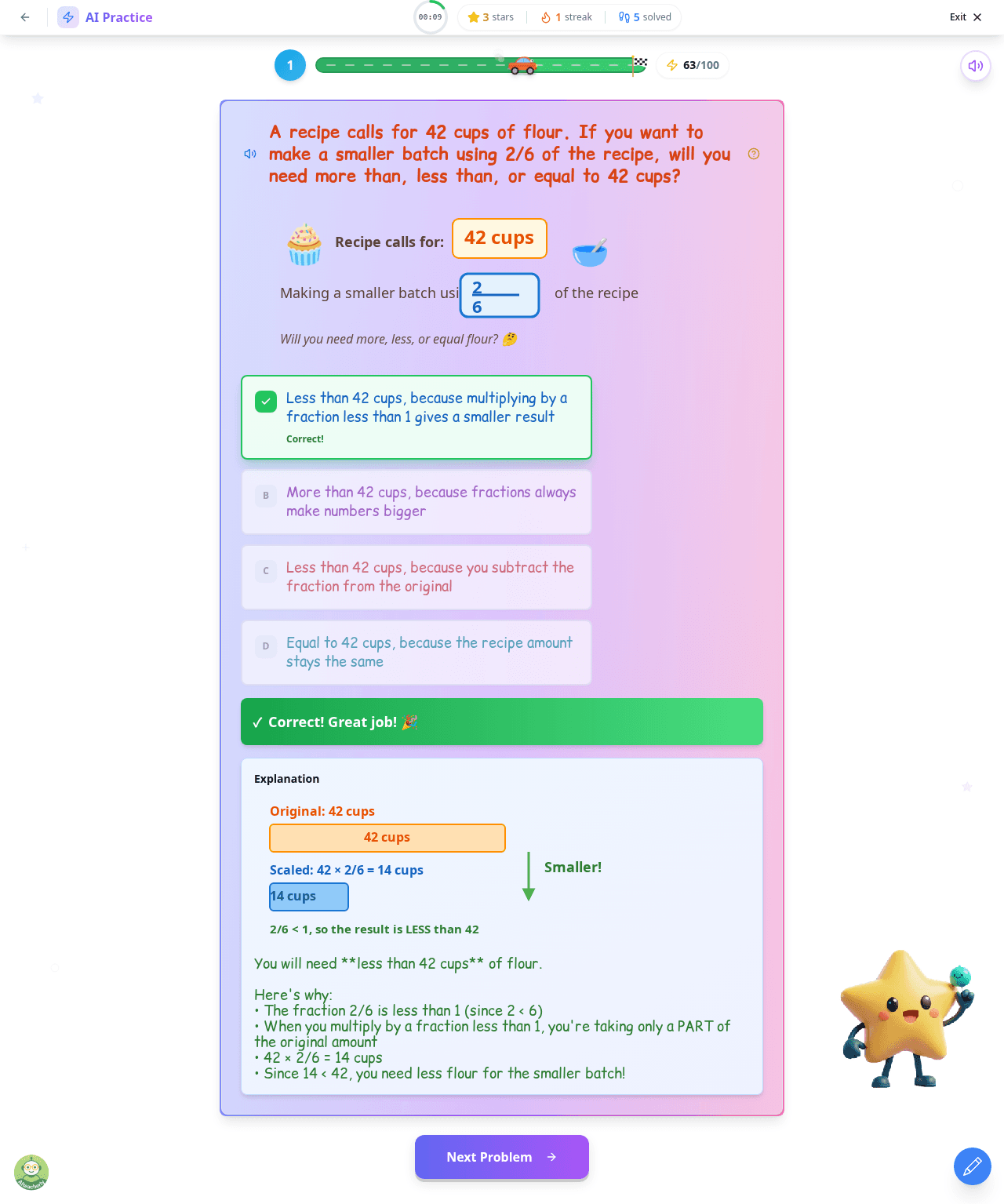
The Multiplication Myth That Trips Up 5th Graders
"But multiplication makes things bigger!" If you've heard this frustrated declaration during homework time, you're witnessing one of the most common math misconceptions in elementary education. Your 5th grader isn't wrong to think this way; they've spent years learning that 3 × 4 = 12 (bigger than both numbers) and 5 × 6 = 30 (much bigger still). Multiplication has always meant "more."
Then fractions enter the picture, and suddenly the rules seem to flip upside down.
When your child encounters 8 × 1/2 = 4, their brain protests. How can multiplying give you something smaller? This isn't a sign that your child is bad at math. It's actually a sign they've been paying attention to patterns. The problem is that fractions introduce a new pattern, and understanding this shift is one of the most important conceptual leaps in 5th grade mathematics.
The good news? There's a simple rule that makes this confusing concept crystal clear. Once your child learns to compare the multiplying fraction to 1, they can predict whether an answer will be larger, smaller, or the same, without calculating anything. Let's break down exactly how this works so you can turn that homework frustration into an "aha" moment.
Why Does Multiplying by a Fraction Make Numbers Smaller?
Here's the key insight that unlocks fraction multiplication: multiplying by a fraction less than 1 means taking a part of something. And a part of something is always smaller than the whole thing.
Think about it in real life. If you have a pizza and you eat 1/2 of it, you have less pizza than when you started. If a recipe calls for 3/4 cup of flour, you're using less than a full cup. When we multiply by fractions less than 1, we're essentially asking "what is a portion of this amount?"
Let's see this mathematically:
- 12 × 1/2 = 6 (half of 12 is smaller than 12)
- 20 × 3/4 = 15 (three-quarters of 20 is smaller than 20)
- 100 × 1/10 = 10 (one-tenth of 100 is much smaller)
In each case, we're finding a fraction of the original number, which naturally produces a smaller result. The fraction tells us what portion we're taking. A fraction less than 1 means we're taking less than the whole, so our answer must be less than what we started with.
This is fundamentally different from whole number multiplication, where we're combining groups. With fractions less than 1, we're dividing into portions.
The Secret Weapon: Using 1 as Your Benchmark
Here's the scaling rule that changes everything for fraction multiplication. Your child can predict the result by comparing the multiplying fraction to 1. No calculating required.
The Three-Part Scaling Rule:
- Fraction less than 1 → Product is smaller than the original number
- Fraction equal to 1 → Product is the same as the original number
- Fraction greater than 1 → Product is larger than the original number
Why does this work? Because multiplying by 1 changes nothing. That's our benchmark. The number 1 is like a pivot point. Fractions on one side (less than 1) shrink numbers. Fractions on the other side (greater than 1) grow numbers.
Here's how your child can use this:
- See 24 × 2/3? Since 2/3 is less than 1, the answer is less than 24.
- See 15 × 5/4? Since 5/4 is greater than 1, the answer is more than 15.
- See 30 × 4/4? Since 4/4 equals 1, the answer is exactly 30.
This rule is incredibly powerful for checking work and building number sense. If your child multiplies 50 × 3/5 and gets 90, they should immediately recognize something's wrong. Since 3/5 is less than 1, the answer must be less than 50.
How to Predict Products Without Calculating
Once your child masters comparing fractions to 1, they can tackle comparison problems without doing any multiplication at all. This skill builds deep number sense and appears frequently on standardized tests.
The Quick Comparison Method:
To determine if a fraction is less than, equal to, or greater than 1, simply compare the numerator to the denominator:
- Numerator < Denominator = Fraction is less than 1 (e.g., 3/5, 7/8, 1/4)
- Numerator = Denominator = Fraction equals 1 (e.g., 4/4, 7/7, 12/12)
- Numerator > Denominator = Fraction is greater than 1 (e.g., 5/3, 9/4, 8/5)
Practice Example:
Without calculating, which is greater: 48 × 3/4 or 48 × 5/4?
Your child can reason: "3/4 is less than 1, so 48 × 3/4 is less than 48. But 5/4 is greater than 1, so 48 × 5/4 is greater than 48. Therefore, 48 × 5/4 is the larger product."
No multiplication needed! This kind of reasoning demonstrates true mathematical understanding, not just procedure following. It's also exactly what test makers want to see: students who can think about numbers flexibly rather than just compute.
Real-World Examples That Make Fraction Scaling Click
Abstract fraction rules become much easier to grasp when connected to situations your child already understands. Here are scenarios that bring the scaling concept to life:
Recipe Scaling: If a cookie recipe uses 2 cups of sugar and you want to make half the batch, you multiply by 1/2. You'll need 2 × 1/2 = 1 cup. Making less than a full batch means using less of each ingredient.
Video Game Scores: Imagine a game where your score gets multiplied by a "bonus fraction." A bonus of 3/4 would reduce your score (bad bonus!), while a bonus of 5/4 would increase it (good bonus!). A bonus of 4/4 changes nothing.
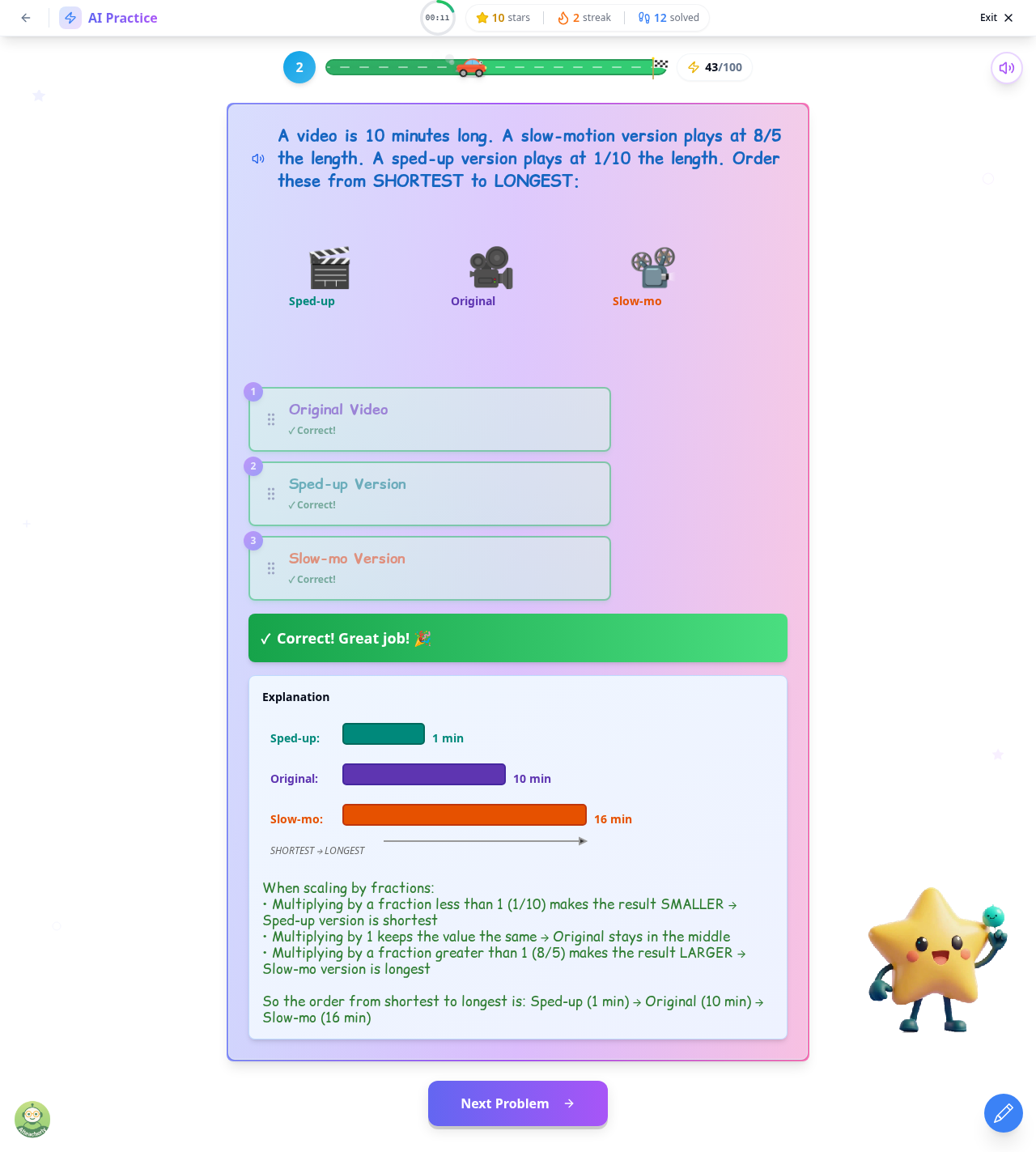
Video Lengths: If a 20-minute video is watched at 3/4 speed, it takes longer to watch. But if we're calculating the content duration at 3/4 of normal length, we get 15 minutes of content. Scaling down means less.
The interactive problem below demonstrates how students order video durations by comparing fraction multipliers, all without calculating the exact answers.
These real-world connections help cement the understanding that fractions less than 1 represent "parts of" or "less than whole," making the smaller products feel logical rather than confusing.
See How Interactive Lessons Teach Fraction Scaling
Visual models make the scaling concept click in ways that worksheets simply can't. When students can see fractions represented as parts of a whole, the "why" behind the math becomes obvious.
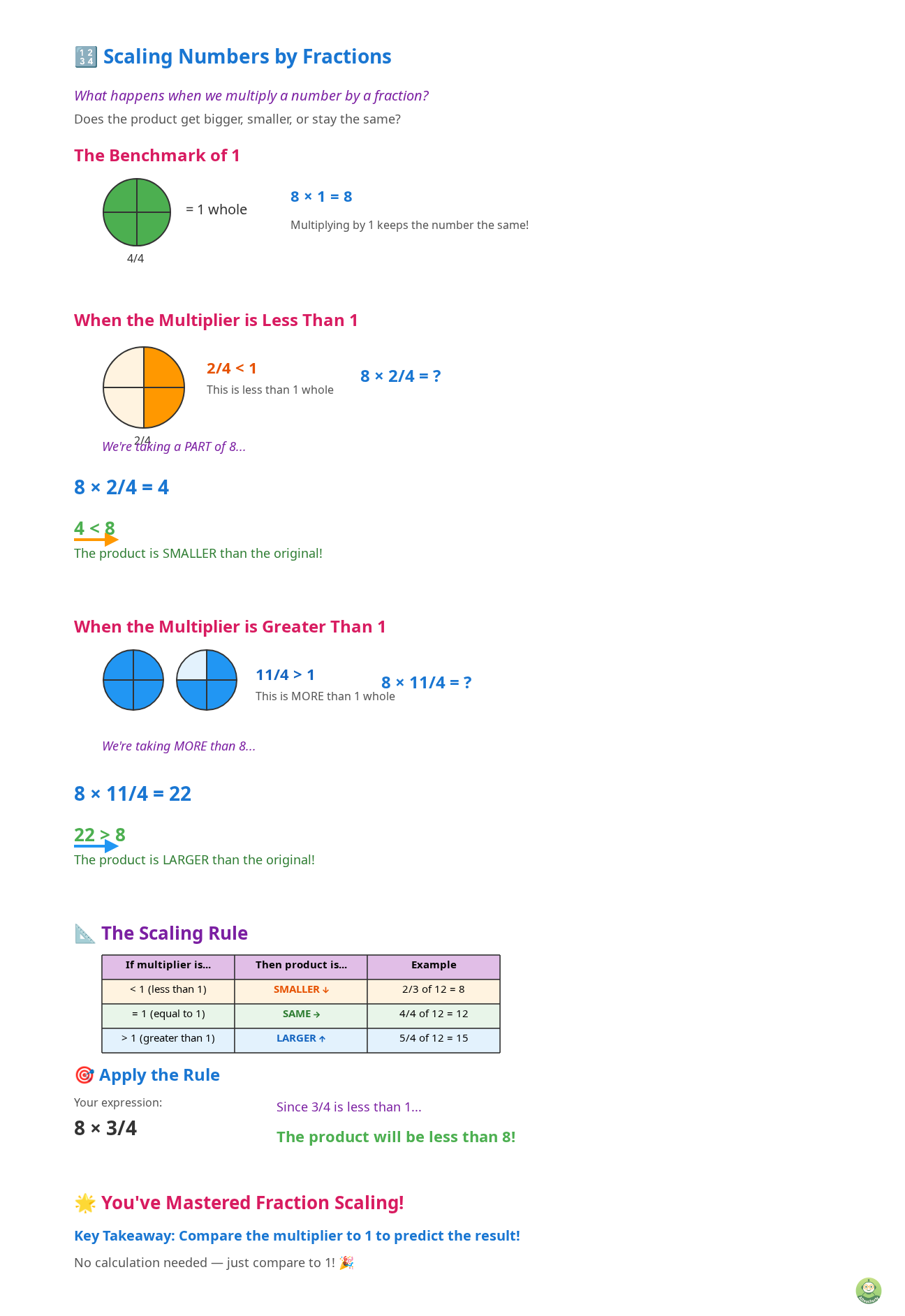
Fraction Circles: Picture a full circle representing 1 whole. When we multiply by 4/4 (which equals 1), we keep the whole circle. When we multiply by 3/4, we shade only three parts out of four, clearly showing less than the whole. When we multiply by 5/4, we need more than one circle, showing the result is greater.
Number Lines: Plotting fractions on a number line helps students see exactly where multipliers fall relative to 1. Everything to the left of 1 shrinks numbers; everything to the right grows them.
Color-Coded Tables: Grouping fractions by their relationship to 1 (less than, equal to, greater than) and color-coding the results creates a memorable visual reference.
Here's what the full interactive lesson looks like on AI Teacherly:
This hands-on approach builds lasting understanding. Instead of memorizing "multiply straight across," students develop intuition for why fraction multiplication behaves the way it does. They learn to predict before they calculate, building the number sense that separates students who "get" math from those who just follow procedures.
Common Mistakes and How to Avoid Them
Understanding where 5th graders typically stumble helps you provide targeted support. Watch for these common errors:
Mistake #1: Assuming Bigger Numerator Means Bigger Result Some students think 7/8 × 24 gives a larger answer than 3/4 × 24 because 7 is bigger than 3. While 7/8 is closer to 1, the comparison to 1 is what matters, not the raw numbers. Both fractions are less than 1, so both products are less than 24.
Mistake #2: Forgetting That Fractions Equal to 1 Exist Students sometimes forget that fractions like 4/4, 7/7, or 12/12 all equal 1. Remind your child that any fraction where the numerator equals the denominator equals one whole.
Mistake #3: Confusing Improper Fractions Fractions greater than 1 (like 5/3 or 7/4) trip students up because they look like "regular" fractions. The key question is always: "Is the top bigger than the bottom?" If yes, the fraction is greater than 1, and the product will grow.
Mistake #4: Not Checking Answers Against the Rule Encourage your child to always verify their calculated answer makes sense. If they multiply by a fraction less than 1 and get a bigger number, something went wrong in their calculation.
Building the habit of predicting before calculating and checking after creates self-correcting learners.
Key Takeaways
- Multiplying by a fraction less than 1 always gives a smaller result because you're finding a part of the original number
- The scaling rule uses 1 as a benchmark: fractions less than 1 shrink numbers, fractions greater than 1 grow numbers
- Compare numerator to denominator to quickly determine if a fraction is less than, equal to, or greater than 1
- Students can predict whether products are larger or smaller without calculating, building valuable number sense
- Real-world examples like recipes, game scores, and video lengths make the concept concrete and memorable
- Visual models such as fraction circles and number lines help students 'see' why multiplication by fractions works this way
- Encouraging prediction before calculation and verification after builds self-correcting math habits
Frequently Asked Questions
Why does multiplying by a fraction less than 1 make a number smaller?
When you multiply by a fraction less than 1, you're finding a part of the original number. Taking a portion of something always gives you less than the whole, just like eating half a pizza leaves you with less pizza than you started with.
How can my child tell if a product will be greater or less than the original number?
Compare the fraction to 1. If the numerator is smaller than the denominator (like 3/4), the product will be smaller. If the numerator is larger (like 5/4), the product will be bigger. If they're equal (like 4/4), the product stays the same.
Is it normal for 5th graders to struggle with fraction multiplication?
Absolutely. This concept challenges a belief students have built over years: that multiplication makes things bigger. The confusion is actually a sign they've been paying attention to patterns. With the right explanation, most students have an 'aha' moment quickly.
What's the difference between multiplying by a proper fraction vs an improper fraction?
Proper fractions (numerator smaller than denominator, like 2/3) are less than 1 and shrink numbers. Improper fractions (numerator larger than denominator, like 5/3) are greater than 1 and grow numbers.
Why does multiplying by 4/4 give you the same number?
Because 4/4 equals 1, and multiplying by 1 never changes a number. Any fraction where the numerator equals the denominator (3/3, 7/7, 100/100) equals one whole.
How can I explain fraction scaling without confusing my child more?
Use the pizza example: if you have a whole pizza and take 3/4 of it, you have less than a whole pizza. Taking a fraction of something means taking a part, and a part is always less than the whole when the fraction is less than 1.
What real-life examples help kids understand multiplying by fractions?
Recipe scaling works great: making half a batch means using half of each ingredient (smaller amounts). Video game score multipliers, sale discounts, and measuring ingredients all connect fractions to everyday experiences kids understand.
Ready to turn fraction frustration into confidence? Try the interactive Scaling Numbers by Fractions lesson free on AI Teacherly and watch your child master this essential 5th grade skill!