PEMDAS Made Easy: A Parent's Complete Guide to 6th Grade Order of Operations
Struggling to remember PEMDAS? This step-by-step guide breaks down order of operations for 6th grade math, covering common mistakes and real-world examples parents can use to help at home.
The PEMDAS Puzzle Every Parent Faces
That moment when your 6th grader shows you their math homework and you realize you've forgotten whether to add or multiply first? You're not alone. PEMDAS, the order of operations, is one of those math concepts that trips up parents and students alike.
Here's the good news: PEMDAS is simpler than you remember, and once you understand the "why" behind the rules, you'll be able to explain it confidently to your child.
In this guide, we'll break down exactly what PEMDAS means, why mathematicians created these rules in the first place, and the most common mistakes students make (so you can help your child avoid them). By the end, you'll feel like a math coach, not just a confused homework helper.
Whether your child is struggling with expressions like 3 + 4 × 5 or more complex problems with parentheses and exponents, this guide has you covered. Let's decode the order of operations together.
What Is PEMDAS and Why Does It Matter?
PEMDAS is an acronym that tells us the order in which to solve math operations. Without these standard rules, the same math expression could give completely different answers depending on who solves it.
Here's what each letter stands for:
- P = Parentheses (solve what's inside first)
- E = Exponents (powers and square roots)
- M = Multiplication
- D = Division
- A = Addition
- S = Subtraction
The Critical Detail Most People Miss: Multiplication and Division have the same priority. So do Addition and Subtraction. When you encounter operations at the same level, you simply work from left to right.
Why Do We Need These Rules?
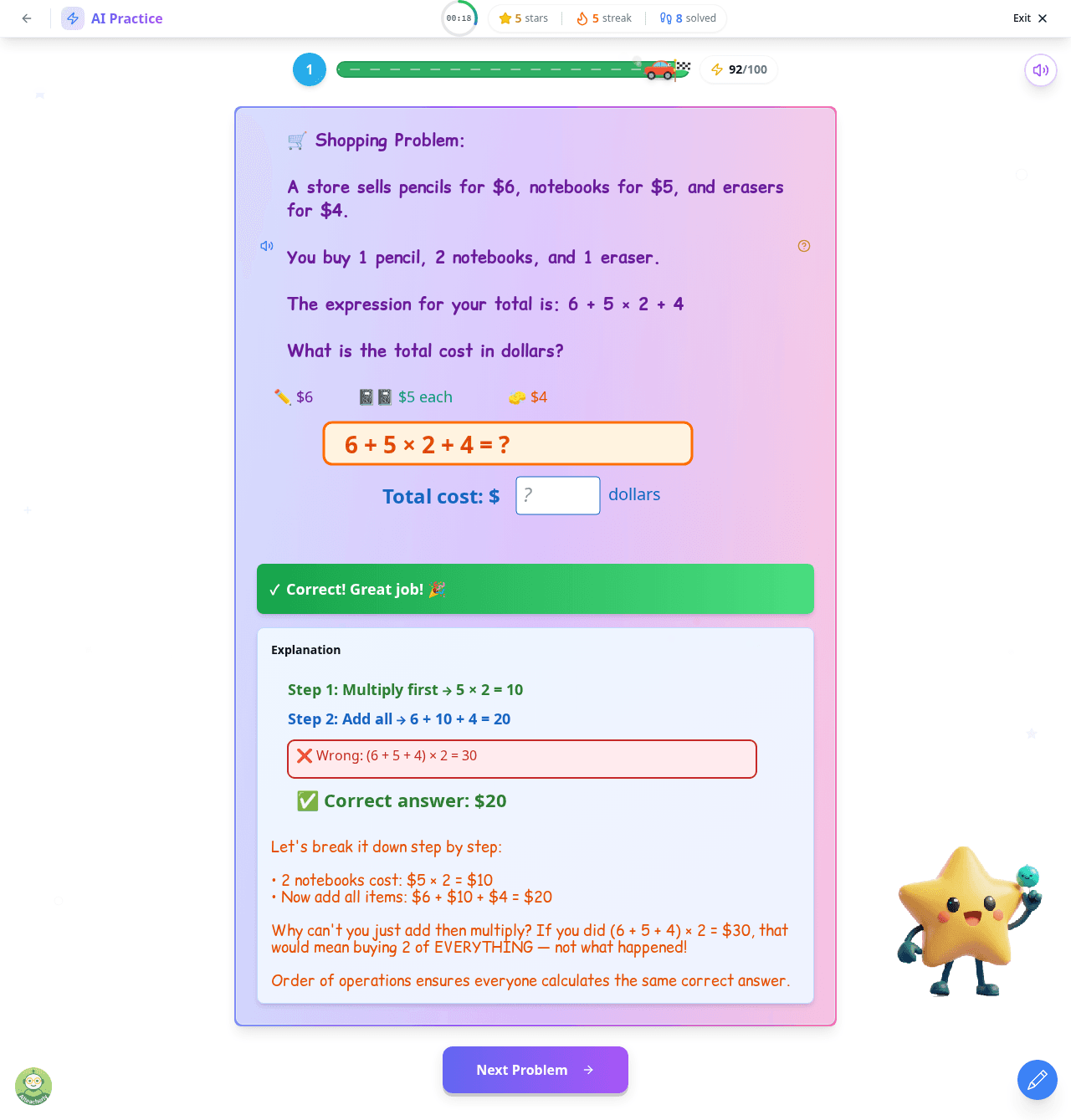
Imagine you're calculating a shopping total: 3 items at $4 each, plus a $5 shipping fee. The expression is 3 × 4 + 5.
- If you multiply first (correct):
12 + 5 = $17 - If you add first (incorrect):
3 × 9 = $27
Same numbers, completely different answers! That's mathematical chaos. PEMDAS ensures everyone arrives at the same correct answer, which is essential for everything from splitting restaurant bills to engineering bridges.
How to Explain Order of Operations Step-by-Step
When teaching your child PEMDAS, the key is to make it visual and methodical. Here's a step-by-step approach that works:
Step 1: Look for Parentheses First
Anything inside parentheses gets solved first. Think of parentheses as a "VIP section" in math. For example, in (2 + 3) × 4, you solve 2 + 3 = 5 first, then multiply: 5 × 4 = 20.
Step 2: Handle Exponents Next
Exponents (like 3² or 5³) come second. In 2 + 3² × 4, you'd calculate 3² = 9 before doing anything else.
Step 3: Multiplication and Division (Left to Right)
This is where students often stumble. Multiplication doesn't always come before division! They share the same priority, so you work left to right.
In 12 ÷ 3 × 2, you go left to right: 12 ÷ 3 = 4, then 4 × 2 = 8. (Not 12 ÷ 6 = 2!)
Step 4: Addition and Subtraction (Left to Right)
Same rule applies here. Work from left to right.
Pro Tip for Parents: Have your child circle or highlight each operation as they complete it. This visual tracking prevents skipping steps and builds methodical problem-solving habits that will serve them well in algebra.
The #1 PEMDAS Mistake (And How to Avoid It)
After working with thousands of 6th graders, we've identified the most common order of operations error: adding before multiplying when there are no parentheses.
The Classic Mistake
Let's look at the expression: 3 + 4 × 5
❌ Wrong approach: "I'll just go left to right!" → 3 + 4 = 7, then 7 × 5 = 35
✅ Correct approach: "Multiplication comes before addition." → 4 × 5 = 20, then 3 + 20 = 23
The difference is significant: 35 vs. 23!
Why Students Make This Mistake
Many kids assume math is always solved left to right, like reading a sentence. The PEMDAS rules override this intuition, which is why explicit teaching is so important.
How to Fix It
Ask the check question: Before solving, have your child identify ALL operations in the problem and rank them by PEMDAS priority.
Use color coding: Highlight multiplication and division in one color, addition and subtraction in another. This visual cue reminds them which to tackle first.
Practice with immediate feedback: Interactive lessons that show the step-by-step solution help students see exactly where their thinking went wrong.
Practice PEMDAS Together: Real-World Examples
The best way to master PEMDAS is through practice with real-world scenarios your child can relate to. Here are examples you can work through together:
Example 1: The Pizza Party Problem
You're ordering 3 pizzas at $12 each, plus a $5 delivery fee and a $3 tip.
Expression: 3 × 12 + 5 + 3
Solution:
- Multiplication first:
3 × 12 = 36 - Then addition (left to right):
36 + 5 = 41, then41 + 3 = 44
Total: $44
Example 2: The Savings Goal
Your child has $20, earns $8 per week for 4 weeks, then spends $15 on a book.
Expression: 20 + 8 × 4 - 15
Solution:
- Multiplication first:
8 × 4 = 32 - Then left to right:
20 + 32 = 52, then52 - 15 = 37
Remaining: $37
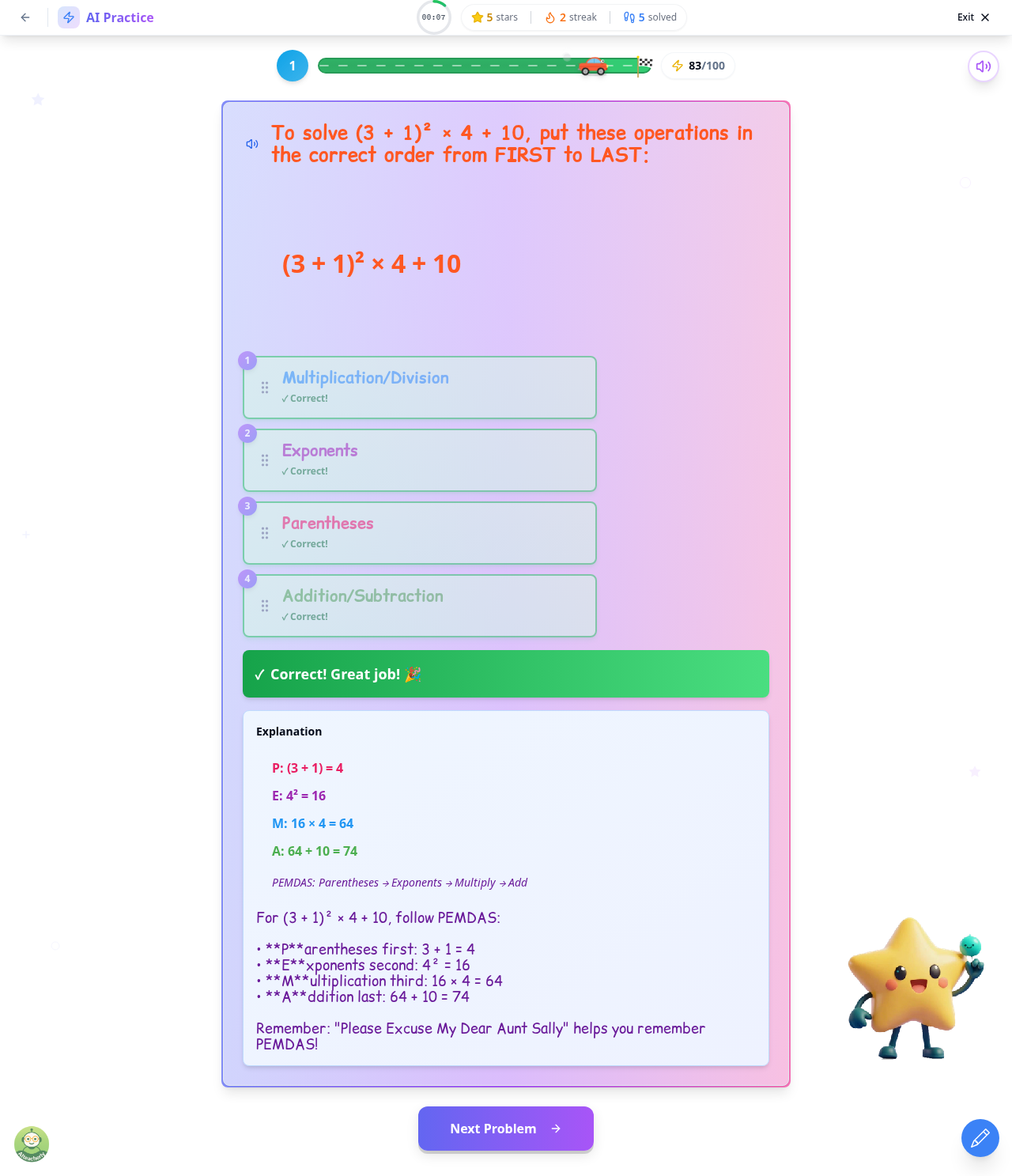
The interactive problem below shows exactly how PEMDAS works in practice, letting students drag and arrange operations in the correct order:
These hands-on exercises help students internalize the order of operations through active learning rather than passive memorization.
See How Interactive Learning Makes PEMDAS Click
Traditional worksheets have their place, but they can't show your child why their answer is wrong or guide them through the correct thinking process. That's where interactive learning transforms understanding.
On AI Teacherly's Order of Operations with Whole Numbers lesson for 6th grade, students experience:
Visual Step-by-Step Breakdowns: Instead of just seeing a red X on a wrong answer, students watch the correct solution unfold one step at a time. They see exactly where multiplication should happen before addition, making abstract rules concrete.
Immediate Error Identification: When a student adds before multiplying, the platform doesn't just mark it wrong. It shows a side-by-side comparison: "You did this... but here's what PEMDAS says to do." This targeted feedback prevents the same mistake from repeating.
Engaging Problem Types: From drag-and-drop ordering activities to real-world shopping scenarios, the variety keeps students engaged while building the same core skill from multiple angles.
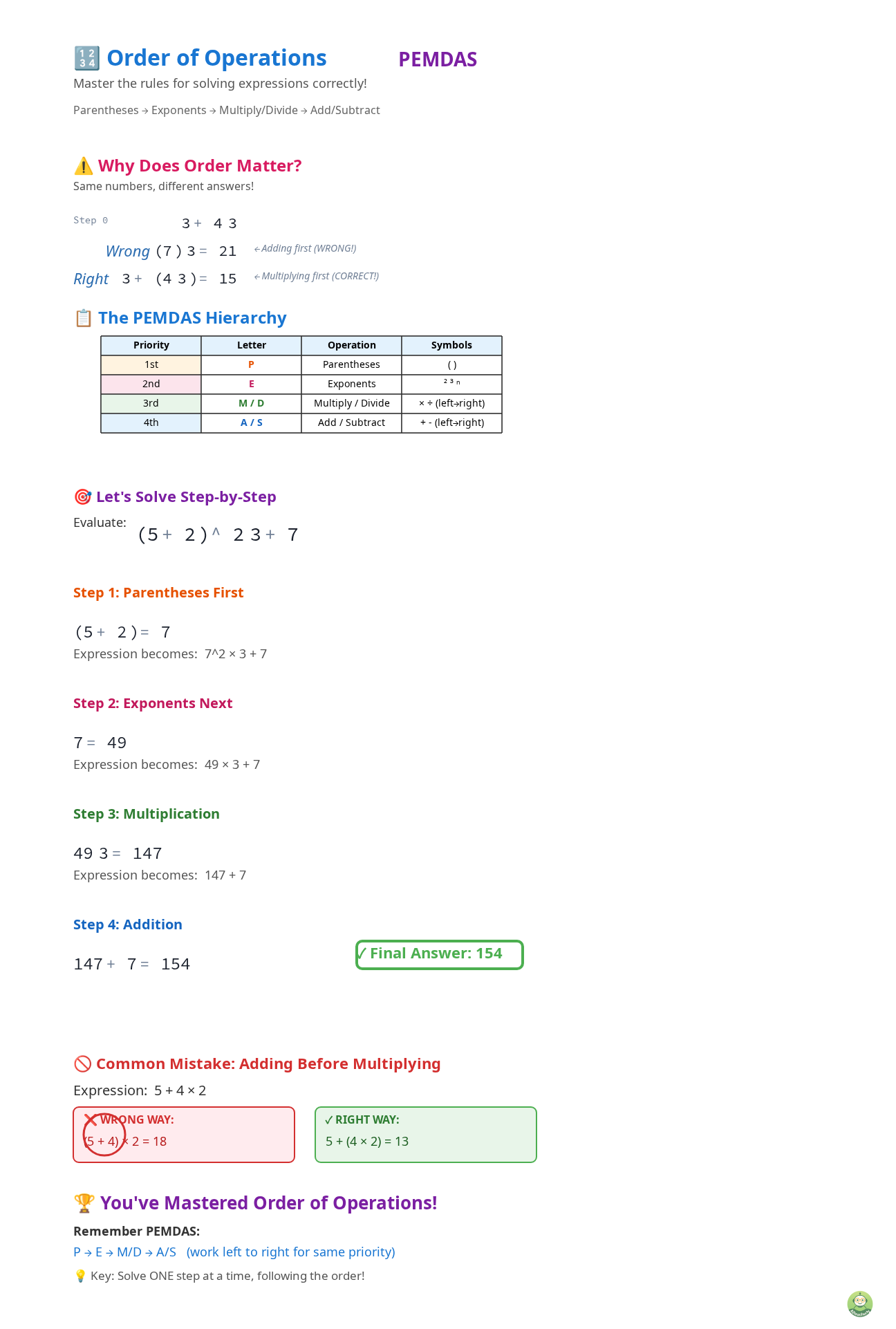
Here's what the full interactive lesson looks like on AI Teacherly:
The lesson builds from simple expressions to complex multi-step problems, ensuring your child develops both confidence and competence. Plus, you can track their progress and see exactly which concepts they've mastered.
Key Takeaways
- PEMDAS stands for Parentheses, Exponents, Multiplication, Division, Addition, Subtraction and provides the universal order for solving math expressions
- Multiplication and Division share the same priority level. So do Addition and Subtraction. When operations share a level, work left to right
- The #1 student mistake is adding before multiplying when there are no parentheses. Always scan for multiplication and division first
- Real-world examples like calculating shopping totals or savings goals make PEMDAS meaningful and memorable
- Interactive practice with immediate feedback helps students understand WHY their approach is wrong, not just that it's wrong
- Color-coding operations by priority level is a simple visual strategy that prevents careless errors
Frequently Asked Questions
What does PEMDAS stand for and what does each letter mean?
PEMDAS stands for Parentheses, Exponents, Multiplication, Division, Addition, and Subtraction. It's the standard order for solving math operations. Remember that M/D and A/S pairs share the same priority level and are solved left to right.
Why do we need order of operations in math?
Without standard rules, the same expression could give different answers depending on who solves it. PEMDAS ensures everyone arrives at the same correct answer, which is essential for consistent mathematical communication worldwide.
Do multiplication and division have the same priority in PEMDAS?
Yes! This is a common misconception. Multiplication and Division share the same priority level, as do Addition and Subtraction. When you have operations at the same level, simply work from left to right.
What is the most common order of operations mistake?
The #1 mistake is adding before multiplying when there are no parentheses. For example, in 3 + 4 × 5, students often calculate 3 + 4 first (wrong) instead of 4 × 5 first (correct). The answers are 35 vs. 23!
How can I help my child remember PEMDAS?
Try the phrase 'Please Excuse My Dear Aunt Sally' as a memory aid. Better yet, have your child identify ALL operations before solving and rank them by priority. Color-coding different operation types also creates helpful visual cues.
Is PEMDAS the same as BODMAS or GEMDAS?
Yes, they're equivalent! BODMAS (Brackets, Orders, Division, Multiplication, Addition, Subtraction) is used in the UK, while GEMDAS uses 'Grouping' instead of Parentheses. All follow the same mathematical rules.
Does PEMDAS apply to all math problems?
PEMDAS applies whenever you have multiple operations in a single expression. As math gets more complex in algebra and beyond, these foundational rules remain constant. Mastering PEMDAS now prepares students for higher-level math.
What happens if you don't follow order of operations?
You'll get the wrong answer! More importantly, mathematical communication breaks down. Engineers, scientists, and programmers all rely on consistent operation order. Teaching PEMDAS correctly builds habits for real-world applications.
Ready to make order of operations click for your 6th grader? Try the interactive PEMDAS lesson on AI Teacherly, where visual step-by-step guidance and immediate feedback transform confusion into confidence. Start your free lesson today!