Place Value Tens and Ones: The 2nd Grade Math Skill That Unlocks Everything
Place value is the foundation that unlocks all future math success. Discover how base-10 blocks work, simple home activities, and interactive practice to help your 2nd grader master tens and ones.
Why Place Value Is Your Child's Math Superpower
That moment when your child stares blankly at a math worksheet and you realize you're not quite sure how to explain it either? You're not alone. Place value, specifically understanding tens and ones, is one of the most important concepts your 2nd grader will learn this year. Yet it's also one that leaves many parents feeling uncertain about how to help.
Here's the good news: place value tens and ones in 2nd grade isn't complicated once you understand the visual approach modern math uses. In fact, it's the foundation that unlocks virtually everything else in math: addition with regrouping, subtraction with borrowing, multiplication, and beyond.
In this guide, you'll discover exactly what place value means, why base-10 blocks are such powerful learning tools, and simple ways you can reinforce this critical skill at home using items already in your kitchen. By the end, you'll feel confident supporting your child's math journey, no teaching degree required.
What Is Place Value in 2nd Grade Math?
Place value is the concept that a digit's position in a number determines its value. In a two-digit number like 34, the 3 isn't just "three." It's 3 tens, which equals 30. The 4 represents 4 ones, which equals 4. Together, they make 34.
This might sound simple, but for 7-year-olds, it's a major cognitive leap. Before 2nd grade, children think of numbers as single quantities. Now they must understand that numbers have structure, that the same digit can mean different things depending on where it sits.
Why Does This Matter So Much?
Place value is the gateway skill for all multi-digit math operations:
- Addition with regrouping: When your child adds 27 + 15 and "carries the one," they're actually moving 10 ones into the tens column. Without understanding place value, this process is just memorized steps with no meaning.
- Subtraction with borrowing: Similarly, "borrowing" from the tens place only makes sense when children understand that one ten can be exchanged for ten ones.
- Multiplication and division: These operations build directly on place value understanding.
When place value clicks, math suddenly makes sense. When it doesn't, children often struggle for years, memorizing procedures they don't understand.
How Do Base-10 Blocks Teach Tens and Ones?
If you learned math through worksheets and memorization, base-10 blocks might seem unfamiliar. But they're actually one of the most effective tools for teaching place value because they make abstract concepts concrete and visual.
What Are Base-10 Blocks?
Base-10 blocks (sometimes called place value blocks) are manipulatives that represent our number system physically:
- Ones cubes: Small individual cubes, each representing the number 1
- Tens rods: Long bars made of 10 cubes connected together, each representing 10
- Hundreds flats: Square blocks made of 10 tens rods (100 ones), used in later grades
Why Visual Learning Works for 2nd Graders
Children at this age are concrete thinkers. They learn best when they can see and touch concepts. When your child counts 3 tens rods and 4 ones cubes, they physically experience that 34 is made of 30 and 4. This visual connection builds genuine understanding rather than rote memorization.
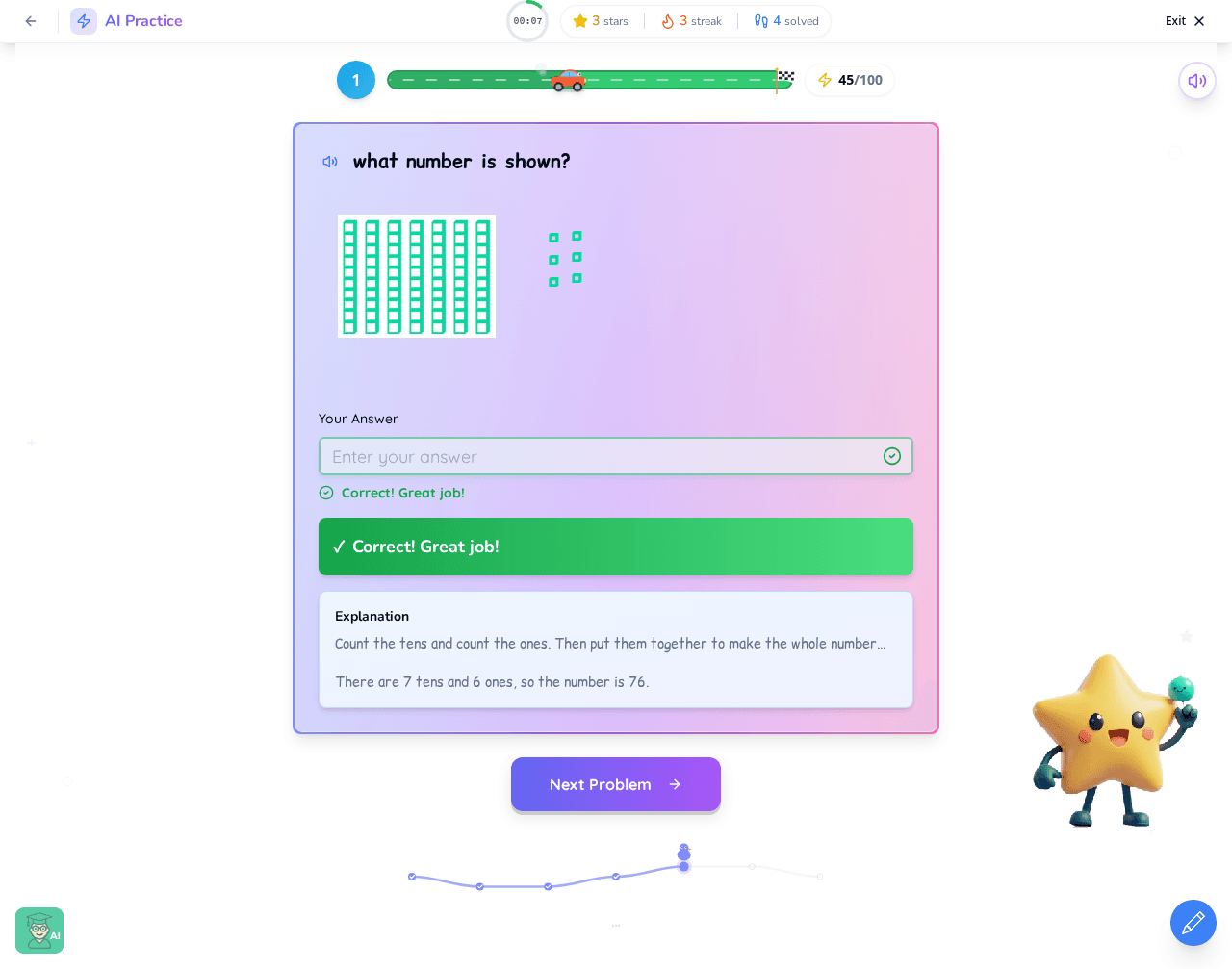
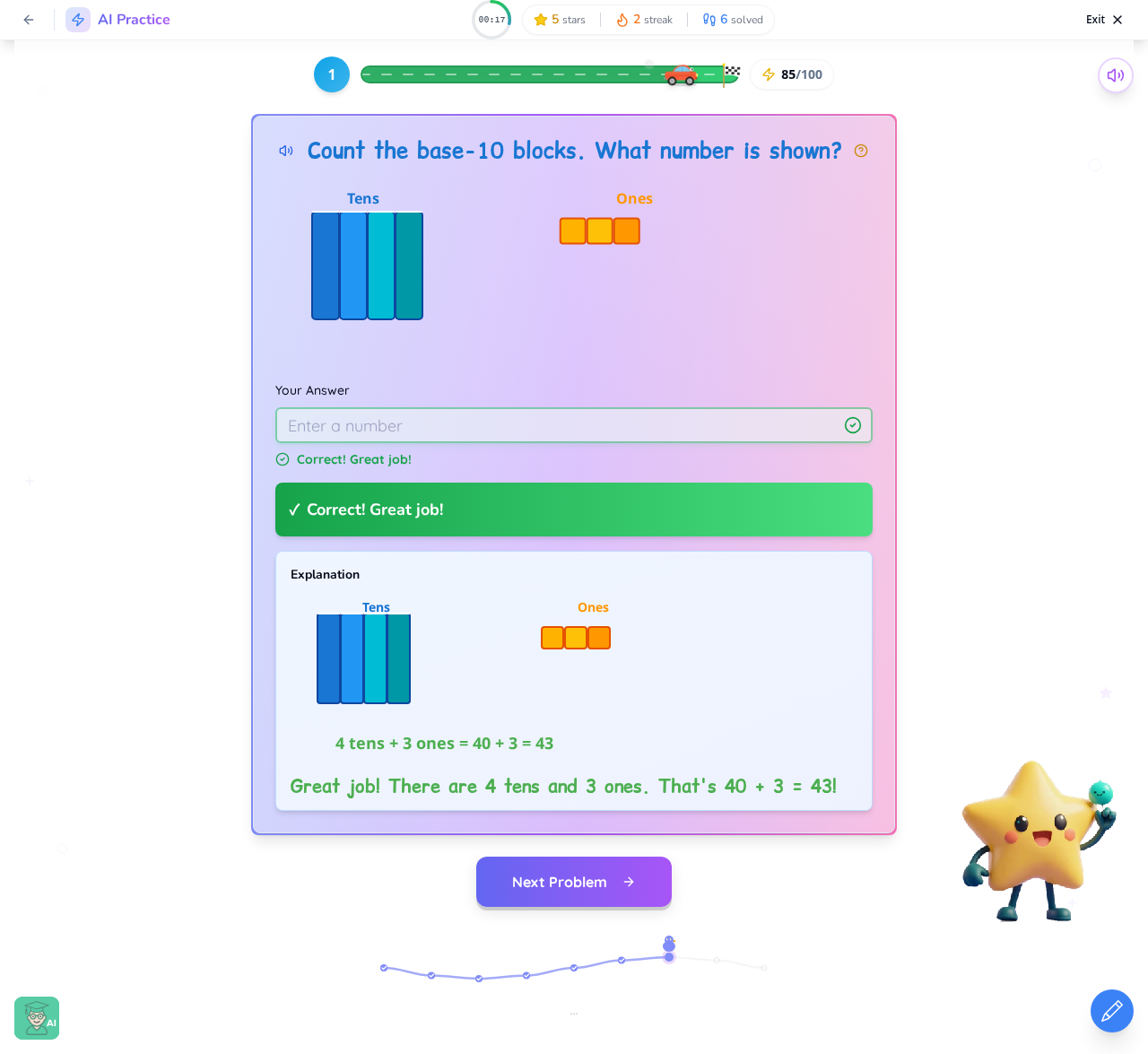
The interactive problem below shows exactly how base-10 blocks work in practice.
In quality math programs, students count the long rods (tens) first, then count the individual cubes (ones), and finally combine them to discover the total number. This step-by-step visual process mirrors how mathematicians actually think about numbers.
Simple Ways to Practice Place Value at Home
You don't need expensive manipulatives or a math teaching background to reinforce place value at home. Here are practical activities using items you already have:
1. Kitchen Counter Math
Grab a handful of pasta, cereal pieces, or small crackers. Have your child group them into piles of 10. Then ask questions like:
- "How many groups of ten do we have? How many extras?"
- "So if we have 4 tens and 7 ones, what number is that?"
2. The LEGO Challenge
If you have LEGO bricks, create "tens towers" (stacks of 10 bricks of the same color) and use individual bricks as ones. Challenge your child to build different numbers.
3. Coin Connections
Dimes are worth 10 cents; pennies are worth 1 cent. This real-world connection reinforces that 10 ones equal 1 ten. Ask your child to show you 35 cents using dimes and pennies.
4. Number Detective
Point out two-digit numbers throughout your day (house numbers, page numbers, prices) and ask your child: "What digit is in the tens place? What digit is in the ones place?"
5. Interactive Digital Practice
Online platforms with visual base-10 blocks provide immediate feedback that helps children self-correct. Look for programs that show the blocks visually rather than just asking text-based questions.
Common Place Value Mistakes (And How to Fix Them)
Understanding where children typically struggle helps you spot issues early and address them effectively.
Mistake 1: Confusing Tens and Ones Positions
The problem: Your child says the number 47 has "4 ones and 7 tens" instead of the reverse.
The fix: Practice reading numbers left to right while pointing to each digit. Use the phrase "the bigger value comes first" since tens are always larger than ones in a two-digit number. Physical base-10 blocks help because tens rods are literally bigger than ones cubes.
Mistake 2: Not Understanding That 10 Ones Equal 1 Ten
The problem: Your child can count base-10 blocks but doesn't grasp the exchange relationship.
The fix: Do hands-on "trading" activities. Count out 10 ones cubes (or 10 pennies, 10 pasta pieces), then exchange them for one tens rod (or one dime, one rubber band bundle of 10). Repeat until the equivalence becomes automatic.
Mistake 3: Treating Place Value as Two Separate Numbers
The problem: When asked what number has 3 tens and 5 ones, your child writes "3 5" with a space or says "three and five."
The fix: Emphasize that tens and ones combine to make ONE number. Use expanded form: "30 + 5 = 35" to show how the parts create the whole.
When to Seek Extra Support
If your child consistently struggles with place value after several weeks of practice, consider talking to their teacher. Early intervention prevents math anxiety from taking root.
See How Interactive Place Value Practice Works
While hands-on activities at home are valuable, interactive digital lessons offer something worksheets cannot: immediate feedback and adaptive difficulty that meets your child exactly where they are.
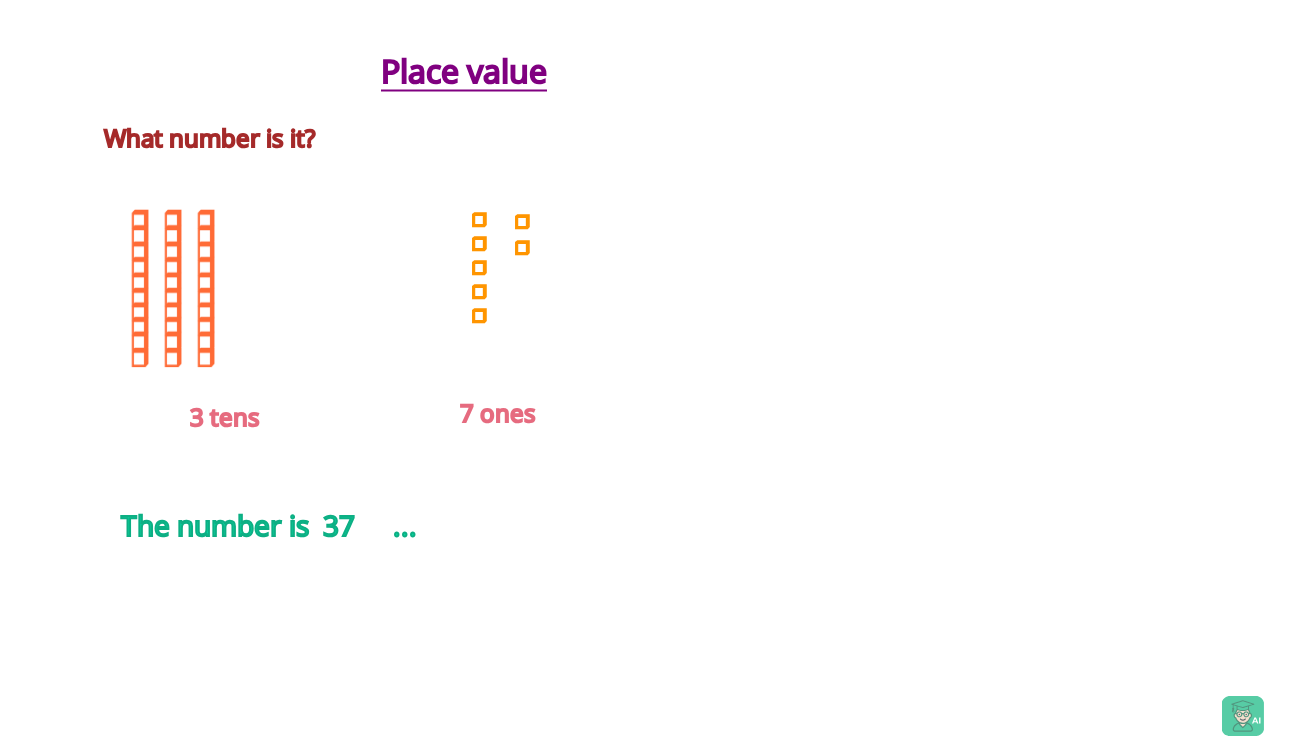
Here's what the full interactive lesson looks like on AI Teacherly:
In the Place Value Models: Tens and Ones lesson on AI Teacherly, students progress through a carefully designed learning sequence:
Visual introduction: Animated base-10 blocks appear on screen with narrated guidance: "Each long rod is a ten... Count with me, ready?"
Guided counting: Students count the tens rods together with the lesson, then count the ones cubes, building confidence before independent practice.
Interactive problems: Students see base-10 block arrangements and type the number they represent. The platform provides immediate feedback, celebrating correct answers and gently guiding corrections.
Personalized pacing: Unlike worksheets that move at one speed, interactive lessons adapt. If your child needs more practice with certain number ranges, the system recognizes this.
Why This Approach Works
Research shows that visual learning combined with immediate feedback significantly improves math understanding. When children can self-correct in the moment rather than waiting for a teacher or parent to check their work, misconceptions don't have time to become habits.
The combination of home practice with physical objects and interactive digital practice creates multiple pathways to understanding, exactly what developing brains need.
Key Takeaways
- Place value is the foundation for all multi-digit math operations, including addition with regrouping, subtraction with borrowing, and multiplication
- Base-10 blocks make abstract number concepts concrete by letting children physically see that 34 is made of 3 tens and 4 ones
- You can practice place value at home using everyday items like pasta, LEGO bricks, or coins grouped in tens
- Watch for common mistakes like confusing tens and ones positions, which can be fixed with hands-on trading activities
- Interactive digital tools provide immediate feedback that helps children self-correct before misconceptions become habits
- Combining physical manipulatives at home with adaptive online practice creates multiple learning pathways for lasting understanding
Frequently Asked Questions
What is place value and why is it important in 2nd grade?
Place value means a digit's position determines its value. In 34, the 3 represents 30 (3 tens) and the 4 represents 4 ones. It's crucial because it's the foundation for addition with regrouping, subtraction, and all future multi-digit math operations.
How do I teach my child tens and ones at home?
Use physical objects grouped in tens: pasta, LEGO bricks, or coins work great. Have your child create groups of 10, then count how many tens and extra ones to find the total number. Dimes and pennies are especially effective since dimes are worth 10 cents.
What are base-10 blocks and how do they help?
Base-10 blocks are math manipulatives: small cubes represent ones, long rods represent tens. They help children physically see that 10 ones equal 1 ten, making abstract number concepts concrete and visual, which is how 2nd graders learn best.
Why does my child confuse the tens and ones place?
This is common because children must remember that position matters, not just the digit itself. Fix this by practicing left-to-right reading, using the phrase "bigger value first," and working with physical blocks where tens rods are visibly larger than ones cubes.
When should my 2nd grader fully understand place value?
Most children solidify place value understanding by mid-2nd grade, though some need until the end of the year. If your child still struggles after consistent practice, talk to their teacher about additional support before gaps widen.
Are online place value games effective for learning?
Yes, when they use visual base-10 blocks and provide immediate feedback. Quality digital lessons help children self-correct instantly rather than practicing mistakes. Look for programs that show blocks visually, not just text-based questions.
How is place value connected to carrying and borrowing?
Carrying means moving 10 ones into the tens column as 1 ten. Borrowing means exchanging 1 ten for 10 ones. Without understanding place value, these are just memorized steps. With place value mastery, they make logical sense.
What's the difference between place value and face value?
Face value is the digit itself (the 3 in 34 has face value 3). Place value is what the digit represents based on position (the 3 in 34 has place value 30 because it's in the tens place). 2nd graders focus on place value.
Ready to make place value click for your child? Try the interactive Place Value Models: Tens and Ones lesson free on AI Teacherly and watch understanding unfold!