Mastering Rounding Word Problems in 4th Grade: A Parent's Guide
Discover how to master rounding word problems 4th grade math with a simple 3-step routine. Turn homework struggles into confidence with practical home tips.

Introduction: Why Word Problem Estimation Frustrates 4th Graders (And How to Fix It)
Math word problems can cause instant panic for fourth graders, and often equal pure frustration for parents trying to explain them at the kitchen table. When numbers get bigger in fourth grade, traditional arithmetic turns into paragraph-long stories about fruit stands, stadium tickets, and library books. Many children freeze up because they do not know where to start or whether they need an exact answer right away. Fortunately, mastering rounding word problems 4th grade math does not require a teaching degree. With the right strategies, you can turn homework battles into moments of clarity and confidence. Here's what the full interactive lesson looks like on AI Teacherly:
Here's what the full interactive lesson looks like on AI Teacherly:
What Is Rounding in Word Problems and Why Does It Matter?
Before diving into calculations, students need to understand what estimation actually means in a word problem context. Rounding involves replacing an exact number with a nearby, friendlier number that makes mental math easier. In fourth grade mathematics, students learn to estimate sums by rounding addends to the nearest ten or hundred before adding them together. This skill is not just a school requirement; it is a practical life tool. Whether you are estimating the total cost of groceries or checking if your homework answer is in the right ballpark, rounding provides a reliable safety net against careless calculation errors. Understanding why we estimate transforms math from a tedious chore into a practical superpower.
3 Simple Steps to Solve Estimation Word Problems at Home
To help your child succeed with fourth grade math estimation, break every word problem down into a predictable three-step routine. Establishing a consistent rhythm removes the anxiety of the unknown and gives students a clear roadmap.
First, read the problem twice. On the second read, have your child underline or highlight the two main numbers being added together.
Second, identify the rounding target. Fourth-grade curriculum often asks students to round addends to the nearest hundred. Look at the tens digit to decide whether to round up or down.
Third, add the newly rounded numbers to find the estimated sum. By following this simple framework every time, kids stop guessing and start solving with structured confidence.
How to Teach Rounding to the Nearest Hundred Without Tears
Rounding to the nearest hundred is a foundational milestone, but it often trips students up when numbers fall right on the boundary. The golden rule for rounding is simple: look at the digit to the immediate right of your target place value. If you are rounding to the nearest hundred, examine the tens digit. If that digit is 4 or less, round down by keeping the hundreds digit the same and changing the tens and ones to zero. If the tens digit is 5 or greater, round up by increasing the hundreds digit by one and replacing the rest with zeros. For example, if a word problem features 472 apples, the tens digit is 7, which means we round up to 500. Practicing this rule with real objects or visual number lines makes the concept stick permanently.
Interactive Practice: Making Math Word Problems Fun for Kids
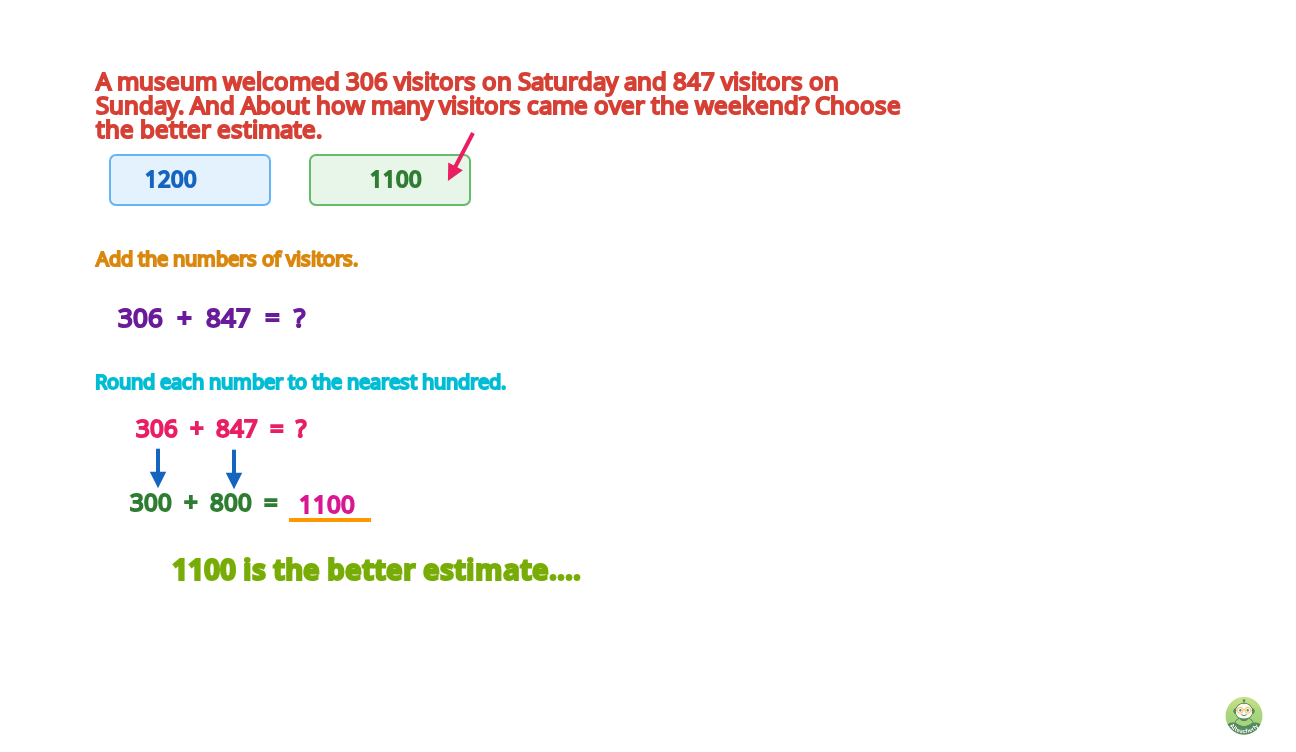
Worksheets alone can feel dry and discouraging for nine-year-olds. Interactive digital platforms bridge the gap by turning abstract math concepts into engaging, game-like challenges. When students can drag numbers, visualize place value charts, and receive instant feedback, their engagement skyrockets. The interactive problem below shows exactly how PEMDAS and estimation work in practice:
The interactive problem below shows exactly how estimation works in practice:

Common Mistakes Kids Make When Estimating Sums
Even confident students make occasional mistakes when tackling rounding word problems 4th grade math assignments. One common error is rounding the numbers after performing the exact addition, rather than estimating first. Remind your child that estimation always happens before the final add. Another frequent trap is looking at the wrong place value, such as rounding to the nearest ten when the question specifically asks for the nearest hundred. Pointing out these pitfalls gently during practice helps children build self-checking habits. When kids learn to catch their own mistakes, their mathematical independence grows rapidly.
Key Takeaways
- Always read math word problems twice to identify key addends before attempting any calculation.
- Master rounding to the nearest hundred by checking the tens digit first (5 or more rounds up).
- Estimation helps children quickly check if their final answers are reasonable in multi-digit addition.
- Short, consistent practice sessions build strong number sense without causing homework burnout.
- Interactive digital lessons provide immediate feedback and visual guidance for fourth-grade learners.
Frequently Asked Questions
Why do 4th graders need to estimate word problems by rounding?
Estimation is essential in 4th grade math because it builds strong number sense and allows students to quickly check if their exact calculations are reasonable. In real life, exact numbers are not always necessary for quick decision-making.
How can I teach my child to round to the nearest hundred easily?
To round to the nearest hundred, look at the tens digit. If the tens digit is 5 or greater, round up to the next hundred. If it is 4 or less, round down. For example, 472 rounds up to 500, while 321 rounds down to 300.
What is the difference between an exact sum and an estimated sum?
An exact sum is the precise total calculated down to the exact digits (e.g., 425 + 389 = 814). An estimated sum uses rounded numbers to calculate a quick, close approximation (e.g., 400 + 400 = 800) before doing heavy math.
How do I explain word problems to my 4th grader without getting frustrated?
Break down the problem by reading it twice, circling key numbers, identifying whether you need an exact answer or an estimate, and working through the addition sentence one step at a time without rushing.
When should kids use rounding in real-life math situations?
Kids should use rounding whenever they need a quick mental check, such as estimating grocery totals, planning time budgets, or checking whether a multi-digit math calculation makes sense.
Why do children struggle with rounding word problems?
Many children accidentally round the wrong place value, such as rounding to the nearest ten instead of the nearest hundred, or they forget whether to round up or down when the digit is exactly 50. Practicing with visual number lines prevents these errors.
How does AI Teacherly support 4th-grade math learning?
AI Teacherly offers interactive 4th-grade math lessons like 'Word problems - Better Estimate' where students practice rounding and estimation with step-by-step guidance and instant feedback.
Ready to make math homework stress-free? Explore interactive estimation and rounding word problem lessons free on AI Teacherly today!