Skip Counting Word Problems for 2nd Grade: Why Patterns Finally Click with Stories
When your child can recite "2, 4, 6, 8" but freezes at word problems, the issue isn't counting; it's context. Discover how skip counting stories transform pattern memorization into real understanding.
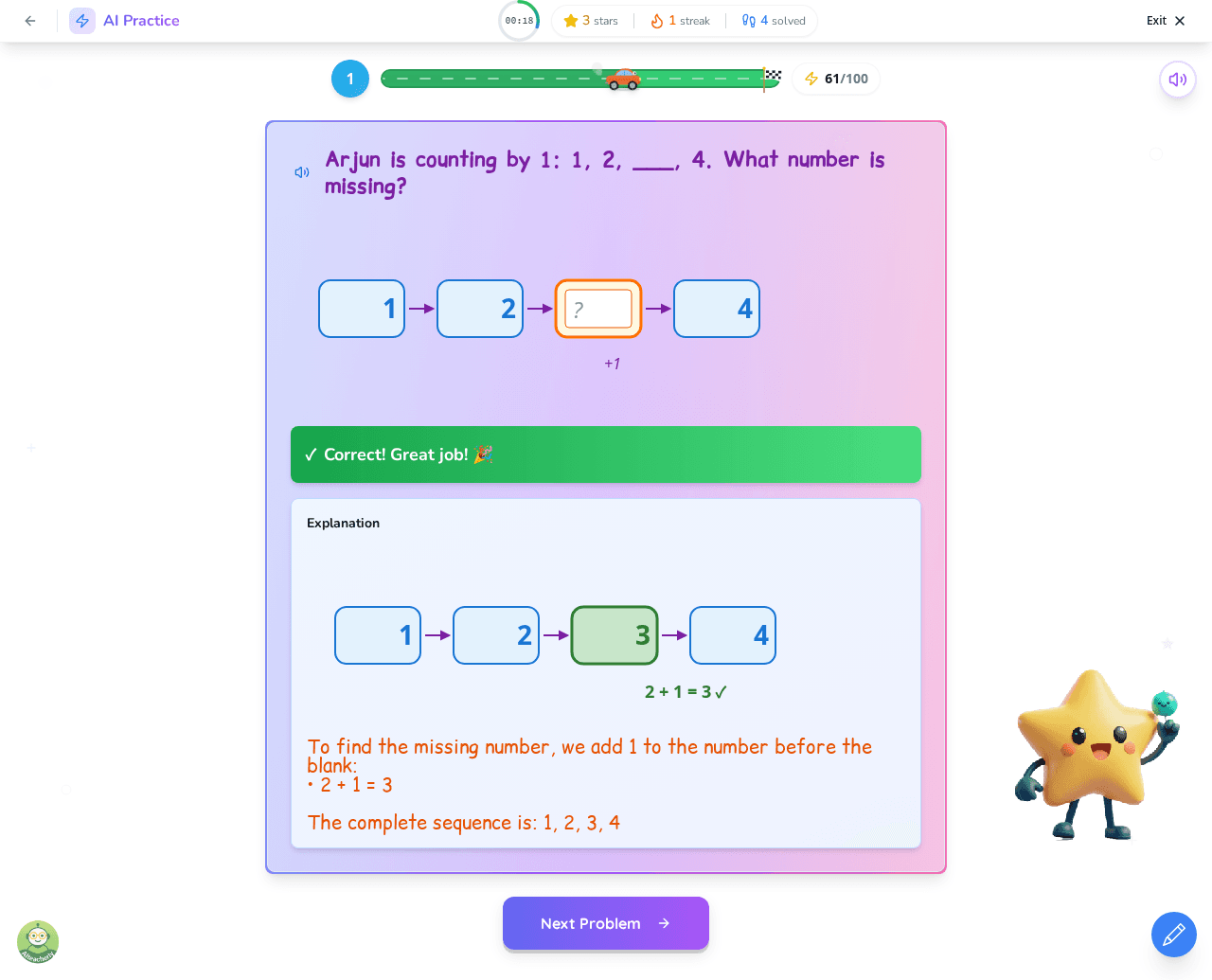
Why Skip Counting Word Problems Trip Up 2nd Graders
Your child can recite "2, 4, 6, 8, 10" like a champ. But hand them a word problem that asks "If each spider has 8 legs, how many legs do 4 spiders have?" and suddenly they're lost. Sound familiar?
This disconnect is one of the most common struggles parents report with skip counting word problems in 2nd grade. Children often memorize sequences without understanding what they mean. When math shifts from rote recitation to real-world application, the foundation cracks.
The good news? Word problems aren't the enemy here. They're actually the key to making skip counting click. When your child sees that counting by 5s helps them figure out how many fingers are on 6 hands, or that counting by 10s helps them count dimes, the pattern transforms from abstract numbers into a tool they can use.
In this guide, we'll explore why skip counting word problems matter for 2nd graders, how to help your child see the patterns, and practical strategies you can use at home to build their confidence. Plus, we'll show you how interactive lessons make this learning journey more engaging and effective.
What Is Skip Counting and Why Does It Matter?
Skip counting is the mathematical practice of counting forward by a number other than one. Instead of counting 1, 2, 3, 4, your child learns to count 2, 4, 6, 8 (by 2s) or 5, 10, 15, 20 (by 5s) or 10, 20, 30, 40 (by 10s).
But why do 2nd graders need this skill? Skip counting is the hidden foundation for multiplication. When your child counts by 3s (3, 6, 9, 12), they're actually discovering that 4 groups of 3 equals 12. This connection becomes explicit in 3rd grade multiplication, but the groundwork starts now.
Skip counting also builds:
- Number sense: Understanding how numbers relate to each other
- Pattern recognition: Spotting what comes next in a sequence
- Mental math fluency: Calculating faster without counting one by one
- Time-telling skills: Counting by 5s helps read analog clocks
- Money skills: Counting dimes (by 10s) and nickels (by 5s)
In 2nd grade, your child should be comfortable skip counting by 2s, 5s, and 10s, typically up to 100 or beyond. They should also begin recognizing these patterns in real-world contexts, which is where word problems come in.
How Do Word Problems Make Skip Counting Click?
Here's a secret that changes everything: word problems give skip counting a purpose.
When your child sees "count by 5s to 50," it's just a sequence to memorize. But when they read "There are 5 cookies in each box. How many cookies are in 7 boxes?" suddenly the pattern has meaning. Each jump of 5 represents another box of cookies. The counting has stakes.
Word problems transform skip counting from "what" to "why":
| Without Context | With Word Problem Context |
|---|---|
| Count by 2s | How many shoes are in 6 pairs? |
| Count by 5s | How many fingers on 8 hands? |
| Count by 10s | How many cents in 5 dimes? |
The magic happens when children realize that the word problem is asking them to make groups. "5 cookies per box" means each group has 5. "7 boxes" means 7 groups. Finding the total means counting: 5, 10, 15, 20, 25, 30, 35.
This shift from memorization to application is critical. Research shows that children who understand the "why" behind math procedures retain skills longer and transfer them to new situations more easily. Word problems provide that crucial context.
The Table Method: A Visual Way to See the Pattern
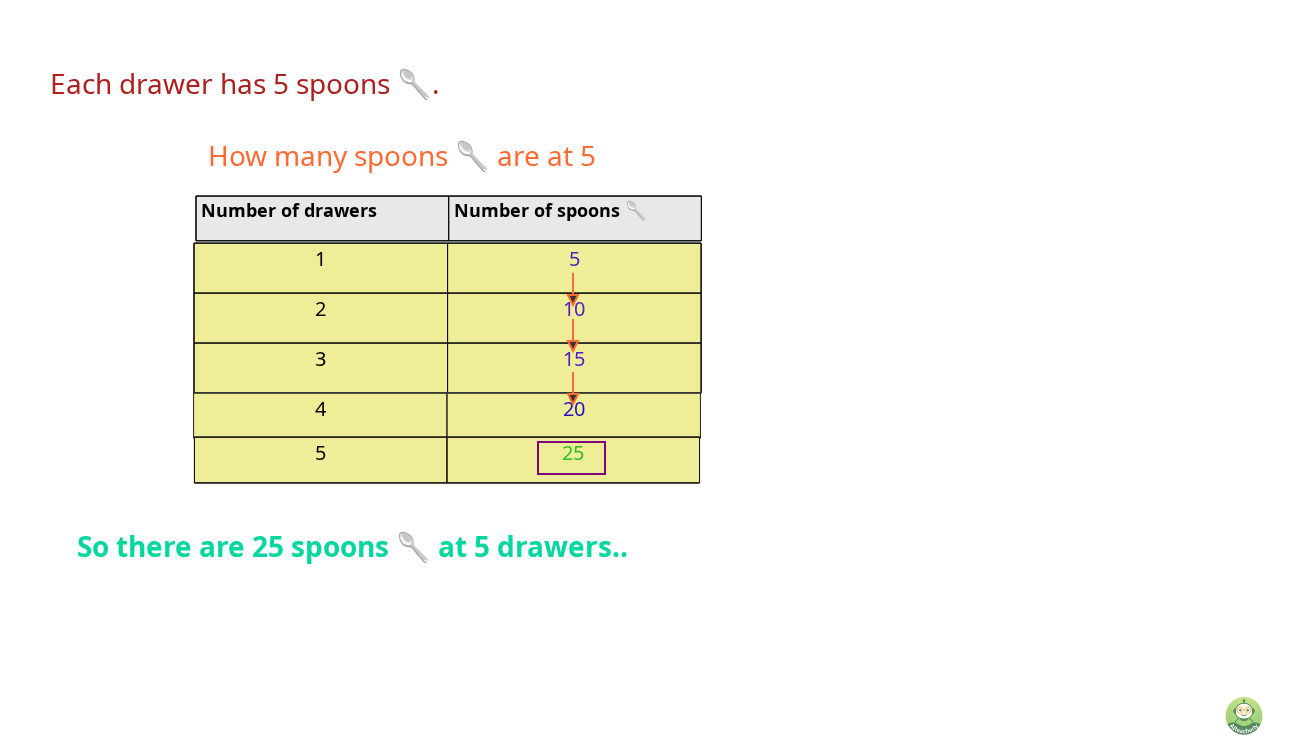
One of the most effective strategies for teaching skip counting word problems is the table method. It makes the growing pattern visible, which helps children predict the next number rather than memorize it.
Here's how it works with a sample problem: "Each bicycle has 2 wheels. How many wheels do 5 bicycles have?"
Step 1: Set up a table
| Bicycles | Wheels |
|---|---|
| 1 | 2 |
| 2 | 4 |
| 3 | 6 |
| 4 | 8 |
| 5 | ? |
Step 2: Spot the pattern together
Ask your child: "What do you notice? Every time we add one more bicycle, how many more wheels do we add?" They'll see it's always 2 more. That's counting by 2s!
Step 3: Predict and verify
"So if 4 bicycles have 8 wheels, and we add 2 more for the 5th bicycle, how many wheels total?" Your child can now confidently say 10.
Why this works: The table externalizes the pattern that skilled mathematicians see internally. It gives your child a scaffold until the pattern becomes automatic. Over time, they won't need the table; they'll just "see" that 5 groups of 2 is 10.
Practice Skip Counting Word Problems at Home
You don't need fancy materials to practice skip counting activities at home. The key is consistency and connecting practice to things your child already knows.
Everyday Skip Counting Opportunities:
- Sorting laundry: "If each person needs 2 socks, how many socks for our family of 4?"
- Setting the table: "We need 5 items per place setting. How many items for 6 people?"
- Counting money: "You have 7 dimes. How many cents is that?"
- Snack time: "If each friend gets 3 crackers, how many crackers for 5 friends?"
Creating Your Own Word Problems:
Use this simple formula: "Each [object] has [number] [items]. How many [items] for [count] [objects]?"
Examples:
- Each dog has 4 legs. How many legs on 6 dogs?
- Each hand has 5 fingers. How many fingers on 7 hands?
- Each week has 7 days. How many days in 3 weeks?
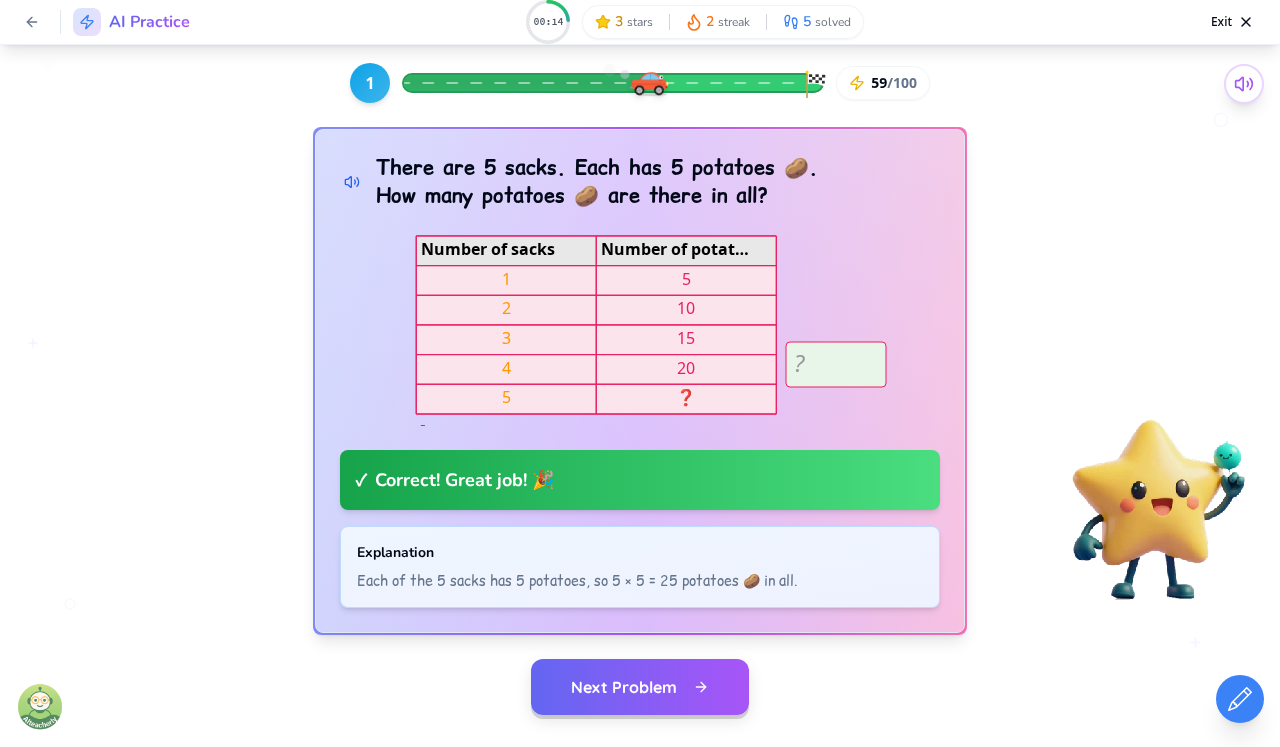
The interactive problem below shows exactly how skip counting word problems look in practice, with visual groups that help children connect the story to the counting pattern.
Pro tip: Start with smaller numbers (2-5 groups) and gradually increase as confidence builds. Celebrate the pattern recognition, not just the right answer.
See How Interactive Skip Counting Lessons Work
While at-home practice is valuable, interactive digital lessons offer something paper worksheets can't: immediate feedback and engaging visuals that keep 2nd graders motivated.
On AI Teacherly, the Skip Counting Stories lesson takes your child through word problems step by step. The lesson builds understanding progressively:
- Visual grouping: Children see objects arranged in groups, making the "per group" concept concrete
- Pattern building: A table grows as they work through the problem, revealing the skip counting sequence
- Guided discovery: Prompts like "Every time we add one more group, we add more items. So we are counting by..." help children articulate the pattern themselves
- Multiple problem types: From fill-in-the-blank sequences to number line selections to ordering activities, children practice the same skill in different formats
Here's what the full interactive lesson looks like on AI Teacherly:
What makes interactive practice especially effective for 2nd grade math word problems is the combination of visual models and instant feedback. When your child types an answer, they immediately know if they're on track. Mistakes become learning moments rather than frustrations, and successes build confidence for the next challenge.
The variety of problem types also prevents boredom. One moment they're filling in a missing number; the next they're clicking on a number line or dragging numbers into the correct order.
Common Mistakes and How to Avoid Them
Even with good instruction, children make predictable errors with skip counting word problems. Knowing what to watch for helps you provide targeted support.
Mistake #1: Counting the groups instead of the total items
If the problem asks "How many legs on 4 spiders?" and your child answers "4," they've counted spiders, not legs. Fix: Have them point to each group while counting: "8 (one spider), 16 (two spiders), 24 (three spiders), 32 (four spiders)." Emphasize that the question asks about legs, not spiders.
Mistake #2: Losing track mid-sequence
Children often know 2, 4, 6, 8... but stumble after. Fix: Use physical manipulatives or drawings. Let them touch or see each group as they count. The table method also prevents this by recording each step.
Mistake #3: Confusing which number to count by
A child might see "5 boxes with 3 cookies each" and count by 5s instead of 3s. Fix: Ask "How many are in EACH group?" and circle that number. That's the number they count by. The number of groups tells them how many times to count.
Mistake #4: Starting the sequence at the wrong number
Some children begin skip counting at the wrong starting point. Fix: Remind them that skip counting starts at the group size, not at 1. "If we're counting by 5s, we start at 5, not 1."
Remember: Mistakes are part of learning. Stay patient, use visuals, and celebrate progress over perfection.
Key Takeaways
- Skip counting word problems connect abstract number patterns to real-life scenarios, making the "why" behind counting by 2s, 5s, and 10s finally click for 2nd graders.
- The table method helps children visualize patterns: when they see 1 group = 5 items, 2 groups = 10 items, the skip counting rule becomes obvious.
- Word problems are secretly multiplication prep; mastering "3 items per box × 4 boxes" now makes 3 × 4 = 12 intuitive later.
- Common struggles include counting groups instead of items, losing track mid-sequence, and confusing which number to count by; targeted practice fixes these.
- Interactive lessons with immediate feedback help children self-correct and build confidence faster than worksheets alone.
- Everyday opportunities like sorting laundry, setting tables, and counting coins make skip counting practice natural and meaningful.
Frequently Asked Questions
What is skip counting and how is it used in 2nd grade math?
Skip counting means counting forward by a number other than one, like 2, 4, 6, 8 or 5, 10, 15, 20. In 2nd grade, it builds number sense, pattern recognition, and prepares children for multiplication in 3rd grade.
How do word problems make skip counting easier to understand?
Word problems give skip counting a purpose. Instead of memorizing sequences, children see that counting by 5s helps answer real questions like "How many fingers on 6 hands?" The story makes the pattern meaningful.
What numbers should my 2nd grader be able to skip count by?
By the end of 2nd grade, children should confidently skip count by 2s, 5s, and 10s up to at least 100. Many curriculums also introduce counting by 3s and 4s as multiplication preparation.
Why does my child struggle with skip counting word problems?
Most children can recite sequences but struggle to apply them. Common issues include confusing which number to count by, counting groups instead of items, or losing track mid-sequence. Visual tables and real-world practice help.
Is skip counting the same as multiplication?
Skip counting is the foundation for multiplication but not the same thing. When children count 5, 10, 15, 20, they're discovering that 4 groups of 5 equals 20. Multiplication formalizes this as 4 × 5 = 20.
How can I practice skip counting word problems at home?
Use everyday situations: counting pairs of socks, calculating cookies per plate for guests, or adding up coin values. Create simple word problems using the formula: Each [object] has [number] [items]. How many [items] for [count] [objects]?
What are real-life examples of skip counting for kids?
Real-life skip counting includes counting by 5s to read an analog clock, counting dimes by 10s, tallying legs on insects (by 6s), or figuring out how many wheels are on multiple bicycles (by 2s).
How do I know if my child is ready for multiplication after skip counting?
Your child is ready when they can skip count fluently by 2s, 5s, and 10s, understand that counting by 3s four times equals 12, and connect skip counting to word problems about equal groups. This typically happens by late 2nd or early 3rd grade.
Ready to make skip counting click for your 2nd grader? Try the interactive Skip Counting Stories lesson free on AI Teacherly and watch number patterns come alive!