Teach 1st Grade Subtraction with the Crossing Out Method: A Visual Strategy That Works
Discover why the crossing out method is the most effective way to teach 1st grade subtraction. This visual strategy makes "taking away" concrete and builds lasting math confidence.
Why Visual Subtraction Changes Everything for 1st Graders
Watching your 1st grader struggle with subtraction can be frustrating for both of you. They count on their fingers, guess randomly, or simply shut down when they see a subtraction problem. But here's the thing: the problem often isn't their ability. It's how subtraction is being taught.
For 6 and 7 year olds, abstract number sentences like "7 - 3 = ?" are genuinely confusing. Their brains are still developing the capacity for abstract thinking. What they need is to see the math happening in front of them. They need to physically watch objects disappear, get removed, or (in this case) get crossed out.
That's where the crossing out method comes in. This visual subtraction strategy transforms abstract math into something tangible and concrete. Instead of asking kids to imagine taking away, you show them. And when kids can see what "minus" actually means, subtraction finally clicks.
In this guide, you'll learn exactly how to teach 1st grade subtraction using the crossing out method, why it works so well for young learners, and how interactive platforms like AI Teacherly make this approach even more engaging. Whether your child is struggling or you just want to reinforce what they're learning in school, this visual strategy will become your go-to tool.
What Is the Crossing Out Method for Subtraction?
The crossing out method is a visual subtraction strategy where children start with a group of objects, cross out (or remove) a specific number, and then count what remains. It's elegantly simple, and that's exactly why it works so well for first graders.
Here's the basic process:
- Start with a group of objects (pictures, stickers, toys, or drawings)
- Cross out the number being subtracted (draw an X through them or physically remove them)
- Count what's left (this is your answer)
For example, if the problem is "5 - 2 = ?", your child would:
- Look at 5 objects (apples, stars, blocks, etc.)
- Cross out 2 of them with an X
- Count the remaining objects: 1, 2, 3
- The answer is 3!
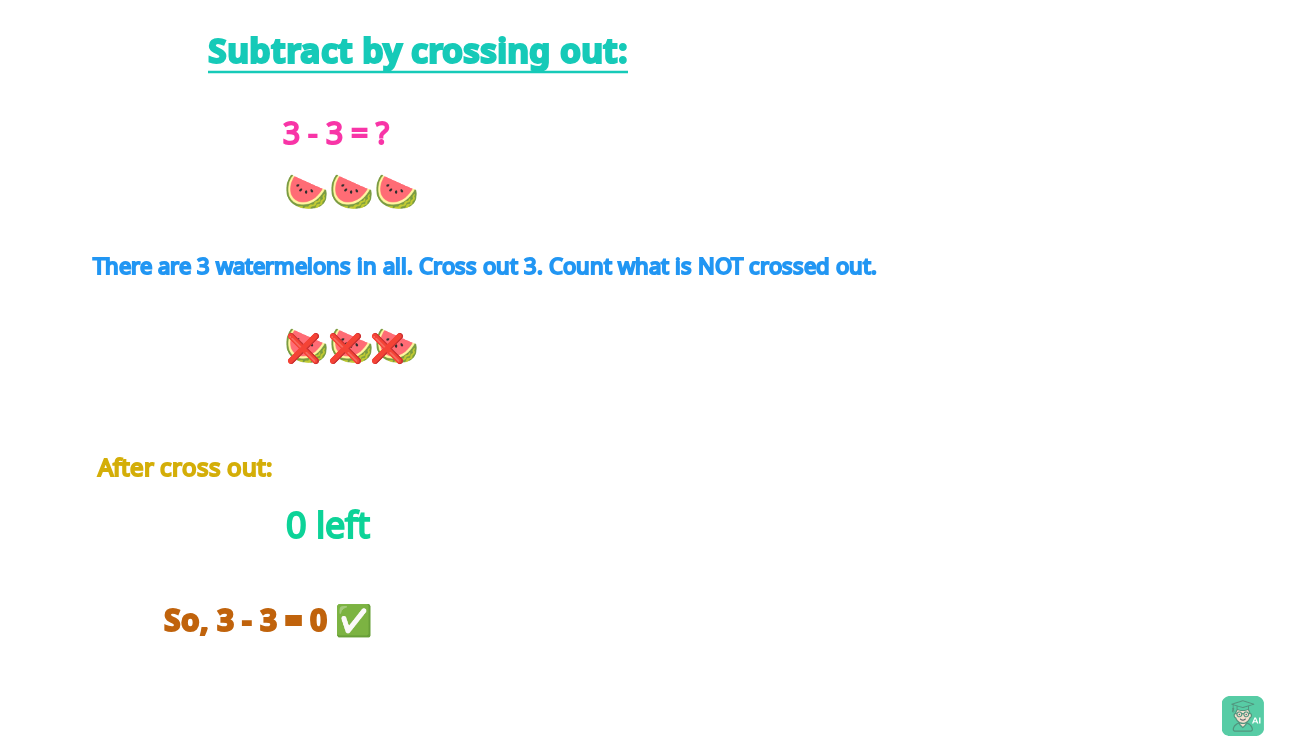
The key insight here is what educators call the "count what is NOT crossed out" strategy. Once kids understand that their job is simply to count the objects that don't have an X through them, the entire subtraction process becomes straightforward.
This method is also called "subtraction with pictures" or "visual subtraction," and it's a standard part of 1st grade math curriculum for good reason. It bridges the gap between physical counting (which kids already know) and abstract number sentences (which they're learning).
Why Do First Graders Struggle with Subtraction?
Before diving into how to teach subtraction, it helps to understand why so many 1st graders find it challenging. Knowing the "why" helps you be more patient and choose the right strategies.
1. Subtraction is more abstract than addition. Addition feels natural because kids can see "more" happening. They put groups together and the pile gets bigger. Subtraction requires understanding that something goes away, which is harder to visualize without concrete tools.
2. The "taking away" concept isn't intuitive. When we say "seven minus three," adults automatically picture removing items. But for young children, the word "minus" is just a symbol with no inherent meaning. They need repeated visual demonstrations to connect the symbol to the action.
3. Working memory limitations. First graders are still developing working memory. Holding multiple numbers in their head while also processing the operation is genuinely difficult. Visual methods like crossing out reduce this cognitive load by letting kids see everything at once.
4. Math anxiety can start early. If a child has experienced frustration or failure with subtraction, they may develop anxiety that makes the problem worse. Visual strategies help rebuild confidence because kids can clearly see their progress.
5. Different learning styles need different approaches. Some children are visual learners who need to see concepts, not just hear them. If your child learns best through pictures and hands-on activities, purely verbal instruction won't be enough.
The crossing out method addresses all of these challenges by making subtraction visible, reducing memory demands, and giving kids a concrete strategy they can rely on.
How to Teach the Crossing Out Method at Home (Step-by-Step)
Ready to try visual subtraction at home? Here's a practical, step-by-step guide you can use today. No special materials needed, just everyday objects and a few minutes of focused practice.
Step 1: Gather your objects Use anything your child finds interesting: toy cars, Lego bricks, crackers, stickers, or even drawings of their favorite characters. The more engaging the objects, the more invested they'll be.
Step 2: Present the starting group Say: "We have 6 toy cars. Can you count them with me?" Have your child touch each object as they count to reinforce one-to-one correspondence.
Step 3: Introduce the subtraction "Now we need to take away 2 cars. Let's cross them out!" If using physical objects, physically remove them or flip them over. If using paper, draw an X through 2 cars.
Step 4: Count what's left Ask: "How many cars are NOT crossed out?" Let your child count the remaining objects. Celebrate when they get the answer: "Yes! 6 minus 2 equals 4!"
Step 5: Connect to the number sentence Write out "6 - 2 = 4" and point to each part as you explain what it means. This builds the bridge from visual understanding to symbolic math.
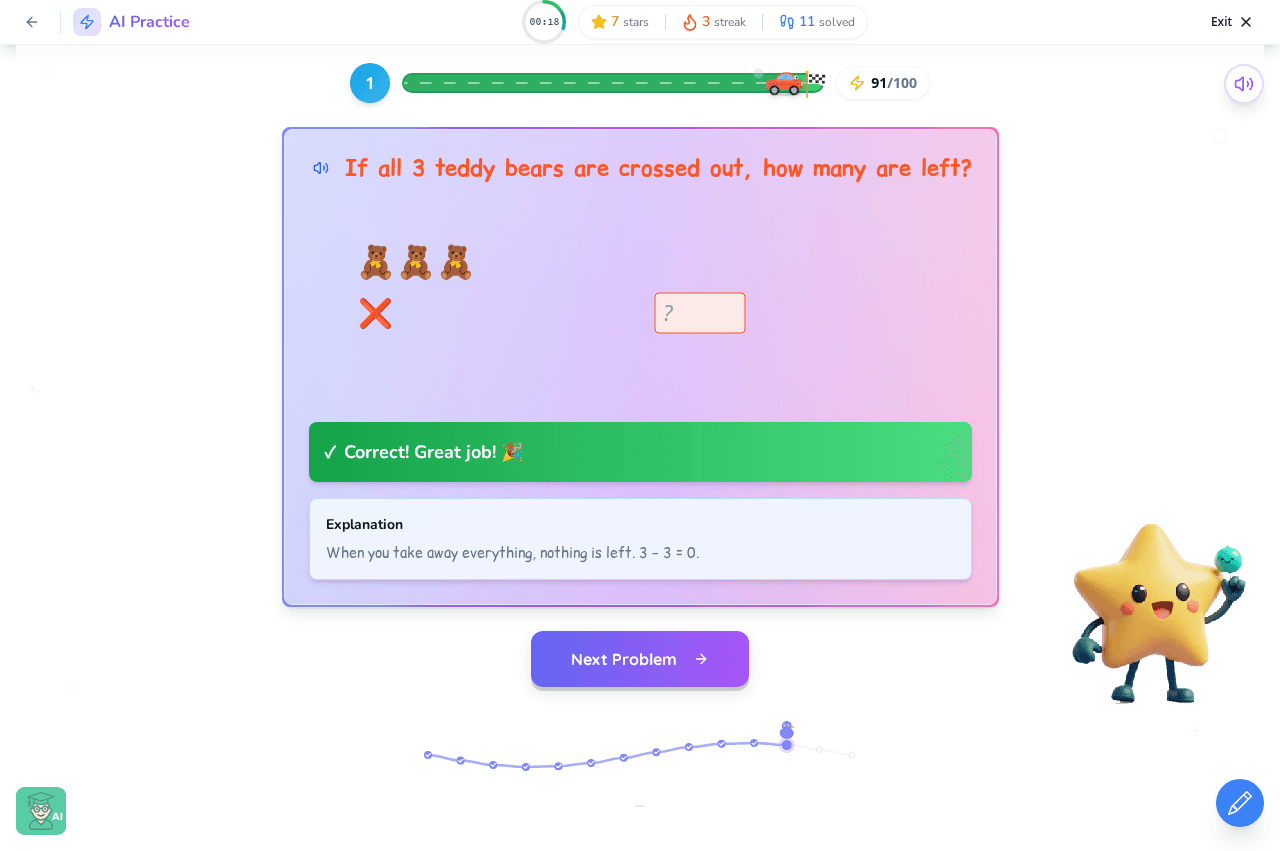
The interactive problem below demonstrates exactly how the crossing out method works in practice.
Pro tips for success:
- Start with small numbers (totals under 10)
- Keep sessions short (5-10 minutes is plenty for 1st graders)
- Use consistent language: "Cross out," "Count what's left," "How many remain?"
- Let your child make mistakes, then work through them together
See the Crossing Out Method in Action
While practicing at home with physical objects is valuable, interactive digital practice takes visual subtraction to the next level. That's because digital platforms can provide instant feedback, colorful visuals, and structured progression that keeps kids engaged.
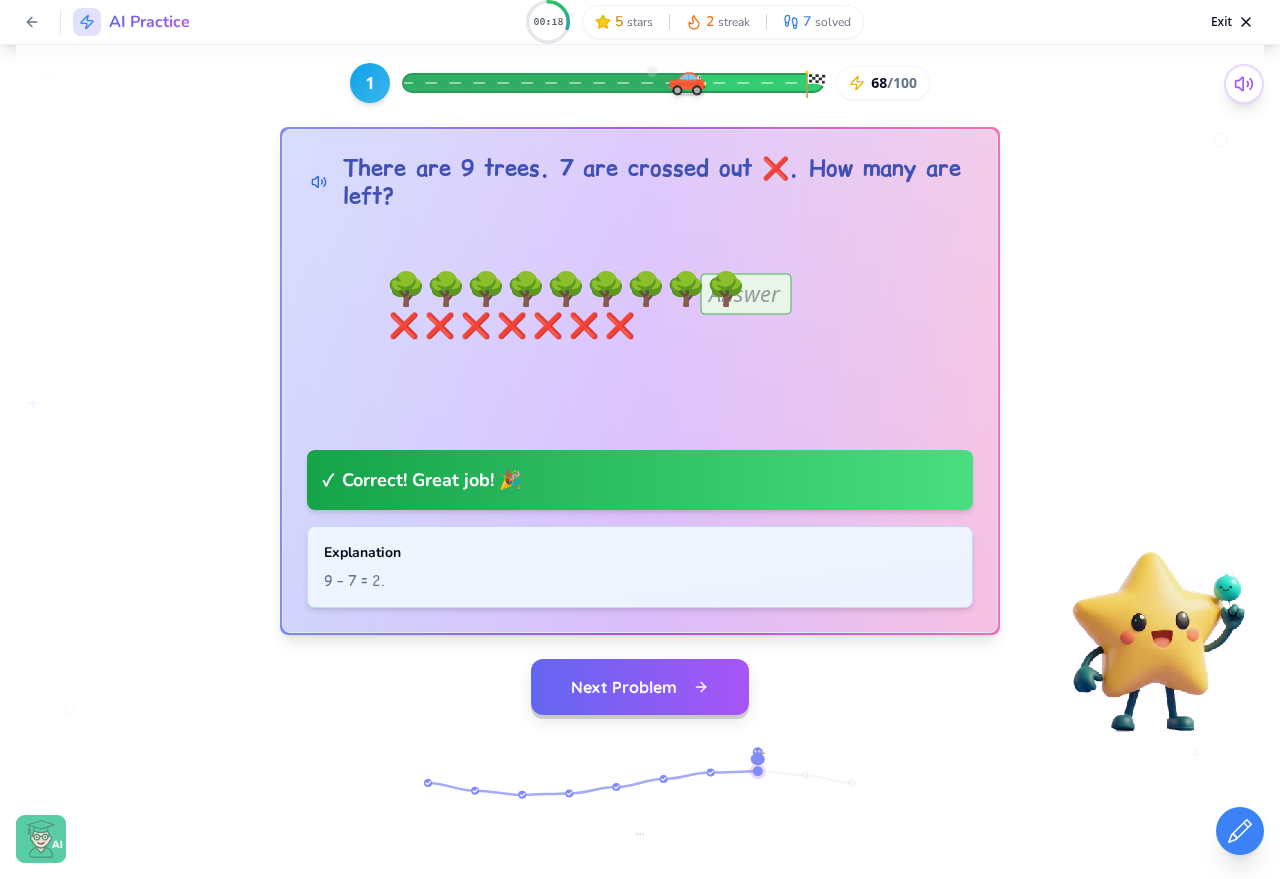
On AI Teacherly, the Subtract by Crossing Out lesson for Grade 1 uses colorful emoji-based problems to teach this exact method. Students see a group of objects (like fruits, animals, or stars), cross out the specified number, and type in how many remain.
Here's what the full interactive lesson looks like on AI Teacherly:
What makes this approach so effective is the immediate visual feedback. When a child crosses out objects and counts correctly, they see instant confirmation. This builds confidence and reinforces the connection between the action (crossing out) and the math concept (subtraction).
The platform guides students with clear instructions: "Cross out the items and find out how many are left. Count what is NOT crossed out." This consistent language helps children internalize the strategy so they can apply it independently.
Why interactive practice matters:
- Engagement: Colorful, game-like interfaces keep kids motivated
- Immediate feedback: Kids know right away if they're on track
- Structured progression: Problems gradually increase in difficulty
- Independent practice: Your child can work through lessons without constant supervision
- Repeatability: Unlike worksheets, interactive lessons can be done multiple times without boredom
For parents, platforms like AI Teacherly provide a way to supplement homework help without needing to become math teachers themselves.
Common Subtraction Mistakes and How Visual Learning Prevents Them
Even with visual methods, kids sometimes make mistakes. But here's the good news: the crossing out method makes it much easier to identify and fix errors. Let's look at the most common subtraction mistakes and how visual strategies help.
Mistake 1: Adding instead of subtracting Some children see two numbers and automatically add them. With the crossing out method, this becomes nearly impossible. When objects physically disappear (or get X'd out), kids can see that the final count is smaller, not larger.
Mistake 2: Miscounting the starting amount If a child counts "1, 2, 3, 5, 6" (skipping 4), their answer will be wrong from the start. Visual methods help because kids can touch or point to each object, making accurate counting easier.
Mistake 3: Crossing out the wrong number Sometimes kids cross out too many or too few objects. The fix? Have them count aloud as they cross out: "One X, two X's. Stop! We only take away 2."
Mistake 4: Counting the crossed-out items This is the classic error. Kids include the X'd out items in their final count. The key strategy is reinforcing: "We only count what's NOT crossed out." Repeat this phrase until it becomes automatic.
Mistake 5: Rushing to answer without checking Impulsive kids may blurt out an answer without actually counting. Visual methods slow them down naturally because there's a clear process: cross out, then count what remains.
The confidence factor: Beyond preventing errors, visual subtraction builds mathematical confidence. When children can see exactly why their answer is correct, they develop trust in their own abilities. This confidence carries over into more advanced math concepts later on.
Key Takeaways
- The crossing out method makes subtraction visual and concrete, perfect for 1st graders who need to SEE the math happening
- Use everyday objects at home: toys, snacks, stickers, or drawings work great for practicing visual subtraction
- Always reinforce the key strategy: count what is NOT crossed out to find your answer
- Keep practice sessions short (5-10 minutes) to match 1st graders' attention spans
- Interactive platforms like AI Teacherly provide structured, engaging practice with instant feedback
- Visual subtraction prevents common mistakes like adding instead of subtracting or miscounting
- Building confidence with visual methods creates a foundation for more advanced math later
Frequently Asked Questions
What is the crossing out method for subtraction?
The crossing out method is a visual subtraction strategy where children start with a group of objects, draw an X through the number being subtracted, and count the remaining objects to find the answer. It makes abstract subtraction concrete and visible.
How do I teach subtraction to my 1st grader at home?
Use everyday objects like toys or snacks. Have your child count the starting group, cross out or remove the number being subtracted, then count what's left. Keep sessions short (5-10 minutes) and use consistent language like 'count what's left.'
Why does my first grader struggle with subtraction?
Subtraction is more abstract than addition because kids must understand that something disappears. First graders also have limited working memory and need visual, concrete demonstrations rather than purely verbal instruction to grasp the concept.
Is visual subtraction better than memorizing math facts?
Visual subtraction builds understanding first, which makes memorization easier later. Children who understand WHY 7-3=4 through visual methods develop stronger number sense and retain math facts longer than those who only memorize.
When should my child move from visual subtraction to mental math?
Most children are ready to transition around age 7-8, after they've mastered visual strategies. Look for signs like quick, confident answers with small numbers. Continue using visual methods for larger numbers even as mental math develops.
How many subtraction problems should a 1st grader practice daily?
Quality matters more than quantity. Five to ten problems with full understanding is better than 30 rushed problems. Aim for 5-10 minutes of focused practice daily, and stop before your child becomes frustrated or fatigued.
What objects can I use to practice crossing out subtraction at home?
Use anything your child finds engaging: toy cars, Lego bricks, crackers, grapes, stickers, coins, or drawings. The more interesting the objects, the more motivated your child will be to practice.
Can interactive apps really help my child learn subtraction?
Yes, quality interactive platforms provide colorful visuals, instant feedback, and structured progression that keeps kids engaged. They supplement (not replace) hands-on practice and give children independent practice opportunities.
Ready to make subtraction fun for your first grader? Try the interactive Subtract by Crossing Out lesson free on AI Teacherly and watch visual learning transform math time!