Teach 3rd Grade Multiplication at Home: Equal Groups and Arrays Made Simple
Your 3rd grader is tackling multiplication, and you don't need to drill times tables to support them. Discover how equal groups and arrays make multiplication concepts click at home.
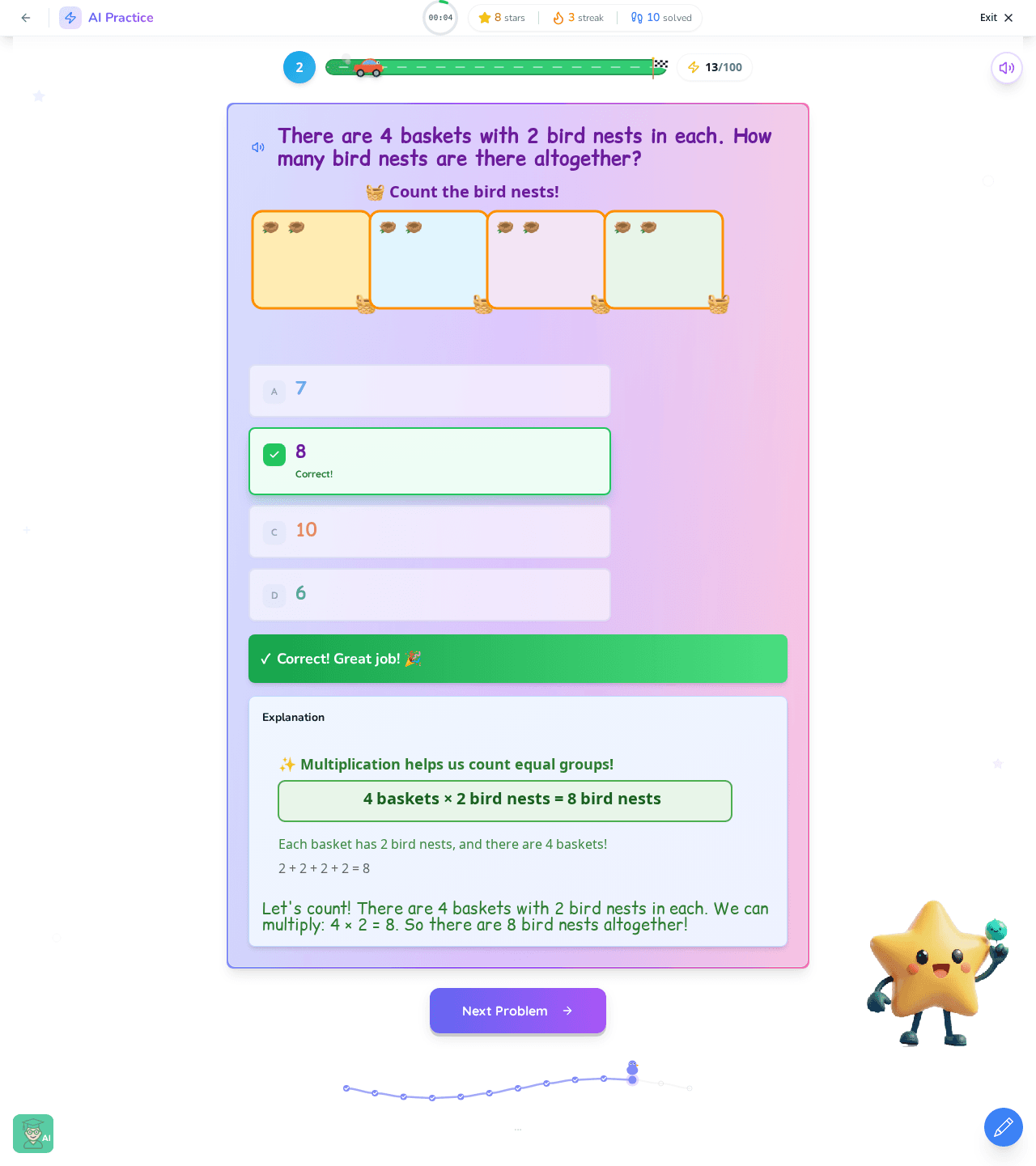
Why 3rd Grade Multiplication Feels Like Such a Big Jump
If your child suddenly seems stressed about math homework, you're not imagining things. Third grade marks one of the most significant shifts in elementary mathematics: the transition from additive thinking to multiplicative thinking.
For years, your child has been adding and subtracting. They've counted on fingers, used number lines, and built a solid foundation with single operations. Now, seemingly overnight, they're expected to understand that 4 × 3 isn't just a new symbol to memorize; it represents an entirely different way of thinking about numbers.
Here's the good news: You don't need to remember your own times tables perfectly to guide them through this. You don't need a math degree. What you need is an understanding of two simple concepts that make multiplication click: equal groups and arrays.
This guide will walk you through exactly what these concepts mean, why teachers use them (instead of jumping straight to memorization), and practical ways you can reinforce multiplication at home using everyday objects. By the end, you'll feel confident supporting your 3rd grader through this milestone.
What Are Equal Groups in Multiplication?
Before your child can multiply fluently, they need to understand what multiplication actually means. And that understanding starts with equal groups.
Equal groups are simply collections where every group has the same number of items. This is the foundational concept that makes multiplication different from random addition.
Think about it this way:
- 3 + 5 + 2 = 10 (different amounts added together)
- 4 + 4 + 4 = 12 (the SAME amount, three times)
That second example? That's where multiplication enters the picture. When you have equal groups, you can use multiplication as a shortcut: 3 groups of 4 = 3 × 4 = 12.
How to explain it to your child:
"Multiplication is a super fast way to count things when they're in equal groups."
The key vocabulary your child is learning:
- Groups: How many sets or collections
- Items in each group: How many objects in one set
- Product: The answer to a multiplication problem
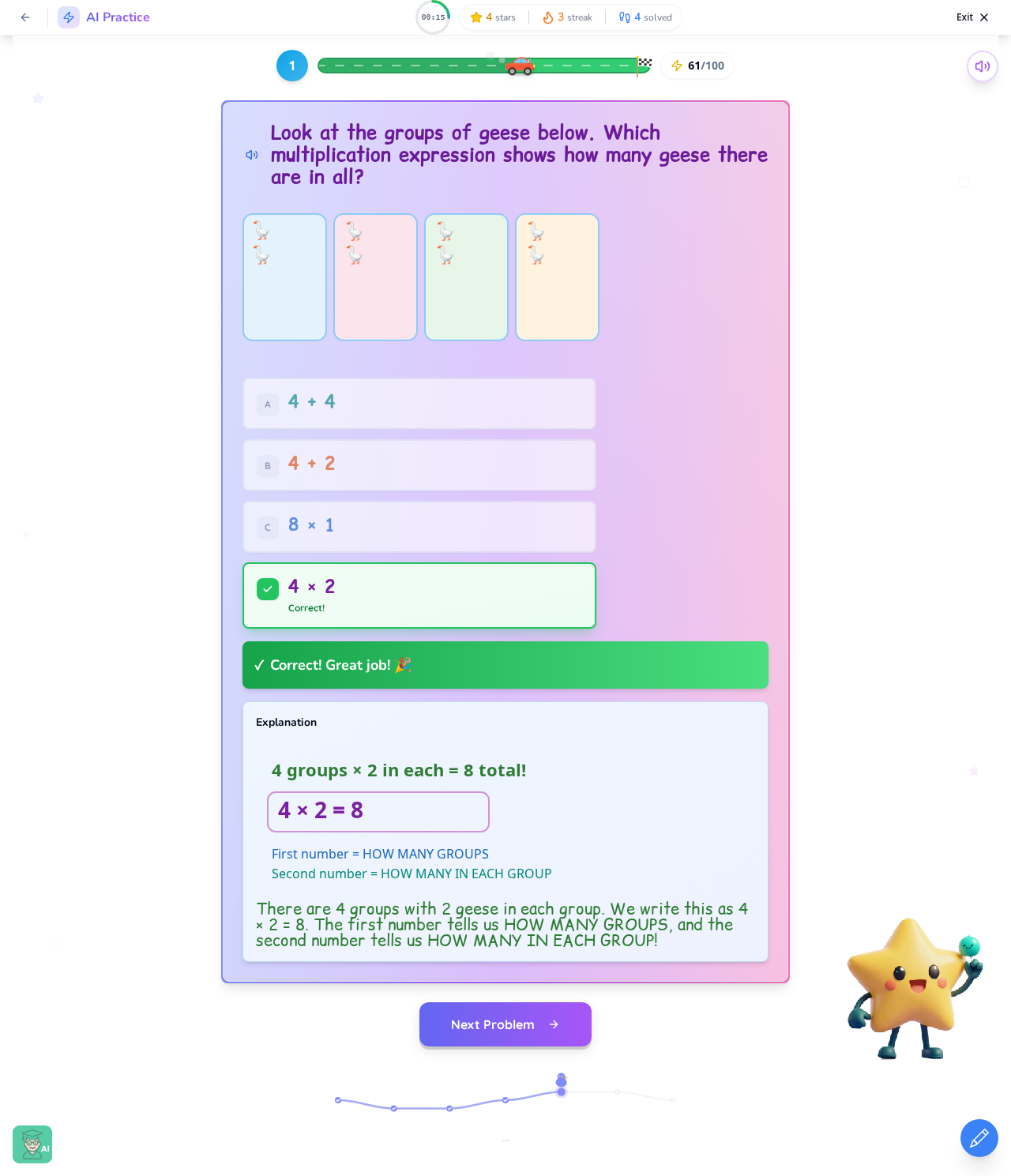
When reading a multiplication expression like 5 × 3, teach your child: "The first number tells us how many groups. The second number tells us how many in each group." So 5 × 3 means 5 groups with 3 items in each group.
The interactive problem below shows exactly how equal groups work visually, with colorful objects arranged so children can count and verify their answers.
How Do Arrays Make Multiplication Visual?
Once your child grasps equal groups, the next concept is arrays. An array is simply equal groups organized into rows and columns.
Imagine you have 12 cookies. You could pile them randomly, or you could arrange them neatly:
- 3 rows with 4 cookies in each row
- Or 4 rows with 3 cookies in each row
Both arrangements show the same total (12), but the organized structure helps children SEE the multiplication happening.
Why arrays are so powerful for learning:
They're visual and concrete: Instead of abstract numbers, children see actual rows and columns they can count and touch
They show the commutative property: 3 × 4 and 4 × 3 both equal 12 (just rotated!)
They connect to real life: Egg cartons, muffin tins, window panes, chocolate bars... arrays are everywhere
How to explain arrays to your child:
"An array is the same items as equal groups, but organized in rows and columns. Rows go across (like reading a book). Columns go up and down."
Here's the connection: In an array, rows are your groups and columns are items in each group. It's the same multiplication, just arranged differently!
Try this at home: Next time you open an egg carton (2 rows × 6 columns = 12 eggs) or see a muffin tin (various arrays), point out the rows and columns. Ask your child to write the multiplication sentence. These everyday moments build number sense without feeling like homework.
The Secret Connection: Repeated Addition to Multiplication
Here's one of the most important "aha moments" in 3rd grade math, and you can help make it happen at home.
Multiplication is just a shortcut for adding the same number over and over.
When teachers show that 4 + 4 + 4 = 12 can also be written as 3 × 4 = 12, something clicks. Your child realizes multiplication isn't a scary new operation; it's a faster way to do something they already know how to do.
Why this connection matters:
- It builds on existing knowledge (addition) rather than starting from scratch
- It gives children a "checking strategy" (they can add to verify their multiplication)
- It removes the fear factor from a new operation
How to reinforce this at home:
When your child faces a multiplication problem, encourage them to think: "What does this look like as repeated addition?"
- 5 × 2 = 2 + 2 + 2 + 2 + 2 = 10
- 3 × 6 = 6 + 6 + 6 = 18
- 4 × 4 = 4 + 4 + 4 + 4 = 16
This strategy is especially helpful for children who feel anxious about timed tests. If they forget a multiplication fact, they have a backup plan: just add!
The progression looks like this:
- See equal groups or an array
- Write it as repeated addition
- Write it as a multiplication expression
- Find the product
Once your child smoothly moves between these representations, they truly understand multiplication; they're not just memorizing answers.
Understanding the Rules for 0 and 1 in Multiplication
Two multiplication rules often confuse kids (and sometimes parents too!). The good news? Equal groups make them logical.
Multiplying by Zero:
Any number multiplied by zero equals zero. Why?
Think of it with equal groups: If you have 5 groups with 0 cookies in each group, how many cookies do you have? Zero! There's nothing to count.
5 × 0 = 0 (five groups of nothing = nothing) 0 × 5 = 0 (zero groups of five = nothing)
How to explain it: "If every plate is empty, it doesn't matter how many plates you have. You still have zero cookies!"
Multiplying by One:
Any number multiplied by one equals that same number. This is called the Identity Property.
5 × 1 = 5 (five groups with 1 item each = 5 items total) 1 × 5 = 5 (one group with 5 items = 5 items total)
How to explain it: "If you have 5 bags, and each bag has just 1 candy, you have 5 candies total. The number stays the same!"
Why these rules matter:
Understanding WHY these rules work (not just memorizing them) helps children:
- Apply the rules correctly in word problems
- Avoid common mistakes on tests
- Build confidence that math "makes sense"
Simple Ways to Practice Multiplication at Home
You don't need workbooks or flashcards to reinforce multiplication. Your home is full of arrays and equal groups waiting to be discovered!
Kitchen Math:
- Egg cartons: 2 rows × 6 columns = 12 eggs (What if we only have 8 eggs? How many rows?)
- Muffin tins: 3 × 4 = 12 muffins, or 2 × 6 = 12 muffins
- Setting the table: 4 people × 2 utensils each = 8 utensils total
Snack Arrays:
- Arrange crackers, grapes, or carrot sticks into arrays before eating
- Ask: "How many rows? How many in each row? What's the multiplication sentence?"
- Rearrange into a different array with the same total
Around the House:
- Windows: Count panes in rows and columns
- Tiles: Bathroom or kitchen floor tiles make perfect arrays
- Bookshelves: Books arranged in equal rows
Game Time:
- Dice multiplication: Roll two dice, multiply the numbers
- Array art: Draw arrays and color them as pixel art
- "How many ways?": Given 24 items, how many different arrays can you make? (1×24, 2×12, 3×8, 4×6)
The key to success: Keep practice sessions short (10 to 15 minutes), positive, and connected to real objects. Abstract math becomes concrete when children can touch, arrange, and count actual items.
See How Interactive Learning Makes Multiplication Click
While hands-on practice at home is invaluable, interactive digital lessons can accelerate your child's understanding by providing immediate feedback and visual reinforcement.
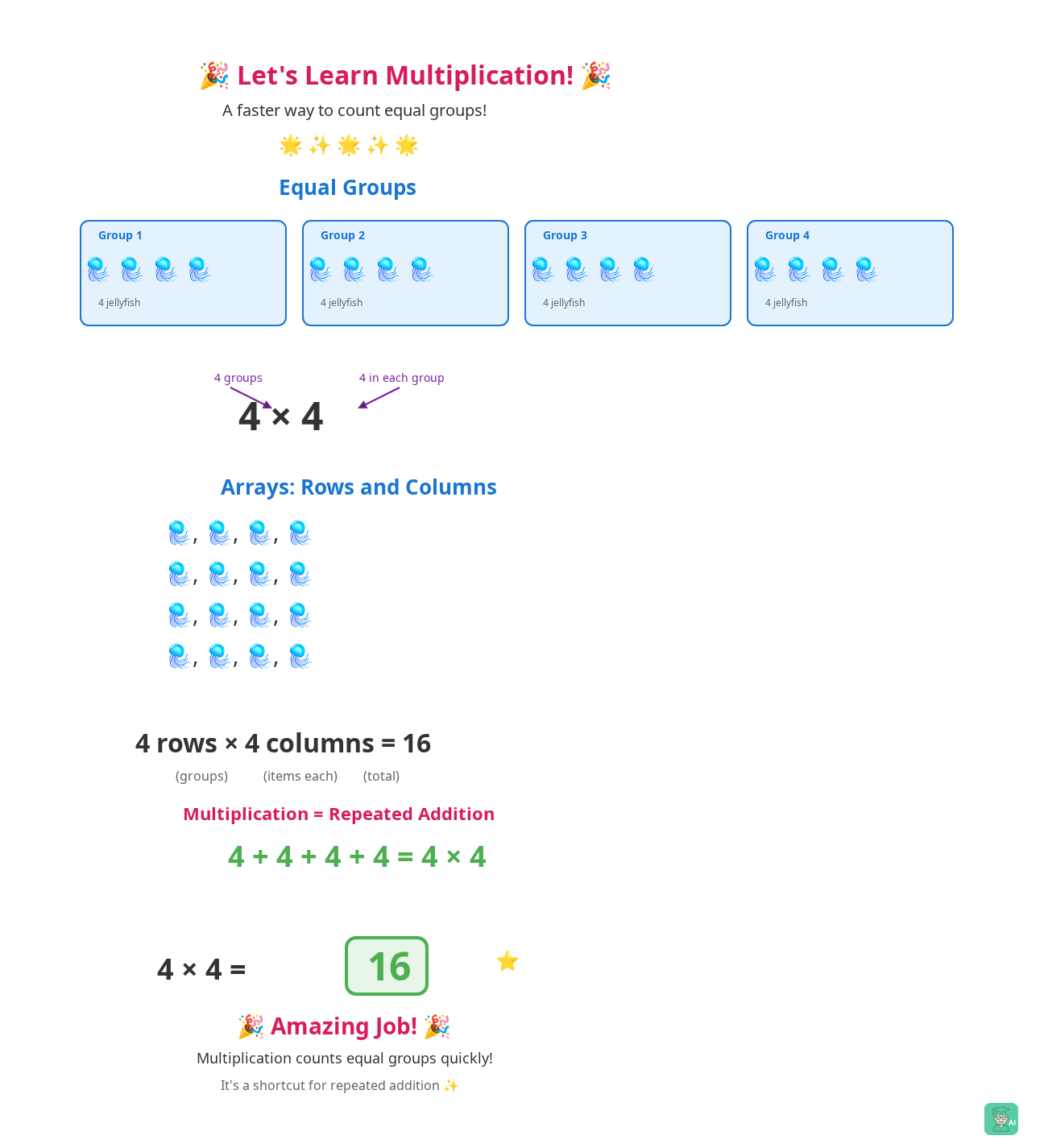
In the Introduction to Multiplication: Equal Groups and Arrays lesson on AI Teacherly, 3rd graders experience a carefully designed progression:
Visual discovery: Students see colorful equal groups and learn to count items in each group
Array exploration: The lesson transitions from scattered groups to organized arrays, helping children see the connection
Repeated addition bridge: Interactive problems show how 3 + 3 + 3 + 3 becomes 4 × 3, with visual support
Expression practice: Students identify which multiplication sentence matches a visual model
Real-world application: Word problems featuring baskets, plates, and everyday objects connect concepts to life
The lesson adapts to your child's pace, provides encouraging narration, and lets them manipulate visual models. It's like having a patient tutor available whenever your child needs practice.
Here's what the full interactive lesson looks like on AI Teacherly:
Key Takeaways
- Multiplication is about understanding equal groups FIRST, not memorizing times tables
- Equal groups = same number in each group; this is the foundation of multiplication
- Arrays organize equal groups into rows and columns, making multiplication visual and concrete
- Repeated addition (4+4+4) connects to multiplication (3×4), giving kids a checking strategy
- Multiplying by 0 always equals 0; multiplying by 1 always equals the same number
- Everyday objects (egg cartons, muffin tins, snacks) are perfect multiplication teaching tools
- Short, positive practice sessions (10-15 minutes) with real objects work better than drill worksheets
Frequently Asked Questions
What are equal groups in multiplication?
Equal groups are collections where every group contains the same number of items. For example, 3 groups of 4 apples means each group has exactly 4 apples. This concept is the foundation of multiplication (3 × 4 = 12).
How do I explain arrays to my 3rd grader?
Tell them arrays are equal groups arranged neatly in rows and columns. Rows go across like reading a book, columns go up and down. Use egg cartons (2 rows × 6 columns = 12) as a perfect real-life example they can touch and count.
Is multiplication just memorizing times tables?
No! Memorization comes after understanding. First, children need to grasp that multiplication represents equal groups. Once they understand WHY 3 × 4 = 12 (three groups of four), then memorizing facts becomes faster and more meaningful.
Why do teachers use repeated addition to teach multiplication?
Because it connects new learning to familiar skills. Showing that 4 + 4 + 4 = 3 × 4 helps children see multiplication as a shortcut, not a scary new operation. It also gives them a backup strategy for checking answers.
What's the difference between equal groups and arrays?
Equal groups can be scattered or arranged any way, as long as each group has the same number. Arrays are equal groups organized specifically into rows and columns. Arrays make it easier to visualize and count multiplication.
How can I practice multiplication at home without worksheets?
Use everyday objects! Arrange snacks into arrays, count egg carton sections (2×6=12), set the table using multiplication (4 people × 2 forks = 8 forks), or play dice multiplication games. Real objects make abstract math concrete.
Why does my child understand addition but struggle with multiplication?
Multiplication requires a mental shift from counting individual items to thinking in groups. It's a new way of seeing numbers. Be patient, use visual models like arrays, and connect multiplication to repeated addition they already understand.
What are the multiplication rules for 0 and 1?
Any number times 0 equals 0 (5 groups with nothing in them = nothing). Any number times 1 equals that same number (5 groups with 1 item each = 5 items). Use equal group examples to show WHY these rules make sense.
Ready to make multiplication click for your 3rd grader? Try the interactive Introduction to Multiplication lesson free on AI Teacherly and watch equal groups and arrays come to life!