How to Teach Addition to Kindergarteners at Home: A Parent's Hands-On Guide
Discover how to teach addition to your kindergartener at home using everyday objects. No worksheets needed, just simple hands-on activities that make math fun and build real understanding.
Why Hands-On Addition Matters for Your Kindergartener
If you've ever watched your kindergartener count on their fingers or line up toys to figure out "how many," you've witnessed the foundation of mathematical thinking. Addition isn't just about memorizing facts like 2 + 3 = 5. For young children, it's about understanding that when we combine two groups of things, we get a new, bigger group.
Here's the reassuring truth: you don't need a teaching degree or fancy math manipulatives to help your child master addition. You just need some toys, snacks, or crayons and about 10 minutes of playful counting together.
Research in early childhood education consistently shows that children learn mathematical concepts best when they can physically manipulate objects before working with abstract symbols. This is why your kindergartener's teacher uses blocks, counters, and pictures in class. The same approach works beautifully at home.
In this guide, you'll discover exactly how to introduce addition to your 5-year-old using everyday items you already have. We'll walk through the step-by-step process that mirrors how addition is taught in quality kindergarten classrooms, so you can confidently support your child's math learning without worrying about teaching it "wrong" or creating math anxiety.
What Is Addition and Why Do Children Need Objects to Learn It?
Addition is simply putting things together. That's it. When we add, we take two groups and combine them into one group, then count how many we have altogether.
But here's what many parents don't realize: young children cannot understand the abstract concept of "2 + 3 = 5" until they've experienced it physically, many times over. Their brains are wired to learn through concrete experiences first.
Think about how your child learned to talk. They didn't start by studying grammar rules. They heard words in context, connected them to real objects and actions, and gradually built understanding. Math works the same way.
The developmental progression looks like this:
- Physical manipulation: Child combines actual objects (puts 2 crackers with 3 crackers)
- Counting the total: Child counts all the objects together (1, 2, 3, 4, 5 crackers!)
- Connecting to symbols: Child learns that we can write this as "2 + 3 = 5"
- Abstract understanding: Eventually, child can solve 2 + 3 without needing objects
Skipping straight to symbols and expecting your kindergartener to memorize addition facts is like asking them to read chapter books before learning the alphabet. The hands-on foundation isn't optional; it's essential.
When children physically put groups together and count the result, they're building number sense, which is the intuitive understanding of how numbers work. This foundation will serve them for years of math learning to come.
How to Teach Addition to Your Kindergartener in 4 Simple Steps
The key to teaching addition successfully is following the same progression your child's brain naturally uses for learning. Here's the simple 4-step method that works:
Step 1: Start with Two Separate Groups
Gather some small objects (Cheerios, LEGO bricks, toy cars, anything works). Create two distinct groups and have your child count each one separately.
"Let's count this group. 1, 2. We have 2 blocks!" "Now let's count this group. 1, 2, 3. We have 3 blocks!"
Step 2: Physically Combine the Groups
This is the magic moment. Have your child push the two groups together with their hands. Make it tactile and fun.
"Now let's put them together! Push them into one big group."
Step 3: Count the Total Together
Once combined, count all the objects together. Point to each one as you count.
"Let's count how many we have altogether. 1, 2, 3, 4, 5! We have 5 blocks!"
Step 4: Introduce the Language (Optional)
After many repetitions of steps 1-3, you can add the vocabulary: "We added 2 and 3. Adding means putting together. 2 plus 3 equals 5!"
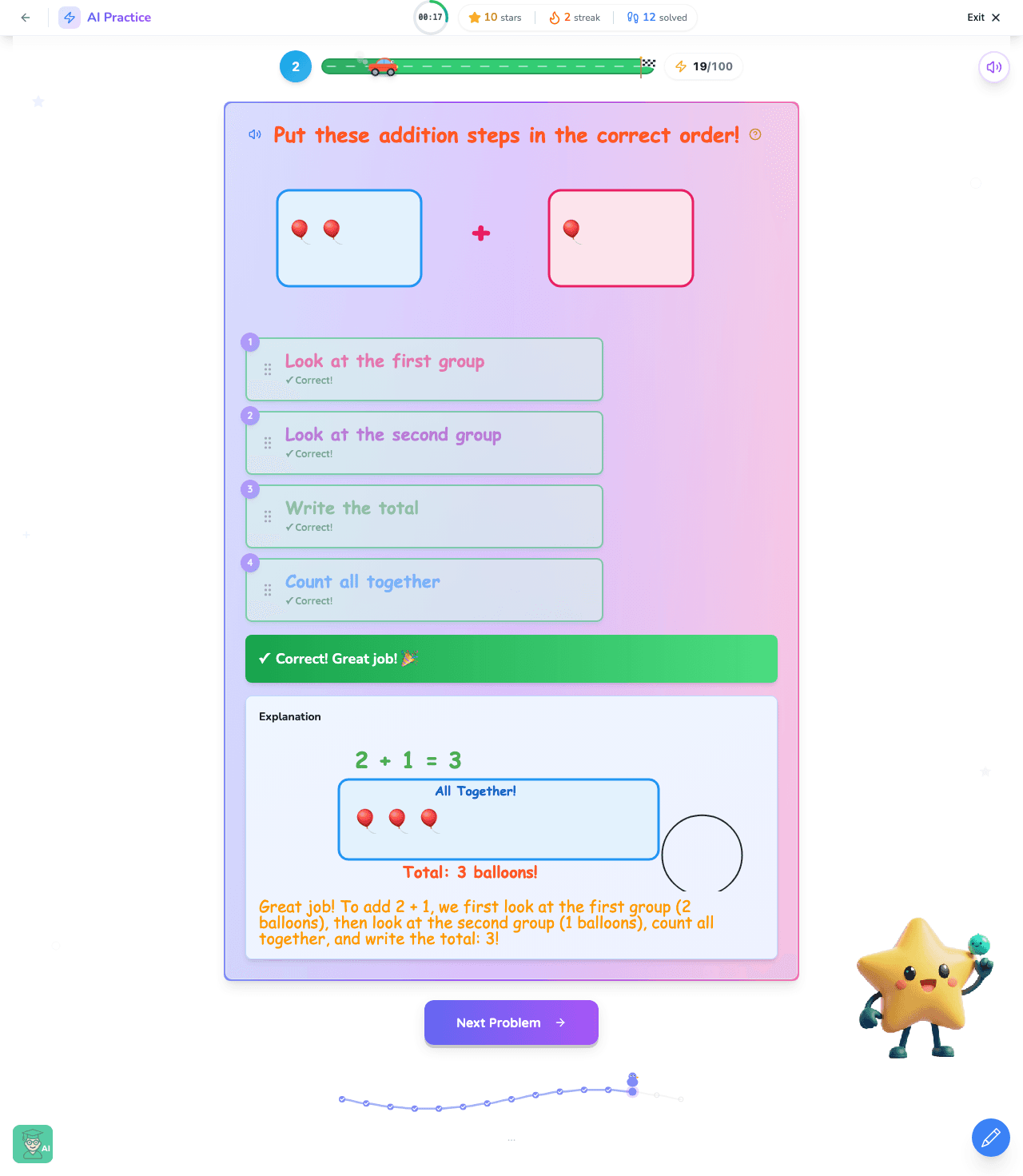
The interactive problem below shows exactly how this counting and combining process works in practice:
Pro tip: Keep sums to 5 or below when starting out. This keeps the counting manageable and builds confidence before increasing difficulty.
5 Easy Addition Activities Using Items You Already Have at Home
You don't need to buy anything special. Here are five simple activities using household items that make addition practice feel like play:
1. Snack Time Math
Use crackers, grapes, or cereal pieces. "You have 2 crackers. I'm giving you 1 more. How many do you have now?" Let them push the crackers together and count.
2. Toy Parking Lot
With toy cars: "Park 3 cars here. Now park 2 more cars. How many cars are in the parking lot?" The physical action of parking reinforces the combining concept.
3. Sock Sorting
During laundry: "Here are 2 socks. Here are 2 more socks. How many socks altogether?" Bonus: they're helping with chores while learning math.
4. Sticker Stories
Use stickers on paper: "Put 1 star sticker here. Put 3 more stars here. How many stars on your paper?" This transitions nicely toward written representation.
5. Block Towers
Stack blocks: "Build a tower with 2 blocks. Now add 3 more blocks. How tall is your tower?" The vertical stacking makes the "adding on" concept very visual.
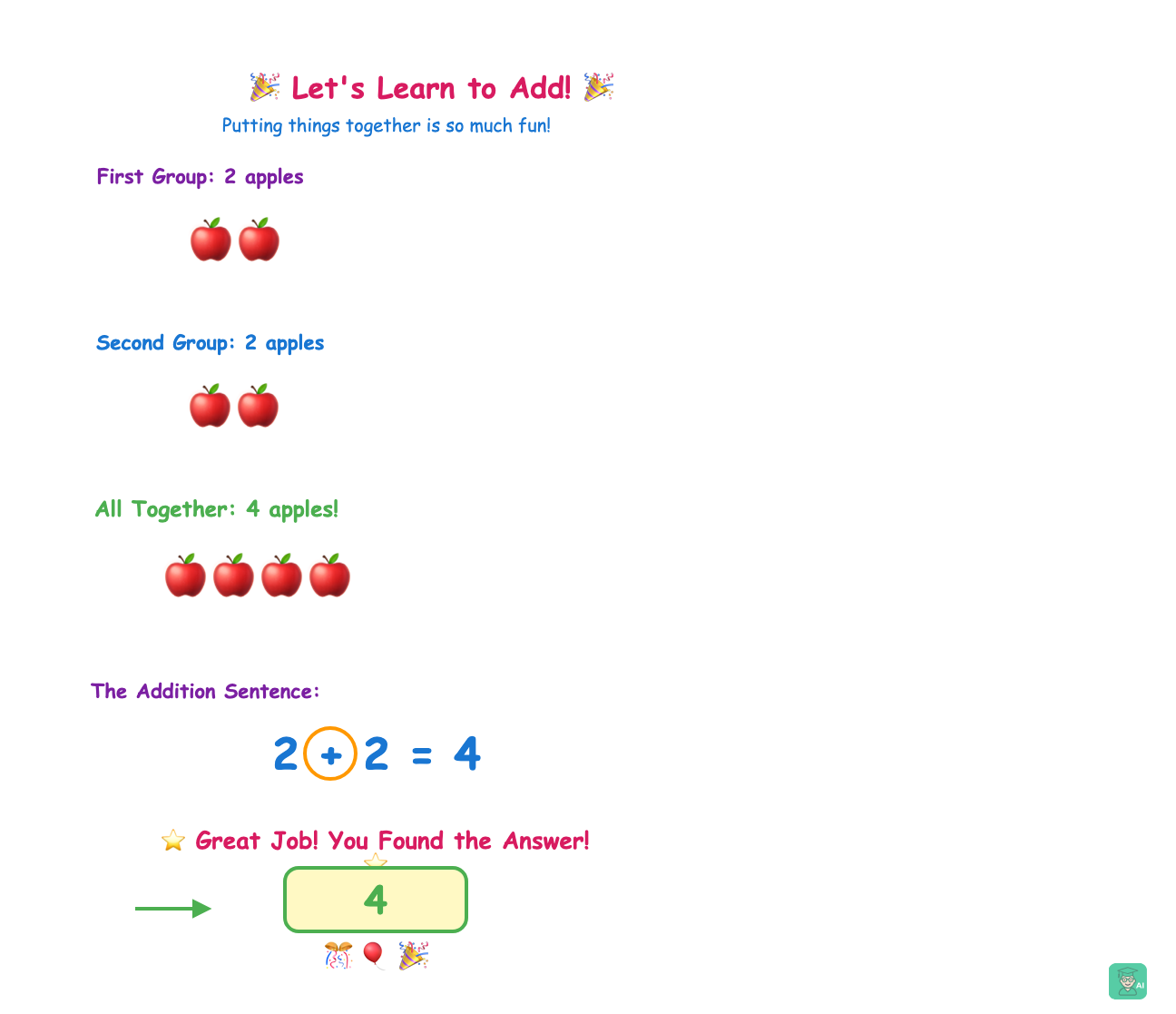
Here's an example of a colorful counting activity that demonstrates this hands-on approach:
Remember: The goal isn't speed or getting the right answer immediately. It's the physical experience of combining and counting that builds understanding.
When Should You Introduce the Plus Sign and Addition Sentences?
Many parents wonder when to move from hands-on counting to written addition sentences like "2 + 3 = 5." The answer: only after your child has had plenty of concrete practice.
Signs your child is ready for symbols:
- They can easily combine groups of objects and count the total
- They understand that "adding" means "putting together"
- They're curious about the numbers and symbols they see
- They can consistently add with sums to 5 using objects
How to introduce the plus sign:
The plus sign simply means "put together." When you're doing hands-on activities, start pointing to an imaginary plus sign between your groups:
"See these 2 blocks? And these 3 blocks? This spot in the middle is where we put them together. That's what the plus sign means: put together!"
Then, after combining and counting, you can write the addition sentence:
"We put 2 blocks together with 3 blocks and got 5 blocks. We can write that as: 2 + 3 = 5. That's our addition sentence!"
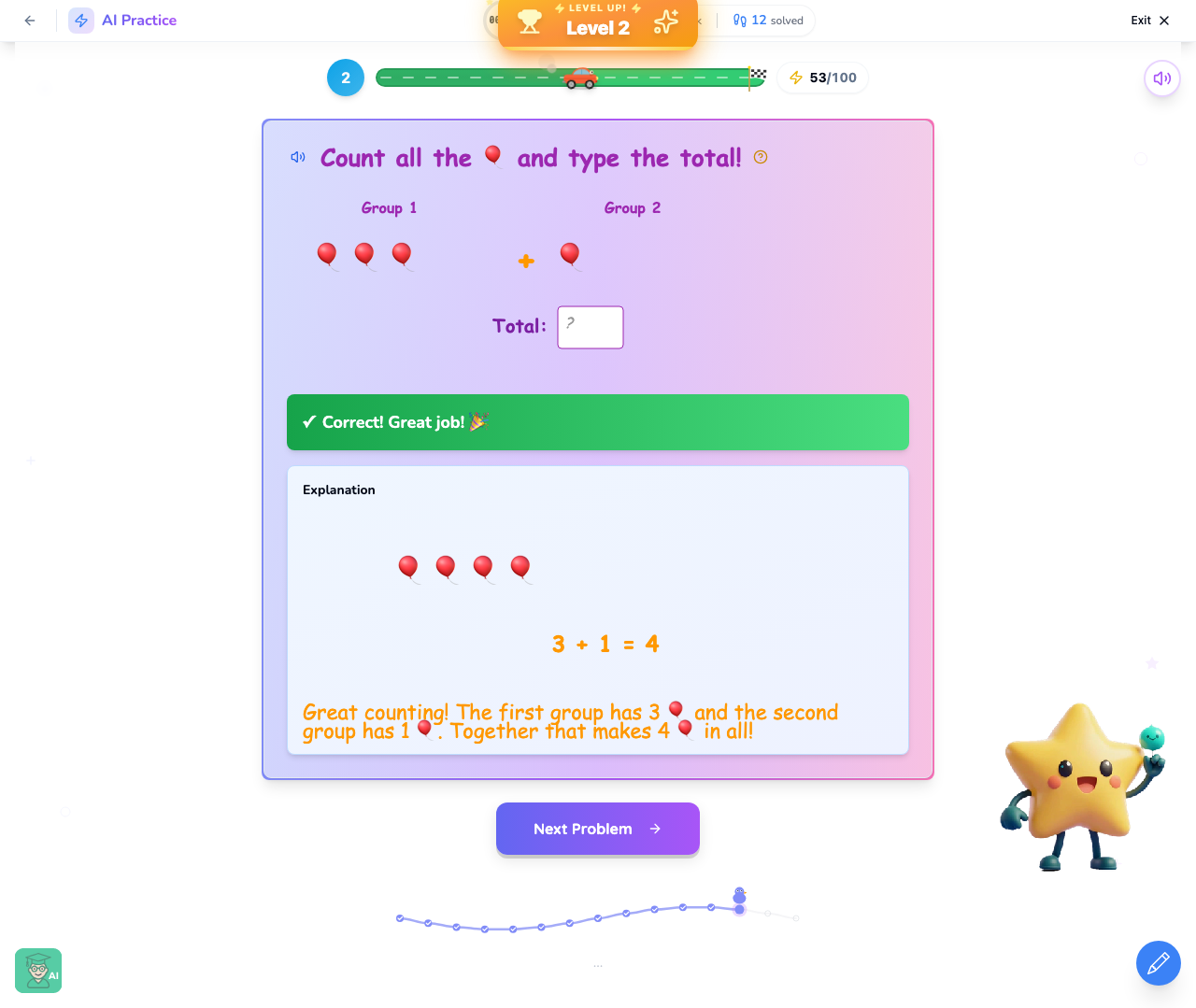
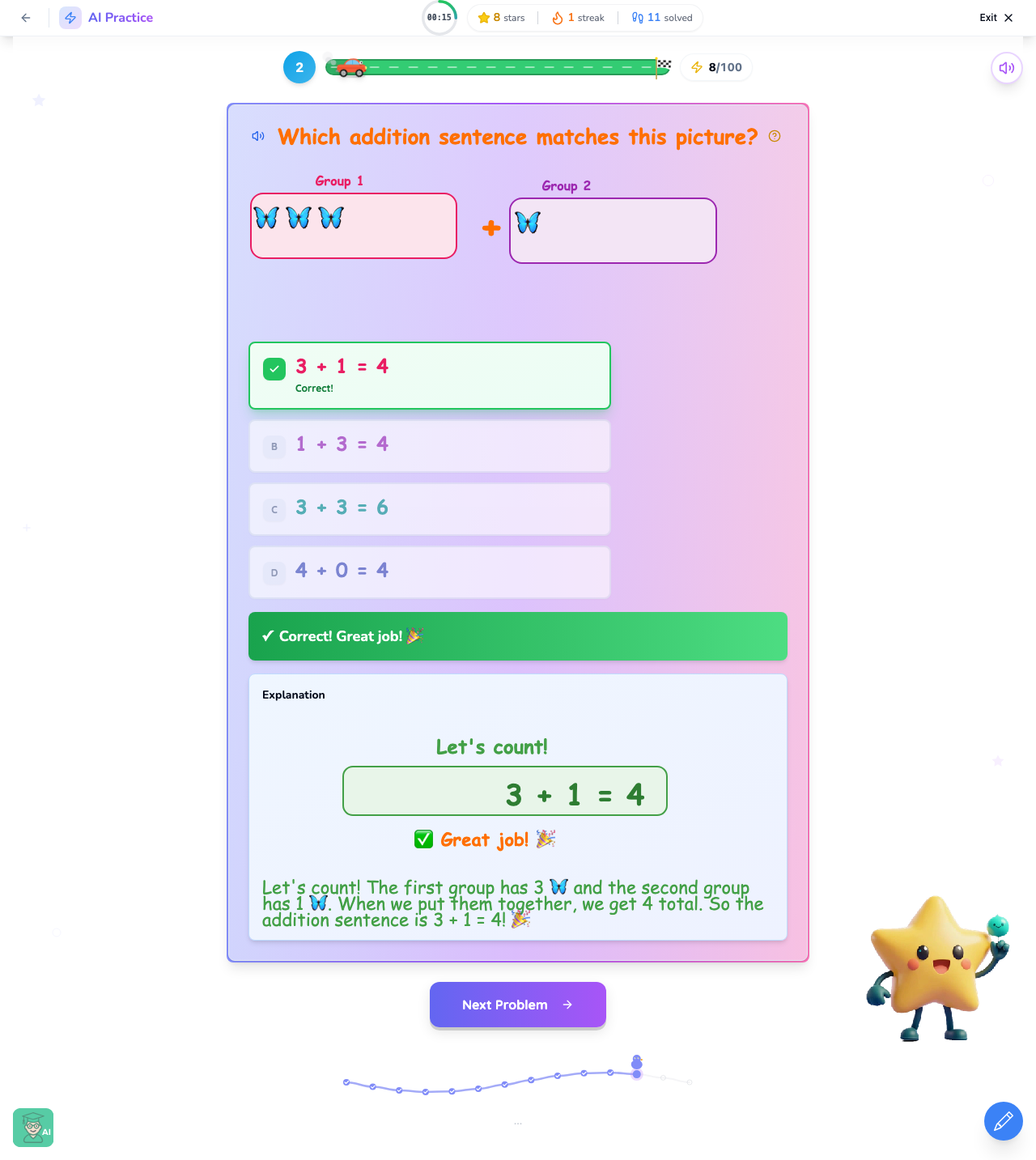
This interactive example shows how pictures connect to addition sentences:
Important: Don't rush this transition. Some kindergarteners are ready for symbols by mid-year; others need the whole year with concrete objects. Both timelines are completely normal. The hands-on understanding must come first, or the symbols will be meaningless memorization.
Common Mistakes Parents Make When Teaching Addition (And How to Avoid Them)
Even well-meaning parents can accidentally make addition harder for their kindergarteners. Here are the most common pitfalls and how to avoid them:
Mistake #1: Starting with Worksheets
Worksheets filled with "2 + 1 = ___" problems skip the crucial hands-on stage. Children may memorize answers without understanding what addition actually means.
Instead: Use physical objects for weeks or months before introducing any written work.
Mistake #2: Pushing for Speed
"Quick! What's 3 + 2?" Pressure and time constraints create anxiety, not math skills. Speed comes naturally with understanding.
Instead: Let your child take their time counting and combining. Praise the process, not just correct answers.
Mistake #3: Correcting Every Error Immediately
If your child counts wrong, resist the urge to jump in. Self-correction builds deeper learning.
Instead: Ask, "Are you sure? Let's count together one more time" and point to each object.
Mistake #4: Going Beyond Sums of 5 Too Soon
Adding larger numbers requires more advanced counting skills. Jumping to sums of 10 before mastering sums of 5 leads to frustration.
Instead: Stay with sums to 5 until your child is consistently successful and confident.
Mistake #5: Making It Feel Like "School Work"
If addition practice feels like a chore, your child will develop negative associations with math.
Instead: Weave addition into play, snack time, and daily routines. Keep sessions short (5-10 minutes) and end while it's still fun.
Key Takeaways
- Addition means putting two groups together — help your child experience this physically before introducing symbols
- Use everyday objects like snacks, toys, and blocks for hands-on addition practice
- Keep sums to 5 or below when starting out to build confidence
- Introduce the plus sign only after your child has had plenty of concrete practice combining and counting
- Short, playful sessions (5-10 minutes) work better than longer, formal practice
- Avoid worksheets and speed drills — they skip the essential hands-on foundation
- Every kindergartener develops at their own pace; some need objects all year, and that's completely normal
Frequently Asked Questions
What age should kids start learning addition?
Most children are ready to begin simple addition around age 4-5 (preschool to kindergarten). At this age, they can start combining small groups of objects and counting the total. Formal addition with symbols typically begins in kindergarten.
How do I teach my kindergartener addition without worksheets?
Use everyday objects like snacks, toys, or blocks. Have your child count two groups separately, physically push them together, then count the total. This hands-on approach builds understanding before introducing written symbols.
Why do children need to use objects to learn addition?
Young children's brains learn through concrete experiences before abstract symbols. Physically combining objects helps them understand that addition means 'putting together,' creating a foundation for later symbolic math work.
What are the best household items to use for teaching addition?
Any small, safe objects work well: Cheerios, crackers, LEGO bricks, toy cars, blocks, crayons, buttons, or stickers. The key is that your child can physically manipulate and count them.
How high should my kindergartener be able to add?
By the end of kindergarten, most children should be comfortable with addition facts to 5 (like 2+3 or 1+4) and beginning to work with sums to 10. Every child develops at their own pace, so don't worry if progress seems slow.
Is it normal for my 5-year-old to struggle with addition?
Yes, this is completely normal. Addition is an abstract concept that takes time to develop. If your child struggles, focus on more hands-on practice with smaller numbers. Building a strong foundation matters more than speed.
What does 'sums to 5' mean in kindergarten math?
Sums to 5 means addition problems where the answer is 5 or less, like 2+2=4 or 1+3=4. Starting with these smaller numbers keeps counting manageable and builds confidence before tackling larger sums.
How do I explain the plus sign to my child?
Tell them the plus sign means 'put together.' When doing hands-on activities, point to the space between two groups and say 'this is where we put them together — that's what the plus sign means!'
Ready to make addition fun for your kindergartener? Try AI Teacherly's interactive Introduction to Addition lesson free. Your child will love the colorful activities, and you'll love watching their confidence grow!