Teach Kindergarten Addition at Home: 5 Hands-On Activities That Actually Work
Your kindergartener doesn't need worksheets to learn addition. Discover hands-on activities using everyday household items that make math click for young learners.
Why Hands-On Addition Changes Everything for Kindergarteners
Here's a secret that early childhood educators know: your kindergartener doesn't need flashcards or worksheets to learn addition. What they need is to touch, count, and combine real objects.
Research consistently shows that young children learn mathematical concepts best through physical manipulation. When a 5-year-old picks up two toy cars, then adds three more, and counts all five together, something powerful happens in their brain. They're not just memorizing "2 + 3 = 5"; they're building a deep understanding of what addition actually means.
This hands-on approach is called the concrete-to-abstract progression, and it's how children's brains naturally develop mathematical understanding. First, they work with real objects they can touch. Then, they move to pictures representing those objects. Finally, they connect everything to the symbols and numbers we use in written math.
The good news? You already have everything you need at home to teach addition this way. No special math manipulatives required. Your kitchen, playroom, and even your snack cabinet are filled with perfect "teaching tools" just waiting to be used.
In this guide, you'll discover exactly how to teach kindergarten addition at home using simple, everyday activities that actually work.
What Does Addition Really Mean for a 5-Year-Old?
Before diving into activities, let's understand what addition means at the kindergarten level. For young children, addition is simply "putting things together."
That's it. No complex terminology needed.
When you explain addition to your kindergartener, use language like:
- "Adding is putting things together!"
- "See the plus sign? It means put together!"
- "Let's put them together and count how many we have now!"
At this stage, children should focus on sums to 5 before moving to larger numbers. This builds confidence and creates a solid foundation. A kindergartener who truly understands that 2 + 3 = 5 by manipulating objects will have a much easier time with more complex addition later.
What addition skills should a kindergartener know?
By the end of kindergarten, most children should be able to:
- Understand that addition means combining two groups
- Add numbers with sums up to 5 confidently
- Begin working with sums up to 10
- Recognize the plus (+) and equals (=) signs
- Solve simple word problems like "You have 2 apples. You get 1 more. How many do you have now?"
Remember, every child develops at their own pace. If your kindergartener is still working on counting, that's perfectly okay. Counting is the foundation that addition builds upon.
How Do I Teach My Kindergartener Addition at Home?
Teaching addition at home is simpler than you might think. The key is following the same three-step progression that teachers use in classrooms:
Step 1: Start with Real Objects (Concrete)
Begin by having your child physically combine groups of objects. Use toys, snacks, blocks, or any items your child enjoys. Say: "Let's put 2 cars here and 3 cars here. Now let's push them together and count all of them!"
Step 2: Move to Pictures (Pictorial)
Once your child understands combining objects, transition to pictures. Draw simple dots or shapes on paper, or use picture-based activities. "Look at these 2 suns and these 3 suns. How many suns altogether?"
Step 3: Introduce Numbers (Abstract)
Finally, connect the experience to written math. "When we put 2 and 3 together, we got 5. We can write that as 2 + 3 = 5. That's how we write adding!"
Important tips for success:
- Keep sessions short: 5-10 minutes is plenty for kindergarteners
- Make it playful: If it feels like a chore, take a break
- Celebrate wins: "You did it! You learned to add!" builds lasting math confidence
- Be patient: Some days will go better than others, and that's completely normal
- Follow their interest: If they love dinosaurs, count dinosaurs. Interest drives learning.
5 Simple Hands-On Addition Activities Using Household Items
You don't need to buy expensive math manipulatives. These activities use items you already have at home:
1. Snack Time Addition
Use crackers, grapes, or cereal pieces. "I'm giving you 2 crackers. Now I'm giving you 2 more. How many crackers do you have to eat?" This makes addition deliciously relevant!
2. Toy Combination Games
Gather two small groups of toys. "Here are 3 dinosaurs going to the party. Here come 2 more dinosaurs! How many dinosaurs are at the party now?" Act it out together.
3. Building Block Towers
Stack blocks in two separate towers, then combine them. "This tower has 2 blocks. This tower has 3 blocks. Let's put them together and count our big tower!"
4. Sock Sorting Addition
During laundry time, create addition problems with socks. "Here are 2 blue socks. Here are 2 white socks. How many socks altogether?" Real-world context makes math meaningful.
5. Finger Addition
Fingers are the original math manipulative! "Hold up 1 finger on this hand, and 2 fingers on this hand. Count all your fingers that are up!"
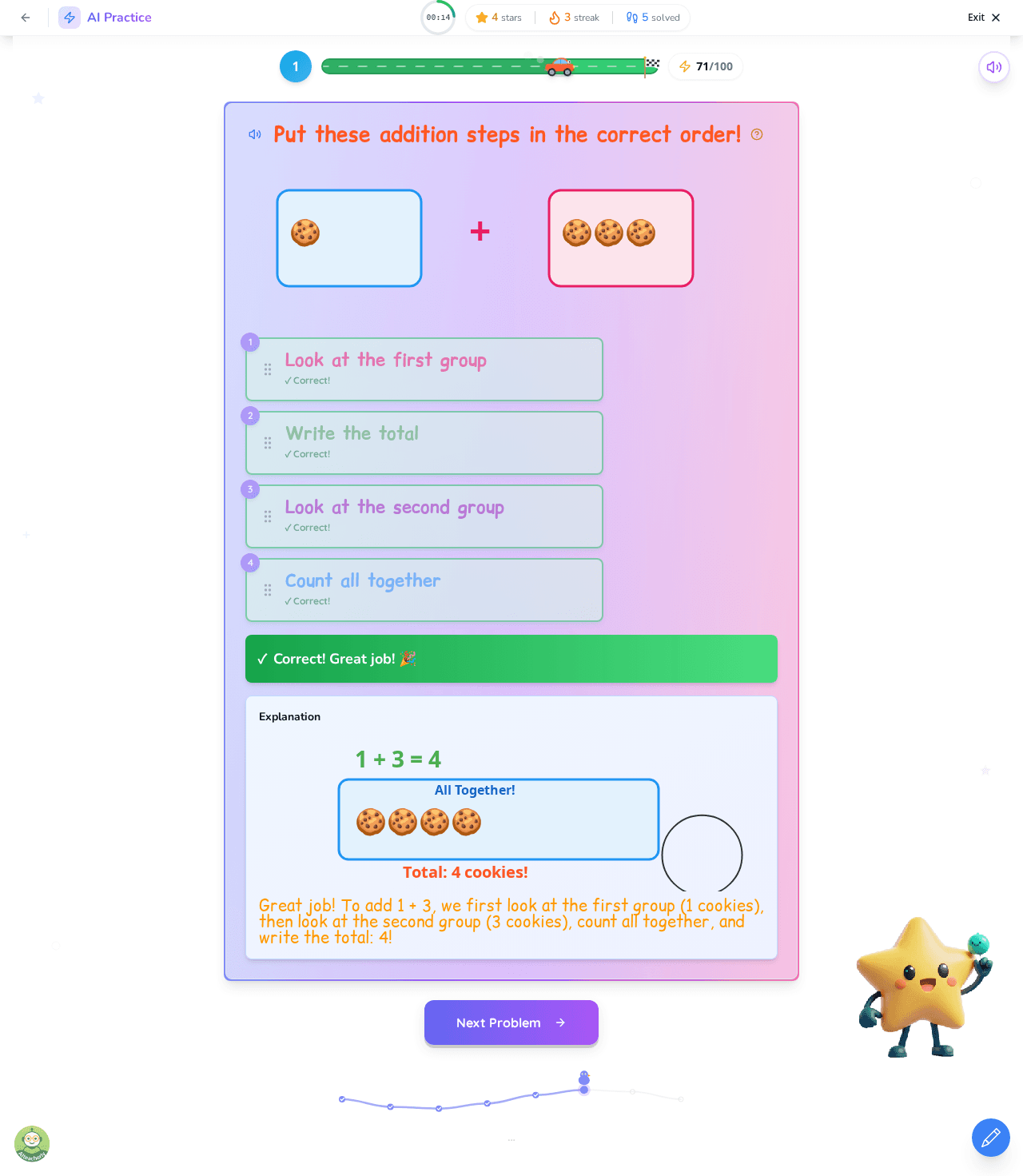
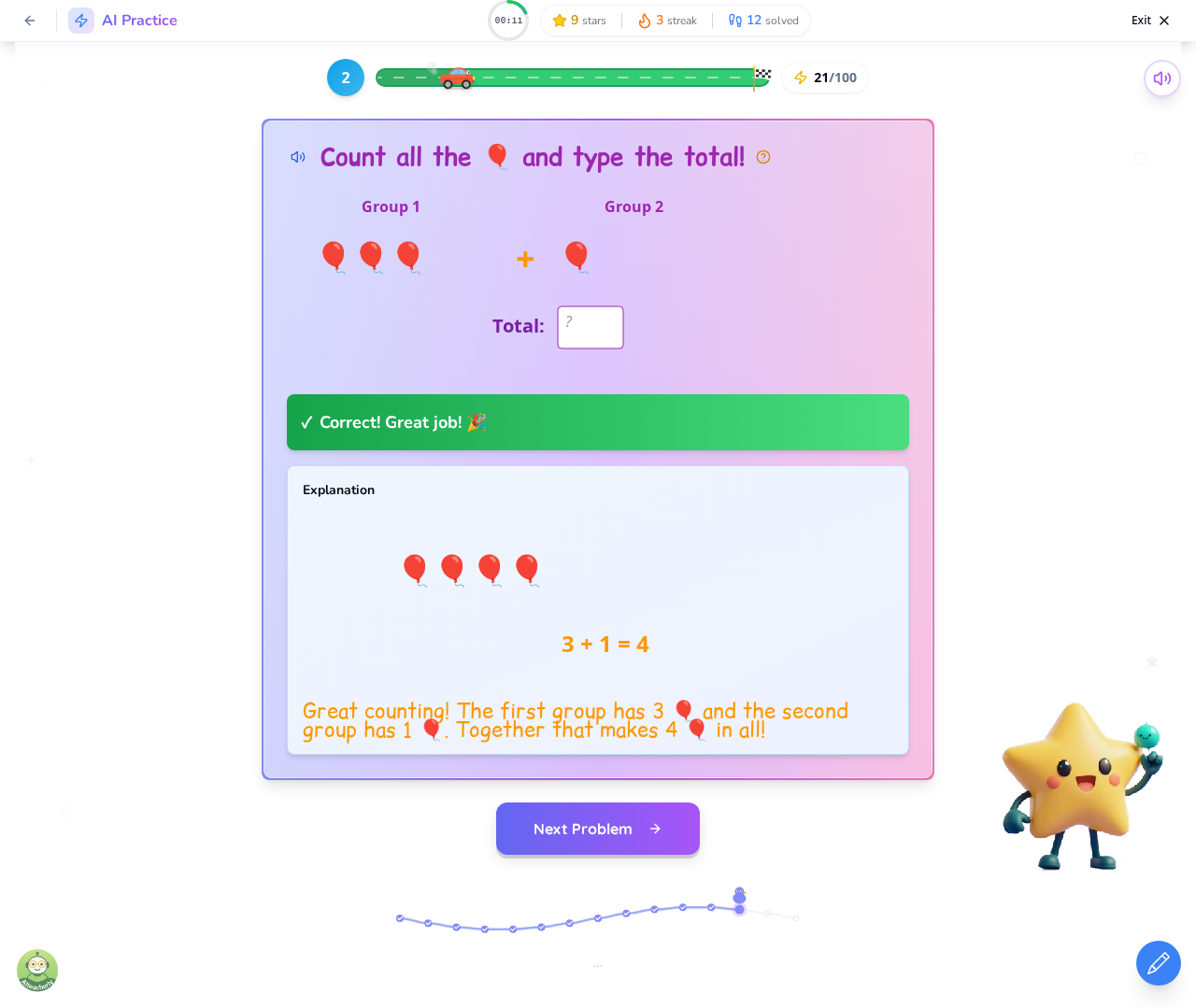
The interactive problem below shows exactly how this hands-on counting approach translates to engaging digital practice:
See Interactive Addition in Action
While hands-on activities at home are essential, interactive digital lessons can reinforce and extend what your child learns. The best educational platforms mirror the concrete-to-abstract approach, using visual manipulatives that children can "touch" on screen.
On AI Teacherly, the Introduction to Addition lesson for kindergarteners does exactly this. Children start by counting two separate groups of colorful objects, then combine them visually, and finally connect the experience to the written addition sentence.
What makes interactive lessons effective:
- Visual appeal: Colorful emojis and images keep young learners engaged
- Immediate feedback: Children know right away if they're on track
- Personalized encouragement: Messages like "Great job!" celebrate each success
- Self-paced learning: Your child can take their time without pressure
- Repetition without boredom: Multiple practice problems with varied visuals
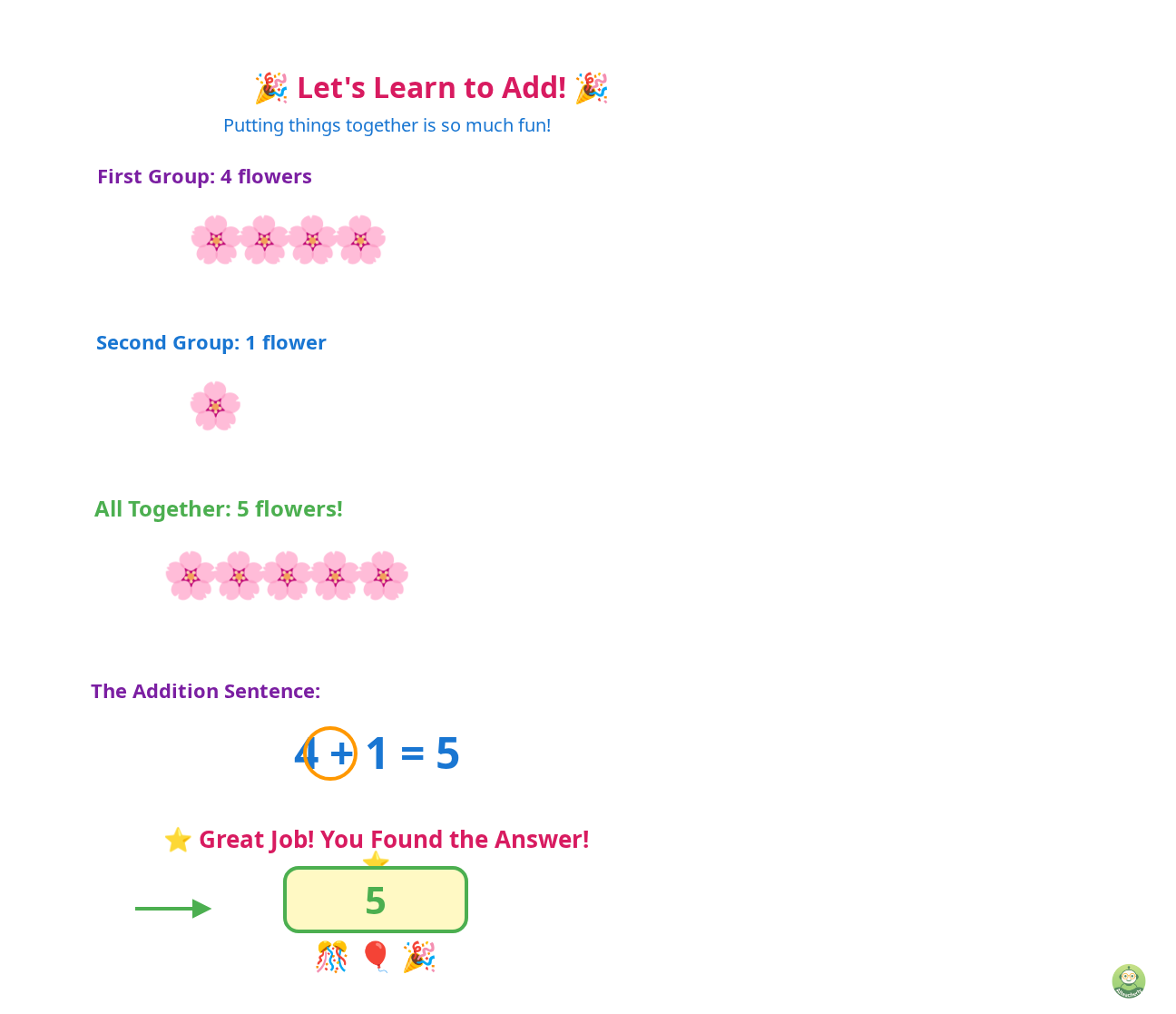
Here's what the full interactive lesson looks like on AI Teacherly:
The lesson guides children through the same progression you use at home: see two groups, put them together, count the total, and celebrate the learning. This consistency between home practice and digital learning reinforces understanding and builds confidence.
Interactive lessons work best when combined with hands-on activities. Use the digital practice to reinforce concepts your child has already explored with real objects at home.
Common Mistakes Parents Make When Teaching Addition
Even with the best intentions, parents sometimes make these common mistakes when teaching kindergarten addition. Here's what to avoid:
Mistake 1: Skipping the Concrete Stage
Jumping straight to written problems ("What's 2 + 3?") without first using physical objects can confuse young learners. Always start with items they can touch and manipulate.
Mistake 2: Moving Too Fast
Once a child gets a few problems right, it's tempting to increase difficulty. But kindergarteners need lots of repetition with sums to 5 before moving to larger numbers. Mastery matters more than speed.
Mistake 3: Making It Feel Like Work
If addition practice becomes a chore, children develop negative associations with math. Keep it playful, brief, and integrated into fun activities. Stop if your child seems frustrated or bored.
Mistake 4: Focusing Only on Right Answers
The process matters as much as the answer. If your child counts incorrectly but understands the concept of combining groups, that's progress! Gently guide them to recount rather than just correcting the answer.
Mistake 5: Comparing to Other Children
Every child develops mathematical understanding at their own pace. Your neighbor's kindergartener adding to 10 doesn't mean your child is behind. Focus on your child's individual progress.
Mistake 6: Using Only Flashcards
Flashcards have their place, but they shouldn't be the primary teaching method for kindergarteners. Young children need hands-on experience before memorization makes sense.
Key Takeaways
- Start with physical objects before introducing written math; the concrete-to-abstract progression is how young brains naturally learn
- Focus on sums to 5 first, building confidence before moving to larger numbers
- Keep practice sessions short (5-10 minutes) and playful; math should feel like fun, not work
- Use everyday household items like snacks, toys, and blocks as your teaching tools
- Celebrate small wins with enthusiasm; saying "You learned to add!" builds lasting math confidence
- Combine hands-on home activities with interactive digital practice for the best results
- Be patient with your child's pace; every kindergartener develops math skills on their own timeline
Frequently Asked Questions
What addition facts should a kindergartener know?
Kindergarteners should confidently add numbers with sums to 5 and begin working with sums to 10. They should understand that addition means combining two groups and recognize the plus and equals signs.
How do I explain addition to a 5 year old?
Use simple language: "Adding is putting things together!" Demonstrate with physical objects your child can touch and count. Show two groups, combine them, then count the total together.
Why do kindergarteners need to use objects when learning addition?
Young children's brains develop mathematical understanding through physical manipulation first. Touching and combining real objects builds deep comprehension before abstract symbols like + and = make sense.
What household items can I use to teach addition?
Snacks (crackers, grapes, cereal), toys, building blocks, socks, crayons, spoons, and even fingers work perfectly. Any small, safe objects your child can count and combine will do.
How long does it take for a kindergartener to learn basic addition?
Most kindergarteners develop solid addition skills over several months with regular practice. Short, consistent 5-10 minute sessions work better than longer, infrequent practice. Every child learns at their own pace.
Is my child behind if they can't add yet in kindergarten?
Not necessarily. Children develop math skills at different rates. If your kindergartener is still building counting skills, focus there first. Counting is the foundation that addition builds upon. Consult their teacher if you have concerns.
Should I use flashcards to teach kindergarten addition?
Flashcards can supplement learning but shouldn't be the primary method. Kindergarteners need hands-on experience with physical objects first. Once they understand the concept, flashcards can help with recall.
What comes after learning addition to 5?
After mastering sums to 5, children progress to sums to 10, then begin learning subtraction. The same hands-on, concrete-to-abstract approach works for these next steps too.
Ready to make addition fun and engaging for your kindergartener? Try the interactive Introduction to Addition lesson free on AI Teacherly and watch your child discover the joy of math!