Teach Your Kindergartener to Count to 10: The Secret Tool Teachers Use
Discover the secret tool kindergarten teachers use to teach counting to 10. Learn how ten frames make numbers click, plus 5 fun activities you can try today at home!
Why Counting to 10 Is Your Kindergartener's First Big Math Milestone
When your kindergartener starts learning to count to 10, they're not just memorizing a sequence of words. They're building the foundation for every math concept they'll encounter throughout their school years. Research shows that early counting skills are one of the strongest predictors of later mathematical achievement.
Many parents assume counting is simple: just recite "one, two, three" and you're done. But true counting involves something called one-to-one correspondence, the understanding that each object gets exactly one number, no more, no less. This skill doesn't come automatically. It requires practice, patience, and the right tools.
If you've noticed your child skipping numbers, counting the same object twice, or reciting numbers without pointing to anything, don't worry. These are completely normal stages of development. The good news? With the right approach, you can transform counting practice from a frustrating chore into a playful bonding experience that builds genuine mathematical understanding.
By the end of this guide, you'll know exactly how to teach your kindergartener to count to 10 using the same visual tools that classroom teachers rely on every day.
What Is a Ten Frame and Why Do Teachers Swear By It?
A ten frame is a simple rectangular grid with two rows of five boxes each. That's it. Ten boxes total. But this humble tool is the secret weapon kindergarten teachers use to make abstract numbers concrete and visual.
Why does it work so well? Here's the magic:
Visual clarity: Instead of counting scattered objects, children see numbers organized in a predictable pattern. Five boxes on top, five on bottom. This structure helps them "see" numbers rather than just hear them.
Building to 10: The ten frame naturally shows how numbers relate to 10. When your child fills 7 boxes, they can instantly see 3 empty boxes remaining. This sets the foundation for addition and subtraction before they even learn those words.
Pattern recognition: Children quickly learn that the top row fills first (1 through 5), then the bottom row continues (6 through 10). This pattern makes counting predictable and manageable.
Subitizing skills: With practice, children start recognizing quantities at a glance without counting each object individually. They see a full top row and know it's 5, even without touching each box.
Research consistently shows that ten frame activities improve number sense more effectively than traditional counting drills. When you teach your kindergartener to count to 10 with ten frames, you're giving them a mental model they'll use for years to come.
How Do I Teach My Kindergartener to Count to 10 at Home?
Teaching counting at home doesn't require a teaching degree or fancy materials. Start with these proven strategies that work for busy parents:
Start with what they know: Your child probably already recognizes small quantities like 1, 2, or 3. Build on this confidence! Say something like, "You already know how to count to five! One, two, three, four, five. Now let's go higher!" This validates their existing knowledge and makes the next step feel achievable.
Use physical objects: Counting becomes real when children can touch what they're counting. Grab cheerios, blocks, toy cars, or crayons. Have your child touch each object as they say the number. This touch-counting reinforces one-to-one correspondence.
Create a homemade ten frame: Draw two rows of five squares on paper, or use an egg carton with two rows of five cups. Let your child fill each space with small objects (beans, buttons, pom-poms) while counting aloud.
Practice little and often: Five minutes of engaged counting beats thirty minutes of frustrated drilling. Look for counting moments throughout your day: steps going upstairs, grapes on a plate, birds at the feeder.
Celebrate the journey: Every number mastered is a win. When your child counts to 7 correctly, celebrate it! Confidence builds skill, and skill builds confidence.
Remember, the goal isn't speed. It's understanding. A child who truly understands that "7" means seven objects will always outperform a child who's memorized numbers like a song.
5 Playful Counting Activities You Can Do Today
The best counting practice doesn't feel like practice at all. Here are five activities you can try right now with materials you already have:
1. Snack Time Counting Pour out 10 crackers, berries, or cereal pieces. Ask your child to count them before eating. Want to add challenge? "Can you eat 3? How many are left?" This naturally introduces subtraction concepts.
2. Ten Frame Parking Lot Draw a ten frame on paper and gather 10 toy cars. "Drive" each car into a parking space while counting. Ask questions: "How many cars are parked? How many spaces are empty?"
3. Staircase Counting Count steps every time you go up or down. Touch each step as you count. This builds one-to-one correspondence through natural movement. Most staircases have more than 10 steps, which eventually extends learning!
4. Nature Hunt Go outside and collect exactly 10 items: rocks, leaves, sticks, or flowers. Use a ten frame to organize your collection. "We have 6 rocks. How many more do we need to reach 10?"
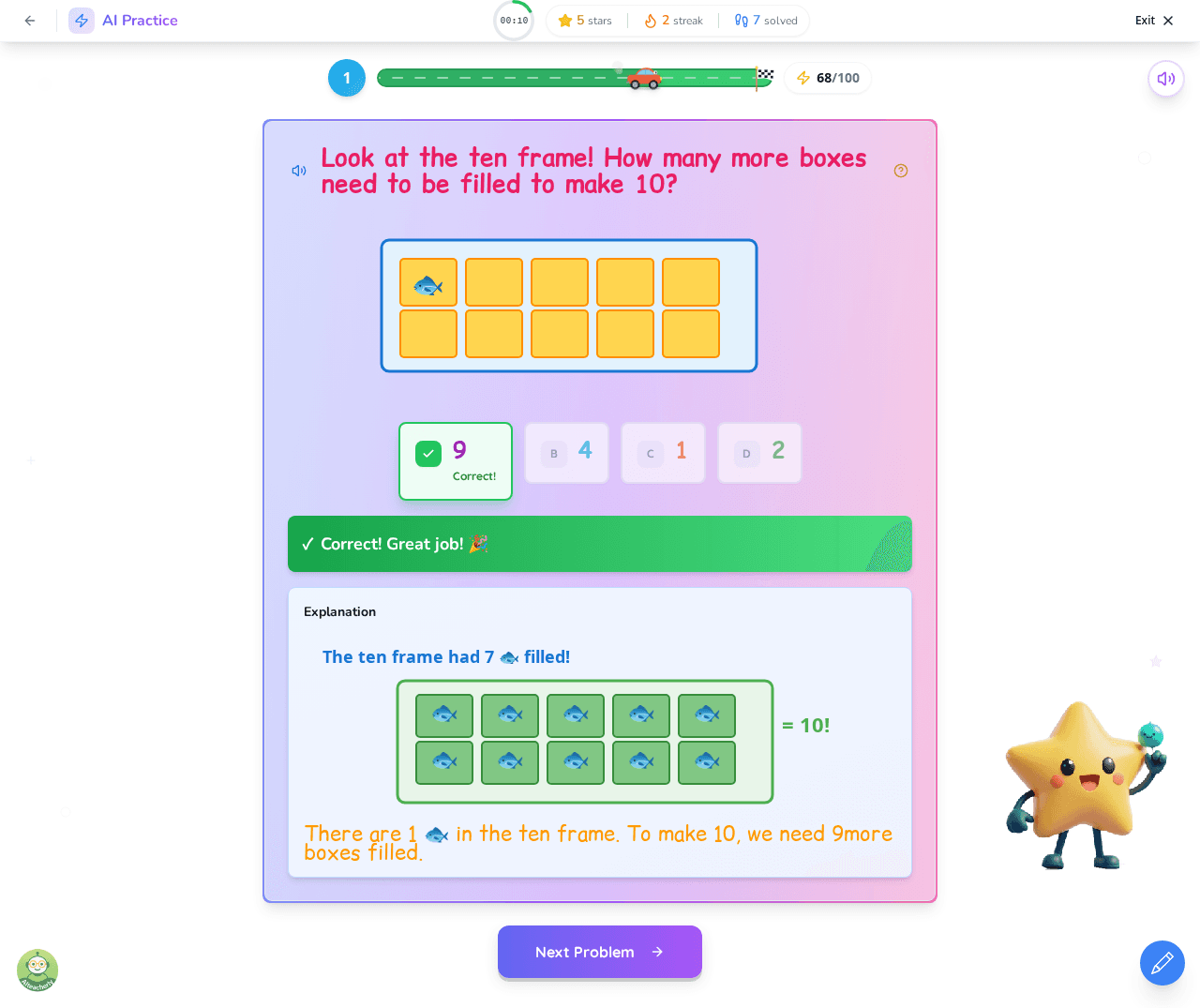
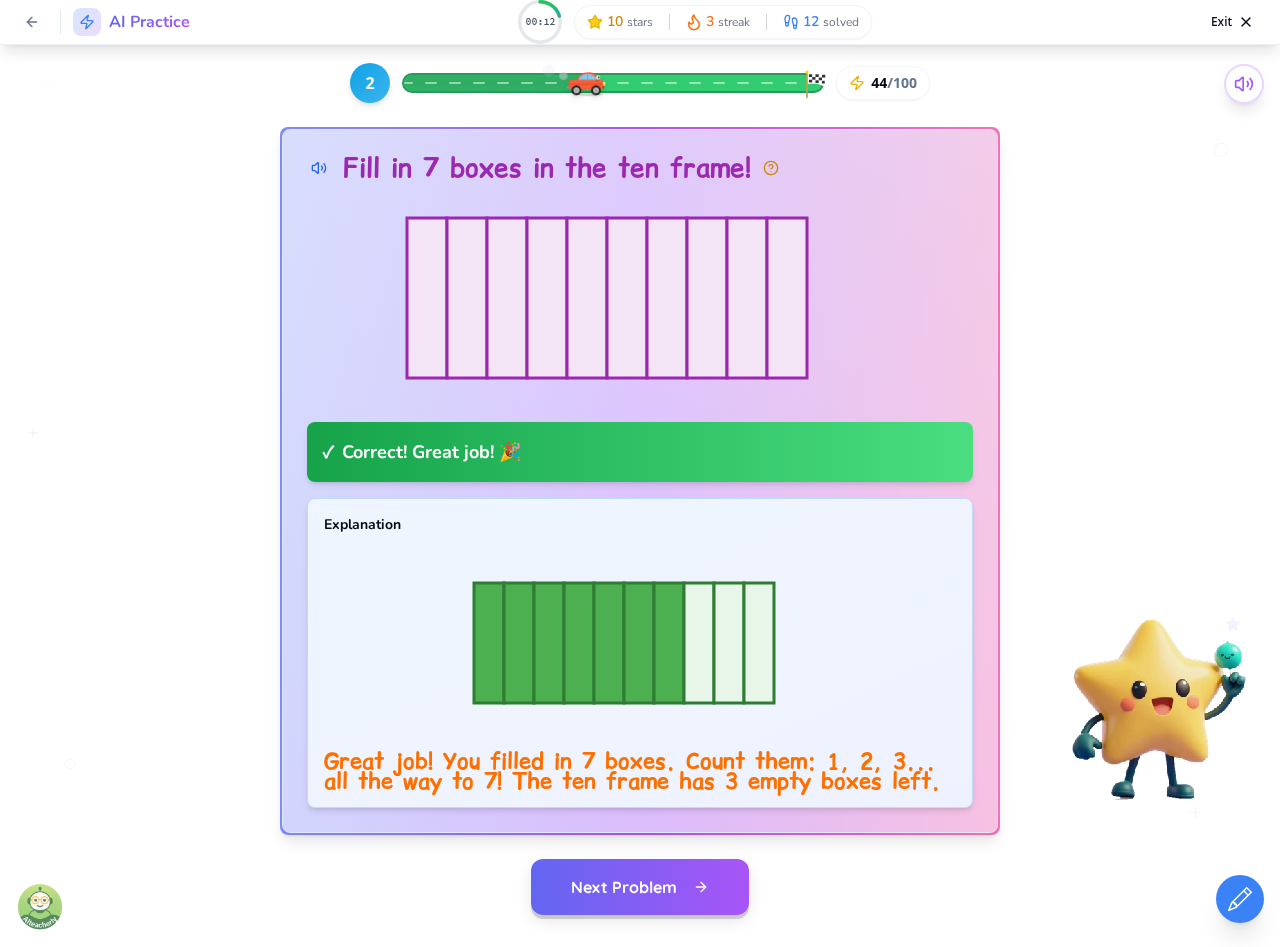
5. Interactive Digital Practice The interactive problem below shows exactly how ten frame activities work in practice. Children select and fill boxes while counting, getting immediate feedback that reinforces correct counting.
These activities work because they embed counting into play. Your child won't realize they're learning; they'll just know they're having fun.
How AI Teacherly Makes Counting to 10 Click
While home activities are wonderful, sometimes children need the structured practice and instant feedback that only interactive technology can provide. That's where AI Teacherly's Learn to Count to 10 lesson shines.
This kindergarten math lesson uses ten frames as its core visual tool, just like the best classroom teachers do. But it adds something special: interactivity. Children don't just look at ten frames; they fill them, manipulate them, and see immediate results.
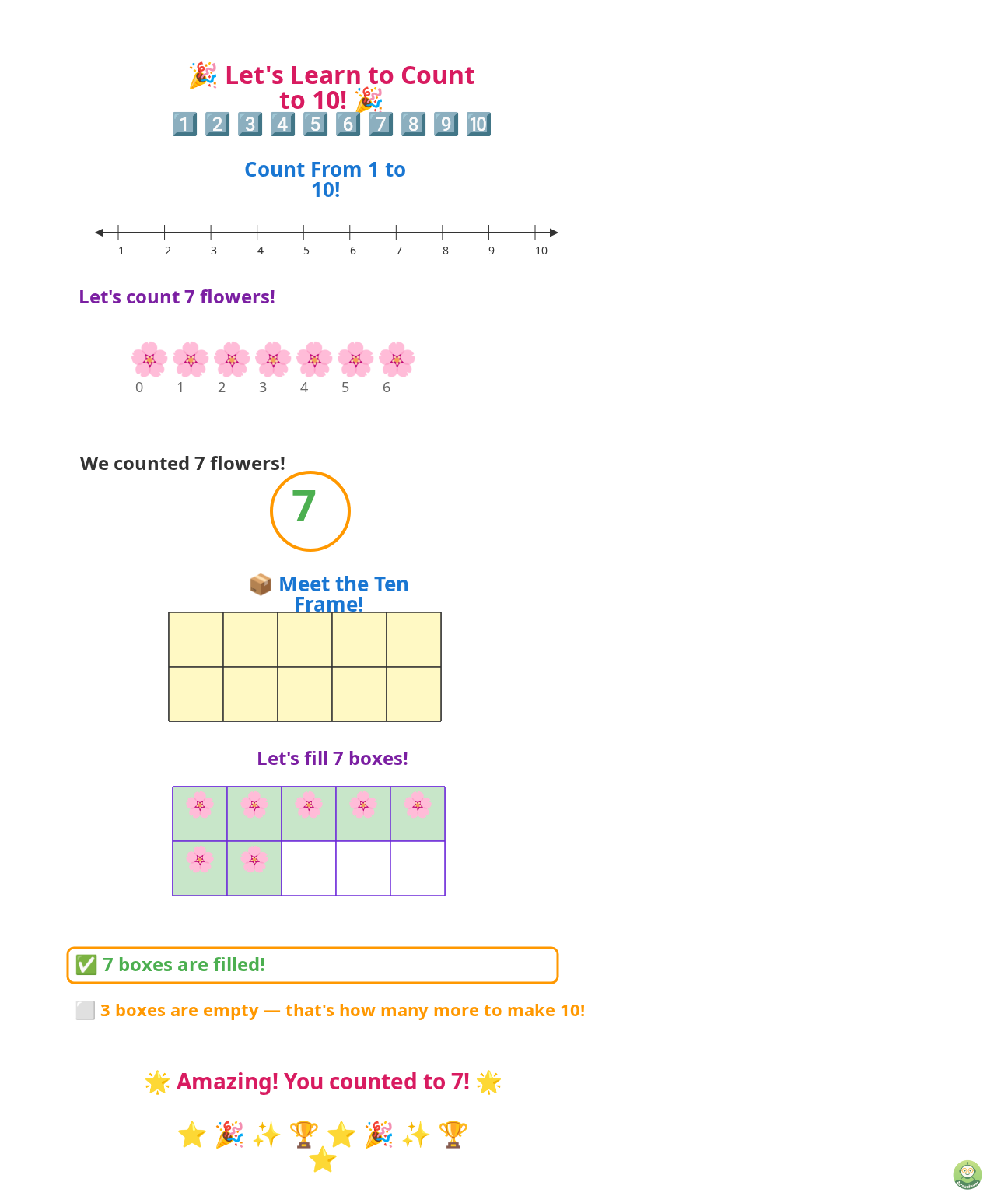
Here's what the full interactive lesson looks like on AI Teacherly:
The lesson is designed around how young children actually learn:
Guided discovery: Instead of being told facts, children discover patterns themselves. "X boxes filled! And Y empty. That's how many more to make 10!" This kind of guided script helps concepts stick.
Multiple problem types: The lesson includes counting activities, ten frame filling exercises, and "how many more to make 10" challenges. This variety keeps engagement high and builds comprehensive understanding.
Immediate, encouraging feedback: When a child answers correctly, they know right away. When they make a mistake, they get a gentle prompt to try again. No frustration, no waiting for a parent to check work.
Self-paced learning: Your child can spend extra time on tricky concepts or move quickly through material they've mastered. The lesson adapts to their needs.
The best part? You don't need to be a math expert. AI Teacherly handles the teaching, while you get to celebrate your child's progress.
Common Counting Mistakes (And How to Gently Correct Them)
Every kindergartener makes counting errors. Knowing what to expect (and how to respond) makes the learning process smoother for everyone.
Skipping numbers: "1, 2, 3, 5, 7..." This usually means the number sequence isn't fully memorized yet. Practice counting songs and rhymes. Emphasize the tricky transitions (like 12 to 13, or 19 to 20) which trip up many children.
Counting the same object twice: This one-to-one correspondence error is very common. Solution: Have your child physically move each object to a new pile as they count it. "Touch it, say the number, move it over."
Reciting without pointing: Some children can sing "1, 2, 3..." perfectly but don't connect numbers to actual quantities. Always pair counting with touching or moving objects. Ten frames are perfect for this because each number gets its own box.
Rushing through: Speed isn't the goal! If your child races through counting and makes errors, slow things down. Count together in a steady rhythm. Clap or tap for each number.
Getting the "how many" question wrong: After counting to 7, you ask "How many?" and your child says "8" or starts counting again. This is actually a conceptual gap. Practice the routine: count, then restate the final number. "1, 2, 3, 4, 5. That's 5 stars!"
Patience is your greatest tool. Every mistake is a learning opportunity, not a failure. Meet your child where they are, and progress will follow.
Key Takeaways
- Counting to 10 is a foundational math milestone that predicts future academic success; it's worth investing time to build true understanding.
- Ten frames are the secret tool teachers use to make numbers visual and concrete; you can create one at home in minutes.
- One-to-one correspondence (touching each object while counting) is the key skill to develop; practice it through games, not drills.
- Short, playful counting sessions (5 minutes) are more effective than long, forced practice; embed counting into daily routines.
- Common counting mistakes like skipping numbers or double-counting are normal developmental stages, not signs of trouble.
- Interactive lessons like AI Teacherly's Learn to Count to 10 provide structured practice with instant feedback that builds confidence.
Frequently Asked Questions
What age should a child be able to count to 10?
Most children can count to 10 between ages 4 and 5. However, there's a wide range of normal development. Focus on understanding (one-to-one correspondence) rather than just recitation speed.
What is a ten frame and why do teachers use it?
A ten frame is a grid with two rows of five boxes. Teachers use it because it makes numbers visual, shows relationships to 10, and builds foundational skills for addition and subtraction.
How do I know if my child understands numbers or is just memorizing?
Ask your child to count a group of objects, then ask 'how many?' If they need to recount or give a wrong answer, they may be memorizing the sequence without understanding quantity.
Why does my kindergartener skip numbers when counting?
Skipping numbers is common when the number sequence isn't fully memorized. Practice through songs, games, and repetition. Pay special attention to transition numbers like 12-13 and 19-20.
How many minutes a day should I practice counting with my child?
Five to ten minutes of engaged, playful practice is plenty for kindergarteners. Short, consistent sessions are more effective than long, unfocused ones. Quality matters more than quantity.
What are fun ways to practice counting at home?
Count snacks before eating, use stairs for step-counting, create ten frame parking lots with toy cars, collect nature items on walks, or try interactive apps that make counting a game.
What comes after counting to 10 in kindergarten math?
After mastering 1-10, children typically learn to count to 20, then to 100. They also begin comparing numbers (more/less), learning number words, and exploring basic addition with small numbers.
Ready to make counting click for your kindergartener? Try AI Teacherly's interactive Learn to Count to 10 lesson free today and watch your child's number confidence soar!