Teach Kindergarteners to Count Coins: Pennies and Nickels Made Simple
Discover easy, hands-on ways to teach kindergarteners to count coins. Learn the simple pennies-and-nickels strategy that builds early math skills using everyday loose change.
Why Coin Counting Is Your Kindergartener's First Real-World Math Lesson
You don't need fancy math manipulatives or a teaching degree to give your kindergartener a head start in math. The loose change sitting in your pocket, car console, or kitchen drawer is one of the most powerful teaching tools you already own.
Coin counting is more than just a money skill. When your child counts pennies and nickels, they're practicing number recognition, one-to-one correspondence, and skip counting. These are the foundational math skills that predict success in elementary school and beyond.
Research consistently shows that early math skills are one of the strongest predictors of later academic achievement. The good news? Teaching kindergarteners to count coins doesn't require worksheets or screen time. It's hands-on, tactile, and connects directly to the real world your child sees every day.
In this guide, you'll learn exactly how to teach pennies and nickels in a way that sticks. We'll cover a simple strategy that professional educators use, plus fun ways to practice at home without it feeling like homework.
What Coins Should Kindergarteners Learn First?
When it comes to teaching money, sequence matters. The best approach is to start with pennies, then move to nickels. Why? Because pennies are worth exactly one cent, making them the simplest starting point for counting practice.
Start with Pennies (1 cent each) Pennies let your child practice counting by ones, which is the most basic counting skill. Each penny equals one cent. Simple. No confusion.
Then Introduce Nickels (5 cents each) Once your child is confident with pennies, nickels introduce the concept of skip counting by fives. This is where the magic happens. Skip counting is a pre-multiplication skill that sets kids up for math success in later grades.
Why Not Dimes and Quarters Yet? Dimes (10 cents) and quarters (25 cents) are valuable, but they add complexity. The numbers 10 and 25 are harder for kindergarteners to work with. Mastering pennies and nickels first builds the confidence and number sense needed for bigger coins later.
As the lesson teaches: "A penny is worth 1 cent. Just one!" This simplicity is exactly what young learners need to build a solid foundation.
How to Teach Pennies: Counting by Ones
Teaching pennies is straightforward because each penny equals exactly one cent. Here's how to make it stick:
Step 1: Introduce the Penny Show your child a real penny. Let them feel it, look at both sides, and notice Lincoln's face. Explain that this small copper coin is worth "one cent" or "one penny."
Step 2: Practice Counting by Ones Lay out several pennies in a row. Have your child touch each penny as they count: "One cent, two cents, three cents, four cents, five cents." This one-to-one correspondence (touching one object for each number said) is a critical early math skill.
Step 3: Ask "How Many Cents?" After counting, ask your child the total. If they counted 5 pennies, help them understand: "5 pennies equals 5 cents." Use the cent symbol (¢) to introduce written notation.
Common Mistake to Avoid Some children try to count too quickly without touching each coin. Slow them down. Accuracy matters more than speed at this stage.
Practice Tip Use a small jar or piggy bank. Each night, have your child count the pennies inside. Start with just 5 to 10 pennies and gradually increase as confidence builds.
How to Teach Nickels: Skip Counting by Fives
Once your child is comfortable counting pennies, it's time to introduce nickels. This is where counting gets more exciting because nickels teach skip counting by fives, a skill that directly prepares kids for multiplication.
Step 1: Introduce the Nickel Show your child a real nickel. It's larger than a penny and silver in color. Explain: "A nickel is worth 5 cents. That's like counting one, two, three, four, five! Remember, nickel means five."
Step 2: Practice Skip Counting Lay out several nickels. Instead of counting by ones, teach your child to count by fives: "Five, ten, fifteen, twenty, twenty-five." This pattern is foundational for understanding multiplication later on.
Step 3: Connect Nickels to Groups of Five To make skip counting concrete, show that one nickel equals five pennies. Lay out 5 pennies next to 1 nickel. Count the pennies, then say: "See? Five cents, just like one nickel!"
Why Skip Counting Matters Skip counting is a pre-multiplication skill. When your child counts "5, 10, 15, 20," they're actually laying the groundwork for "5 times 1, 5 times 2, 5 times 3, 5 times 4." Starting this in kindergarten gives them a huge advantage.
Practice Tip Sing skip counting songs together. Rhythmic repetition helps the number sequence stick in memory. Count by fives to 50 or even 100 once your child gets comfortable.
The 'Nickels First' Trick for Counting Mixed Coins
Here's where everything comes together. Once your child knows how to count pennies by ones and nickels by fives separately, it's time to count mixed coins. This is the skill that makes coin counting truly useful in the real world.
The secret? Count the nickels first, then count on with pennies.
As the lesson teaches: "Here's our trick! First, count the nickels by fives. Then, count on with pennies by ones."
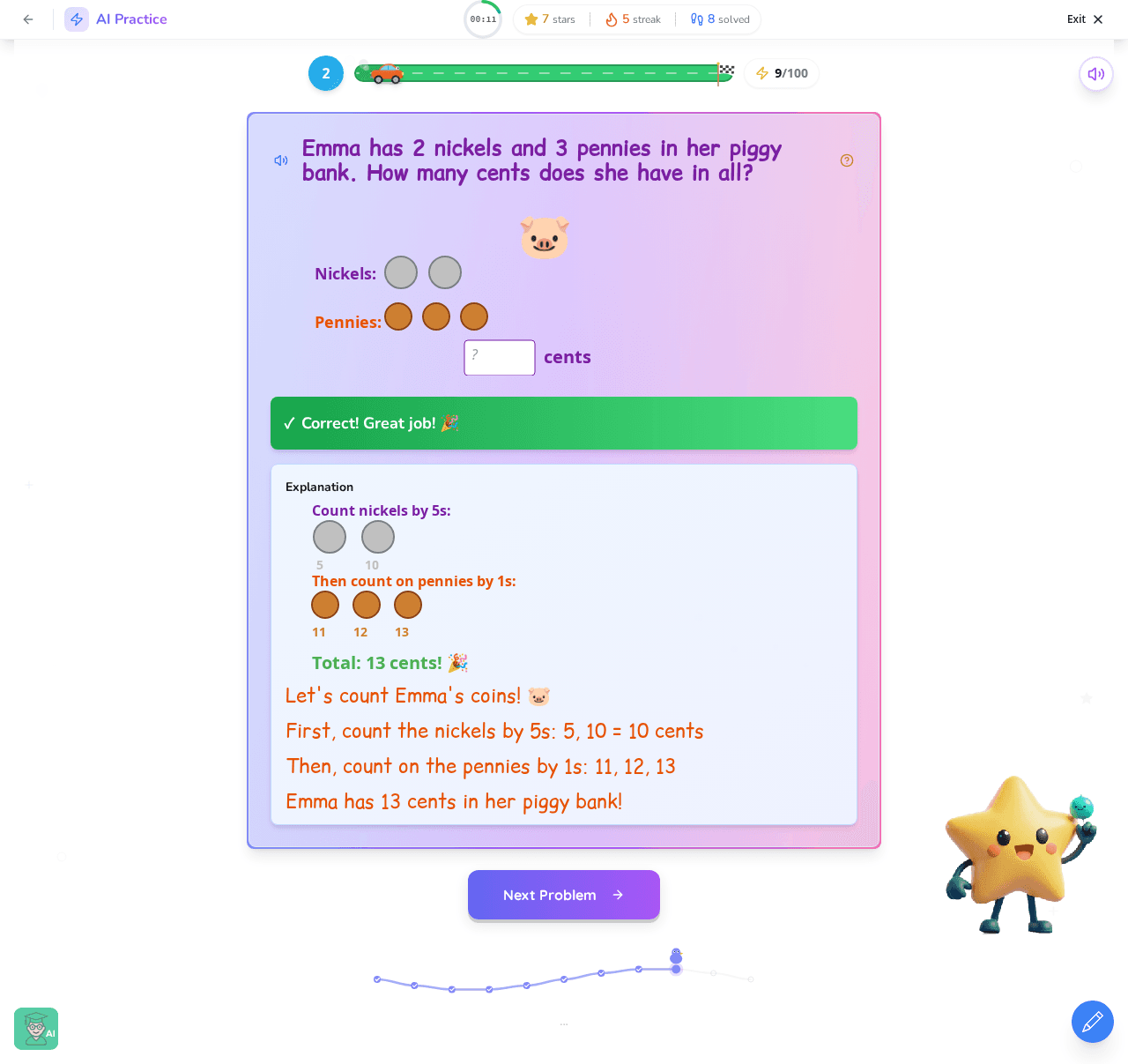
Step-by-Step Example Imagine your child has 2 nickels and 3 pennies:
- Sort the coins into two groups: nickels on one side, pennies on the other.
- Count nickels first by fives: "Five, ten." (That's 10 cents from the nickels.)
- Count on with pennies by ones: "Eleven, twelve, thirteen." (Adding 3 pennies.)
- State the total: "I have 13 cents!"
This "nickels first" strategy teaches organization and efficiency. Instead of randomly counting, your child learns to group and sequence, skills that transfer to more complex math problems.
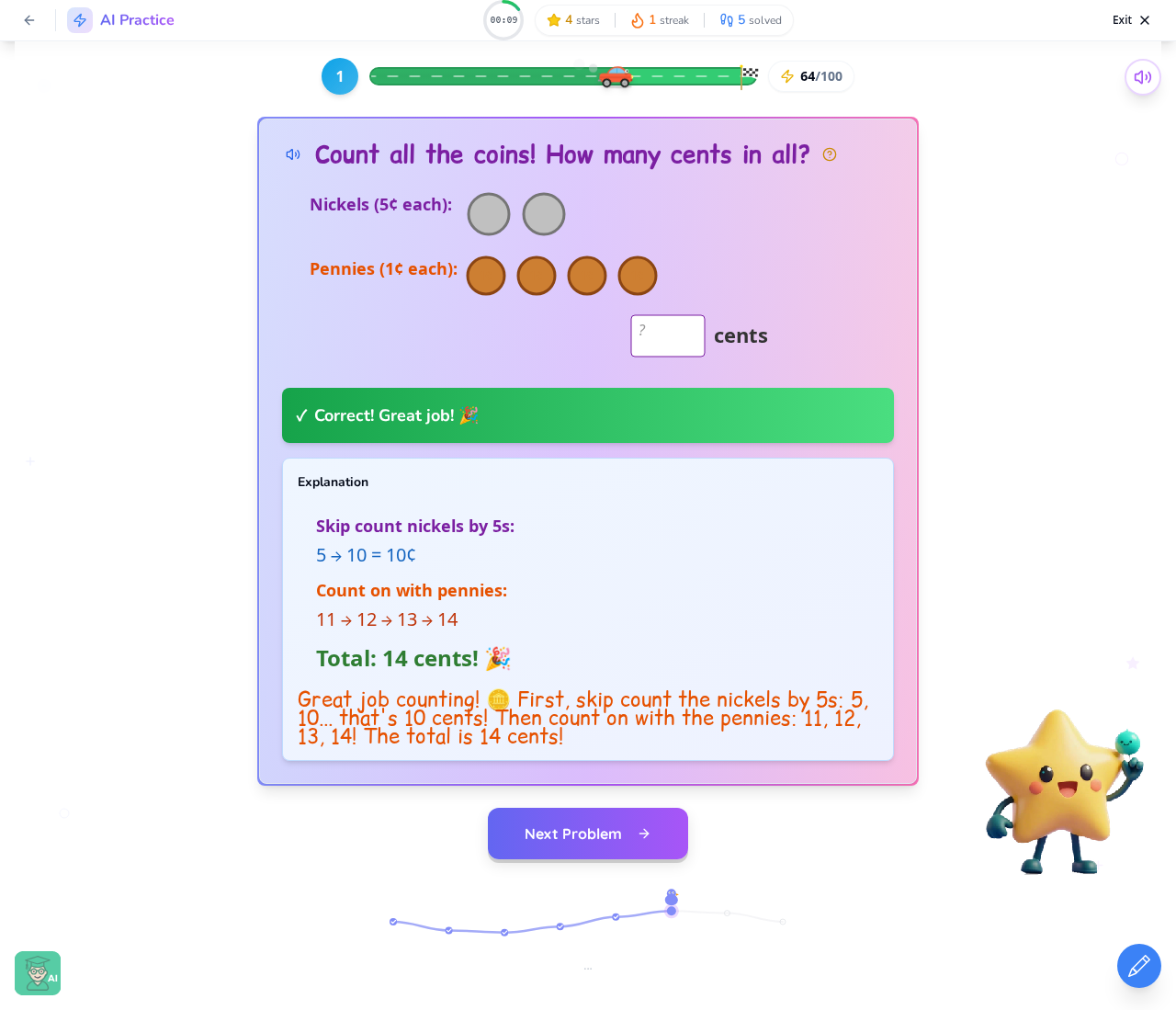
The interactive problem below shows exactly how this mixed coin counting works in practice.
Practice Tip Give your child a small pile of mixed pennies and nickels (start with just 2 to 3 nickels and 3 to 4 pennies). Have them sort, count, and tell you the total. Celebrate when they use the "nickels first" strategy correctly!
See How Interactive Coin Counting Works on AI Teacherly
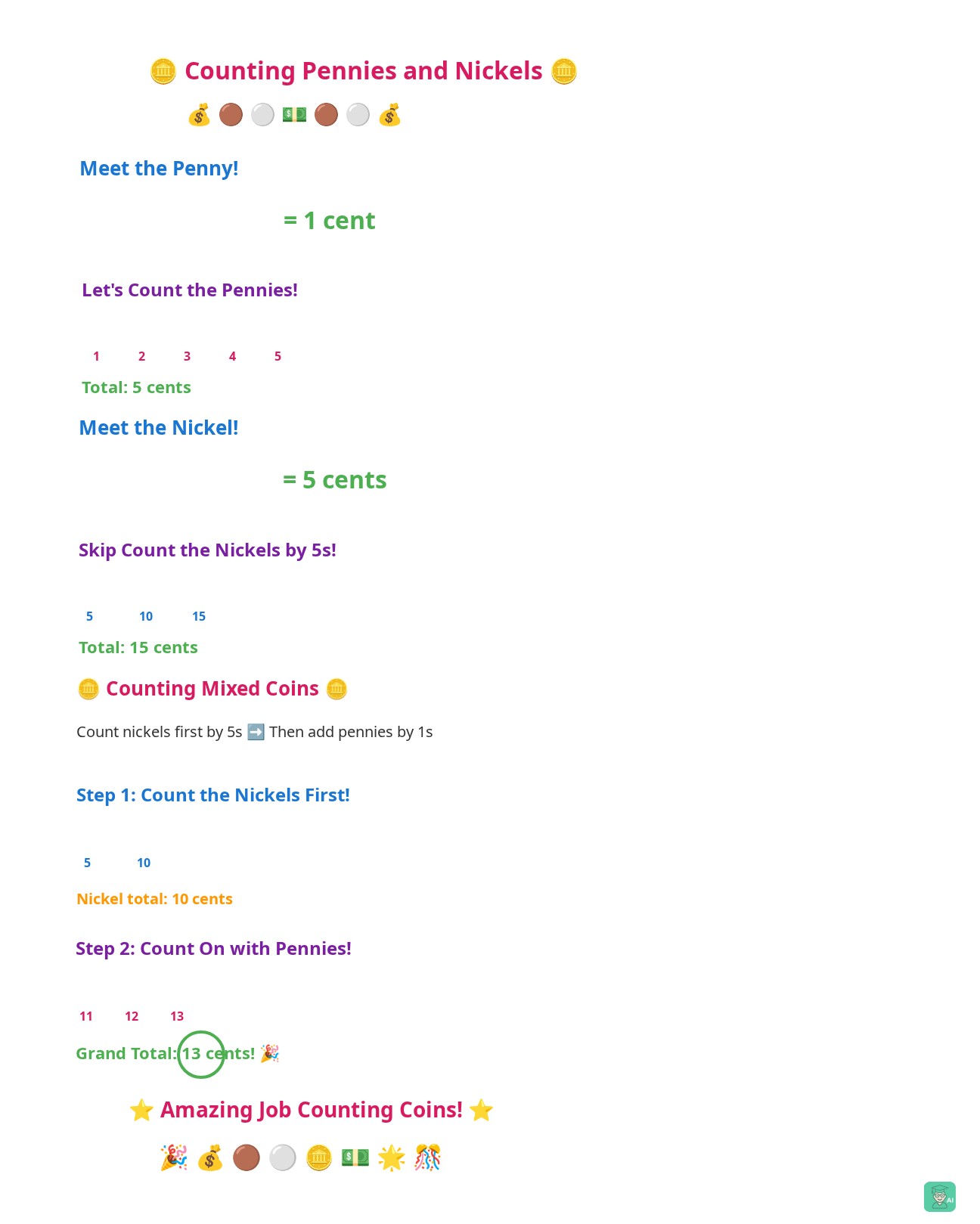
Reading about coin counting strategies is helpful, but seeing it in action makes all the difference. AI Teacherly's Counting Pennies and Nickels lesson brings these concepts to life through interactive, visual activities designed specifically for kindergarteners.
Here's what the full interactive lesson looks like on AI Teacherly:
What Makes Interactive Learning Different
Unlike worksheets that feel like work, interactive lessons let kids drag coins, tap to count, and see immediate feedback. When your child gets an answer right, they feel accomplished. When they make a mistake, the lesson guides them gently without frustration.
The lesson covers:
- Penny introduction with visual counting practice
- Nickel introduction with skip counting by fives
- Mixed coin problems using the "nickels first" strategy
- Real-world word problems like counting coins in a piggy bank
- A quiz to check understanding
Why Parents Love It
This isn't passive screen time. Your child actively engages with the content, building skills through practice. And because lessons are self-paced, your kindergartener can repeat sections as needed without any pressure.
The best part? You don't have to be the teacher. The lesson explains concepts clearly ("Nickel means five!") so your child can learn independently while you supervise.
Fun Ways to Practice Coin Counting at Home
The best learning happens when it doesn't feel like learning. Here are practical, hands-on ways to reinforce coin counting skills using items you already have at home:
1. The Piggy Bank Challenge Give your child a small piggy bank and a handful of pennies and nickels each week. Have them count the total every few days. Watch the numbers grow!
2. Grocery Store Helper At the store, give your child a few coins and let them "pay" for a small item (with your supervision). Even if you use a card, letting them hand coins to the cashier makes money feel real.
3. Coin Sorting Races Mix pennies and nickels together in a bowl. Challenge your child to sort them into two piles as fast as they can, then count each pile. Make it a game with a timer!
4. Treasure Hunts Hide pennies and nickels around a room. After your child finds them all, they have to count the total "treasure" to win a small prize.
5. Play Store Set up a pretend store with toys or snacks. Price items at amounts like 7 cents, 12 cents, or 15 cents. Your child "pays" with coins and counts out the right amount.
6. Coin Rubbings Place coins under paper and rub with a crayon. While creating art, talk about the coin values. It's tactile learning disguised as craft time.
Remember the lesson's summary: "Pennies by ones, nickels by fives, and mixed coins, nickels first!" Repeat this phrase during practice until it becomes automatic.
Key Takeaways
- Start with pennies (1 cent each) to teach counting by ones before introducing nickels
- Nickels (5 cents) introduce skip counting by fives, a critical pre-multiplication skill
- Use the 'nickels first' strategy: count nickels by fives, then count on with pennies by ones
- Real coins beat worksheets because tactile, hands-on learning sticks better
- Everyday moments like piggy banks, store trips, and coin jars are powerful learning opportunities
- Interactive lessons like AI Teacherly's coin counting lesson build confidence through visual practice
- Keep sessions short (10 to 15 minutes) and fun to maintain your kindergartener's interest
Frequently Asked Questions
What age should kids learn to count coins?
Most children are ready to learn basic coin counting between ages 5 and 6 (kindergarten). Start with pennies, as counting by ones is the simplest entry point. Introduce nickels once counting by ones is solid.
Should I teach pennies or nickels first?
Always start with pennies. Since each penny equals exactly 1 cent, children can practice counting by ones without confusion. Nickels (5 cents) come next to introduce skip counting by fives.
How do I explain what a nickel is worth to a 5-year-old?
Use a simple phrase: 'Nickel means five!' Then show that one nickel equals five pennies by placing them side by side. This visual comparison makes the value concrete and memorable.
What is skip counting and why does it matter?
Skip counting means counting by a number other than one, like 5, 10, 15, 20. It's important because it builds the foundation for multiplication. Counting nickels by fives is perfect skip counting practice.
How can I practice coin counting at home without worksheets?
Use real coins for hands-on practice. Try piggy bank counting, grocery store visits, coin sorting races, treasure hunts, or playing pretend store. Kids learn best when it feels like play.
Is it normal for kindergarteners to struggle with counting money?
Yes, completely normal. Mixed coin counting requires multiple skills: sorting, skip counting, and counting on. Be patient, use plenty of repetition, and celebrate small wins to build confidence.
When should I teach dimes and quarters after pennies and nickels?
Once your child confidently counts mixed pennies and nickels, usually in late kindergarten or first grade, you can introduce dimes (10 cents). Quarters (25 cents) typically come in first or second grade.
How long should coin counting practice sessions be for kindergarteners?
Keep sessions short: 10 to 15 minutes is ideal for kindergarteners. Frequent, brief practice is more effective than long sessions. Stop while it's still fun to keep motivation high.
Ready to make coin counting fun and interactive? Try the free Counting Pennies and Nickels lesson on AI Teacherly and watch your kindergartener master this essential math skill!