Equal Groups and Arrays: The Visual Way to Teach 3rd Grade Multiplication at Home
Multiplication doesn't have to feel like a big jump. Discover how equal groups and arrays turn abstract math into visual, hands-on learning your 3rd grader will actually understand.
Why Multiplication Feels Like a Big Jump (And Why It Doesn't Have to Be)
That moment when your child's homework shifts from addition to multiplication can feel overwhelming. Suddenly, there are new symbols, new vocabulary, and concepts that seem far more abstract than counting on fingers.
But here's the secret that transforms everything: multiplication is just a faster way to count groups of things. Your child already knows how to add. Multiplication simply gives them a shortcut for adding the same number over and over again.
In 3rd grade, the curriculum introduces multiplication through two powerful visual concepts: equal groups and arrays. These aren't just teaching methods schools use to confuse parents. They're research-backed strategies that help children build genuine understanding, not just memorization.
When children see multiplication as organized counting rather than abstract symbols, something clicks. The times tables stop being a list to memorize and become patterns to discover. And the best part? You don't need to be a math teacher to guide this discovery. You already have everything you need at home.
This guide walks you through exactly how equal groups and arrays work, why schools teach them this way, and practical activities you can do tonight to make multiplication meaningful for your 3rd grader.
What Are Equal Groups in Multiplication?
Equal groups are the foundation of multiplication. The concept is simple: multiplication is counting when every group has the same number of items.
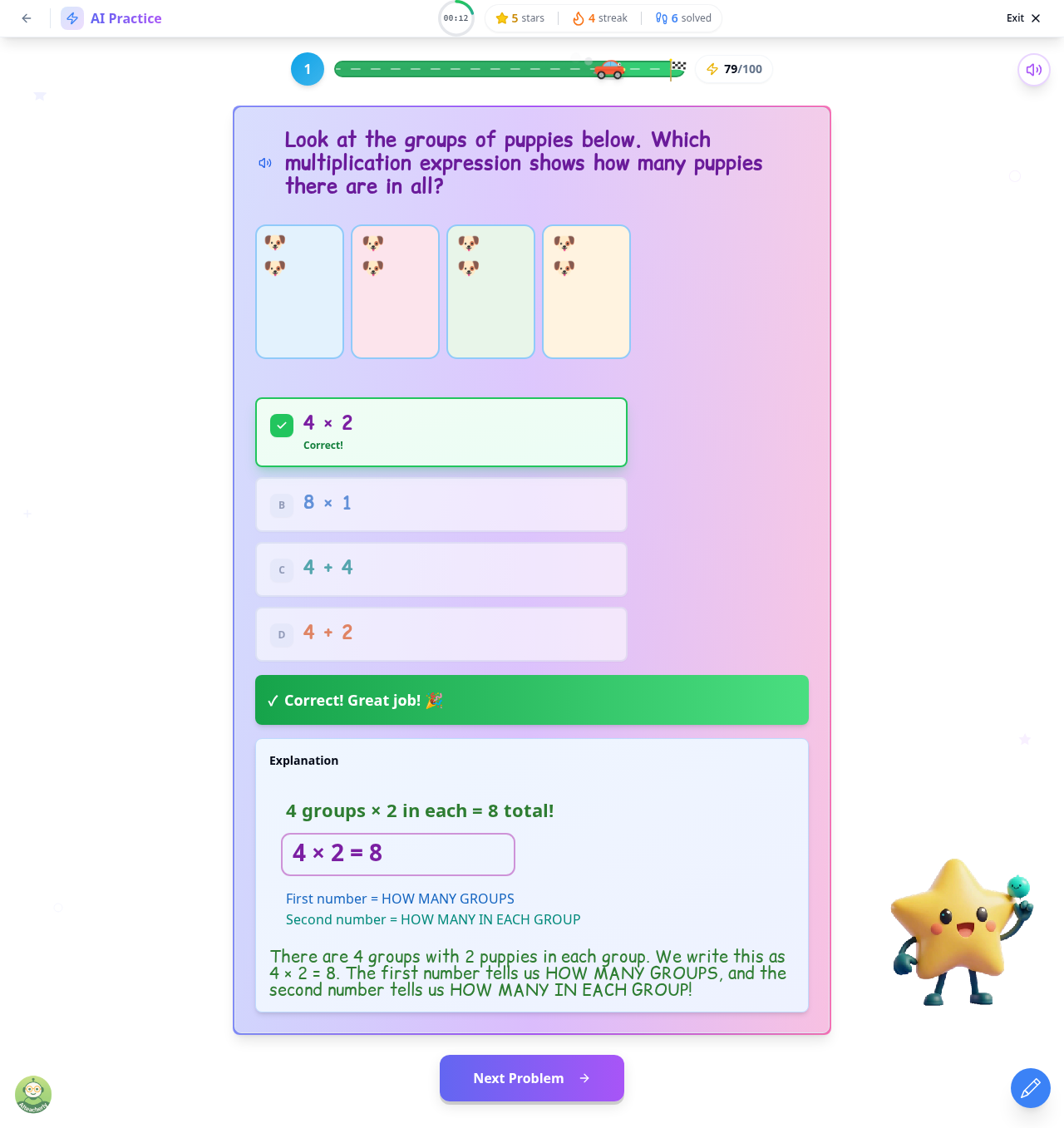
Imagine your child has 4 bags, and each bag contains exactly 3 apples. Instead of counting 3 + 3 + 3 + 3, they can say "4 groups of 3" or write it as 4 × 3. That's multiplication in action.
The two numbers in a multiplication problem tell a story:
- The first number tells us how many groups we have
- The second number tells us how many items are in each group
So when your child sees 5 × 2, they can think: "I have 5 groups with 2 things in each group." This mental picture makes the abstract equation concrete and countable.
The interactive problem below shows exactly how equal groups work in practice:
Why does this matter? When children understand that multiplication means "equal groups," they can check their work by drawing or counting. They're not just memorizing that 4 × 3 = 12; they understand why it equals 12. This conceptual foundation becomes crucial when they encounter division, fractions, and algebra in later grades.
Real-world equal groups are everywhere once you start looking: eggs in cartons, wheels on cars, legs on chairs, players on sports teams. Point them out during daily activities, and multiplication transforms from homework into a game of pattern-spotting.
How Do Arrays Help Kids Visualize Multiplication?
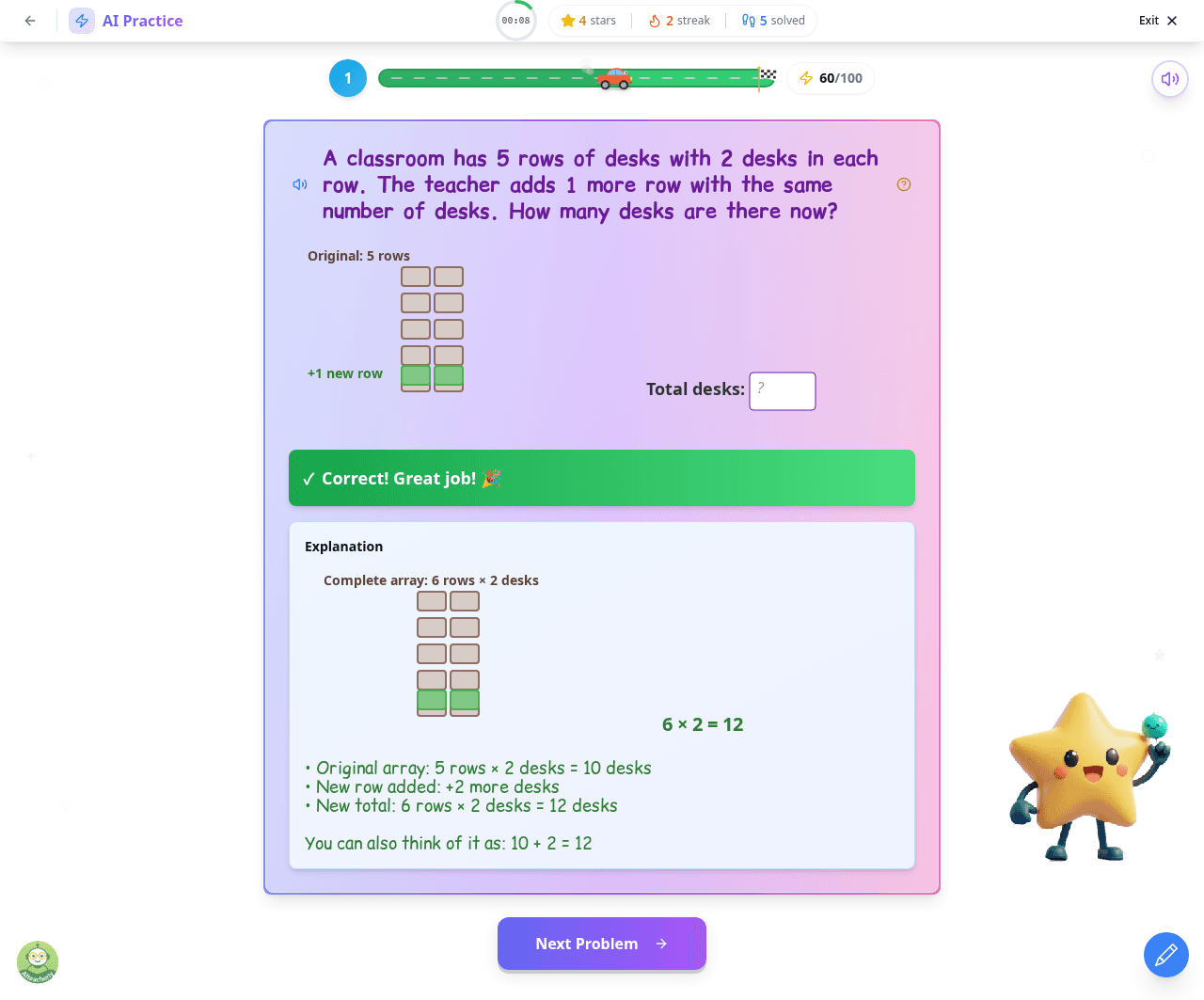
Arrays take equal groups one step further by organizing them into rows and columns. Think of an egg carton, a muffin tin, or the desks in a classroom. These everyday objects are arrays.
In an array:
- Rows go horizontally (left to right)
- Columns go vertically (up and down)
- Every row has the same number of items
Here's the powerful insight: arrays and equal groups represent the same multiplication fact. If you have 3 rows with 4 items in each row, you can see it as 3 groups of 4. The array is simply equal groups arranged neatly.
This organization reveals something magical about multiplication: you can count the same array two different ways and get the same answer. A 3 × 4 array (3 rows of 4) contains the same number of items as a 4 × 3 array (4 rows of 3). This is the commutative property in action, and kids discover it naturally when they explore arrays.
Why arrays matter for your child:
- They make multiplication visible and countable
- They show why multiplication problems can be "flipped" (3 × 4 = 4 × 3)
- They prepare children for area calculations in geometry
- They build the foundation for understanding division
At home, array practice can be as simple as arranging crackers on a plate, organizing toy cars in rows, or looking at windows in a building. Ask your child: "How many rows? How many in each row? What multiplication problem does this show?"
The Secret Connection: Multiplication Is Just Faster Addition
If your child already understands addition, they're halfway to mastering multiplication. That's because multiplication is essentially repeated addition written in a shorter form.
Consider this example:
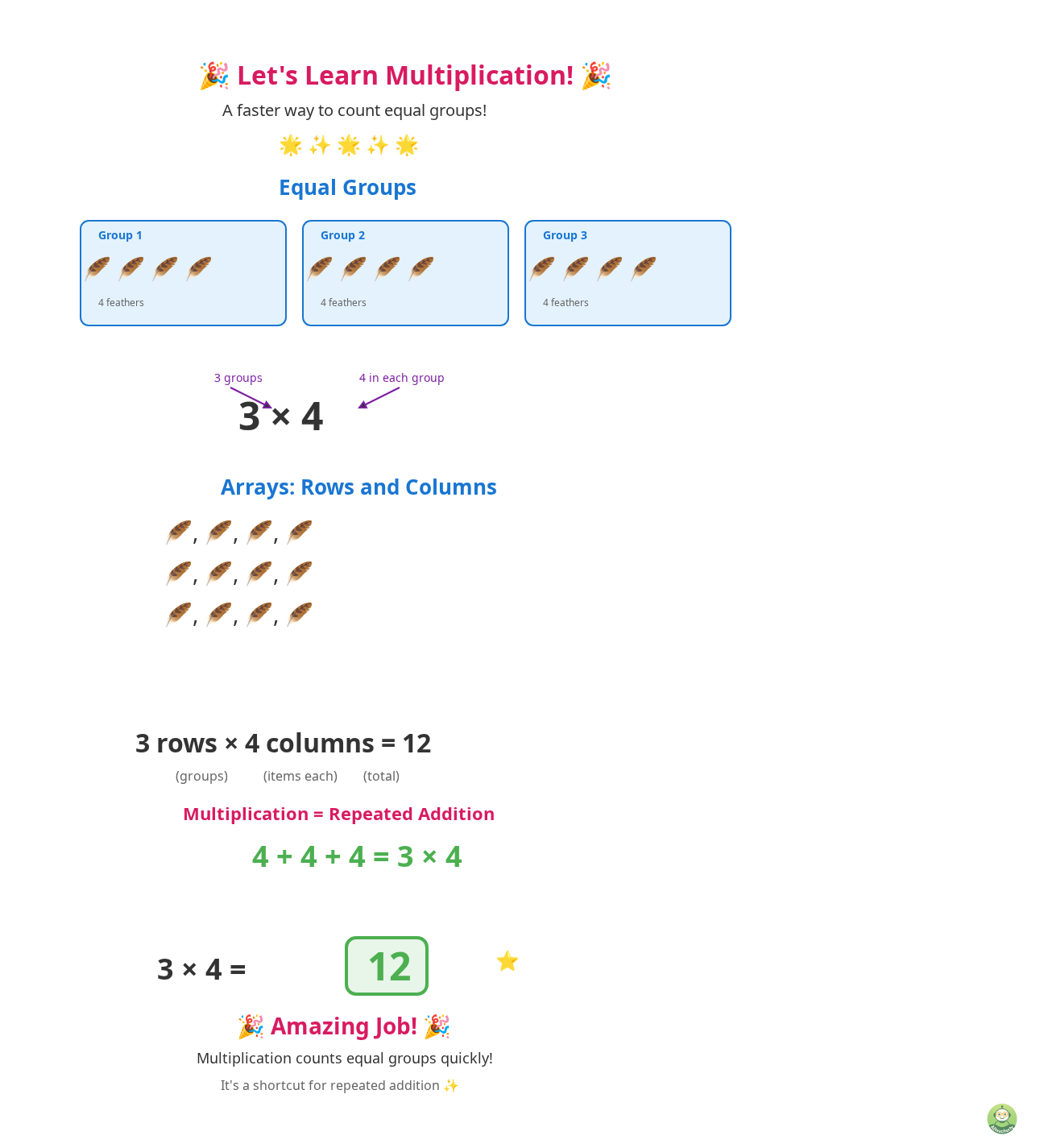
- Repeated addition: 4 + 4 + 4 = 12
- Multiplication: 3 × 4 = 12
Both expressions describe the same thing: three groups of four. Multiplication just says it faster.
This connection is incredibly important for building your child's confidence. When they encounter a multiplication problem they don't know, they can always fall back on addition. Multiplication isn't replacing what they know; it's building on it.
Here's how to use this connection at home:
Start with addition, then introduce the shortcut. "You just added 5 + 5 + 5 + 5. There's a faster way to write that: 4 × 5!"
Let them verify with addition. If they're unsure whether 6 × 3 = 18, encourage them to check: 3 + 3 + 3 + 3 + 3 + 3 = 18. Correct!
Practice skip counting. Counting by 2s, 5s, and 10s is repeated addition in disguise. When your child counts "5, 10, 15, 20," they're actually practicing 1×5, 2×5, 3×5, 4×5.
This bridge between addition and multiplication helps children who feel intimidated by "times tables." They realize they're not learning something entirely new; they're learning a shortcut for something they already know how to do.
5 Hands-On Ways to Practice Multiplication at Home
The best multiplication practice doesn't feel like homework. Here are five activities that turn everyday moments into learning opportunities:
1. Snack Time Arrays Arrange crackers, grapes, or carrot sticks into arrays on a plate. "Can you make 3 rows with 4 crackers in each row? How many crackers total?" Let them eat their correct answers!
2. Toy Organization When cleaning up, group action figures, blocks, or cars into equal groups. "Let's put these 20 cars into 4 equal groups. How many in each group?" This naturally introduces division as the reverse of multiplication.
3. Table Setting Setting the table is perfect for multiplication practice. "We have 4 people. Each person needs 3 items: a plate, fork, and cup. How many items total?" (4 × 3 = 12)
4. Stair Step Counting As you climb stairs, skip count together by 2s, 3s, or 5s. This builds automatic recall of multiplication facts through rhythm and movement.
5. Window and Tile Hunts Look for arrays in the environment: window panes, floor tiles, brick patterns, chocolate bar sections. Challenge your child: "What multiplication problem does that window show?"
The key is keeping it playful. These activities work because they connect abstract math to things your child can see, touch, and (sometimes) eat. When multiplication shows up in their real world, it stops being scary and starts being useful.
See How Interactive Learning Makes Multiplication Click
While hands-on activities at home are powerful, interactive digital lessons can accelerate understanding by providing immediate feedback and visual manipulatives that would be difficult to create with physical objects.
The Introduction to Multiplication: Equal Groups and Arrays lesson on AI Teacherly guides students through the exact progression we've discussed:
- Discovery phase: Students explore what makes groups "equal" through visual examples
- Connection building: They see how repeated addition transforms into multiplication
- Array exploration: Interactive manipulatives let them arrange and rearrange objects
- Practice with feedback: Problems adjust to their level, building confidence step by step
Here's what the full interactive lesson looks like on AI Teacherly:
What makes interactive practice especially valuable for multiplication:
- Visual manipulatives let children drag and arrange objects, making abstract concepts tangible
- Immediate feedback helps them catch and correct mistakes before wrong patterns set in
- Scaffolded difficulty builds from simple equal groups to more complex arrays
- Engaging presentation keeps practice feeling like play rather than work
The lesson includes audio narration that explains concepts using language like: "Multiplication is just a shortcut for adding the same number over and over." and "The first number tells us how many groups. The second number tells us how many in each group."
These clear, consistent explanations reinforce what you're practicing at home, creating a unified learning experience.
Common Multiplication Mistakes (And How to Gently Correct Them)
As your child learns multiplication, watch for these common stumbling blocks:
Mistake 1: Confusing which number is groups vs. items For 3 × 4, some children draw 4 groups of 3 instead of 3 groups of 4. While both equal 12 (thanks to the commutative property!), understanding the difference matters for word problems.
How to help: Use consistent language. "The first number is how many groups. The second number is how many in each group." Practice with word problems: "3 bags with 4 apples each" is 3 × 4.
Mistake 2: Adding instead of multiplying A child might see 4 × 3 and write 7 (because 4 + 3 = 7).
How to help: Return to the visual. "Show me 4 groups of 3 things." When they draw or arrange objects, they'll see the answer is 12, not 7.
Mistake 3: Struggling with 0 and 1 facts The rules for multiplying by 0 and 1 can seem arbitrary.
How to help: Make it concrete. "If you have 5 bags with 0 apples in each, how many apples total?" (Zero!) "If you have 1 bag with 7 apples, how many apples?" (7!)
Mistake 4: Thinking they need to memorize before understanding Some children (and parents!) believe times tables should be memorized first, then understood later.
How to help: Reverse this approach. Understanding first, then fluency follows naturally. A child who understands equal groups will remember 6 × 4 = 24 because they can verify it, not just because they drilled it.
Key Takeaways for Parents
Multiplication doesn't have to be a source of stress for you or your child. Here's what to remember:
- Equal groups are the foundation: multiplication means counting when every group has the same number
- Arrays make it visual: rows and columns turn abstract numbers into something kids can see and count
- Addition is the bridge: multiplication is repeated addition written faster, so your child is building on what they know
- Practice can be playful: snack time, toy cleanup, and table setting all offer multiplication moments
- Understanding beats memorization: children who grasp the "why" remember facts longer and can figure out ones they forget
- Visual and interactive tools accelerate learning: digital manipulatives provide feedback that physical objects can't
- Mistakes are learning opportunities: common errors reveal where understanding needs reinforcement
Your child is at an exciting point in their math journey. The multiplication concepts they're learning now form the foundation for fractions, division, algebra, and beyond. By making these concepts visual and connecting them to everyday life, you're setting them up for long-term success.
Key Takeaways
- Equal groups are the foundation of multiplication: counting when every group has the same number of items
- Arrays organize equal groups into rows and columns, making multiplication visual and countable
- Multiplication is repeated addition written faster, so children build on what they already know
- The first number tells how many groups; the second tells how many in each group
- Practice with everyday objects: snacks, toys, table settings, and windows are all multiplication opportunities
- Understanding the concept leads to better fact retention than memorization alone
- Interactive visual tools provide immediate feedback that accelerates learning
Frequently Asked Questions
What are equal groups in multiplication?
Equal groups means every group has the same number of items. For example, 4 bags with 3 apples each is 4 equal groups of 3. Multiplication counts these groups quickly: 4 × 3 = 12.
How do arrays help kids understand multiplication?
Arrays arrange objects in rows and columns, making multiplication visual. Children can count rows (groups) and items per row, then see the total. This concrete representation helps them understand why multiplication works.
Why is multiplication taught as repeated addition first?
Because it connects new learning to what children already know. When kids see that 3 × 4 is the same as 4 + 4 + 4, multiplication feels like a shortcut rather than a scary new concept.
What household items can I use to teach multiplication?
Egg cartons, muffin tins, crackers, LEGO bricks, toy cars, window panes, and floor tiles all work perfectly. Anything you can arrange in equal groups or rows becomes a multiplication manipulative.
Is it normal for 3rd graders to struggle with multiplication?
Absolutely. Multiplication requires a shift from additive to multiplicative thinking, which is a significant cognitive leap. Patience and visual supports help most children overcome initial struggles within weeks.
What's the difference between equal groups and arrays?
Equal groups can be scattered (like 3 piles of toys), while arrays organize those same groups into neat rows and columns. Both represent the same multiplication fact, just arranged differently.
How do the multiplication rules for 0 and 1 work?
Any number times 1 equals itself (5 × 1 = 5, because 1 group of 5 is just 5). Any number times 0 equals 0 (5 × 0 = 0, because 5 groups of nothing is still nothing).
When should my child have multiplication facts memorized?
Most curricula expect fluency with facts up to 10 × 10 by the end of 4th grade. Focus on understanding in 3rd grade; automaticity develops naturally with practice and will solidify in 4th grade.
Ready to make multiplication click for your child? Try the free interactive Equal Groups and Arrays lesson on AI Teacherly and watch understanding grow!